Episode Transcript
[00:00:00] Speaker A: Hey everyone, this is Tom Salemi of Device Talks. Welcome back to the Device Talks weekly podcast. You are in luck. We have another great episode for you coming your way.
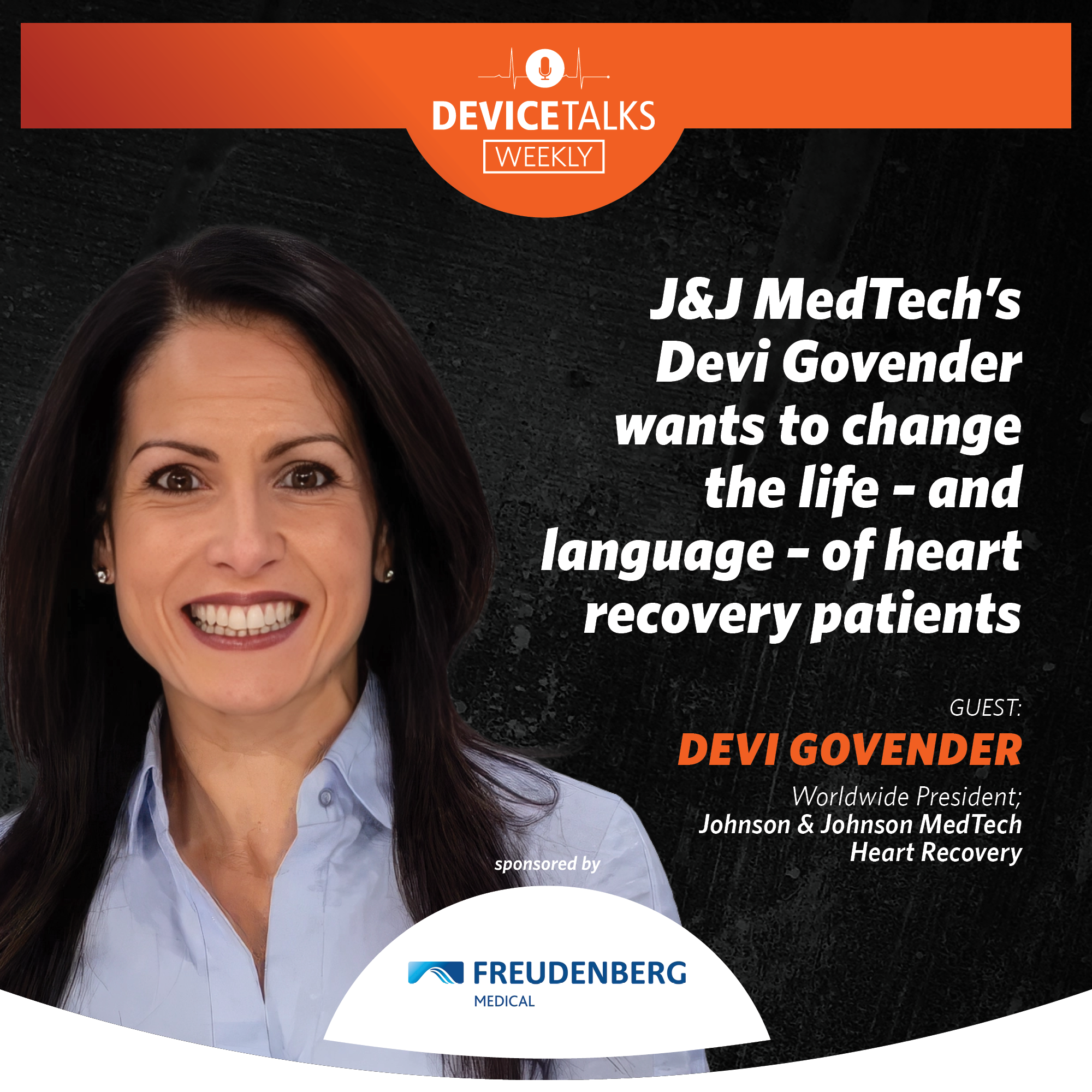
A little later in the podcast, Managing editor Kayleen Brown sits down with Debbie Govender. She's the worldwide president of Johnson and Johnson Medtech Heart Recovery. They spoke at Device Talks Boston. So if you were there, you've enjoyed this conversation. But I find I love listening to great conversations twice and this one is worth hearing many, many times. So re enjoy this conversation if you've heard it before. Enjoy it if you missed us at Device Talks Boston. And shame on you if you did. This replay is brought to you by our fine friends at Freudenberg Medical. You'll hear from them a little later in the episode, but first, Chris Neumaker and I sit down and dissect the big news of the week in the vaunted award winning Newmarkers Newsmakers. A few bits of housekeeping before we begin this episode. I will be at SRS later this week or later next week as I'm recording this on Thursday.
If you are going to be there, reach out to me on LinkedIn. I would love to say hello, Love to hear what you're talking about before I go though. I'll be running a webinar on Tuesday, July 21 at 4pm it's brought to you by our friends at Advantage and it's called Medical Edge. AI in the or From Video Capture to Surgical Intelligence. If you want to be part of that talk, you want to ask your own questions, go to devicetalks.com to register. You can watch it live or you can watch it on demand. All right, let's get this podcast started.
All right, you ready for this?
[00:01:51] Speaker B: Ready.
[00:02:12] Speaker A: Chris Newmarker. How are you, sir?
[00:02:14] Speaker B: Doing all right, Tom. Doing all right.
[00:02:17] Speaker A: So you've been watching the World cup there, my friend.
[00:02:21] Speaker B: Oh, yeah. My gosh. And you know, it's cool. A few months ago I ran into an event around here. Ludovic Labat is the CEO of Neo Bionica. He's, you know, they're based in Australia actually, but he was at the University of Minnesota's Design and Medical Devices Conference. And you know, he's actually originally from France and he says he watches our podcast all the time. I just hope we'd worked in some soccer instead of baseball sometime. And so I'll just have to say, you know, you know, Ludovic, I. Sorry about France, man. That was, that was, that was a stunner. So sorry, sorry about your, your French team. But. But, man, it looks like that, that young talent on that Spanish team is on fire and it should be a good, good final game on, On Sunday.
[00:03:10] Speaker A: Yeah. I'm not going to promote myself as a World cup follower, but I'll say Sunday's match is poignant for me because my dad was from Argentina and my mom was of Spanish descent. So, yeah, wow. We've got some parental ties.
My dad was a rabid, of course, fan of the Argentine team. Being from Argentina, I don't think he have a choice otherwise. My mom, not so much, but I'm sure she would have had her dander up if we were able to watch the game on Sunday, but unfortunately they're no longer with us. But that would have been a. That would have been a special Sunday afternoon.
[00:03:47] Speaker B: Was there a big depiction of Maradona as a saint somewhere around your house or. You know, I've heard now you go to Argentina, you see, like, murals of, like, Maradona welcoming Messi up into heaven. So it's good stuff. But, oh, my gosh. And, you know, I just. Just the other day, the New York Times, like, kind of updated story on the athletic. I mean, just the age difference between Messi and, you know, in Spain's, you know, star, star player.
Like, there was actually a.
Like, when Messi was a star in Barcelona, they were doing a charity where, like, the soccer stars did pictures with babies. And Lamina Mall was like, there's a picture of Messi, like, giving him a bath when he was a baby. It's fantastic. I mean, now that baby is leading Spain against Argentina. So that's.
Yeah, that's going to be fun.
[00:04:43] Speaker A: I'm not sure what sort of signage. The signs they have in the stands of the World cup, but I could see that picture making its way into the. I think they're playing at the Meadowlands or they're playing in New Jersey.
[00:04:55] Speaker B: Yeah. Playing New Jersey. Yeah.
[00:04:57] Speaker A: Yeah.
[00:04:58] Speaker B: Excellent.
[00:04:59] Speaker A: Well, it's been a fun experience having folks in town. Of course, we had the tartan army here in Boston early on.
And just hearing the great stories of people.
I love the analogy that had been posted on social media of this is like having your cousins over for a sleepover that you haven't. The cousins you haven't seen for five or six years because your parents hated each other.
Once we all get together and just sit next to each other at a bar or a pub, we're all just people. It's pretty special and heartwarming.
[00:05:32] Speaker B: All just people. And it was really cool watching Just Americans around the country getting excited about the World cup and welcoming all the teams and fans. I mean, that was.
We live in some crazy times, but that was definitely uplifting.
It's showing our country in a more positive light. So that's fantastic.
[00:05:54] Speaker A: Yeah. Again, nice to see each other as just people and not countries.
So it's been definitely a positive experience and I'm looking forward to. By this time, I'm guessing the game will have been decided. I don't know who.
If I'm rooting for anyone, I'm always, you know, the. Argentina seems to be the Yankees of the World cup right now, so it's easy to root for Spain, but I know my dad was much more rapid fan than my mom, so I, I guess I can't lose. I have to take a. I win either way.
[00:06:21] Speaker B: So, hey, I mean, I'd be excited. Those older guys in Argentina, like, just pull it off. I mean, they haven't had, like. I mean, it's so rare to see a team World Cup, a team, like, win two World Cups in a row. I think it's only been done once before by like, Brazil, like decades ago. So, I mean, yeah, that would be fantastic in sp.
Like, wow, look at the young team, you know, and they're, you know, kind of like, you know, you know, so it's. It's kind of like the, the old guard against the new guard and I mean, I would be fun either way, but it's. It's a good story either way and, you know, it's. I guess it's just one of those games, like, I can just like, you know, crack open a beer and. Yeah, just. Just enjoy the ride, so.
[00:07:01] Speaker A: Well, I'm glad. I've really enjoyed the World cup, but next week I'm. I'm looking forward to being down at SRS. SRS 2026, the Society of Robotic Surgery, and that's down in Fort Lauderdale, Florida. So, hoping to get an interview with Tava, Chris Newmarker. We'll see if we can get a Tava on the podcast. That'd be great.
[00:07:20] Speaker B: Yeah, I'd love to hear about it. I mean, and that's. That's such a. You know, it's just so exciting to see that system moving forward. And yeah, to get more details about that would be great. So that's definitely, you know, at the top of my.
I'm sure your wish list too, you know, so that'd be fantastic. I mean, you know, my kids really want a 3D printer, but I'll take getting some More information on OTAVA too would be really nice.
[00:07:45] Speaker A: I'm sure your kids will be thrilled with that. No, your kids.
[00:07:48] Speaker B: It's a surgical robot.
[00:07:52] Speaker A: I don't know for sure that I think that, I mean, the speculation is that there'll be some sort of OTAVA presentation, but I don't know that for sure. But I think if there isn't some sort of visibility, I think people will be disappointed.
[00:08:04] Speaker B: Absolutely.
[00:08:04] Speaker A: But looks like a great program.
Lots of companies have a nice expo floor there where companies present. So I'm looking forward to seeing some of the new systems out there and just it's a good high energy conference.
[00:08:18] Speaker B: So I need to get there in a future year because I mean, every time you go, you come back with like, you know, like, oh, I found out about this system and this system. And I mean, it's just, it's such a dynamic space right now. And this is like, that's kind of the place where like all those companies go. So that would be. Yeah, that would be fantastic.
[00:08:33] Speaker A: Yeah. I was thinking about you. I remember seeing Histasonics. They had an exhibit there and they were pulverizing some piece of flesh with their technology.
[00:08:42] Speaker B: Was it the old chicken liver where they had the more pulverizing more chicken,
[00:08:46] Speaker A: maybe chicken breast or something like that? I'm not sure, but fantastic. So if folks are going to be down there, if they're hearing this podcast or SRS, make sure you connect with me on LinkedIn. And we'd love to say hello and hear what you're seeing, hear about what you're seeing at srs.
All right, Chris Demarker, what do we have for the newsmakers?
[00:09:07] Speaker B: Hey. Well, number five on the list we've got talking about robotics. We've got Zeta Surgical receiving FDA clearance for their TMS robotic system.
And it uses robotics for real time positioning with these TMS coils that it uses to, you know, it's using, you know, transcranial magnetic stimulation, like, you know, tms modulation of different brain regions and neural regions. But the robotics enables the system to stay positioned with the head while the therapy is being delivered. But you know, this is like non invasive therapy for treatment resistant depression, you know, and other conditions like OCD or ptsd. So I mean, not surgery, but another just exciting use of robotics and med tech.
[00:10:11] Speaker A: No, it's interesting seeing the robotics find its way into different specialties. And I was wondering why you would need robotics for tms. And I looked it up because I thought it was maybe just a feature that was not necessary. But as you noted it's. Apparently it's a.
As the head moves, you want to make sure you're focused on the same exact spot or very precise spot. And the robot allows the TMS delivery system to stay focused on the one spot in the brain. But we've seen. I think this week we heard from envu, which has got a surgical robotic, or, excuse me, a robotic feeding, navigation systems. And last week we talked about.
I don't know if we talked about it, but I posted about Spiro Robotics. Yeah, they. No, they actually, yeah, they announced late last week they have an intubator that has a robotic element to it. So, again, I'm not sure. There are certainly moments where you need robots and robotics and there are moments when you don't. It's going to be interesting to see how things sort out, but if there's a crunch on the workforce, you could certainly see robotics playing a role in making more people able to intubate someone to deliver care, to administer a feeding tube.
We'll talk about Moon Surgical. I talked with Jeff Alvarez. He's not on the podcast today, but he will be in a future podcast about Moon Surgical's maestro and obviously holding laparoscopic tools and alleviating the workforce shortage in surgery.
So robots are finding their way into lots of different parts of healthcare.
[00:11:55] Speaker B: Yeah, absolutely.
It's gonna be really cool to keep on following what some of the new applications are. And you're right, it's not just robotic surgery, which is kind of like allowing all these laparoscopic procedures and whatnot to be done in a lot more places, but actually finding robotics that can, you know, kind of solve some of the, you know, the workplace shortages, the workplace training, just the overall trying to, like, make the health care setting more. More efficient. So, I mean, you know, we're, we're starting to see health care providers even experiment with robots delivering stuff through, you know, hallways and hospitals and whatnot. So it's.
Yeah, it's, it's, it's really fascinating. It's going to be. It's going to be fun to keep on covering this.
So I guess, moving on, number four, we've got, you know, and just, just to back Quag Zeta was by our great senior editor, Sean Hooley. Sean also caught a report in the Financial Times, anonymously sourced, but it's saying that Blackstone, under its new private equity ownership, might be looking to sell its surgical business for $4 billion.
We'll keep on following that and see if that pans out. You get a lot of these stories in Financial Times or Bloomberg or whatnot that are not sour. Sometimes they happen, sometimes they don't. But it's interesting that rumors going around right now in the investment community.
[00:13:28] Speaker A: Yeah. And it's interesting opportunity for a company that's not in Women's health to move into Women's Health. You know, anyone from Stryker or Boston Scientific, obviously they have some plays there. Olympus maybe, maybe bd.
You can see Cooper Surgical. I posted about the wrote about this on LinkedIn when the news broke.
Cooper Surgical could certainly make a play and really establish itself as a leader in the space. But I think if the price tag is 4 billion, I think everybody agrees it's most likely going to be a private equity buyer. But it could be a private equity corporate partnership. We've certainly seen those.
[00:14:04] Speaker B: We're starting to see those more.
[00:14:05] Speaker A: Yeah, yeah.
But interesting that Hologic is sort of breaking up. It's going to be moving more, I guess, into more diagnostics than the surgical part. So, you know, that's what, I guess once again, this is what private equity does so well.
[00:14:22] Speaker B: And, you know, and Hologic already like, you know, got even more focused on diagnostics during the pandemic with all the COVID testing they got involved with. So, you know, this could just be like, okay, this is your focus area. Like, you can double down more on it, but, you know, see how it plays out.
[00:14:38] Speaker A: So for sure. All right, Chris Newmarker, what's number three?
[00:14:41] Speaker B: Well, hey, number three on the list. This is also from Sean. We're talking on Thursday and this is like breaking news today. There was a, you know, ruling out of U.S. district Court in Minnesota that pretty much dismissed most of the spinal cord stimulator lawsuits that Medtronic had been facing. And, you know, the FDA had been kind of like implicated in these lawsuits as well. Like, the plaintiffs were seeking to sue the FDA too, you know, saying that they hadn't done the regulatory approval process correctly on these systems. But, you know, the federal judge here in Minneapolis, you know, said that, you know, that these suits were like time barred, you know, so they, you know, so like basically most of the stuff now is being dismissed. So it's a legal win for Medtronic.
[00:15:35] Speaker A: Absolutely. And it looked like most of the cases were thrown out for the time
[00:15:39] Speaker B: consideration, I guess more of the time consideration. Yeah, yeah.
[00:15:43] Speaker A: But certainly this does a great job of validating, you know, Medtronic's regulatory position. And tech's a pretty important business for Medtronic as well. And as you said, the FDA gets a boost as Well, I guess a more of a defensible position.
So interesting outcome.
I'm not sure where that final claim will go.
I'm sure you'll be tracking that, reporting on the outcome.
[00:16:10] Speaker B: Yeah, absolutely.
[00:16:12] Speaker A: All right, what's number two?
[00:16:13] Speaker B: Chris Newmarker, number two on the list. This was from associate editor Skyler Rivera.
I thought this was especially fascinating. I kind of recall you commented on LinkedIn about this as well Fractal Health.
You know, so they, you know they had a randomized clinical trial and they're, they're saying that like among all these patients that use GLP1s for weight loss, like fractal was saying it's Revita technology used one year after their discontinuation of the, of the GLP1s that it maintained up to 84% of the weight loss that these people, you know, experienced. And you know, Ravita is like kind of this one shot catheter, you know, you know, based endoscopic ablation procedure, you know, like kind of heading down in the duodenal mucosa, you know, to you know, to you know, to provide this, you know, therapy to, for long term weight loss.
But yeah, I mean this would, I mean at least these clinical trial results they're releasing, you know, you know, you know it's hydrothermal ablation. By the way. Like are, you know suggesting that this could be, this could be a good pairing potentially.
You know, like people take GLP ones to lose the weight and this technology could be an answer to give you a long, long term weight, you know, to maintain that weight loss long term. So I mean getting a lot of attention on mass device right now.
[00:17:48] Speaker A: Yeah, no, and you had said the, I think the 84% number, 82% number and I guess the, the control group was 34% managed to maintain their weight. So I mean that's quite a difference between, between the two. Yeah, yeah. Fractals. I mean fractal has been around for, for, I'm trying to remember exactly when at least 10 years, a little more than that.
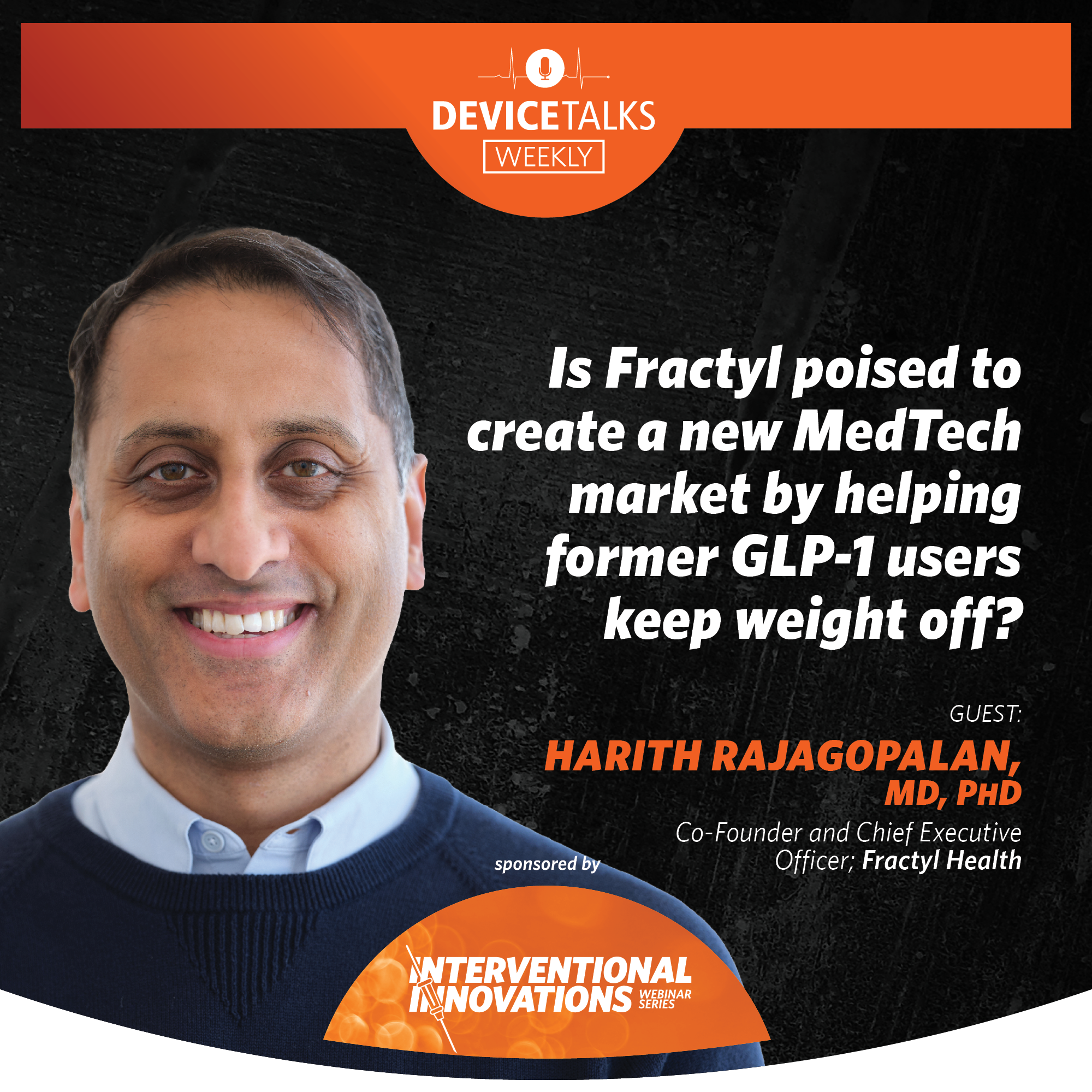
And it initially was going to be using, was pursuing a treatment for diabetes and this has been sort of an accessory or a pivot sort of focus for the company. We'll have the CEO Harith Rajgarpahal and I was actually going to speak with him today, but we had to move the interview to next week. We'll talk about this news but it's an excellent pivot for a device company and I think it's certainly would be a great complementary treatment to folks on GLP1 who.
I think a major concern for folks who don't use it is the fact that you may need to be on it forever. You may not be able to afford it forever, or you may not have the coverage you need forever. You may not just want to take it forever. And if there's a way to sort of get to a target weight and keep that, maintain that target weight without having to do the GLP1s, I'm sure there's.
There's a lot of value in that. It could probably open up the market for GLP1s as well. Not that they necessarily need the help, but excellent focus for fractal, for sure.
[00:19:14] Speaker B: One of the things I've been seeing in all the reporting around GLP1s is that, I mean, the fact that they don't. People have to stay on them in order to keep the weight loss.
That's one of the challenges around them. So, yeah, I think that's why this story is getting so much attention, because it's like, okay, here's a solution that could, you know, that could solve that challenge so you don't have to be on GLP1s forever. You can go, then do. And it sounds much better than something like, oh, go do a bariatric procedure or something that's like, super invasive. I mean, this is something delivered endoscopically. So, I mean, it sounds like something you could go in, get done, you know, like, go, you know, go. Go back to your life, you know, you're not gonna.
[00:19:56] Speaker A: Exactly.
[00:19:57] Speaker B: Yeah, exactly. No, no, no, no. No big surgical scars from. From that one. So. So yeah, that I think. I suspect we're going to see even more, like, stories of other med techs, like, coming out and being like, hell, here's. Here's how our technology could be a potential solution for this.
[00:20:15] Speaker A: Yeah, I mean, if there's a. If you find the biological pathway for this to work, you know, I wonder if it does open up opportunities for other energy sources as well, or if this is something that fractal has a unique hold onto. I'm not sure. I'm not sure how that part of that tissue responds to different energies.
RF and others may not have been an option, but hell, let's get pulse field ablation.
[00:20:38] Speaker B: There we go.
[00:20:39] Speaker A: Seems to be working on everything else.
[00:20:41] Speaker B: It works with cardi. It works with cardiac tissue.
[00:20:44] Speaker A: I mean, but.
[00:20:45] Speaker B: But yeah, I mean, interestingly enough, like, when we've asked people in renal denervation, like, why don't you. Why don't you go. They're like, no, no, it didn't work well for pfa. Didn't work well for that, so.
But. But yeah, I'd be interested. Like what? Yeah, that's. That's a really good question. What kind of energy sources or whatnot? Like, how does that, you know, that kind of like do to. No tissue down there. Like when you head down past the stomach. I mean, how does that.
[00:21:08] Speaker A: I think it's wildly sensitive and it's in. It's. You have to be very careful. But I'll ask for reef Raja Kapalan next week. We'll find out.
[00:21:15] Speaker B: I mean, I know it's sensitive if I've like eaten some really spicy nachos.
[00:21:19] Speaker A: Oh, you don't need to go there, Christian.
[00:21:21] Speaker B: Sorry.
[00:21:22] Speaker A: Number one on the new market tmi, my friend.
[00:21:27] Speaker B: Sorry, man. Sorry.
Be careful about too many raw jalapenos, man. You gotta be careful. Anyway, for me it's ice cream.
[00:21:35] Speaker A: Go ahead.
[00:21:36] Speaker B: Now, you know, the number one on the list. You know, we actually got a tip from you because you saw like our great.
[00:21:47] Speaker A: The great Steve Bell.
[00:21:49] Speaker B: Yeah, yeah. Good. Yeah, Steve's a good guy. Like, he was posting on LinkedIn that he.
This is sad news.
You know, the vicarious surgical is, you know, there was an SEC filing where their, you know, board was saying they're gonna close the company as. As soon as next week.
But yeah, I mean, I just think the overall, I mean, vicarious, you know, was like trying to work on all these innovations and soft tissue robotic surgery, you know, meanwhile, intuitive came out with their, you know, next gen DaVinci 5 that just kind of even kind of widened the mode for them in that space and you know, in vicarious timelines. I remember we were been reporting over the years like kind of continually getting pushed back. And I think the moral of the story is, I mean, it's. Surgical robotics is a tough space.
[00:22:41] Speaker A: Yeah, it is. I mean their design I always thought was very ambitious and I love ambition, so I knock against them. But having the entire robot, the imagery and the devices inside, and almost a humanoid form robot where you have the face and the devices was really amazing to see and the videos were great. But it seemed compared to how other systems were approaching it, it seemed again, very ambitious. We did have Steve from on Stephen Frahman, their CEO, their new CEO, earlier this year. And I thought his pivot is to making this less of a surgical robotic system and more of a medical device that could be used for a very specific treatment.
Made a great deal of sense, but at the end of the day, you're Right.
Surgical robotics is difficult. It's expensive.
Vicarious Surgical had gone through the SPAC a few years ago and had gotten a lot of money from it. But for.
[00:23:44] Speaker B: Because money only lasts so long. Yeah, yeah.
[00:23:47] Speaker A: They still have to get somewhere for that. So it is sad news. I got to talk to Adam Sachs, co founder and the first CEO some point. He was one of my early Covid conversations where we were doing this.
I don't know if I had him on the podcast initially, but we had a great talk. I remember my son was interested in robotics at the time and then he agreed to talk to my son for a bit about just robotics. So that's cool. Very good guy. Always enjoyed conversations, very generous with his time and no doubt he'll use the experience at Vicarious and, and it'll be to the benefit of something else he started or some other company out there.
[00:24:28] Speaker B: Yeah, I'm sure.
[00:24:29] Speaker A: So we'll see him again in Surgical Robotics, no doubt.
[00:24:33] Speaker B: Yeah. There's plenty of Surgical robotics operations and companies around the Boston area. So I mean, it's tough news for the people who are still efficarious, but I'm sure there'll be new opportunities for them as well and I'll have really good learning experiences. So, so, so, yeah, but I mean I, I know Steve and his post was kind of saying, and we had, we had Vicarious, you know, this happened with Vicarious. We had Carl Storrs, which had acquired a census, saying hey, we're, I mean they pretty much are getting out of that Surgical Robotics and they're going to use that Ascensus technology kind of like more for surgical imaging and you know, more smart surgery systems, but, but not as much robotics.
You know, I mean, Steve, Steve was kind of saying that he thinks this is a trend that, you know, like we're kind of entering this phase where we've had so many companies with so many technologies and ideas and we're going to start to see them, you know, merging, sometimes going out of business.
You know, there's going to be some consolidation going on now in the space.
[00:25:38] Speaker A: Well, you even had the great issue, the MDO issue put together by Jim Hammerand and Skyler Rivera and the whole team, of course, but the focus on, on neurosurgery, or rather neurovascular treatments for stroke.
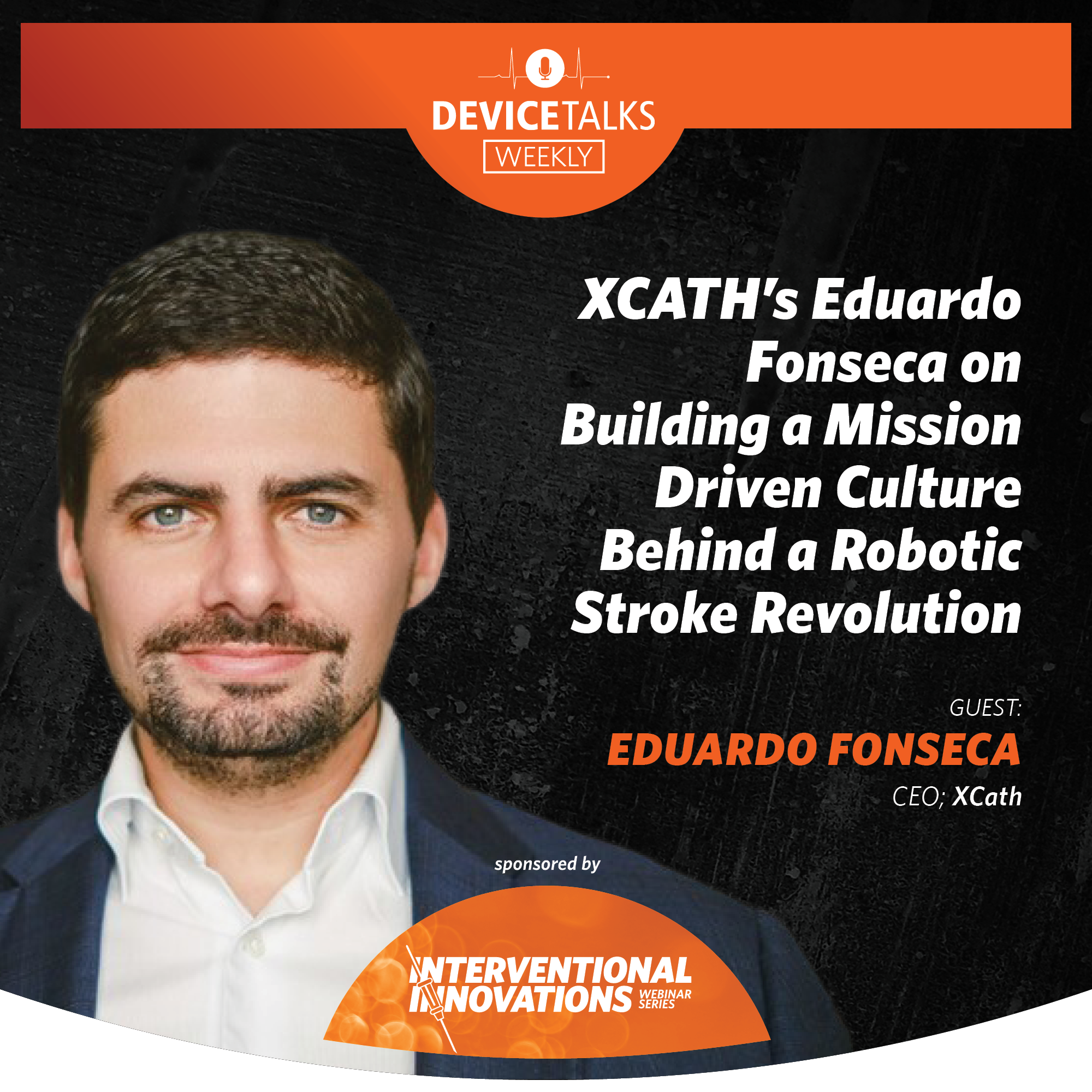
And I think there's a dozen or so companies out there treating stroke. I talked with Eduardo Fonseca Last week on Xcath, CEO of Xcath, talking about the space and there's 12 companies I mean, there's not going to be 12 companies five years from now. No, this is just the nature of this industry.
[00:26:14] Speaker B: It's true.
[00:26:14] Speaker A: Folks will be giving their best shot and making their best case and we'll see which ones survive. Yeah, there's looking at the SRS annual meeting page of all the exhibitors and it's a lot bigger than it was two years ago when I was down there for that then. So I'm interested, seeing how differentiated the systems are, how different the approaches are.
We can only, I think, have so many sort of da Vinci types out there, but that doesn't mean that there's not a lot of opportunity for very new approaches. So.
[00:26:50] Speaker B: That's true.
[00:26:51] Speaker A: I'm hoping to connect with Steve Bell down there. Maybe we'll have him on the podcast next week to kind of give us a rundown of srs.
[00:26:57] Speaker B: That's true. I mean, we'll see consolidation with certain applications, but we could still see a lot more companies coming up that are seeking new applications. So, yeah, I mean, and maybe overall the number of companies we're following will stay the same or even grow, but we're going to definitely see more and more diversity.
Where else can robotics be employed in healthcare? So, I mean, it's not going to get boring anytime soon. I mean, this is a pretty exciting space to be covering.
[00:27:32] Speaker A: No. And again, going back to your first number five item, the robotics use the TMS procedure. Again, going back to, to talking about his mood surgical. I mean, mood surgical is kind of, I think, pivoting away from surgical robotics more and becoming more of a surgery platform.
[00:27:54] Speaker B: So here's a robotic assistant.
[00:27:56] Speaker A: I think 10 years from now
[00:27:59] Speaker C: we
[00:28:00] Speaker A: won't be using the term robotic as much because it's just going to be assumed that it's part of whatever procedure or whatever device is being used. Not every device, of course, but I think many areas of healthcare can benefit from, from robotics.
[00:28:14] Speaker B: That's true. I mean, it's like, I mean, we've been around enough. I mean, we remember when the Internet was really breaking into journalism. Everything like, oh, it's, it's a web based, I mean, no one says web based anymore. I mean, and, and I, I really suspect, like, oh, it's AI enabled. No one's going to be saying AI enabled. It's just an assumption there's going to be some kind of AI involved with whatever you're doing.
Yeah, Roblox is going to be the same way. I mean, I, I remember we had a device talks a few years ago where Gary Gothard, as the speaker, he was saying the same thing. He was like, this isn't, I mean, it was kind of like, I think the two big takeaways I got from his talk was intuitive, is awesome. And by the way, like, robotics overall, it's not going to be, it's not going to have this. It's just going to be normal.
It's going to be normal in 10, 20 years. It's just going to be assumed if I'm getting a surgery or something at a healthcare setting, there's going to be robotics involved in some way.
[00:29:10] Speaker A: So.
[00:29:11] Speaker D: Absolutely.
[00:29:12] Speaker B: But I'll have a lot of fun for now, like being like, woo, it's robotics. Like, yeah, we keep that going for now. So. But yeah, absolutely. Cool.
[00:29:20] Speaker A: All right, Chris Newmarker, great news.
[00:29:21] Speaker B: Great as always.
Yeah, awesome, man. Take care.
[00:29:24] Speaker A: All right, thank you, Chris Newmarker, for the top news of the week. Now, I'm very happy to bring you our message from our very great partners, Freudenberg Medical, your trusted CDMO partner.
Listen.
Hi everyone, this is Tom Salami of Device Talks. Very happy to have our friends from Freudenberg Medical joining us on the podcast. I'm speaking with Shane Healy, he's the senior Director of Technology at Freudenberg Medical. Shane, thank you so much for joining us today.
[00:29:53] Speaker D: Tom, thanks for your introduction and thanks for the opportunity to be on this podcast with you.
[00:29:57] Speaker A: Oh, it's my pleasure. So we love to talk medtech, but I love to talk to medtech people. So let's take this opportunity to introduce our audience to you and to Freudenberg Medical. Who are you? How do you work with medical device companies?
[00:30:09] Speaker D: So my name is Shane Healy and I'm a senior Corporate Director of Technology for Freudenberg Medical. I've been working in medical devices or medical device components for over 30 years now.
And Freudenberg Medical are a contract device design and manufacturing partner who support the OEMs predominantly.
And they work in 12 locations across the globe in the U.S. europe, Asia and Costa Rica.
And we support customers with a broad range of vertically integrated components and technologies that basically help us to produce solutions in the minimally invasive catheter space. And we also operate in the biopharma processing space where we produce some solutions in that area too.
And what really connects all of that is our deep material expertise.
We've got a lot of thermoplastics, fluoropolymer, silicon, metals and coating expertise. And when we bring all those together using our two main process platforms of molding and extrusions, we produce what I think are really appreciated solutions for our customers.
[00:31:14] Speaker A: So, Shane, when we speak with the CDMO sector, a consistent trend that we're hearing is a move from transactional outsourcing to more strategic partnerships. Where do we stand on that today?
[00:31:25] Speaker D: I think that is accelerating, and I think there's a couple of reasons for that.
Definitely, catheters are becoming more complex. There's more technology in catheters.
So OEMs are looking for CDMO partners who can manage that technical complexity.
And then in addition to that technical complexity, there can be more supply chain complexity.
So there could be components that are bought in from various parts of the world. So the ability to manage that technical complexity and supply chain complexity is something the OEMs value, and that's what they look to in CDM Oil Partners is to help them bring that to the table.
[00:32:07] Speaker A: It's amazing how complex medical devices have been getting just over the past five years or so. How is that complexity changing what customers actually need from their strategic partners?
[00:32:18] Speaker D: Well, if you look at some catheters, you know, a lot of these new catheters that we're developing and with OEMs, and they're putting in the marketplace, they're getting smarter.
Years ago, you might have a catheter with two or three layers in it.
You might have a slippy layer, PTFE to get over a guide wire, maybe a reinforcement layer, and then an outer jacket.
Now what we're seeing is those catheters with kind of the same wall thickness requirements, but with things like pull rings for steerable catheters, pull ring assemblies. We're looking at things still reinforcement, we're looking at things like still lubricious liners, possibly incorporating flexible electrode circuits. So we're trying to pack far more technology into the distal section of those catheters.
And you need the internal capabilities to do that, and you need the connections with supply chain, the correct suppliers to help you outsource those technologies where you don't have them in house.
[00:33:20] Speaker A: So as these devices get more complex, you really need broad integration as a CDMO to support customers.
How do you get to that level of capability?
[00:33:31] Speaker D: So you can develop it internally or you can acquire it, or both, you know, and that's what we do, is both.
So recently we would have acquired a hypotube manufacturer in Japan called Fuji Seiko. So we've brought in hypertube manufacturing internally, and then we can develop that. As we acquire that technology, we can expand the range.
Another example of would be the launch of Lubertech, which is a lubricious coating that we've launched in the marketplace in the last several months.
And then we also have what we call platform technologies. So we have a range of sealing technologies, introducer sealing technologies, flex seal, hyperseal, and we build those out because we can help our customers bring their solutions quicker to the marketplace by providing some of these kind of peripheral technologies that may not be core to those business, but they're highly valued in terms of them being able to bring those accessories to their on market with their main devices.
So the investments in kind of platform technologies, acquisitions and component technologies, I think all that helps.
[00:34:44] Speaker A: Amazing. So just to conclude, take a step back. We've covered a lot. What do you think matters most to customers when choosing a CDMO partner?
[00:34:54] Speaker D: So I think a customer that our customers want partners that have sufficient vertical integration so we can keep control of that very complex technology and supply chain that are going into these more and more complex catheters that our customers are looking for in the market to build.
And then the other drive will be not just going to the technologies, but the location of the technologies in region support.
As these bonds become more complex, the supply chains can become more complex. We're flying components all around the world.
So partners that can actually bring up component technologies in region to support customers in region I think will be part of the selection criteria for those OEMs as we go forward.
[00:35:43] Speaker A: Fantastic. Shane. I've always learned a lot when I talk with Freudenberg Medical. Today I learned more than I could have hoped. I really appreciate your taking the time and joining us on the podcast. Great.
[00:35:53] Speaker D: Thank you, Tom. Thanks for having me.
[00:35:56] Speaker A: All right, thank you, Shane Healy. Thank you Freudenberg Medical for sponsoring this episode of Device Talks Weekly. Once again, if you'd like more information about Freudenberg Medical, as if that great conversation was not enough, go to freudenbergmedical.com Freudenberg is spelled F R E U D E N B e r g medical.com that's Freudenberg medical.com All right. Now I'm very happy to bring you a conversation between our managing editor, Kayleen Brown and Debbie Govender, worldwide president of Johnson Johnson MedTech Heart Recovery.
Oh, and just one more thing before I start the interview. You'll notice the start of the interview, Debbie and and Kayleen refer to a video that had just been played. We had played an excellent, very touching patient video on screen before Debbie and Kayleen took to the stage.
So that is what they're referencing. If I can find it on YouTube, I'll post a link of it in the show notes. But I think with this little bit of background, you should have most of the information you need. But it was truly an amazing story.
[00:37:15] Speaker E: Wow. What a way to start the morning.
[00:37:17] Speaker C: I know.
[00:37:18] Speaker E: I mean, I think that sort of revisiting the patient experience and the impact we have in medtech, the real world impact, is an important way to start a day of these really important conversations.
Debbie, what came up for you rewatching? Because you and I both, we had this, this con, this moment, this connection, watching that. What came up up for you?
[00:37:38] Speaker C: Yeah, I mean, generally it's how to avoid crying before you get on stage when you're watching a story like that.
But I am, I personally know Lane, and I think this is one of the things that is so wonderful about working at a company like Abiomed, which is how much the patients are part of everything we do.
From the start of the development process all the way through how we think about how best to design technology and deliver that to the community and how we inspire our teams and our culture. So Lane, actually, five months after having her scad heart attack, came to headquarters.
Very special moment for me because it was also our patient summit and my own mom was there with me in the building and my husband as well to participate because we're a family first and a patients first organization.
But just the strength and fortitude of the human that has lain and the commitment that not only she has given to herself and her family and her recovery, but also to her community.
I'm so inspired, and I'm sure you've all had experiences with patients in your own companies like this who take on the mantle of actually wanting to make sure that they are part of the solution, that they're out there in their communities raising awareness, educating, sharing their stories. And the power of a single patient story is more monumental than I think most people realize.
When we have. I think when Tom was in the building, we had patients there and we were talking about that influence. And every patient that comes through the door says, what else can I do to help people understand what's possible?
My answer is always the same. It's a very simple statement of do exactly what you're doing now, which is just share your experience with others, because the impact that you'll have have in sharing that story is far beyond what you'll ever know. So she's a special human. Her. Her kids are special, her husband is special. We got to meet all of them. So it's always emotional, but it's also the thing that inspires me to get out of bed every morning.
[00:39:39] Speaker E: I can see that. And I have a feeling that so many of us feel that same connection.
You mentioned that your family was there.
I especially, I have to imagine many of us left our family to be here in this room right now. And I'm so grateful for that. Do you feel like having your family in the room, seeing your impact, the impact you are making on these patients, has that reinforced your mission in Medtech and double down on why we choose to come to Medtech every day?
[00:40:12] Speaker C: Yeah, I mean, I guess particularly poignant for me. And maybe I'll share a little bit of kind of my, My. My own why and why it's very important that my mom specifically gets to see these moments.
I came to Medtech from a very personal journey.
My own father had his first heart attack at 39 and survived, yet suffered a long journey with cardiovascular disease and ultimately ended up being a heart transplant recipient survive 14 years post transplant.
So for me, the mission or the journey to do things to impact this disease state that's so burdensome to our globe called heart failure.
It's a mission. It's not just a job that I go to every day. It's what can we do to extend life with quality?
So my mom, as a carer and a caretaker, and I'm sure many of you have been a caretaker for family members.
It's not a fun journey, Albeit extending life is a wonderful thing to be able to do. And we got 30 more years with my dad, which I will always cherish.
Caretaking is hard. And so for me to be able to kind of come full circle with my mom, being able to see that what we're doing at Abiomed actually could change that trajectory for many other families. I think even for her, that's a.
A bit of catharsis to know that the way that technology is advancing within the cardiovascular space could mean a decade more, 15 more years for Lane and her family, who was able to not have to have that transplant today, but should there be something for her tomorrow? She has options now, and that's really what we're all striving for, which is as we live longer and we want life to be long, but we want it to have quality too. And we want to make sure that we're. We're creating as many options for the continuum of care as possible that we can.
[00:42:09] Speaker E: I love that. What a special moment.
[00:42:11] Speaker C: Yeah.
[00:42:13] Speaker E: And I know we're going completely off talk track here, but, I mean, you sold me with that video. I have to.
If you don't mind me asking, when was your father's heart attack? How many years have passed? Because I'm just so interested in the advancement of technology. From five years ago to today is massive comparatively. So when did your father have that?
[00:42:33] Speaker C: Yeah, so it was was 45 years ago when he had his first heart attack. So, yeah, he would have been 39 at that point in time.
And when you think about the advances in technology and drug therapies and everything that have happened along that, I mean, I think he had five heart attacks, unfortunately, but benefited from the advancements of technology. And I think this is the thing that excited me the most about being in this space was just the pace of innovation, the creativity of our clinical community.
I feel like every day we're trying to play catch up with our physician friends who take technology and therapies and apply them in new ways all the time. And so while that was a long journey along those five heart attacks, there was balloon angioplasty, which was the beginnings of what we did for people with ischemic disease.
Dad benefited then from the evolution of the stent technologies that we all know and are very familiar with today in its original version as a bare metal stent with no drug to give options for trying to minimize vessel closure. But then he benefited from the evolution of drug losing stents after that and all of these things. I mean, we were told many times he should not still be here along Metrogen trajectory. But device technologies intervention kept him alive for multiple more years. He benefited from surgery as well. So he had a triple bypass.
But then ultimately there was no impella back then. And while I can't actually with definitive data say that that would have completely changed his trajectory. What I know today from our experience now and nearly half a million patients worldwide, we know what the opportunity is with every LV left ventricular recovery and getting the muscle to work again, if you can actually intervene early on many of these patients.
So he didn't get that benefit, but he got transplant. And so the transplant, like I said, that was a 14 year journey, which is a really long life with a heart transplant. And so, yeah, all the things that could have been done at that point in time were done. And when you think about the fact that that was 45 years ago, just how fast cardiovascular medtech is moving and the things that we can do to actually extend life, it's pretty fantastic.
[00:44:56] Speaker E: I'm always trying to find a way to illustrate the patient journey and why our impact or why showing up every day is so important. And you Just did that so beautifully. So thank you for sharing. Again, very off script.
[00:45:08] Speaker C: Yeah.
[00:45:08] Speaker E: So let's get right back on script.
So in 2022, Abby and was brought into the Johnson and Johnson family. So what were those initial goals for the integration?
[00:45:19] Speaker C: Yeah, I mean, I think, look, you can look at this from the two sides of the coin with any integration. It's the company being integrated and the integrator and kind of what the objectives are of both sides of that equation.
I think for us at Abiomed, it was the scale and capability that would come with a giant multinational organization like JJ with the power and capability to actually fuel the mission faster and with more scale geographically as well. So when I think about those first couple of years, it's how do we build out our team? How do we build out our capacity to expand globally? When you think about Abiomed from an operating model perspective beforehand, the device that we deliver is not a device you take and put in a shelf and you walk away from. We have to support it with 24, 7. Clinical care requires a full infrastructure built out to be in ICUs, to be with that patient while they go through the journey and partner alongside a physician. So to be able to do that required a lot of resourcing and time and finance and everything goes with that. So while our pace was as fast as we could do it when we were abiomed, I considered us a smallish startup company at that point in time. Maybe teenager.
The ability to actually now leverage resourcing of the fuel that JJ could inject into our reach, if you will, access for patients was the first goal. The second was to do that kind of rooted in that same culture and patient centricity that we had always had.
So to deliver that with teams who knew that decisions would be made with a patient's first mentality and actually kind of marrying up those cultures, which is the thing that inspire our teams, our teams work and life and death situations. So knowing that you have a culture that supports that from a very patient centric viewpoint was critical for me and the organization. And that married up really well with JJ's credo and their belief system.
And we wanted to make sure that we were able to just run at pace, so keep doing what we were doing, but mature even more. Right. So do it with even more opportunities.
I think from a JJ perspective it was they wanted that same goal. They saw this novel technology that was actually meeting patients where there were no solutions. Today we are the only miniature heart pump on the market right now. We are the Only ones invested in this journey to heart recovery from a temporary support perspective. So they saw a huge opportunity to continue to build out the cardiovascular portfolio with a patient population that was a true unmet need today. That really helped build out their future of heart failure. When you think about the high tech med tech that J and J already have in the EP space and other, these things really fit well into kind of their portfolio of heart failure overall. But they wanted us to run at speed, so an end to end business and keep doing what you're doing and make a dent in patient care.
So I think overall objectives were, were those primarily and I think for the most part those things have worked out. We're three and a half years in now and we are running apace and we are expanding access to more patients than we ever have before.
[00:48:35] Speaker E: Well, you mentioned a few wins, very important wins. And that made me think about success in measuring success. And you made such a great point, Debbie, that it's two companies coming together, not just one. How do you measure success? And did you have milestones that were agreed upon by both groups coming in?
[00:48:55] Speaker C: Yeah, I think for us again, it was really rooted in the patient access piece, Kayleen. So our goals were really making sure that we could expand access geographically, that we could do that with the genius of the and so that we could do our scale and our resourcing, build out teams.
So we went from being a, a 1200 ish, 1500 person team when acquired in 2022 to being just almost 4000 people now in 2026.
So our commitment was to scaling opportunity together. And our commitment was doing that both in depth and our ability to build new technologies both for the US and the current markets that we were in which we wanted to continue to move apace, to build science around that and continue to move those RCTs at pace, which we did too. So again, the genius of the and but also to expand reach globally. So I think they were the primary goals. Obviously there was details within that as to which countries, where and when, but that was really the three big targets were making sure that we could bring this technology to other patients that needed it in communities far beyond where we were today.
[00:50:08] Speaker E: Excellent.
[00:50:08] Speaker C: Yeah.
[00:50:10] Speaker E: So kind of continuing with this idea again, this, this two sided integration.
Was there a specific business model or. You mentioned patient first model with Abiomed. What is there like a specific model that helped influence maybe how the business was structured? This patient first credo, like how did Abiomed influenced Johnson and Johnson Recovery?
[00:50:37] Speaker C: Yeah, I mean, I think this is where I think many people have probably been through integrations. And you want to be a world class import export business is kind of how I describe it. So we wanted to make sure that we were importing all the things that were great about jj, but also exporting what we thought was world class about Abimet at the time. I think this is where I will credit what JJ did when they acquired us in acquiring us as an end to end business business. So allowing our teams to continue to run that bench to bedside capability.
We have three decades of expertise in engineering that still sit at my staff every Monday morning. So the original founder and creator of Impella is still on our team, Dr. Torsten Zeiss. And so he is a genius. He knows how to build pumps. And we had, like I said, three decades of expertise that had worked alongside him for a really long time.
So why interrupt that capability? Why say well we maybe need to integrate R and D more fully. Why pull things into a broader business that's more generalized when you can keep a hyper specialized team really focused on executing on their goals.
And that doesn't always happen. We've seen integrations where we completely integrate teams immediately on acquisition. And so we got to do just stay as we were for the most part. And I think that really was a success story in that it allowed us to continue to use the experts that we had in place to say what patient need are we meeting? How do we need to build the next technology, Continue to work our science with the clinical teams that we had in place already.
And so I think that to me is a best in class moment. I think that's some of what you see an influence on the rest of the Medtech organization right now where you have seen business unit alignment that's actually now just been announced from J&J MedTech to say that this kind of end to end model is where they see the future. And I think it's a really smart move to try to give people again that same capabilities within the other verticals that exist within MedTech so that we can all operate with speed and pace and delivering what we need to with experts around that.
[00:52:49] Speaker E: So taking what works best and applying that model to the other business units.
[00:52:53] Speaker C: And it's just there's been some influence. There's also been influence from a patient perspective. I think if you with J and J, very patient centric organization already. But when you look at how we build patient advocacy into what we do every day, like I said, from how we build the technology to how we have worked through making sure that the people who could legislate for payment and the structures that would support patient care in the future understood what was critical.
Patients advocate on the Hill and they, you know, so we. It's a very, very intentional program to make sure that we're raising awareness to what's needed to service our communities. And I think that now is also starting to kind of spread across the medtech organization.
[00:53:34] Speaker E: You made me think of two new questions. So I really should just rip up these questions because I'm not following it at all.
This is just too juicy and too interesting.
Do you. You mentioned that. Okay, let's talk about the patients.
And you said that patient forward, really having that connection with patients. Do patients have an actual influence in the room? And if so, what does that room look like?
[00:53:55] Speaker C: Yeah, I mean, we have patients in our building, I think, every week.
Whether that's to inspire our teams. We obviously, when you're in production and when you're building pumps as an example, it's really easy to feel distant from what you do every single day. And I think for all of us that have people who work, work in our teams, we want to make sure that they feel really connected to what they're doing and the end product, especially in healthcare.
So we have patients come in to talk to our production teams about why the work they do is so critical. And when you think about how they have to think about the pieces of the puzzle that they're putting together and how that supports a life and how important that is for just thinking about how their piece of the puzzle can actually really overall impact patient life and sustainability and all of those things, it gets people really motivated in their work and wanting to make sure they do everything the right way. So that's number one. Number two is also that patients are in our. We're now using patient advocates as part of our clinical trial infrastructure. So we have patient advocates that actually work in our studies. So. And I think this is becoming best practice across industry. This isn't unique to abiomed. I think. I think we're seeing this in a multitude of different arenas. We're on panels and in advisory committees. You're seeing a lot more patient voice in that narrative. And I think it's critical because it's very easy for us as industry and clinicians and regulators to talk about what we think is most important. But at the end of the day, we're serving patients. And so having their voice actually be part of influencing the future of healthcare or is critical. So I think even from the base level. How do we design science? How do we design technology? That's where our patients come and they talk to our engineers as well. Again, it really is an educational program to help influence the future in a
[00:55:47] Speaker E: different way, from policy to engineering. Have the patient voice. And I'm curious, this is a conversation that I've been having over the last five years and I feel like this has come up more and more and more. So I'm curious with our audience and feel free to nod your head or raise your hand. Do you feel like you are integrating the patient voice more in the last five years than you have previously?
I see a lot of nods. Maybe we need a little more nods.
I see a lot of smiles. I'll take that.
And then the last tangent that I wanted to go on. As you mentioned before Abiomad was acquired in 2022, you considered it a teenage startup. Do you still consider it a teenage startup within Johnson Johnson Medtech?
[00:56:26] Speaker C: I, I think we've gone past our teenage stage. I think we're young adult at this point in time. I, I, I'm going to answer that two ways. I think if you look at the team, the size, the scale, the resourcing and how we're approaching the business now, I would consider us definitely transitioned into young adulthood. I think our opportunity is still in the early stages. I think we, the power of the pump and the, and the potential that we have to actually help more patients like Lane. If you think about Lane, it was only in 2018 that we actually got an indication to help patients with postpartum or peripartum cardiomyopathy. And so what can be done with unloading therapy? The potential there is still probably early teenager because we have so much more work to do and we know there's more potential.
But as a company and operations and business, I'm going to call us young adult. That's a sweet spot.
[00:57:21] Speaker E: I feel like I love that little sweet spot there.
So let's talk about evolution. We've been talking about how the organization has evolved, but what about the definition of heart recovery in general? Like, how has that evolved across acute to chronic continuum?
[00:57:38] Speaker C: Yeah, I mean, I think how we, how we think about our opportunity to help a very complex patient population. I think when you think about the evolution of any technology at the start of your journey, the technology really drives the data and so you're learning how this works, who it works in and how and when should we utilize this technology in the hands of our clinicians?
We're now at a stage Where I said earlier, we're almost at a half a million patients worth of experience with what this device can actually be powered to do. So now our, our patient experiences driving our data.
So we've learned that there's actually a lot more that you can do. Like I said, 2018 was a new indication. We got an indication not too long ago for a pediatric application for the pump. So when we think about acute to chronic disease state management, the ability to actually intervene earlier is demonstrating that actually we can do things that will help us to provide more longevity, if you will, with quality. So I think our approaches are now not just going to be one technology driven. I think what's really starting to evolve is what's the power in combination therapies. When I talk about impella, I talk about it. It's a therapy, it's not a tool and it's part of an overall patient treatment strategy. When I think about the future of how we can actually impact heart recovery, it's not just one single thing. There's an ecosystem system of tools and therapies within that that we are number one, developing internally, number two, looking at external opportunities.
But simple things like now we're exploring drug device combinations. So we have two things that I'll just talk to you quickly. We have a study that's just starting called Integrate, which is basically looking at the use of our 55 pump with GMT, which is the four pillar heart failure therapy that is gold standard right now for heart failure treatment. And if you combine those two things, can you actually recover more hearts? So that's number one and there's strong belief that that actually will be something that will play out positively from a patient perspective. But obviously still in clinical trial world, we've also just announced a research partnership with Lexio Therapeutics where we're looking at, at preclinical work where we would use 55 to actually embed stem cell therapies to see if that can also help in restoration of heart muscle. So when I think about what's possible with heart recovery, I think the pump plays an integral part in how we deliver more opportunity for patients.
Lifetime disease state management needs to be a bigger topic when we talk about heart failure, which, which we're going to shift that nomenclature. I don't know about the rest of you, but I don't ever want to be a heart failure patient. I would like to be a heart recovery patient.
Just, just the very, yeah, just the words by themselves changes how a patient even feels about their opportunity for future care.
So I think for me, how we start to look at things, like I say, across borders, and I think within jj, this is also one of the things as I see as a big opportunity, opportunity where we have a giant innovative medicines business and a med tech business. And how do we actually bring those two things together? I think that's part of the vision of our CEO as well as to how do we power and fuel the future of cardiovascular care by bringing together drugs and technology. And I think there's much more opportunity there than we've really even tapped into today. But what I do know is that our commitment to, is to do that. We do want to shift the narrative, change the paradigm. Standards of care are already changing. We're seeing that with the influence of positive randomized clinical trials in the shock space.
But there's more to come there. And so I think the narrative is moving and I think our structural heart friends are helping because even in the structural world, the conversation is really now moving from what do we do for just this moment in time for therapy for this patient and how do we actually think about the 20 years that this patient or 30, 30 years may need heart failure therapies delivered, and how do we do things in sequence with thoughtfulness around life extension and quality?
[01:01:58] Speaker E: Again, I'm going completely off script here. I mean that trying to change the standard of care and change a narrative more than anything, as a storyteller myself, to change a narrative could be the most difficult part of the process. So how do you even start that? Do you.
Do you have a group of people that come together and if so, who do you call and what is the first question?
[01:02:21] Speaker C: I wish I could just call somebody and say, can we change this?
Look, this all builds with clinical understanding, patient experience and the scientific rigor that you generate.
I did reference earlier on as an example, there was a randomized control trial that was just done in patients with cardiac cardiogenic shock with a positive survival benefit that has already changed guidelines globally. And so we're moving in the right direction. I think there's still more that we can continue to do with building evidence. I also think, though, beyond that is we have to think about the infrastructure that we're delivering change into.
And I maybe just go back to the first little interview here where we were talking about the systems that we actually have to bring technologies into. So when you think about delivery of healthcare, it's not just what technology or therapies can we build or deliver, it's how do we actually partner with healthcare systems to actualize that then like the implementation science of actually bringing therapy to patients.
Because when you think about shock, if you have a heart attack tomorrow, it is agnostic to where you have us. You could be in rural North Dakota or right here in Metroplex Boston, and your ability to access care in an immediate fashion or get equivalent care so get the same care is still variable today.
And so how do we not just change standards, but how do we actually influence care delivery models that will mean. So I mean, it's wonderful that we have a clinical community now that all read the guidelines and, and understand the benefit and shock as an example and want to implement the technology. The question isn't why, the question is how.
So now there's more work that we have to do, I think with our hospitals and our hospital systems to say there are things that we just need to take away the luck and variability from and we have to create opportunity. And that's going to be a different answer based on geography and economic situations and insurance and reimbursement. But it's a challenge that I'm certainly willing to take on with the organization and we think is critical because you should be able to get equivalent care if you're in the US no matter what. As an example. Right. We'll talk about the US for today. Globally, I think we have to achieve the same thing.
But that's some of what I think is still the challenge today. Hospitals want to do this, this, but it's not always easy to deliver high quality acute care when you're looking at kind of some of the geographic disparity that we deal with in just delivery models across the country.
[01:05:02] Speaker E: Absolutely. I mean, proximity and access are not the same thing.
[01:05:05] Speaker C: They're not the same thing. Absolutely.
[01:05:07] Speaker E: That's a huge part of the narrative Y and just kind of redefining that.
So interesting.
Let's talk about precision medicine. When you think about cardiovascular care. So what does that look like in practice over the next five years?
[01:05:21] Speaker C: Yeah, I'm afraid now to say AI in this room because everybody's talking about AI.
[01:05:26] Speaker E: We have a pico card. Actually everybody has a pico card. They can stamp their AI.
[01:05:30] Speaker C: I do have to talk about it. Look, we are, we're a data rich environment now and I think this is the responsibility of, of those of us that work on the healthcare industry side is to think about how we actually deliver, for the most part the customized care that each of our patients require.
Like I said, heart failure, which is what we're really trying to change the trajectory on, which is a Huge burden to our patients, to our economy, to our hospitals, to the families that have to care for those that have heart failure.
It's not a one size fits all solution.
I do think this is where the power of AI comes into play and it's something that we're obviously heavily investing in as an organization.
We have fantastic real estate in that we actually have a pump inside the left ventricle and our ability to capture data and to use technology to then figure out exactly how we react and respond to the heart. I think it's changing the narrative in all regards. So not just what we do at abiomed, but for all of us, it's changing the narrative from reactionary medicine to proactive medicine ahead of the curve. And so we're all trying to get there.
So how do we do that in a better way and how do we actually use our technologies to embed more intelligence within them? I think this is one of my biggest priorities is how do we make sure that the pump response to the patient can actually help decision making on the other end for the clinical community. So I think for us, I'll probably reiterate a little bit of what I was talking about about beforehand. I think for all of us as a community, I'm using the royal us right now, which is all of us in this room. I do think it's using data and using intelligence to inform better how we can manage patients with specificity. And I think then as well, it really does come down to this, reaching across borders into finding out how do we combine therapies, so not just the hardware and the technology side, but the other pieces in the puzzle that are drug therapy, therapies and other things that can actually augment a patient's opportunity for a better outcome and use those things to define the future.
So I think that's, like I said, I think that's where we're all headed right now. It's not a simple thing to decode, but I think there's a lot more that we can be doing to take some of the complexity out and to serve our patients up with better solutions.
[01:07:59] Speaker E: You definitely caught my attention when you said going from reactive to proactive. So I just want to touch that, that on a bit. Would you consider a proactive approach being now part of this care continuum that you're talking about?
[01:08:10] Speaker C: Yeah, and I think a lot of that does actually come down to education and awareness as well, which I.
I think we still can do more with ensuring that people know what the options are earlier intervention is better in most disease states, it's very few things in the medical arena that you could say doing something earlier will not be better for a patient. And I think there's a number of different ways that we have to influence that. One is we have to create awareness and education from a patient perspective and a clinical perspective as to what's possible. Number two, again, I said the delivery model. So how do we make sure that standards go across from how the technology is deployed to how we actually implement the technology at the hospital level? I don't think there's any C suite member of a hospital system or administrator who doesn't want to be able to create delivery models that will serve their communities. But it's not always easy to do.
So I think we have to work on making sure that we create those opportunities for those earlier interventions. It also will unburden us from. When we think about the cost of health care.
We all have a part to play in making sure that we increase opportunity, we reduce burden in every regard. So I think all of these things require our focus.
But I think it's all doable if we start thinking about the proactive approaches and early intervention as a positive for our patients.
[01:09:40] Speaker E: I can definitely see how having a focus on heart health early on has this really positive domino effect down the line. And I can see what you're saying about this continuing.
I mean, it really is a connected cycle and the further in advance you can get with education and communication, hopefully the better the cycle turns out.
Ultimately, there's a lot of talk here about patient forward, patient first.
And we were just talking about the importance of gathering data and using that data to inform and to change the standard of care. So how has this patient first focus and exactly what we're talking about right now, how does that affect the way that you do go into clinical studies?
[01:10:30] Speaker C: Yeah, I mean, it's, it, it focuses your energy in the right places. I think, you know, there's a. There's many things that we can do. I talk about this, the. What we can and what we should every day we have to.
Science is not easy to generate always. And in complex patients like heart failure can be really challenging. I think, though, we have real world evidence in ways that we can actually interpret real world evidence now in a way that allows us to try to find out what are the specific questions that we want to be answering now. I think we're really honing our understanding of where the biggest opportunity is for patients.
At the end of the day, you have to start with them. What are our biggest patient unmet needs? Where are the gaps in treatment? Where do we actually see where even the treatments we deliver today don't have durable outcomes over time that we need to derive more specific answers to.
So I think the data just allows us to prioritize in a different way. And I think while it's great to have a lot of shots on goal, I think we always want to try to do as many things as we can. I think when it comes to generating science, we really do have to start with what are the biggest challenges that we're facing with the disease state that we can actually start to answer better questions for. And RCTs are wonderful ways. Randomized controlled trials are wonderful ways to do that. But I think as a community and industry, we also have to expand the opportunity to say, what other ways can we derive data and understanding that can deliver faster solutions for patients, too?
And again, this is where, not to mention the AI term again, but even AI now can actually help us with analyzing large data sets to derive things, even things that we might want to randomize in the future to help us to gain answers faster for patients. So I think speed to getting those answers is critical. And how do we do that now as we move forward? And I think we have to get very agile in how we can build data and interpret data and then implement it at the same time, which all of those three things are challenges in themselves, but things that we're definitely going to take on.
[01:12:38] Speaker E: Well, it gives me really great optimism to think about your lived experience that you so graciously shared with us with your father, and then the example of your patient story here, and just how we have advanced in cardiovascular care so dramatically.
So thinking about my own optimism and how AI can help that. Sorry again. Check her AI bingo card.
When you look at the future of cardiovascular care, what is your most hopeful, most optimistic hope for the future? What does that look like the next five years?
[01:13:16] Speaker C: Maybe I actually stole my own thunder a little bit earlier on when I talked about changing the narrative from heart failure to heart recovery. And I really do think as a cardiovascular community, like many of you in the room, I'm sure are in this world as well, we have an opportunity to do this together. I think the energy and enthusiasm around how we continue to make a dent in that burdensome disease state globally, I feel there's a genuine interest in investment and a passion. When you look at the companies around us, like the large players, and where they're putting their investment dollars right now, there's a lot of interest in the heart failure space. And I think that's just testament to the fact that everybody realizes that we can do more and we can do better. And I think at jj, it's a big, big focus for us. And obviously, I'm very proud that when they acquired us, they called us JJ MedTech Heart Recovery. That was our new name.
And when you have a giant organization as powerful as J and J wanting to put heart recovery up front and center on a shingle that says we're committed to this, we were already committed. Now we have the commitment of a giant multinational organization to help us fuel the future of what's possible when we start to break down the barriers about thinking about disease states as failure modes and think about them as recovery modes. So that's what I'm most excited about.
[01:14:46] Speaker E: Well, I'm glad that you doubled down on that, and I. Every.
Every stakeholder in MedTech has a responsibility, and I think that we could all probably agree that that is the narrative that we'd like to surround ourselves around in media. I have a responsibility too. So, Debbie, I am committed to not using heart failure. From now on, it will be heart recovery.
[01:15:07] Speaker C: Thank you.
[01:15:08] Speaker E: Tom, write that down.
We are officially heart Recovery.
[01:15:12] Speaker C: I'll be reading and listening. I'll be reading and listening.
[01:15:14] Speaker E: I'm committed, and I hope each of you think about that too, and maybe walk away with thinking about how you can change the narrative within your own organization, within your family, within your community, so we can start thinking this way.
[01:15:25] Speaker C: Absolutely.
[01:15:26] Speaker E: Debbie, any last thoughts?
[01:15:28] Speaker C: No. It's just an absolute pleasure to be up here. And.
And I. I look forward to the future in this room. I look forward to learning from everybody here. I mean, there's many. So much that we can do together. So I just appreciate the time and the opportunity to share all the things that we're doing at our little teenage company.
[01:15:45] Speaker E: Amazing. Debbie Govender, worldwide president from Johnson and Johnson Heart Recovery. Thank you so much for joining us.
[01:15:51] Speaker A: Thank you.
[01:15:51] Speaker B: Thank you.
[01:15:54] Speaker A: All right, well, that is a wrap. Thank you so much for joining us on this episode of the Device Talks weekly podcast. Thanks again to our fine friends at Freudenberg Medical for making this episode possible.
You can go to freudenbergmedical.com for more information.
Please take just a few seconds to do us a really big favor. You can subscribe to the Device Talks podcast network so you don't miss a future episode of the Device Talks weekly podcast or our other fine podcasts. Or you can subscribe directly to the Device Talks weekly podcast channel. I really don't care. I just want you to get great podcasts and you deserve them. So make sure you do subscribe.
Please also take just a few seconds to follow Device Talks and mass device on LinkedIn. And while you're there, why not connect with me? Why not connect with Kayleen Brown? Why not connect with Chris Newmarker? We are fun people and we love to talk MedTech, so we'd love to be part of your future MedTech conversations.
Finally, don't forget to join us on Tuesday at 4pm for our device Talks Tuesdays. Brought to you by Advantic. Once again, the title is Medical Edge AI in the OR From Video Capture to Surgical Intelligence. You can go to devicetalks.com to register. You can watch that free. I'm sorry, you can register for free. You can watch that live or you can watch that on demand. Get your questions answered either way. All right, thanks again to Freudenberg Medical for making this episode possible.
And thank you for listening to the Device Talks weekly podcast.