Episode Transcript
[00:00:01] Speaker A: All right, you ready for this?
[00:00:03] Speaker B: Ready.
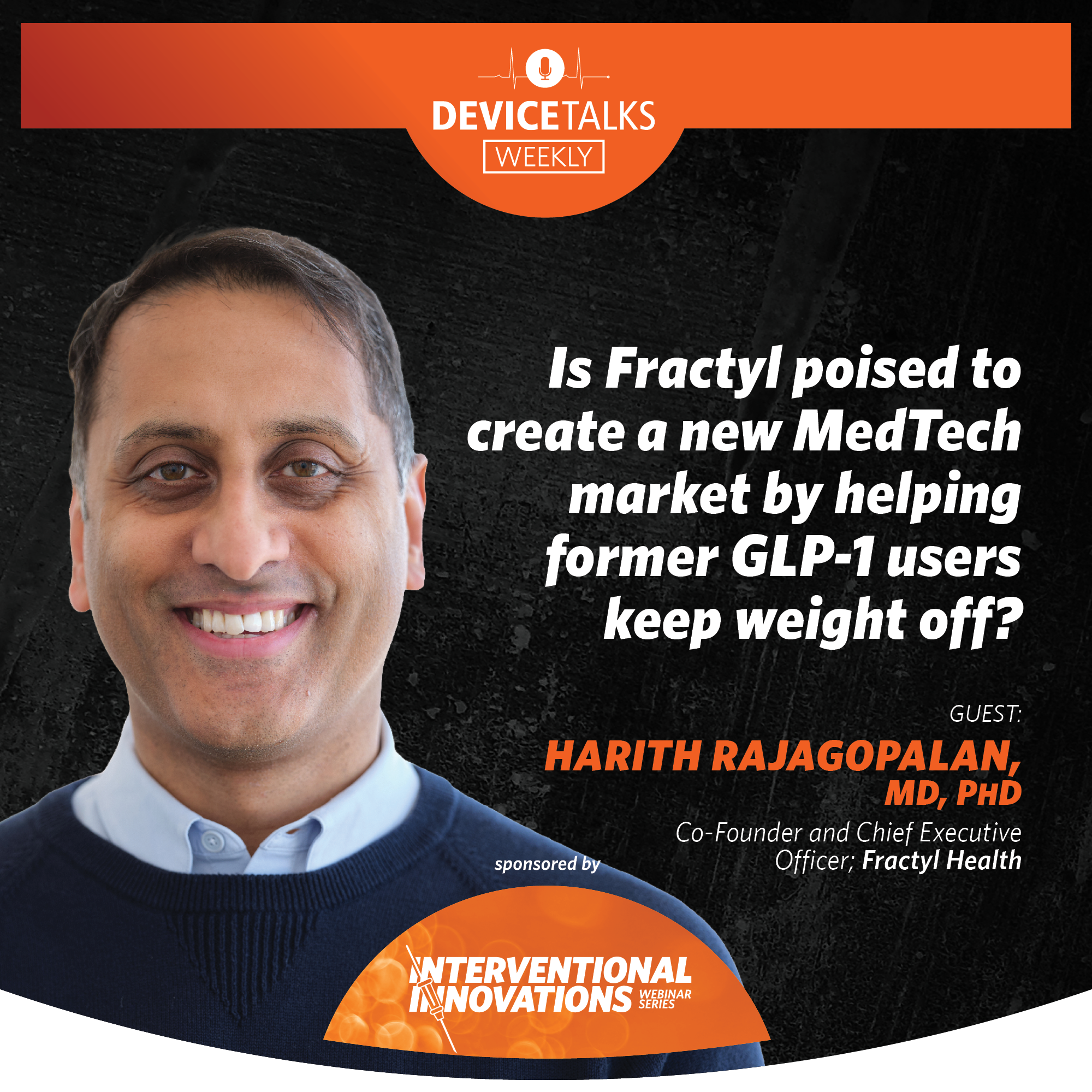
[00:00:22] Speaker A: Hey, everyone, this is Tom Salome of Device Talks. Welcome back to the Device Talks weekly podcast. We have, they call it in the West Wing, they call it a bottle episode. I think one of those episodes you could just sort of take off the shelf and plug it in. This is one of those. I'm at SRS this week, so don't have time to do the newsmakers or the FOMOs, but did want to share this great conversation I had with Harith Rajagopalian. He's the CEO of Fractal Health. Fractal Health has been an amazing company to follow, and they're moving into a potentially enormous space, the GLP1 space, and helping people to maintain the weight loss that they've achieved using GLP1s without remaining on GLP1s. So huge opportunity for Fractal Health. Fractal Health, huge opportunity for other medtech companies as well.
We'll explore Fractal Health's history, its recent redirection, and its future in this conversation. So once again, enjoy this single conversation. No newsmakers, no fomo, Just me and Harith Raja Gopalyan and my inability to say duodenum. I don't know why I couldn't say it, but next time I'll practice. So thanks, everyone for tuning in. Let's get this podcast started.
Well, Harith Rajagopalan, welcome back to the podcast.
[00:01:36] Speaker B: Thank you, Tom. So great to see you again.
[00:01:39] Speaker A: Great to have you back. It's one of the stories I've enjoyed following through the years, and we don't need to go way back. You've been on the podcast a few times talking about your move into medtech, but I think folks would love sort of a brief overview of fractal Health.
You've been around for. Is it 16 years?
Founded in 2020.
[00:02:01] Speaker B: 15 years.
[00:02:02] Speaker A: 15 years.
Give us a brief sense of how it was started, and then we kind of move into some of the directions you've taken as of late.
[00:02:12] Speaker B: Sure. So we started the company with a very simple idea, which is that when we try to treat obesity and type 2 diabetes, we've got solutions that are inadequate in two fundamental ways.
On one hand, you have diets and lifestyles and medications that work as long as you take them, but they're not really fixing the root cause of the disease in the body. And so they stop working when you stop taking them. They're addressing sort of some of the parts of the problem, but they're insufficient. On the other hand, you have bariatric Surgery, which is remarkably effective, but doesn't have a safety and scalability profile that can offer benefit to the hundred million people in the United States with obesity and who are at risk of type 2 diabetes and other metabolic diseases.
So we started with the question, how do you develop something that has the disease modification of bariatric surgery and yet the scalability of both medicines and diets and lifestyle? And that's how we arrived at our approach to trying to target the gut in the duodenum in particular, because it became very clear that there are root cause changes in the gut that are driving obesity and type 2 diabetes. And so by targeting the gut, you'd have an opportunity to be able to change the trajectory of the diseases. That's how we started the company.
[00:03:39] Speaker A: The gut's become sort of a, if you will, a sexy sort of organ to focus on. Some books have been written about it. I think it's getting a lot more attention as to the importance that it plays in the body's health. What are the complications, what are the difficulties of targeting the gut with a device?
Can you. It's not like the heart, where you can precisely target, I suppose, atrial fibrillation.
[00:04:04] Speaker B: Yeah. So, I mean, I would say start by saying that the gut is not even just one organ. The gut is very different along its entire length. The esophagus is different from the stomach, which is different from the small intestine and the duodenum in particular.
So I think number one is you have to think about the differences of the anatomy and what those differences in anatomy require out of your device and your device development. That's number one. Number two is everything that you're doing in the gut, you're either gonna need to access surgically, which means a person undergoing a surgery, or endoscopically, which means everything that you're doing is at the end of a several foot long tube with a camera at the end of it. And so you're operating at quite a far remove from where you're actually manipulating the device, which is outside of the body. And so the second piece of it is you gotta be doing things via catheters that acting distally in, you know, deep within the intestine versus where it's being held, which is in the mouth or outside of the mouth.
So those are two core issues. And now the duodenum in particular is a very thin walled organ. It's highly vascular, it takes a circuitous route around the pancreas and is a organ that you have to be very careful with because the pancreas is right next to it. You don't want to cause any damage to the duodenal wall or to the pancreas. And so all of these features about, like, how do you operate at a distance through the mouth in the duodenum, how do you deliver ablative energy, in our case, in a manner that can be precise and directed directly to the mucosa and the superficial submucosa of the duodenum without causing any damage to deeper structures. And how do you do all of that in a manner that a GI endoscopist can learn to do in less than five cases and feel like it's leveraging familiar skills and ex works within their existing workflow? Those are some of the challenges that we work through. You know, we started by saying we've been at this a long time, which we have. You know, I think it's worth mentioning that when we started, this was a back of the napkin idea in the truest sense of the word. We were observing that bariatric surgery had this profound effect on obesity and type 2 diabetes, and people had very little understanding as to how or why that was happening. It was only becoming clear around 20, 20, 2010, 2011, that the gut may be a root cause of obesity, and that's why bariatric surgeries were working.
And then we entrained our attention on the lining of this first part of the gut, the duodenal mucosa, as a key metabolic signaling organ for the very first time. I mean, when you say we started the company 15 years ago, that's what we started with. The duodenum is a key metabolic signaling organ. And so slowly and methodically, we were the leaders in establishing the science, establishing what goes wrong pathologically from high fat, high sugar diets in the duodenum and then developing a technology that understood the unique challenges of the duodenum in order to be able to develop the technology and then all of the clinical evidence. But we've been at it for a while and we've learned like, some critical lessons that we think are shaping up for an exciting opportunity in the very near term.
Happy to chat with you about, about how we've gotten to where we are today, because absolutely an exciting time.
[00:07:37] Speaker A: But, but, but I just, I'm glad you, you raised the point as to what, what our knowledge of, of the gut and of the duodenum duodenum, what our knowledge of the gut was back back then and, and the role of bad bariatric surgery, because I think people today sort of we, we've. We've get an understanding that as to why some of these things work. But what was it like sort of building out this specialty at the time? Because there's not the work that's been done in other parts of the body. There wasn't the deep well of knowledge or experience. And I don't even know what the clinical.
The clinical landscape was like in terms of the physicians and sort of how they engage with medical device companies and medical device startups in particular. What was that experience like, sort of building out the world of knowledge you needed to even move forward as a medical device startup?
[00:08:34] Speaker B: I guess I would say it's been exciting for me personally to be at the forefront of advancing the science. I find that steep part of the learning curve to be particularly gratifying.
But it's also, of course, challenging for that same reason. I mean, this is not a copycat technology leveraging things that exist, really establishing new science, establishing new technologies, establishing new clinical paradigms. And that has been something that has taken real effort, but that effort has been rewarding as we have seen how all of that has begun to materialize in the evolution of the field.
I would say that where we met GI when we first came to it, and just as a reminder, I'm a cardiologist, and so I had a lot of the benefit of where cardiology device development has gone over the course of the last 20 years or so when I started this company.
But where we met GI was a lot of folks who were quite interested in treating obesity and metabolic disease, already knowledgeable about bariatric surgery, but then taking a mechanical approach to the understanding of the disease and how to treat it. So the approaches at the time, I thought were highly mechanically aimed at replicating aspects of surgery.
The different approach that we took was to ask fundamental questions about what is surgery teaching us about the physiology of the disease? How do you replicate the physiology, but not the mechanics of bariatric surgery? So we honed in on the duodenal mucosa, the lining of the duodenum, not because it's like we wanted to figure out another way to bypass it, but instead because we realized that by bypassing it, surgeons were actually showing us that the lining of the gut plays a key role in regulating metabolism. So is there a different way to alter or to reverse the pathology in the duodenal lining than a mechanical surgical bypass? And what we realized is that there is overgrowth of the lining of the duodenum caused by chronic exposure to high fat and high sugar. Diets. And that overgrowth changes how the body senses the nutrients that we eat and then how the whole body responds to it. It's kind of like an early warning beacon, like a flag that the duodenum is waving saying, hey, you're eating, you're eating a lot of fat and sugar, so you better get ready to be able to process it. That process is not working well in people with obesity and diabetes.
So the very first thing that we showed is that if you can ablate the duodenal mucosa, the body can restore a healthy new mucosa in its place. And in so doing seems to be able to repair the abnormal nutrient sensing and signaling mechanisms that are driving the disease.
And now, like fast forward a decade, we now believe that this is the fundamental thing that goes wrong right at the upstream root cause of why people develop obesity, insulin resistance and type 2 diabetes in the first place. Because it seems to be the very first change that occurs in the body even before people are actually obese.
So what that means is now you have an opportunity to understand what's the very first change that takes place in the body that's causing all of the downstream consequences associated with obesity. Can we fix that and then fundamentally change the trajectory of disease?
[00:12:18] Speaker A: That's amazing. And I know we spoke about, I don't know, 10 years ago or so and I had raised the comparison to renal deriner innovation. At the time, renal derineration had gone through its clinical trial difficulties.
Now it's found its way forward. And I'm just fascinated by the. You opened up saying that this population has been sort of difficult to treat because sometimes they'll take the meds, sometimes they won't. There's a lot of control that the patients have something similar to how the challenges would pulmonary hypertension patients, the challenges they presented for clinical trials.
But now we're seeing renal derineration as sort of this huge potential subset, well, existing and even larger, potentially larger subset for MedTech. And I get the same energy from talking to you that this could be sort of a gateway to treating a number of different diseases. I'm guessing that you see that same thing we do.
[00:13:12] Speaker B: I mean, from our very first days, one of the things that we were motivated by again from bariatric surgery, is that bariatric surgery not only improves body weight, it also improves blood sugar, it also improves cardiovascular lipids and cardiovascular risk. It also reduces obesity associated cancers. It is doing something very, very profound that's not just measured in weight or hemoglobin A1C and it forces the realization that whatever it is in the gut that bariatric surgery is targeting, is actually targeting the upstream root cause of everything associated with obesity and metabolic disease throughout the body. That's a pretty amazing observation because now, without having to undergo surgery, you can leverage endoscopy, the scale of the endoscopic infrastructure that exists in the United States, the skill sets available to endoscopists to target a root cause of the majority of the morbidity and mortality of the 21st century that's associated with obesity and metabolic disease, and to do so in a manner that's disease modifying, which you really don't get. No matter how good the GLP1 drugs are, they don't really fundamentally change the underlying biology of the disease in the body.
Now we can do that for the very first time.
So in our early clinical studies, we saw not only effects on blood sugar, but other cardiometabolic parameters as we get better and better at and more comfortable with ablating longer segments of the duodenum, sort of higher ablation doses, shall we say. What we also began to see is it's not just improving hemoglobin A1C blood sugar, but it is also lowering body weight. And that then led to the realization that we may be able to work not just on metabolic parameters, but, but also on weight parameters. And the combination of that is highly attractive.
[00:15:16] Speaker A: Well, let's take, take us back to a couple of years.
A couple years ago, your primary focus, as you've said, had been type 2 diabetes. You saw this opportunity in GLP1. What was that redirection like? Take us through that process and that decision.
[00:15:32] Speaker B: Sure. I mean, well, as you know, we were in a pivotal trial in type 2 diabetes. The fundamental structure of the type 2 diabetes market in the United is that these, this is a disease that's mainly managed by primary care until those patients become challenging, at which time they often have lost a lot of their beta cell function and require insulin and then often managed by endocrinologists. So this is a disease that is not currently under the purview of GI endoscopists. It's a disease that is sort of existing in primary care and in endocrinology.
Through our work in type 2 diabetes, we observed that patients who underwent the Ravita procedure not only saw improvements in their hemoglobin A1C, they also saw reductions in body weight within about four weeks that were sustained for two years or more. And what's interesting about that is that it's hard to lower body weight in patients with type 2 diabetes. And we weren't asking them to change their diet or lifestyle in any meaningful way. And yet for two years they were maintaining much lower body weights. Just naturally.
That became interesting sort of through this new light of how the world has changed with GLP1s, because now GLP1s are like remarkably effective agents to lower body weight. In some sense they've solved the weight loss problem.
But most people stop taking these medicines within 6 to 12 months. When they do, they regain all of their weight, they lose all of that benefit. So all that hard won weight loss is essentially vanishes when you stop taking this medicine. And so we were approached by players in the large pharmaceutical space who were developing GLP1 drugs and they said we have a weight maintenance problem and we think based on your type 2 diabetes data, you may have a potential solution.
So over a six month period of time, we did a very rapid review of like the post GLP1 weight maintenance opportunity. We went all the way from like seeing all of our data, convincing ourselves that we had an opportunity there, through to discussions with regulators, getting a pivotal trial designed and approved by the FDA and then getting breakthrough devices designation. And then once we started enrolling that study in post GLP1 weight maintenance, that study started to enroll 20 to 50 times as fast at our clinical trial centers as our type 2 diabetes trial enrolled.
[00:18:21] Speaker A: Were you working with the pharma companies that were part were getting people obviously who had been prescribed the glp?
[00:18:26] Speaker B: Well, I think the pharma companies sell medicines and I think they don't really sell devices. And so we did this on our own because we became convinced that it's a large problem. And once we started to see the traction of the enthusiasm from patients to say that they don't want to be encumbered by being dependent on these medicines to keep a lower weight for the rest of their lives, that they're struggling with the side effects or the constant burden of having to stay on this medicine and not wanting to have to do so, but also afraid of stopping them and then losing all of their weight gain, their weight loss, and then talking to primary care doctors who've readily acknowledged that patients really don't want to be on these medicines, and then seeing the extraordinary motivation that the health system has to now shift from dealing with late stage complications of diabetes to really addressing obesity, and then seeing we have a unique opportunity to do so in a durable manner led us to make a very rational decision to pause Our type 2 diabetes program and then focus on running a weight maintenance pivotal study, which is what we've been doing. And I think that these decisions only get evaluated through the retrospective scope. Now we've had two studies with one year of data. I'm hoping we get a chance to talk about it in post GLP1 weight maintenance that really, really show how exciting this indication can be for Rvita and duodenal resurfacing in general.
[00:20:07] Speaker A: Well, let's talk about your recent trial. So I mean I've seen two. I've seen the Remain one trial and the Reveal trial. What are the clinical trials you have ongoing right now?
[00:20:17] Speaker B: Yeah. So there's three trials that we kicked off in parallel when we started this program. One was the Reveal one cohort. These are patients who were.
That's an open label study in people who'd already lost at least 15% body weight on a GLP1 in the real world needed to stop or wanted to stop the medicine for whatever reason. That's an open label cohort. Then we ran a sham controlled proof of concept study called the Remain one midpoint.
And in the midpoint cohort what we took was 45 patients. We gave them Tirzepatide, which is Mounjaro Zepbound, got them to at least 15% body weight loss and then stopped their drug and randomized them to either Revita or a sham endoscopic procedure. We just saw one year data from them, looked great.
And now we have 50 patients across the reveal one open label cohort and the remain one midpoint cohort in the DMR in the Revita arm with one year worth of data showing a very consistent picture of durable weight loss maintenance after the discontinuation of GLP1 medicines, where
[00:21:28] Speaker A: are the trials being conducted?
[00:21:30] Speaker B: Those two trials are essentially open label and proof of concept sham controlled, leading to the pivotal cohort of over 300 patients.
Similar design to the proof of concept study. And that pivotal study is reading out in early Q4. So a lot of data being generated in a very, very short amount of time, reflective of the magnitude of the opportunity and I think the scalability of the opportunity as well.
[00:22:01] Speaker A: And I'm sorry, the locations of the
[00:22:03] Speaker B: clinical trials are there, all United States sites for these three studies and so centers across the United States.
[00:22:11] Speaker A: How it sounds like a massive undertaking to have that many trials going on at the same time. After the decision to sort of redirect a few years ago, what has that process been like over of getting these clinical efforts underway? You mentioned earlier on the attention that the patients have shown for the trials and their eagerness to be part of it. What have the past two or three years been like enrolling these trials?
[00:22:38] Speaker B: Whenever you make a strategic reprioritization like we did, you owe.
There's a lot of people whom we depend on, investors and patients and advocacy groups and physicians. We owe an explanation for why we're making such a shift.
And we sort of, we spent some time explaining to folks that we can remain committed to helping with the type 2 diabetes problem.
But there is a unique opportunity now for us to be able to intervene in a disease category that is brand new, never existed before and has no approved therapies at all. You know, post GLP1 weight maintenance is the largest orphan disease you could possibly imagine because there are a million people a month in the United States who are stopping GLP1s and most of them regain almost all of their weight over 12 to 18 months afterwards and they lose not only the weight benefit but also all the hemoglobin A1c and other metabolic benefits. And so what, what we have is a group of people who are absolutely ripe for a disruptive solution and who are eager for it. And so the alignment of like the cost offset from the GLP1 medicines, the payer's desire to help treat obesity but not have a lifetime payment stream to the GLP1 manufacturers, patients extraordinarily strong desire to live a life at a lower wage free of medications, the market's realization that there's nothing that exists for these patients and critically the GI endoscopists ability to truly own this disease category without needing the permission, shall we say, of endocrinology community, like in type 2 diabetes really presented, I thought an extraordinary opportunity. Now you also mentioned the renal denervation studies. You may know that in renal denervation they ran trials on Med and OffMed. You know, their OnMed trials had all sorts of medication adjustments throughout the trials. OffMed was a clean design where patients were not on any medicines, allowing you to really have a very good clear focus on efficacy. Well, one way to think about post GLP1 weight maintenance, it's kind of like our version of an off med study because you sort of get people to lose weight and then you stop their medicines and now all you're able, now you're only, only isolating the treatment effect
[00:25:19] Speaker A: in R.
Is our lifestyle taken into consideration as well? Are they asked to diet, asked to track intake of food or anything like that?
[00:25:30] Speaker B: Yeah, in all of these three studies we have a very standard moderate diet and lifestyle Program, something that most patients with obesity would be told to follow.
500 calorie deficit every day and a regimented exercise program.
The dietitians in the study, in the blinded studies, do not know whether the patients underwent the Rubeda procedure or sham. And so therefore they are blinded. They're providing like essentially the same advice regardless. So it's the same in both arms.
[00:26:02] Speaker A: Talk a bit about the procedure, if you would, and the technology required for duodenal mucosal resurfacing.
You use just hot water. I mean, you're not using RF or any sort of hot energy. It's a very specific approach.
What first, is the procedure physically light, and second, perhaps we can talk about how what you do impacts the tissue down there, how the ablation occurs.
[00:26:31] Speaker B: Yeah, so RV is a single use disposable catheter and a control console that is outside of the body that has sensors that are regulating and monitoring during the procedure, during the entire time. The business model is a razor, razor blade business model. So we would sell the catheters on a per use basis and the consoles would be sold, placed or leased at a hospital or outpatient setting.
And it's a single outpatient procedure in a standard GI endoscopy suite, leveraging existing endoscopy tools, skill sets and workflow.
And the way that the RITA procedure works is by essentially a two step procedure where the first step is the, after the delivery of the catheter into the duodenum, it's a single submucosal lift, circumferentially, that's automated, that creates a saline cushion between the mucosa that you wish to oblate and the muscle that you don't want to damage. And then hydrothermal ablation that causes denaturation of the proteins in the mucosa and the superficial submucosa so that the mucosa then dies in a very programmatic, careful way. And then those cells then get sloughed off and are passed in the GI tract over a course of two to four weeks. Afterwards, the new mucosa grows back.
It does not appear to grow back with the same pathology that they had from the high fat, high sugar diets beforehand. And so the cellular density is reduced. And in animal models you see a normalization of the structure and functional integrity of the duodenal mucosa compared to the high fat fed mice that underwent the ablation.
So the experience of the patient, I think, is also one that we've thought a lot about, because really all you're asking someone to do is to commit half a day to coming into an endoscopist's office after not having eaten anything after dinner the night before, under propofol or general anesthesia. You undergo this procedure, nothing is left behind in the body.
In our recent randomized trial, the number of adverse events was equivalent in the RM and the sham arm. That means there was no signal of adverse events, and they were in both arms. They were mild symptoms lasting about two days when they occurred, but most patients didn't experience any symptoms at all.
So we're very proud of the safety and tolerability profile that we've accrued over hundreds of cases so far. It's not accidental. It's really by design. The way that we've built the semicosal lift, the way that we've chosen our energy, has all been very, very purposeful in order to ensure that it provides an optimal experience for patients and for the physicians who are performing the procedure.
[00:29:50] Speaker A: So how are you looking at the next few years? What are you preparing for? You did go public in 2020.
I'd love to sort of take a moment to just talk about that experience.
As you're redirecting your clinical programs, you're also selling your stock to public investors. How difficult was that?
[00:30:11] Speaker B: Well, pre commercial medical devices have a hard time getting public in the United States. But luckily we had a very strong and committed set of investors who were able to help us go through that process.
I think that where we sit now, everyone is very much focused on the pivotal data that we have coming in early Q4, the results of which will, if they substantiate what we've seen from the pilot data, I think really set us up to begin to prepare for a substantial commercial opportunity ahead.
[00:30:47] Speaker A: And you do have the great ticker of guts, which I think is great.
[00:30:50] Speaker B: The ticker is guts. Exactly. It just works on so many different levels.
[00:30:53] Speaker A: It does.
And I see that you brought aboard a new market access and commercial strategy. Senior Vice President Mike Zumdal. So what is this commercial strategy? I know he just started a few six weeks ago, but what does this strategy look like? Do you see this as something you're going heavily into ASCs? Is this a larger clinical hospital sort of setting?
Who are your future customers once you hopefully secure FDA approval? And I don't want to get too far ahead of us, but I just love to know what the new world looks like.
[00:31:25] Speaker B: Yeah, I think the right way to think about this would be a Center of Excellence model, one that replicates a lot of what we've been doing in our pivotal trials.
And so we anticipate a targeted and efficient launch at centers of excellence across the United States, many of whom we already have very strong relationships with, either because of their clinical work that they've done in our studies or just because of relationships that we've built along the way.
And I'm very proud of the relationships we have with the GI doctors because I feel like we've been co creating this field of metabolic endoscopy together for the past several years and sort of learning how about not only the device development, but also the clinical development and how that translates to the market development. That will be an opportunity here to help a lot of people.
So within a targeted sort of center of excellence model, we'd be focusing on hospital outpatient endoscopy centers, and we will be building a patient journey. One of the exciting aspects of how this technology has been maturing is to see that GI endoscopists are already claiming a clear pathway in obesity management themselves. Many are already prescribing GLP1s, and I think they recognize that almost nobody wants to be on the GLP1 for the rest of their lives if they don't have to. So I think there's a ready population of patients who are already in GI clinics or GI practices who are getting GLP1s today who would be eager for this if it were available.
[00:33:05] Speaker A: And what about the payer community? I imagine there you've been contacting a few of them as well. They must be optimistic.
[00:33:13] Speaker B: You know, it's an interesting time right now, because you may or may not know this, but CMS recently initiated its bridge program for GLP1s just on July 1, exactly three weeks ago. And what the Bridge program is intended to do is to expand access to Medicare beneficiaries to GLP1 medicines for weight loss above and beyond the people who already had access to it. And what I'm understanding from physicians is that this has been something that's been working very well and is expanding access very rapidly. What that implies is that there will be a lot of people in the Medicare age who will be on GLP1s this year.
And about a year from now, I think many of them will be looking to find an off ramp. We believe that RVITA offers that potential off ramp. So if you'd asked me two or three years ago, I would have said from a payer perspective, this might have to be focused on commercial payers. But given the fact that we've just had a new Change in cms.
We think that this is something that affects not only the commercial payers, but also the Medicare population. And I think there's a particular unmet need in the Medicare population for GLP1 Ofram because these medicines are known to be associated with muscle loss and frailty. And you can imagine that that's of greater concern in elderly individuals who are otherwise have other comorbidities.
And so we see an opportunity to be able to provide some real value, to be able to help patients who may be needing to not be on these medicines. And our conversations with CMS and with commercial payers is suggestive of the fact that there's a broad widespread recognition that obesity should be treated, but that GLP1s for life may not be the right answer for most.
[00:35:10] Speaker A: Does the off ramp, the attractiveness of the off ramp or necessity of the off ramp change if GLP1s as they become available in different forms and pill forms and other. Or are the side effects that you just mentioned, are they something that present no matter how the drug is delivered?
[00:35:28] Speaker B: Yeah, I mean, the downsides of the GLP1s are inherent in the mechanism by which they work.
So the GI side effects are actually probably pound for pound worse with the orals than they are with the injectable.
And I really don't see anything on the near term horizon that can offer the profile that Rivita offers, which is durable weight maintenance with a really excellent safety and tolerability profile in clinical trials so far that can also offer durable weight maintenance. And even though I think some of the new orals that are becoming available that people are talking about and the monthlies are going to provide more options for more people to start the GLP1, I think all of them are still at high need of an off ramp. Regardless of what your on ramp is, we are thinking we're going to be the only off ramp that's really going to be available potentially.
[00:36:27] Speaker A: And final question, just help me understand the future potential competitive landscape. Are there other companies out there that offer a technology similar to yours that could be used in the duodenum as you do once you open up this market?
As I said earlier, this isn't a place for heat energy, for more intense energies.
Is this an area you expect to have exclusive hold on in some form or fashion?
[00:36:54] Speaker B: There are other technologies in development. They're not as far along as we are. You can imagine, given the size of the market opportunity, given the quality of the science and clinical evidence that we've been generating, that this is going to be interesting to a lot of people to want to participate. And candidly it's too big of an opportunity for any one company to be able to build on its own. And so we welcome the fact that there's an entire field forming around our early insights and our leadership.
[00:37:28] Speaker A: And do you and I know I think I said that was final question, but I always have one more is type 2 diabetes still on your to do list? Do you expect that you'd like to once this is hopefully settled in your favor, do you expect to go back to that? Is that become even necessary? Or do you sort of help that population by helping this population?
[00:37:47] Speaker B: So I have three answers to the
[00:37:48] Speaker A: question, but it was only a two part question.
[00:37:50] Speaker B: I don't understand how it's a two part question with three answers. The number number one, within the weight maintenance there's a large fraction of patients who are pre diabetic with obesity. And I am particularly intrigued by the prospect that by helping people maintain body weight loss we may also be able to prevent them from going on to develop type 2 diabetes within this patient population alone. So we'll be watching for that in the years ahead. Number two, I told you that we paused our type 2 diabetes program. We did not arrest it or killed it, but we do look forward to coming back to that with Rvita. And as we build and expand the market opportunity for Rvita in let's say a lower hanging fruit like post GLP1 weight maintenance, I think that the virtues and the benefits on the metabolic effects will become clear and we can begin to bring more patients in. Not just type 2 diabetes but also potentially patients with metabolic fatty liver disease.
Third, we have a second product candidate in development called Rejuva which is a one and done GLP one delivered endoscopically by the same physicians who would do revita directly into the pancreas with a one time administration of an AAV9 gene therapy that we think could have potentially long term curative effect or remission of type 2 diabetes and that just got cleared by regulators in Europe to begin a first in human study in type 2 diabetes.
So we are going to begin to see preliminary patients dosed and very early data in this half of this year. So like in the coming months from that program.
So my three answers are within weight maintenance? Yes, within rvita in type 2 diabetes indication. Yes, we will come back to that as well. And then number three, there may be a really compelling option with our Rejuva program for a potential remission approach to type 2 diabetes with a pancreatic smart GLP1.
[00:40:00] Speaker A: Amazing. Well, it's always exciting to see a new field of medtech open up. I'm very glad you're leading the way. Hyru, thank you for joining us on the podcast.
[00:40:09] Speaker B: Thank you Tom. Great to see you.
[00:40:13] Speaker A: All right, well that is a wrap. Thanks again for joining us on this episode of the Device Talks Weekly Podcast. Please subscribe to the Device Talks Podcast Network or Device Talks Weekly Podcast. Either way, you'll get this podcast episode or many like them sent to you in the future. And you'll also, if you just subscribe to the Device Talks Podcast Network, get our other amazing podcasts as well. Connect with me on LinkedIn, connect with Kaylene Brown, connect with Chris Newmark, and make sure you follow LinkedIn and mass device so we can be part of your future medtech conversations. All right folks, thanks again for listening in to the DeviceVox weekly podcast.