Episode Transcript
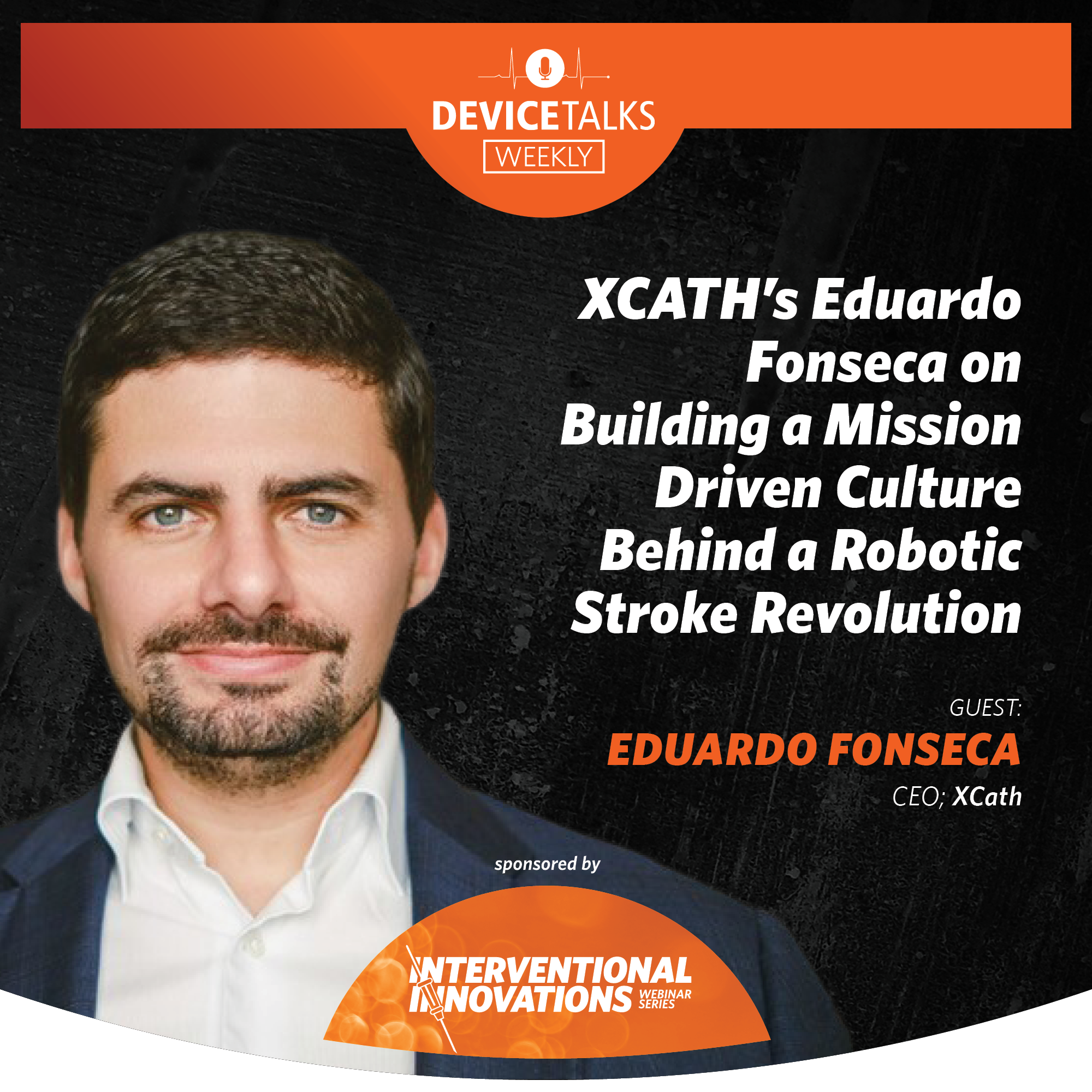
[00:00:00] Speaker A: Hey everyone, Tom Salemi here. Welcome back to the Device Talks weekly podcast. Yes, yes, yes. It's another great episode coming your way, Chris. Newmarkers back. We'll kick things off with the Newmarkers newsmakers and then we'll delve into a conversation I had with Eduardo Fonseca. He's the CEO of xcaf. XCAF made some news late last year when it announced that it had its ISIS system had been used in the first 10 telesurgery stroke treatment. And we'll talk a bit about that with Eduardo in the conversation. I mean, clearly stroke is an area, I think, where surgical robotics can do a great deal of good. It can provide care for millions who aren't able to receive it right now, who are just not close enough to the talented neurologists and neurosurgeons and interventionalists who perform these procedures. So great work being done by xcath and we're going to unpack what they're doing, not only here on the podcast, but a little later this month if you want to see what they're doing. If you want to ask your own questions, you can join us at Device Talks Tuesday's Interventional series. I'll be leading a conversation with Eduardo Fonseca. It'll be live. You can ask your own questions. He'll be giving a presentation on what XCATH has been working on, what its IRIS surgical robotic system is capable of.
And this is one of our great webinars. Again, you'll be able to ask your own questions, you'll be able to be part of the conversation and you can follow up on some of the things we're talking about here.
That Interventional week is brought to you by our great sponsors, Confluent, vitalpath, Jabil, Maxon, Solisis and Aviant. And it's one of right now two presentations that are going on that week. I'm trying to lock down a third. In addition to to xcath, you'll hear from another semi recent guest to the podcast.
Wayne Allen of Profuse will be on as well.
And we'll be talking about Profuse's stroke technology. So I went with the stroke flavor for at least two of the interventional presentations.
Excited that both of these gentlemen have agreed to talk to me again. That's always a plus.
And to make themselves available to you for questions as well. So. So if you want to be part of these conversations, go to devicetalks.com to register for those Device Talks Tuesday sessions. Once again, the entire week is brought to you by our great sponsors, Confluent, Vitalpath, Jabil, Maxon, Solisis and Viant.
All right, without any further delay, I think those are really the things we'll need to talk about. Actually, you can join us this coming Tuesday. We've got another Device Talks Tuesday presentation coming up that I'm sure you'll enjoy. You can find information about that as well@device talks.com. so without any further delay, let's kick off this episode of the Device Talks weekly podcast.
All right, you ready for this?
[00:03:07] Speaker B: Ready,
[00:03:27] Speaker A: Chris Newmarker. How are you, sir?
[00:03:29] Speaker B: Hey. Doing well, Tom. Doing well.
[00:03:31] Speaker A: It's been so long.
[00:03:32] Speaker B: I know, man. Well, you know, had a. Had a big. Had a big vacation. Some good rest and relaxation. So I'm tanned, rested, and ready for what we got.
[00:03:43] Speaker A: Give us the audio slideshow, my friend. Where'd you go? What'd you see?
[00:03:46] Speaker B: Oh, my gosh, we stood. Well, you know, I had a big milestone birthday. Birthday.
[00:03:50] Speaker A: I'm turning up 39.
[00:03:53] Speaker B: 39. It was my 39th birthday.
[00:03:56] Speaker A: Your 11th 39th birthday. Yes. Congratulations.
[00:03:59] Speaker B: Exactly. My wonderful wife planned a big trip for the family. So we did a nice good two weeks, one week on the Big Island.
Highlights included seeing a kilauea shoot lava 700ft into the air. That was fantastic.
[00:04:13] Speaker A: Very cool. This is in Hawaii. I don't think we've established.
[00:04:16] Speaker B: We did Hawaii, so we did the Big island and then we did Maui. And so it was.
Yeah, it was really fun. It was a great experience for the kids.
I mean, I'd never been to Hawaii, but I always heard the beaches, everything was beautiful, and it was.
[00:04:31] Speaker A: That's great.
[00:04:32] Speaker B: Just really fun.
And then actually we kept the traveling going and had a nice long weekend for 4th of July with some cousins in Chicago. So very cool. That was great as well.
Including.
Have you ever been to the Science and Technology Museum in Chicago?
[00:04:51] Speaker A: Yes.
[00:04:53] Speaker B: I'd been there as a teenager and I had a vague memory of the U boat there.
Did you check out the U boat when we were there?
[00:05:02] Speaker A: I'm pretty sure we did. I actually went to Chicago for my 50th. We didn't go to Y. Went to Chicago. I saw Hamilton. This is a few years ago, Hamilton. They had the museum, the Hamilton Museum set up there, and we visited all those museums along the. Along the lake there, which is a cool little place to pop around.
[00:05:18] Speaker B: Yeah, I swear, I had some really cool memories just of how cool that U boat was. And my kids thought it was extremely cool as well. So that was very cool as a
[00:05:30] Speaker A: 1-2U boats are creepy as heck.
[00:05:34] Speaker B: It's the only one that survived the war.
[00:05:36] Speaker A: Wow.
[00:05:37] Speaker B: And we captured it.
It's a war monument. We captured that. The United States captured that u boat in 1944 and secretly towed it to Bermuda. But then after the war, the commander who.
Naval Command, who had captured the boat, he was from Chicago and, you know, the US Was going to scrap it, and he was like, hey, I think the Science and Technology Museum in Chicago would like to have this, so, you know, you can go. And I had a vague memory.
And the tour guide mentioned this too. Like, back in the 90s, when I was a teenager, I saw this.
There was, like, a German guy, German American guy who was showing you around the U boat. And he was one of the people who served on the U boat.
[00:06:18] Speaker A: Oh, no way. Really?
[00:06:20] Speaker B: Yeah, he volunteered. I mean, you know, he passed away years ago, but, I mean, he. He was a pow. It's how great the US Was and end up eventually, like, living in Chicago and volunteering to show people around the U boat. So. Because I remember, like. Like have, like, you know, my. My dad was in the group. It was like, like, oh, you know, that's really interesting. They did. Blah, blah. Yeah, well, we did this and this. And my dad was like, it's like, oh. I mean, I served on this. And like, when I was like, oh, no, no kidding.
[00:06:50] Speaker A: My grandfather was a merchant marine, and he was torpedoed by a German U boat off the coast of New Jersey in, like, 1942, 1943. The Lemuel Samuels, I think, was the ship. And he was in the water, and the U boat came about and was looking for officers. And, yeah, there was a lot of that going on right off the coast.
So they are terrifying pieces of war.
But to walk through them to see how people, like, live and just. I could never do that.
[00:07:27] Speaker B: That's the sleeping by the torpedoes.
I guess they didn't have baths while they served on there. I mean, they were all. It was pretty.
I did like, they dove so fast because when they'd have an alarm that they needed to submerge, all the 50 dudes on the boat would run in the front and jump on top of each other.
That just sounds gruesome.
[00:07:52] Speaker A: Oh, wow.
All right, let's roll on to the new.
[00:07:57] Speaker B: People are like, these guys are just. What the heck? It's like, you're sitting. I'm sitting at a barber shop or something. Anyway, number five on the list. This actually just came out yesterday. We're talking On Thursday, like our associator, Skyler Rivera has a really nice summary on medical design outsourcing of, of like the highlights of the MDUFA, the draft MDUFA 6 agreement. Um, it's, it's, I mean, as I was saying on LinkedIn, it's kind of, it's a wonky subject, but it's really, it's really important for people in our industry because I mean, this is, you know, this is really like kind of, I mean it's an interesting, such an interesting system that because, you know, like FDA regulation of medical devices is paid for by Congress. Congressional, congressionally mandated fees that our industry gets to negotiate with the fda. Kind of like on what kind of new programs could we have, how could we like, you know, have regulation that speeds up innovation while still maintaining safety?
And you know, so it's really important to kind of like, you know, like, okay, great, we've got the sixth iteration of this now that's a draft that, you know, is going to eventually get submitted to Congress and to see what some of the highlights are is just really important.
[00:09:20] Speaker A: This is still in a draft format, right? There's still an opportunity for comments before it goes to Congress. But no, I think you're right. It is kind of wonky. But MDUFA is what gave the industry a lot of leverage during the whole DOGE experience when jobs were cut and then a came to realize that no, absolutely, these jobs are paid for by industry.
And if the government is going to regulate an industry as closely as it does and as it should, the medtech industry, then it should responsibly use the dollars the industry is paying toward getting devices to market. So. Nope. Glad that there's a movement forward on mdufa.
[00:10:02] Speaker B: Yeah, I love to hear that the draft has a faster pre submission track.
Trying to get like earlier communication for de novo applicants. And there's also like a kind of like what they're calling an international harmonization pilot program. But I mean, I mean, just like, I mean I've been covering the industry now for over a dozen years. You always have like, oh, we went and got FDA approval, now we're getting Europe approval or maybe you got Japan approval first. I mean the, yeah, like kind of the FDA kind of moving more toward like, oh, you know, let's try to harmonize how things get approved here versus like other countries. Other countries in the world.
That looks highly valuable as well. It should hopefully help focus regulatory strategies more for medtech companies.
[00:10:48] Speaker A: And it looks like there's also an international harmonization pilot program in which the same device with the same intended use could be submitted simultaneously to the FDA and other device.
[00:10:59] Speaker B: Exactly.
[00:11:00] Speaker A: Regulatory bodies, anything about sort of reimbursement and sort of getting moving forward to kind of having. Here we go. The draft agreement also proposes a total product lifecycle advisory program, the TAP program, into a full program that will cover all product areas. In the new agreement, the TAP program will feature more engagement between the FDA and CMS for technologies with potential new coverage determination. So no good news all around. It's got a little bit of everything. So I think as we've seen, the FDA over the past decade or so has been a lot more amenable to work with the medtech industry and it seems as if that continues. So great news.
All right, Chris Newmarker, what's number four?
[00:11:47] Speaker B: Number four, unless we have more private equity moves in medtech, a lot going on.
Definitely a growing trend overall over the years, private equity has been very active in the contract manufacturing supplier space for the industry. But recent years I'm just seeing private equity getting more involved with the OEMs as well.
We have news that ResMed will sell its Metricare software business to a private equity firm, Fraser healthcare partners, for 490 million doll.
And then meanwhile, we've got GTCR saying that.
Private equity firm GTCR is arranging for Corza Medical to sell its biosurgery business unit to another private equity firm as well.
So I mean that's, yeah, that's EQT is going to be the buyer.
So, yeah, just some more private equity moves in the industry.
[00:13:11] Speaker A: Absolutely. No, it's interesting stuff regarding Corza and Takasil. I mean, Takasil was a big part of the origins of Corza was one of the principal things that had been built out, that Corza had been built around, had been licensed from Takeda initially, just got the rights to the business, ultimately bought the manufacturing plant.
And interesting that it grew into such a business that it was seen as something that could stand alone. And I think even more interesting that it wasn't sold to a metal device company. It was sold to yet another private equity firm. So it's private equity upon private equity. So I mean, this is what private equity does. It finds efficiencies.
It moves more nimbly than corporate company's mind. It doesn't have to answer to public investors. It doesn't have to meet expectations. It can just kind of look at the numbers and make a decision.
So now interesting news there. And yeah, the resume news was also interesting. I mean the MatrixCare software.
I never could get kind of specific numbers on their revenue, but it looks as if MatrixCare was kind of lumped into ResMed's larger software offerings and that business as a whole was growing less quickly or at a lower pace than its medical products. So, yeah, ResMed is like a lot of other medtechs are moving into higher growth opportunities and private equity is there, in this case Frazier Healthcare, which is a longtime healthcare investor stepping up to take that company. And then they do a lot of great work in the services space. So that'll be a good home for, for MatrixCare. All right, Chris Newmarker, what's number three on the Newmarkers Newsmakers?
[00:14:54] Speaker B: Well, number three on the list we have actually yet another higher up executive at Medtronic leaving the company. Our senior editor Sean Hooley caught the news on LinkedIn that Medtronic's chief sustainability officer is leaving his role at Medtronic, though. I mean, I would say that with Raman Venkatesh, like he was saying on LinkedIn when he was announcing that he was departing, that.
He was wishing he was talking about a strong foundation in place for sustainability in Medtronic and wishing his team continued success on this important journey. So, I mean, that definitely sends the message that Medtronic is going to continue to focus on sustainability as a goal. But to me at least it just kind of like just plays into this trend that we've seen a lot of changes in upper executive ranks at Medtronic in recent years.
And at this point we kind of have it's interesting that the industry now has kind of like former Medtronic executives all around in new positions, all these different companies.
So it kind of reminds me of the way GE was in the past, that we had kind of had GE executives and a bunch of different, different places in the industry in the past. And now we kind of have this Medtronic diaspora, you know, with, with kind of like all these Medtronic things that they learned that are now, you know, being being brought to other companies.
[00:16:32] Speaker A: Sure. Yeah. No, it's going to be interesting to see. I mean, obviously we saw Bob White moving over to Olympus after leaving Medtronic and bitching to see if, if and where Brett Wahl winds up. So, yeah, yeah, lots of, lots of changes over there. Very, very deep management bench. All right, what's number two on the Newmarkers newsmakers? Chris?
[00:16:52] Speaker B: Hey, number two on the list. This is from last week, but we took a hold on Newsmakers for a week. As of July 4th so we've got Zimmer Biomet making another tuck in acquisition. They're going to pay $140 million for the levera nerve therapy tech from Pasira Biosciences. So we've kind of had a, you know, a roll of stories of Zimmer Biomet doing tech and acquisitions and it continues.
[00:17:19] Speaker A: Absolutely. No, and it's, it's an interesting space too because also today you had on mass device and we're recording this on Thursday, a deal between Kinematic and Whoop.
They're combining forces to create a kind of a post operative recovery service called Restore again trying to help patients, orthopedic patients postoperatively recover more quickly, have their, their performance track more closely, give physicians greater insights on how they're getting up and about.
So between that and the deal with Zimmer Biomet which is more of a dealing with cutting off the pain receptors, numbing the pain receptors. So folks post surgery don't require opioids or other painkillers as much.
Definitely makes a lot of sense. I mean it's part of the bigger economics of healthcare now where hospitals are paid for the sort of the single procedure. And then these companies are going to have to find ways to make their implants work better and to make sure surgeries are more effective. So interesting pairing of a couple of deals for sure.
[00:18:27] Speaker B: Yeah, I mean definitely with all of Zimmer Biomet's like orthosurgery and other surgery products. I mean it makes, yeah, the deal makes a lot of sense. I mean it looks like a good, good technology to kind of like add to all of Zimmer Biomet's offerings that you got like okay, this non drug pain management.
Absolutely device. So yeah, really cool news. And then number one on the list we've got another dual energy ablation system entering the US market after Johnson Johnson received FDA approval of its dual energy thermo cool smart touch SF platform.
It's you know, like, I mean kind of like, you know, JJ's part of this other group of like big med techs including Medtronic and Abbott that you know, kind of kind of betting that even as pulse field ablation, you know, just grows so much and has so much potential as this technology to treat afib while like avoiding you know, some of the possible side, you know, side effects or challenges that came with RF ablation that you know, electrophysiologists will still like. Like having like systems where you of toggle between PFA and RF and kind of try to find that kind of secret sauce to better treat AFIB on the heart.
[00:19:52] Speaker A: That's interesting. Yeah, you're right. We've kind of been looking at PFA as something that's gonna take over, but RF certainly is still holding on.
I sort of saw this as a surgeon would choose one or the other sort of going in. Do you think there is a toggle where in some cases the, in the same heart during the same procedure, RF may be the better approach and then in other cases it may be pfa. Do you think that's how it's going to be used?
[00:20:18] Speaker B: Yeah, I mean, absolutely. I mean J and J's like said that, you know, the platform will, you know, provide electro electrophysiologists with kind of this ability to switch between RF and pfa. So, you know, it's.
Yeah, it's kind of, it's kind of neat that you can, you know, kind of like, you know. Yeah, exactly. Kind of like toggle between, between those. So isn't just like this is going to be an RF procedure and this is going to be an ab, you know, PFA procedure? I mean, I mean I, this is just maybe an educated guess, but maybe it's, you know, you know, it could even be a situation where like maybe, maybe you go in and do a PFA and. Or like, I don't know, I'm not unsure about the results of that. Let's, let's just follow this up with an RF perhaps, you know, just to make sure we got the job done, you know, so, I mean that, I mean, I could see an electrophysiologist liking that option potentially.
[00:21:16] Speaker A: Absolutely. I mean, flexibility is always, I think, welcome and folks would want the choice. And I think as digital imaging and visibility and all the data platforms get better and better, electrophysiologists will have a clearer idea or vision of what will be needed. So, interesting release or interesting news by jj it's going to be. I'm looking forward to watching sort of how this plays out on the market.
[00:21:42] Speaker B: Yeah, absolutely. I mean, yeah, I mean we've seen it with Medtronica Fera too. You know, is that kind of that being able to switch between, you know, Abbott's been working on something Boston Scientific, at least a few years ago they were kind of said like, no, we're, we're like gung ho, just moving to PFA systems. But maybe that talk has changed. That'd be interesting to check back on that as well. But as a journalist, I love covering competition, but I also do believe that competition really can help spur innovation. So, I mean, it's going to be fun to watch where this goes.
[00:22:23] Speaker A: Absolutely. All right, Chris Newmercher, well, good to have you back. Thank you to Skylar Rivera, Sean Hooley and Jim Hammerand for filling in while you were gone. I think each did an excellent job and I think brought some new types of conversations to the newsmakers, which was fun. That's awesome. You got a great team there.
[00:22:41] Speaker B: Chris Newmarker, I know I'm a fortunate person. It's really awesome. It's great to work with you too, man. It's awesome.
[00:22:48] Speaker A: Same here, man. Talk to you next week.
[00:22:50] Speaker B: Talk to you next week.
[00:22:51] Speaker A: All right. Great to have Chris Newmarker back on the NEWMARKERS Newsmakers. Now it's time for our keynote conversation. Once again, I spoke with Eduardo Fonseca. He's the CEO of xcath. And if you want to follow up on my conversation with Eduardo, you can join us on July 29th.
He'll be part of our Device Talks Tuesdays Interventional series. It's our webinar platform. You can ask questions through me. You can submit your questions and be part of the conversation. Eduardo will be giving a presentation as well. Go to devicetalks.com for that. And again, that entire series is sponsored by our great the great folks at Confluent, Jabil, Solisis, Viant, Maxon and vitalpath. So without any further delay, let's kick off my interview with Eduardo Fonseca, CEO of XXT.
Well, Eduardo Fonseca, welcome to the podcast.
[00:23:48] Speaker C: Hi Tom, thanks for having me. Really appreciate it.
[00:23:52] Speaker A: Great to have you back. Actually, I know we've connected it previously, but the space you're in, surgical robotics and stroke treatment, I think, is probably one of the more interesting spaces out there in medtech.
Certainly the larger laparoscopic systems are getting a lot of the lion's share of the attention. But stroke, I think is going to be an area that we'll be talking about for many years. And I think it's going to be an area that's really going to be a game changer and save a lot of folks lives. And you've had some recent experiences of that, which I'd love to delve into.
But before we get into Ex Cath's and Iris story, I'd love to just remind our listeners a bit about your background. How did you find your way into the medtech industry?
[00:24:37] Speaker C: Yeah, well, I'm actually a banker by profession. I found myself being a diplomat, then on the board of medical device companies and now have the honor and pleasure of running two of them, Xcath and EndoQuest. So the story is they both spun out of the University of Texas's microsurgical lab. Incredibly talented engineers, as you could imagine.
And those core team of engineers are still with us after well over 11 years. So it's been quite an amazing journey for these companies. And it seems to be that there's this crescendo building of the possibility of increasing human longevity and really creating an impact in entire communities because of the power of these technologies.
[00:25:24] Speaker A: Take me to the moment where you ceased being primarily a diplomat and banker and moved into medtech executive.
What was the kernel of excitement that convinced you to take on these roles?
[00:25:40] Speaker C: Well, I think physician excitement really is what drives it.
So that was the initial driver. You're somehow in the intersection of the absolute leading edge of medical technologies and at the same time medicine. And when we deal with physicians and they're just convinced of the power of these technologies, you know, it's hard not to get enthused and really excited about what it could happen. And then you speak to the technologists that, you know, make it happen. And at the same time, somehow the AI revolution came in the middle of it.
And I strongly believe, if you ask me today, you know, if you look at 10 years from now, what is the value of robotics? It is the way to put software in between a surgeon's fingertips and end effectors. So as AI develops and creates more and more value, robotics stands to capture that value. So it's really future proofing the future of medicine. So it's an incredibly exciting time.
And obviously the AI revolution touches on everything from development to the actual procedure.
So that I guess was the initial driver, the ability to manage high performing teams.
And we've developed our own quasi culture of incredible focus. So I would find it hard to believe that you ask any of our team members and their primary focus in life is not bringing these technologies to market.
We do extensive psychometric testing to ensure cultural fit and obviously a very high intellect. So we have our own process of making sure there's a good fit that's led to very low attrition in the teams, which is wonderful, but more beyond that. So I guess that was the initial driver, the management piece, the challenge, the puzzle, bringing the three different stakeholders, the physician, the business folk and the engineers together and really creating that healthy confrontation of ideas.
And.
And then you fast forward and then there's the patient. And that's just such a powerful driver and motivator for anyone when it's not at arm's length.
We did the stroke case.
Case finished. I'm having dinner with the family and the patient himself is thanking our team for giving him a second birthday. There's just.
I can't think of more powerful moments in life than that.
[00:28:23] Speaker A: Well, I'll look forward to getting. Unpacking that and getting more details there.
Two things I wanted to explore, though, with you. The AI revolution you spoke of for us, for most of us out in the real world or the general world, you're looking at two or three years ago when things really started to catch fire. When did your AI revolution start? When did you see that there was going to be this torrent of information and accelerated development of ideas like, like this?
[00:28:54] Speaker C: Oh, it was definitely early and, you know, on the different investing side, we had dealt and were investing in similar technologies, not in the medical space. And this is prior to the ChatGPT era. And the whole thesis is the, you know, the wealth of human knowledge, you know, it goes through with a human. You know, the master surgeons, they, they build up experience, they reach peak, they transfer that experience to other physicians, which then reach their peak. But what if we could capture that experience and the next wave of surgeons actually leverages all that gained experience and your baseline, your start line, is the absolute peak of the physician before you.
And I'm convinced this is going to happen. It's not autonomy per se, which I think is a controversial term.
Airplanes have been able to land themselves without AI for a very long time, but they don't. Right.
They use guidance systems that enable pilots to be incredibly safe and create repeatable procedures and to track patterns and make sure that what they are doing is bound between very, very safe confines of repeatability. And I think that's exactly what's going to happen with surgery.
[00:30:18] Speaker A: No, that makes a great deal of sense. And it's not as if there's people whose jobs are going to be lost because of this. It's quite the opposite, in fact. We need more ways to leverage the people we've got and will have to get these procedures done.
I always am fascinated by the entrepreneur's story, though. I mean, yes, you're meeting these physicians who are excited, you're talking to these technologists who are so smart and so impressive and see a vision that I think anyone listening can get wrapped around. But then you look at the path forward, you look at MedTech, you look at the FDA, you look at the cost of healthcare, you look at all these things that have just hollowed out other metal device efforts. Medtech efforts.
How do you get to a point where you're saying you convince yourself that this is something you want to pursue, that all those cautions and hollowed out husks along the side of the road be damned. This is something that you need to undertake.
Was that a momentary let's do this, saddle up everybody, or was it kind of a gradual walking into the frigid ocean and suddenly getting comfortable?
[00:31:33] Speaker C: That's a great question, Tom.
I think it really is a collective feeling. It's not an individual drive. It is, you know, and I think our jobs as leaders in any organization, it's really creating trust and it's trust for our team members to express themselves. It's creating trust for someone to raise their hand and say, hey, I think there's a risk here and you're going to get rewarded for flagging risks.
It's really creating the trust to say, look, this is outside my area of expertise or this is daunting, or this is exciting.
And once you create that team, motivation comes from within the team. It's no longer an individual pursuit.
And I believe that our role is really to create conversations and very direct and I call it carefrontation, which is speak your mind, be direct, do it in a care way. Because if you don't have trust by the nature of it, confrontation will never work. Right. So you have to find this, this inner, you know, why you're doing what you're doing. It's not just about right. This is your job, this is your nine to five.
No one of the team works at nine to five.
[00:32:52] Speaker A: Right.
[00:32:52] Speaker C: You know, it's not the culture we developed. There's extensive travel involved, there's extensive sacrifice. So if you're not willing to make this the best primary driver for everything you do in life and every one of your decisions, this is definitely not the place for you. Right.
So you start from that. And you take highly motivated, incredibly talented individuals that are motivated for the right reasons. And Medtech is this space where you find that motivation. People join Medtech with all its complexities to improve other humans lives. And if, and if you can create a tangible pathway and suddenly there are patients that can attest with their own life experience. You know, I am no longer dealing with the uncertainty that an aneurysm could kill me at any moment and I've waited for treatment and I'm in a dangerous space or I've avoided a craniotomy or you know, stroke is a, is the most powerful example of, you know, I probably wouldn't be on this earth, or I would be a burden to my family as someone severely disabled if it wasn't for this treatment. So, you know, it's a long winded way of saying that motivation is collective and at some point you're no longer the greatest champion. You know, there's, you know, there's other, other stakeholders that are rooting for your success, whether that be the patient's family, whether it be other physicians, whether it be your teammates. And we all go through ebbs and flows and, and difficulties, you know, in personal lives and work lives and, and knowing that you will have your team there for you and they're rooting genuinely for you. I think that is the motivation. It's the motivation of winning as a team. It's the motivation of creating a real dent in human longevity. It's a motivation of avoiding human tragedy, you know, because we, we speak of stroke as a statistic, but, you know, be behind every stroke case, you know, there could be a story of an entire community that's fractured and entire families pushed into hardship, especially with younger stroke patients.
So I think that real, that moment is collective. It sort of creeps up on you as you realize that what you're doing is both intellectually fascinating, but also it's really impactful. And what I love about surgical robotics is it's the ultimate team sport. There's no human on earth that is an expert in firmware, software, hardware, and then you layer on medicine on top of that. There's simply no human being in the world that I could consider the ultimate expert that understands the entire problem. So therefore, you have to work as a team. And how you design that team, I think is key to success, it's key to motivation, it's key to, to ultimately executing on a vision.
[00:35:47] Speaker A: I really love that because we see entrepreneurship as sort of in many cases, and obviously it can't be that way in medtech, but in many cases it's this person who's taken the world upon their shoulders and they're going to carry this ball forward. And I'm going to mix every possible metaphor here, but this is not a singular journey. It's not something that you can just will to happen.
You touched upon this a bit earlier, but how much of this journey has been figuring out how to build that team? And was it more than you thought it would be? What did you initially think? Oh, I'll just find, I'll put an ad on indeed, and I'll get the right people and I'm being a bit cute. Or did you know, going in like, no, we need to go into this and build that culture, build that team, build those folks who are not afraid to say, whoa, hold on a minute. I know we have some deadlines, but this right here really concerns me. How much effort went into building that team?
[00:36:48] Speaker C: Yeah, so it's a great question, Tom. And the first thing I'll say is culture is never what you say. So you can write down a culture, and pretty much every Fortune 500 will have its culture sheet and say, this is what we do. Culture is not that. Culture is what you do.
And what you do exemplifies what the company is expected to do. So you are the example, and that's not just me. It's every leader in the organization. So if you're putting in the time, if you're putting in the effort, that becomes your culture. So I think setting culture is about setting example. That's the first bit.
But most importantly, when you ask someone, if you want to be part of a team, you have to be here and you have to move.
More likely than not move to Houston, you know, base yourself, basically uproot all of your family, friends, all of your current network, and transplant yourself to a new place.
And once you're there, you're actually going to have to travel quite a bit because, you know, we have to support clinical trial sites, and we have an engineering office in Korea.
So are you willing to let go of what you think of yourself as your life and really make this your primary pursuit? And I think that in itself answers a lot of questions culturally. We then go through extensive psychometric testing, and we've developed our own series of parameters of what we look for in different individuals. And the third and most important is, are you going to be a team player? You know, this is not a place for lone geniuses or, you know, I'm going to commandeer the room and let you know, because it's a. It's a team sport. So are. Are you the type of person that can confront a neurosurgeon with respect, but. But very directly, are you the type of person that can. Can say, I had a really strong idea, but, you know, ultimately, I think yours is better, you know, and those are very rare individuals that are highly driven for the right reasons?
So, yeah, so I would say it's. It's been a journey of. Of how you.
How we define who's. Who's the right fit. But I would say high talent, motivated for the right reason, very curious, and also very humble to realize that no one knows the entire equation. We are solving a problem that by the nature of it, has never been solved before.
So you're basically charging into the dark, and are you going to be that individual that starts filling in the blanks for everyone, or are you going to be that individual that is humble and can start saying, look, let's work on this together. Let me recruit the right resources.
But at the same time, I'm going to be incredibly driven and experiment, because that's the basis of innovation, constant experimentation.
[00:39:43] Speaker A: That's great.
So let's look at the company and about your recent success. And I'd like to sort of structure this conversation in three ways. First, I'd like you to first identify the problem that we're facing today in healthcare. The challenges facing stroke patients. And I agree with you 100% that I think no disease or condition is good disease, but stroke just can change lives of families in a split second. You can be living one day, one second, and then the next day, the next second, your life is completely altered. And that's terrifying. Number two, I'd like to understand the technology that you're deploying to potentially solve this problem. And then third, let's talk about the recent success that you alluded to earlier.
And I'd like to folks to understand that a bit more. So describe the problem of stroke right now.
[00:40:42] Speaker C: Yeah. So there's very few problems in the world that can be defined as a percentage of world gdp. So GDP defined as everything humanity produces. And it's been estimated that 0.66%, or roughly $721 billion, is spent dealing with stroke, and stroke disability.
That is just an unfathomable number.
That means that a large percentage of global healthcare costs around the world would be eliminated if we had a access to stroke therapy. So roughly 15 million patients and 5 million will make some recovery.
5 million will die, which is incredible. It's just such a. A powerful number, 5 million deaths. When you have mechanical thrombectomy, which is one of the most effective therapies in medicine, that could significantly alter the course of 5 million people that die a year. And then there's the bucket in the middle, which is probably what drives most of the number. And it's 5 million severely disabled. So if you think of that, a patient goes and becomes a burden on healthcare systems and beyond that. So that's just a pure economic rationale. Imagine you have the caretaker and the breadwinner for a family in the developing world. That person is now severely disabled. He went from breadwinner to Needing family's attention so it can just devastate an entire community.
And if you look back and we've analyzed some really tragic, horrible cases of, you know, family members being forced into prostitution and, you know, just devastation to a scale that is just hard to imagine. These are individual human tragedies.
So that, that is the problem in a nutshell. And then you, you take it to these group of incredible pioneering neuro intervention lists developed what is, you know, essentially mechanical thrombectomy where, you know, patients can just make this incredible recovery and it's somehow only accessible to 2.8% of the world's population. So, you know, if you just think of it as pure economics, this should be. The world should make efforts to make sure this is available to absolutely every patient that needs it, just on an economic basis. You know, if you even discount the human tragedy and, and we then go into, well, why not? Well, neurointerventionists trained for a very long time and you know, and I have incredible respect for, for the profession, these are physicians that expose themselves to probably one of the greatest learning curves in medicine, are then exposed to radiation throughout their careers.
And even once they've reached and are able to practice, at that point they have to be on call 247 because stroke doesn't exactly tell you when it's going to be. So it's just amazing superheroes, but there just aren't enough of them just by the nature of it.
So that's the promise of robotics, making sure that robotics can widen access.
And from day one, We were founded as an impact organization. Our endpoint is to create a meaningful dent in human longevity. And therefore we've made every decision thinking this is not only for the developed world, the major academic centers, we have to make a robust device that can serve the developing world if we really want to be true to our mission. And that's what we've been doing. You know, it's been, well now in engineering terms, 11 years. And it seems like a very simple mechanical problem. You know, you're at the end of the day translating and rotating catheters, right?
But when you get down to it, the devices have different sizes, the devices have different hydrophilic coatings. Even within hydrophilic coatings, you then go into, well, liquids behave differently and sometimes they're wet and they're not wet. And you know, there's different patient anatomies and different forces acting. So what, what initially is a very basic problem actually ends up becoming incredibly, incredibly, incredibly complex. And then, you know, you layer on top of that. And the brain is obviously the most magnificent matter in the universe. It's also one of the most fragile. So to be safe, you really have to make sure that you offer that submillimetric precision, not just most times, but all times. And then you're turning into quite a fascinating mechanical robotics program.
[00:45:50] Speaker A: Absolutely. And the path to get to the brain is torturous and never quite the same.
And there's peril at every turn.
So what is it that XCATH has been able to develop both the robotic technology, but also I understand you have got some, some interesting material that you're using to, to, to help guide the robot. What is it that, what is your solution to, to this enormous problem?
[00:46:18] Speaker C: Yeah, so, you know, it basically our, what our engineers were trying, were tasked to do is find out how to create that silver metric repeatability and in a form factor that respects what we are trying to do and the environment. And I'll speak a little bit more about what is the environment we are operating in.
This is not a planned procedure. This is an emergency procedure.
So therefore human factors becomes a huge element. How you interact with that device is a major part of the success of the company.
So at its basic limits, we've really set out to experiment and we encourage experimentation and fast prototyping. And through many years of, you know, it really came down to primarily material sciences, you know, how different materials interact with each other.
And we, so we, we have material sciences obviously for the robot and then material sciences applied to the end effector robotics. You know, say it makes easy things hard and hard things easy. So what is the hard thing it makes easy is, you know, and I'll.
This is one of the core memories we have from the company. You know, we're doing our series of first aneurysm cases.
It was the first time in the world that we were done with monoplane imaging. So this is a real world scenario, not just, you know, high academia and Dr. Fradz at the bedside. Dr. Vitor Pereda is, is, you know, interacting with him. They're in the middle of the case and Dr. Fred's very curious about, you know, in, in your view, Dr. Vitor, is this a different way of doing your procedure or can robotics tangibly add value to procedures? You know, in other words, take away telerobotics in a local setting. Is that robot adding value, is it?
And you know, like we just said, place a pin in it, I'll explain why.
And then he. We had a complex aneurysm navigated it beautifully. And he introduced a catheter inside the aneurysm. This is a kink catheter. It was inside the aneurysm. Thin walls.
Very, very, very impactful moment. Right? And this is where angio sweets become silent. Right?
You could touch that aneurysm, it could explode, it could kill the patient.
And you're holding these devices with your hands, so you have to pin your hands, pause them. There's probably a fellow in the back that's moving in tandem with you. So it's a very delicate time.
Catheter is there, right. And it's just bobbing up and down with the patient's heartbeat. Dr. Vitor lets go of the controls, turns around to Dr. Fred and tells him this is why robotics is going to add value. It pauses everything in place. It created the precision to get there. But you can't do this in a manual case. You can't just pause everything and take a break. Decide your strategy, decide your device.
That's something robotics enables. So that's on the really hard thing manually to do. Easy. Now let's take it the inverse. What is something easy that's hard? And these neuro intervention lists, it's almost like watching a symphony. You know, it's just the amount of precision and stored forces, you know, that they are able to introduce with their hands. So, you know, they're storing different forces, releasing them at the right time.
Right. You know, it's just the resolution in a physician's hands is just incredible, Incredible, incredible amount of resolution.
And that's something you can't replicate with a robot.
So, you know, so we decided, okay, so how are we going to add value? So we created a lab that's working on electroactive polymers. And we developed an O14 guide wire that shifts ions from side to side. And it actually bends the tip of the guide wire.
Right. So it's not kinking the entire device, it's just bending at the very tip. And we have some other devices we're working on. So there's kind of, that's the element of technology, material sciences and all with an aim for repeatability of the procedures.
[00:50:42] Speaker A: Is that the electro steer technology?
[00:50:45] Speaker C: Yes.
[00:50:46] Speaker A: Yes. Okay, great. And just to clarify or to be certain, Dr. Fred, in this conversation is Fred Moll.
[00:50:54] Speaker C: Yes, yes, correct.
He's a chairman, mentor, all the accolades.
It's really incredible how he'll, he'll just get there and understand his genius is how physicians interact with a robot and what that human factor should be.
I have never seen anyone else on earth with that level of clarity.
And I think it's just nature of experience and his rare genius.
But, yeah, he's a big supporter and now our second largest investor after those cases.
So it's obviously, he's amazing to work with. He traveled actually down to Panama and was with us, I would call it, in the middle of nowhere for a while waiting for the stroke patient. So it was quite special to live it and experience it while he was there.
[00:51:46] Speaker A: Let's talk about that experience. So back in November, you announced the first successful telesurgery treatment of an aneurysm.
I mean, and this is, I think, the critical part where I think stroke treatment is different than perhaps the others, where the need to carry the expertise that you've described to places that folks, because time is brain, because folks don't have time to get put in a helicopter and taken to a health center that's 100 miles away, 200 miles away, whatever the distance you need to get the doctor there instantaneously.
Talk a bit about that, about that procedure, a little more about that procedure, and walk us through sort of the.
I'd like to understand the details a bit more as to where were you, where was the patient, and how that procedure unfolded.
[00:52:41] Speaker C: Yeah, so it was a major operation that, you know, and it actually, we borrowed a lot of military terms to describe alertness, and we used the DEFCON scale to describe different levels of alertness, and everyone has a different job. And so the challenge actually started years ago, and it was a lot on concept of when the patient arrives and how you identify it and what's the right suitable patient. And we quickly discovered the challenge is actually much, much larger than technology.
The first is time is brain, as you very well noted, Tom, and 2 million neurons a minute are dying. That's a massive amount. So that tells you if you delay a procedure 30 seconds, you're responsible for a million dead neurons. So what we quickly realized is if there is a manual alternative, stroke cases can be done very quickly.
And therefore, we couldn't confidently say the robot's faster than the human. Right. So what that guides you is we immediately thought, well, it would be unethical if we are roboticizing a case that would have otherwise been done manually.
And that narrows your possibilities of where you create this case to a very small segment of places. Right.
Because you need a place where the patient would not have access to mechanical thrombectomy. You need a place where you would have a relatively high volume of stroke cases.
And to create these conditions is not easy, because you don't get to choose your patient. Right.
So quite quickly, Panama became an amazing sort of place and case.
And in the public healthcare system, they weren't offering mechanical thrombectomies at the time.
And now it's okay. So you have these major hospitals recruiting.
These are public hospitals.
So how do you guarantee that a stroke patient is identified correctly? Okay, well, you definitely need your people in triage. Right.
So we had a clinical research coordinator and a general physician and triage in three major hospitals on eight hour shifts for a week times three.
And all in all, there were 60 physicians involved in this.
[00:55:14] Speaker A: Wow.
[00:55:15] Speaker C: And, you know, it's just an incredible amount of dedication to learn to be part of a team, to have the communications open and ensure that the right lines of communication are being followed, that there's no bottleneck. So that's, that's the first. That's the recruitment problem.
Right. And then comes the second layer, which is every. Everyone needs to be there. So we ran through a list of redundancies, and where this operation happened was a live or in a private hospital.
So what that means is that or was being used throughout that waiting period. So the robot's not installed there. So we had to develop procedures for once the patient's identified at a certain stage, you do the cta, and then you have to have your team install the robot 247 for an entire week. What if anesthesia doesn't show up? What if this doesn't? So it's just a series, an endless series of redundancies, procedures, processes that just make it a very, very complex case. But, you know, we're learning so much along the way, even without having the patient now.
Now it's just the moment that everything transforms and patient's identified, and immediately he has a stroke score of 21. This is a very severe M1 stroke commonly associated with severe disability or death. So he's identified, they've given him tpa, but the patient's rapidly worsening.
All our processes as a company, do you really want to see worst case scenario on your first case? Right.
And then comes in the ethical boundaries of can you have the ability to create an impact on this patient?
Can you ethically say, look, I prefer a relatively milder case? So, no, it's just we had processes, we had physicians, and it's go time.
You know, you immediately, you know, you go into your processes, you go into your training. You know, I, I described it as a formula one pit crew, you know, the network teams online, you know, bedside teams. You know, it's just, it's a beautiful concert that we had rehearsed so many times that it all came together perfectly, right.
And you know, it's just surprise, calm in that moment, just complete professionalism. So I was really, really impressed with just the, the level. There was no anxiety, it wasn't chaos, it was just, we're professionals, we've trained, we've sacrificed a lot to get here.
I know what I have to do, I know my role, and I'm going to execute it perfectly. That's just an incredible amount of professionalism from both engineering and the medical staff.
And then the moment I was on the remote side, so we were with the network team and we had Dr. Fred, Dr. Vitor, Dr. Todd Wilson, myself. So we were there and you have screens of the or. So you're kind of monitoring everything that's going on. You're not interfering.
And then comes the patient. And it was just a powerful moment. When you see a patient that's that ill, you just sense, you know, there's no other way to say it, that you know, someone is dying. There is. That's very clear. It's just on. On in the expression, you know, it's just that is life leaving a body and this is real. And then, you know, the patient's there.
First pass, success. It's just a. It's just a textbook case. It's just a beautiful case. First pass, complete refer fusion. And, you know, it was just pure joy. You know, everyone's crying, you know, family members, you know, they're realizing what's been going on. And two hours later, the patient waking up and doing, you know, basic therapy and now the patient with the strokes go zero. So, you know, it's just, it's both the worst case with the best outcome, that we couldn't have asked for a better representation of technology. But I think really what all that's done is just the amount of fire and drive that's inside of every member of the team is just incredible because you have this opportunity to save lives very tangibly, and now that's no longer a job. That's a responsibility and that's a mission. And that's just an amazing transformation to all of us that witness that moment.
[01:00:07] Speaker A: Your telling sort of reminds me of the launching of a rocket or something where the first go around is complex and everyone's on pins and needles and hoping it works out. And then ultimately, if it happens again and again and again, it becomes.
It becomes more commonplace and just a matter of sop.
So While this sounds incredibly complex now, I could see a future where all of these uncertainties are more certain and these procedures can happen more easily. I'm curious though, in this case, who was bedside with the patient? Was there a specialist there sort of assisting or who is there in the room with the patient being treated?
[01:00:55] Speaker C: Yeah, so Dr. Vitor has. The head of his lab is Nicole Cancelleri. She's incredibly talented. She's, you know, Ms. Robotics.
She understands, knows a robot really well, incredibly talented.
So she is guiding the robotic element. Obviously, we have our engineering team, and because this is a world's first, we had a bedside intervention list team as well. So we wanted to make sure we optimize for that patient's success in any case.
Obviously in the future there won't be an intervention list on site, and we're already working on it, but that's essentially the makeup of the team.
And then obviously we had the medical director of the hospital. And so there was, there was a lot of, you know, it was a very important moment for, for, for Panamanian medicine, for world medicine. So we wanted to make sure that, you know, it was recorded accordingly. And we, we actually had a, a team of documentarists on site as well. So we'll be, we're working on that and making sure that, you know, it helps spread the word of the power of the mission and, you know, the potential benefit this could have to patients. So it's going to be a little film, but we'll actually have the patient describing his experience from his point of view.
So, yeah, we're really looking forward to that.
[01:02:21] Speaker A: No, I think media like that is necessary and it's high time that MedTech sort of step out of the shadows and start showing all the amazing things that happen in this industry. So I think it's fantastic that you had this recorded.
So going forward, let's just wrap up the conversation. So where do you go from here? Where does xcath go from here? I know you've raised some capital. You mentioned Dr. Fred Mohl led that round.
What's next? What's your next milestone?
You've sent the lunar module, command module. It orbited the moon and came back.
What is the next sort of step in this, this voyage of discovery?
[01:03:09] Speaker C: Yeah, so I would describe this as the Mercury program, Tom.
You know, we have now seen the problem, right. And it's incredible. We could have sat down and theorized on how to solve this problem for decades, and we would have not reached the level of knowledge that we know we have to solve. For today. So, you know, as is typical with these procedures, you will inevitably encounter and realize, oh, wow, you know, that, that, that actually was an issue. We didn't think, or, or we really optimized and thought this was massive. And you know, it's actually not that big of a problem. So, so I think what that procedure did is we understand where we're operating. Right. We are a team that has now gone to war, right. And we've gone to war with this disease. And, and you know, we won the battle, but by no means we've won the war in any stretch, but we know what we're dealing with and that's, that's important because it's guiding every decision we're doing now where we have. So what is the ultimate vision? Right. The ultimate vision is to ensure mechanical thrombectomy reaches the developing world. And, and that is a tall order. I mean, that's about robots being serviceable, maintainable, robust, and most importantly, very easy to use.
Right. So, you know, what is our setting from day one?
We've never done a procedure on a biplane device. And every endovascular robotics case before us had only used biplanes. Right. Because biplanes are the gold standard. They're found in major academic centers, but that's not really the problem we're trying to solve. You know, major comprehensive centers, they have interventions.
[01:04:50] Speaker A: What's by biplane? What is meant by byplane? I'm not getting that.
[01:04:53] Speaker C: So the fluoro device has two different X ray plate, so you get a 3D image, essentially. So it's much higher resolution, much easier to navigate.
Monoplane is the standard, most common device used around the world. It's much cheaper.
So from the get go, we optimize, let's optimize for as much as we can. Real world conditions. Right. So what comes after is a lot of robotics development where we're tailoring the device to the problem that we saw and keeping these endpoints in mind.
We want to establish clinical sites that we encounter and we go to war more often.
We want to see the problem repeatedly and iterate based on experience. Right.
And I think this goes to organizations, and there's a lot of organizations that, you know, let's theorize, let's keep this in academic setting. You know, it's a multifaceted problem from imaging to devices to robotics. Right. And we're of the view of make sure the device is as safe as you can make it, but you need to use it, you need to encounter the problem consistently to be able to know what you're dealing with. And from there iterate and constantly iterate and experiment. You know, there's, you know, throughout business history there are those companies that find a winning model and they stick to it.
And then there's other companies like Amazon, which they're tinkerers. You know, how many initiatives has Amazon come out with that is completely outlandish, you know, and suddenly it's oh, we have this new feature and then a month later it disappeared because it never made any sense. Right.
So it's from that culture of, you know, there's a lot of little labs in our campuses where the just engineers, they have this outlandish idea and instead of squashing it and saying, you know, hey, this is clearly not going to work, but someone's tried it, it's like, no, go for it, experiment. If you get a breakthrough, then obviously let us all know.
There's one particular one where Dr. Fred, he founded Hanson, which is the first endovascular robotics company. And, and he told the engineer, I've tried that, that's not going to work.
And that engineer has been trying to prove Dr. Fred wrong ever since. And he hasn't been able to just for full disclaimer. But, but we encourage engineers to really experiment and think outside the box. And out of these little crazy experiments have actually come the breakthroughs that were required to get us here. So we want to continue with that culture of a lot of freedom, a lot of experimentation, but also, you know, you have to layer it on top with we are operating in the brain. So therefore when it actually comes to clinic, that's when the experimentation stops. You know, we need to hold ourselves not just to high but the highest standards of safety and replicability. So I guess it's the dual prong approach with a lot of experimentation at a lab setting, a lot of interaction. So our engineers, I always like to say, if an organization is designed where there is a department or there is a person and that person is tasked with interacting with physicians, you've already lost.
We encourage our engineers to go to angio suites, experience the problem and more importantly to have an individual relationship with physicians.
If you have a question, don't go through me. You know, we don't have a physician's relations team. Just call them up, go there physicians, you know, and especially because of the nature of the problem, they're very keen to help. You know, they, they took enormous amounts of sacrifice in their own lives to get to where they are to solve this problem. And now you're giving them the opportunity to really not just create a dent for that one patient, but to create procedures that could help millions a year.
[01:08:57] Speaker A: Fantastic. Well, I love the energy, I love the vision, I love the imagery. I love the mission. So Eduardo, thank you for sharing xcast story on the podcast and for all you're doing for Medtech. It's a great story to follow.
[01:09:13] Speaker C: Thank you so much for your leadership, Tom. Really appreciate it. Always a pleasure to be here.
[01:09:20] Speaker A: All right, well, that is a wrap. Thanks so much for joining us on this episode of Device Talks weekly podcast. I hope you'll join us on July 28th and July 29th for our interventional series on Device Talks. Tuesdays again we'll open up with Wayne Allen of Perfuse, and then the next day I'll visit with Eduardo Fonseca of xcaf. And thanks again to the folks at Vyance, Alesis, Maxon, Jabil, Vital Path and Confluent for sponsoring that series. And if you can't wait until the end of the month, you can join us on Tuesday, July 14th. I'll be talking with the fine folks at Gridlex about how medical devices can reduce commercial operational costs by replacing their fragmented systems with a unified AI, CRM and MDM software. So go to devicetalks.com to register for that. All these presentations are free and you'll walk away with some great knowledge, insights and, I hope, some laughs. We try to have some fun at Device Talks Tuesdays. All right, folks, thanks again for listening to this episode of the Device Talks weekly podcast.