Episode Transcript
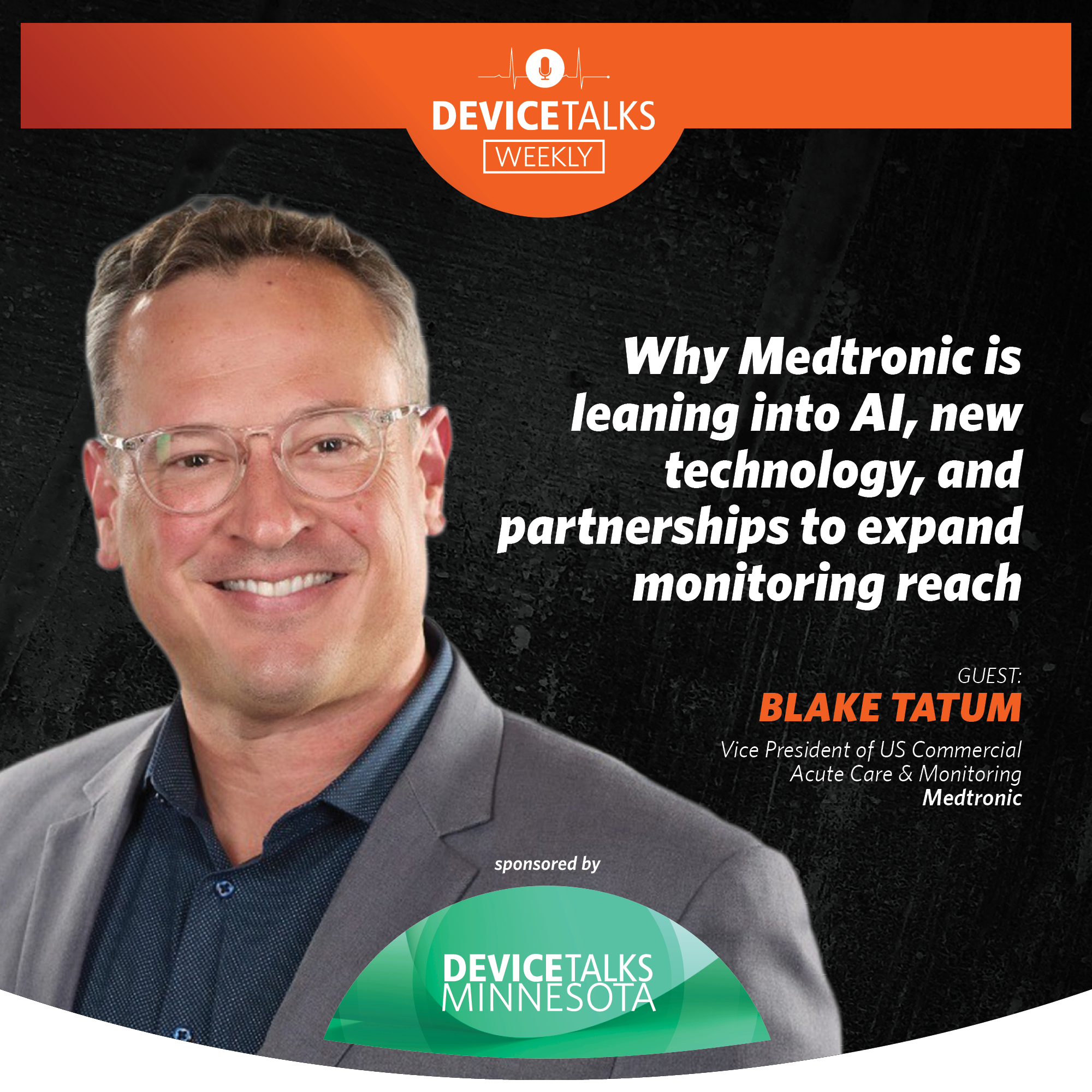
[00:00:00] Speaker A: Hey, everyone, this is Tom Salemi of Device Talks. Welcome back to the Device Talks weekly podcast. Glad you could join us. Today we've got a conversation with Blake Tatum, the vice president of US Commercial of Acute Care and Monitoring at Medtronic. I'll talk to him a little later in the podcast about that business, how it's using technology and collaboration to build out its business. Before that, Chris Newmark and I will tackle this week's Newmarkers newsmakers. And I want to invite you all to hang out with Chris and me and Kayleen Brown at Device Talks Minnesota. That's happening on May 4th.
We have a great lineup of conversations, a lot of technical conversations, but four big keynotes. Kicking it off with Heather Knight, the Chief Commercial Officer at Sylventum. Then we'll have Mike Blue of Histasonics, followed by the legendary Manny Vilafana. I'll talk with him about his work in leadership in the medtech space. And finally, I'm really looking forward to my conversation with Lisa Earnhardt of Abbott.
That's just an amazing company going in many new and fascinating directions, and I can't wait to unpack that all with her. So please make sure you check out the agenda. Register, go to minnesota.device talks.com and when you register, use the code DTW25 to save 25% off the cost of registration. Now, let's get this podcast started.
All right, you ready for this?
[00:01:21] Speaker B: Ready.
[00:01:39] Speaker A: Chris Newmacher. How are you, sir?
[00:01:41] Speaker B: Doing all right, Tom? Doing all right.
[00:01:43] Speaker A: I'm dragging, Chris. I'm dragging. I got a late flight last night. Here's a tip for everybody out there traveling. I didn't have any major TSA line problems, but I think if you're taking one of the last flights of the night, count on being delayed for an hour or more because I think the cumulative delays of the day will finally catch up with you at the end. So it was one of those 859 flights that actually, actually 833 flights that left at like 10, 19 flights, which I got to watch the whole Purdue Texas game, so. Nice.
[00:02:15] Speaker C: Yeah.
[00:02:15] Speaker B: Oh, hey, there you go.
[00:02:16] Speaker A: So I was at Airport Chili's watching that and made my little airport travel buddies, you know, talking, talking about the game with them. So it was a nice time, but I didn't like getting home at 2:30 in the morning.
[00:02:26] Speaker B: Do a little plate of Southwest egg rolls at Chili.
[00:02:29] Speaker A: Oh, I went with the, I went with the, the beef, the sliced beef with the flour tortilla thing. I forget what they call that. But it was nice. Yeah, that was nice. Yeah, yeah, yeah. You know, it's totally respectful. You know, it was a good time.
[00:02:43] Speaker B: Yeah, Good times.
That's fantastic. Did you. I mean, when you're in the TSA line, did you have an ice agent come up and give you a bottle of water? I heard they were giving out bottles of water.
Oh, it's too bad.
[00:02:56] Speaker A: But everyone was very nice, and this was West Palm Beach Airport. It was very good, and Logan was fine. I went to Logan two hours early, anticipating just in case, and there was no problem whatsoever. So I just got to hang around this terminal for an extra hour and a half because I was anticipating a problem that didn't exist.
[00:03:15] Speaker B: I've had a lot of bad luck at Logan over the years, including having coming back for Device Talks Boston one year. I'm like. I'.
I'm like, you know, I see my plane and, you know, I have a nice little place I can get a breakfast burrito and watch the plane out the window. And I'm like, why aren't they dragging my plane away? And it turned out it had been struck by lightning.
[00:03:33] Speaker A: Yeah, that's a new one.
[00:03:34] Speaker B: Outside the terminal.
[00:03:36] Speaker A: In Logan's defense, you've also been in a plane that got struck a flock of geese, too, right?
[00:03:40] Speaker B: Yes. Yes. That was years ago.
[00:03:42] Speaker A: You don't have the best plane luck when it comes.
[00:03:45] Speaker B: Yes, I know that when a goose gets sucked into an airplane engine, it sounds like a. Like a shoe in a clothing dryer.
It's not a sound you want to hear on an airplane.
[00:03:55] Speaker A: Laughing at that.
Good description, though. Very vivid.
[00:04:00] Speaker B: Yes.
[00:04:01] Speaker C: You don't.
[00:04:01] Speaker B: You don't want to be on a flight where afterwards, like, I mean, I literally saw, like, FAA people staying outside with clipboards, like, looking into the engine, like.
Like. No, that's. That's not good.
[00:04:12] Speaker A: Any. Who. Well, that's our. That's the travel segment of Device Talks weekly podcast.
[00:04:16] Speaker B: There we go.
[00:04:17] Speaker A: Now let's get.
[00:04:18] Speaker B: You know, you.
[00:04:19] Speaker A: You.
[00:04:20] Speaker B: I mean, you had this, like, another fun airport airplane time. You know, you got in early in the morning. But, Lisa, it's. We're talking on Friday morning, and you do your. I saw you were telling on LinkedIn it's the Salemi family pizza night again tonight. You get some pizza going.
[00:04:35] Speaker A: You know, my wife made plans with her friends tonight, so she's going out to eat. So we're moving pizza night to tomorrow. Yes.
[00:04:42] Speaker B: Okay.
[00:04:43] Speaker A: We talked it through. We were all fine. We're good with it. But, yeah, it has disrupted the flow she didn't choose the night. But pizza night will be one night, one more night. So it gives me something to look forward to tomorrow after the. After the Purdue. The Purdue game.
[00:04:56] Speaker B: So here you go. You got the weekend. Got the pizza night. Awesome. Well, we'll jump now into the new Markers newsmakers. So like, especially because we have a tired Tom Salemi here. So we'll, we'll get. Tom, wake.
[00:05:09] Speaker A: Wake up.
[00:05:10] Speaker B: Tom, wake up. All right, let's get going. I'm up.
[00:05:12] Speaker A: I'm up. Go. Okay, Number five,
[00:05:16] Speaker B: Number five on the list.
Yours truly. I posted a story on mass Device this week about 10 surgical robotics companies you need to know. And it's just kind of like a roundup, like talking about the surgical robotics companies that especially stood out in mass devices. Surgical Robotics special report. So I encourage you just check out that article. You can get a little snapshot of where things are right now in the surgical robotics space. And then I encourage you download our free Surgical Robotics report, which has profiles of 73 companies in it. Some deep feature stories about Medtronic Intuitive.
Just a really good publication on what's going on right now. What's the state of affairs in this extremely exciting space in medtech?
[00:06:04] Speaker A: Absolutely. And looking at the list, there are actually a couple of names that surprised me that are on the list. So folks should check that out. And as I told you on the staff call yesterday, I was down visiting a friend of Device talks and the friend of Device talks said the report is great. And they downloaded and pass it and sent the link to all their colleagues and said, you got to read this. It's really good. So well done.
[00:06:25] Speaker B: Fantastic. That's great to hear about it.
[00:06:27] Speaker A: Providing a service to the medtech industry.
[00:06:29] Speaker B: As always, I think that's the best thing just to know that that's the thing that's rewarding the most. When I hear that the work we're doing is really informing people across the industry and helping to spur innovation. That's the best.
That's what makes me enjoy this and lived there pretty much.
[00:06:46] Speaker A: One of my favorite vivid moments of journalism was I'd written a story about right medical for In Vivo magazine. This was probably like 2007 to 2008 and I was on a flight, sitting in the aisle seat and the person, the woman on the other aisle seat was reading that magazine and was reading my article as I was sitting there. So it was kind of cool to see, like, wow, someone actually reads these things and they enjoy it and they. She read the whole thing and it was Very graphic.
No, I did not go like, do you know who I am? I'm Tom Ty.
[00:07:16] Speaker B: Do you know who I am? You're just peeking over the seat like, is she reading the whole article? She read the whole article.
[00:07:23] Speaker A: She'd probably roll up the magazine and beat me with it. Like, get away.
You're watching me read weirdo with it,
[00:07:29] Speaker B: yet you're not done with it. Keep on.
Oh, no. She put the magazine away. Oh, no. Devastation.
[00:07:35] Speaker A: But we do like to know that our work is appreciated and the robot report was definitely appreciated. So folks, can we'll the link again in the show notes so folks can download that. Oh, then you just go to mass device.com too and find it. I'm sure it's right there front and center.
Or unless you want to say severe severin or 8 hyphens again like you did last week.
[00:07:53] Speaker B: No, I don't want to do that.
Don't want to like somebody's, I don't want to sound like somebody's great grandma sharing a, a master like a web address like www.com.
yeah.
All right, number four on the list is from senior editor Sean Hooley.
It's that Abbott closed its $21 billion acquisition of Exact Science is best known for its cologuard tests. But this deal, which we've talked about it before, like, greatly, greatly, it's a big boost for Abbott's diabetes business. And you know, it's, I'm sorry, a big boost for Abbott's diagnostics business. And you know, that's, yeah, it's going to be exciting to see where that goes. And I mean, and also like their medical devices business, I mean everything from freestyle Libres to cardiac implants has been just doing really great too. And if people want to find out more about where that's going, you can come to the McNamara Alumni center on May 4th for what's that event they're doing over there where Lisa Earnhardt device
[00:09:04] Speaker A: talks Minnesota and Lisa Earnhardt of Abbott will be our closing keynote conversation. I'll talk to her.
Exact sciences doesn't fall under her purview, but the medical group is obviously doing a lot of exciting things and I'm sure we'll talk about sort of the patient focused and customer focused direction that Abbott's going and talk about its partnerships with other medtech companies. Really, I think we even quite the tapestry in the medtech industry. So anxious to talk to Lisa about that. Folks can certainly join us there. We'd love to see you.
[00:09:34] Speaker B: Fantastic.
Number three on the list we've got like Sean's really been on of coverage about the aftermath of Stryker being hit with a Iran backed cyber attack. And his latest story that we just had on Mass Device yesterday was him jumping on reports from Bloomberg and Reuters that Striker's now saying they've confirmed they were ramping up their manufacturing after restoring systems that had been affected in the attack. But just still I suspect this ramp up more continues to drag on. We're going to see more of these type of things happen to medtech companies and companies in general. So we'll keep on, stay on the lookout on what's going on. I know the SEC in recent years has said the companies need to start reporting cyber attacks in their SEC filings. So we'll be keeping an eye on those SEC filings to see if anything else happens.
[00:10:36] Speaker A: Yeah, folks out there are a bit chilled by the fact about Stryker and Intuitive too. Companies that have surgical robots were impacted by this and the robots weren't themselves impacted from everything we've heard. But just the fact.
[00:10:48] Speaker B: Yeah. And there hasn't been with the intuitive thing, there hasn't been something saying it was ran backed. But it is interesting that you've got, you know, now two major companies have had like cybersecurity incidents now like in just recent weeks while this huge geopolitical situation's going on.
[00:11:08] Speaker A: Yes, absolutely. So it's something we'll continue to track and of course cybersecurity will be an even more important conversation going forward.
[00:11:18] Speaker B: Absolutely.
[00:11:19] Speaker A: Chris Newmarker, what's number two?
[00:11:21] Speaker B: Yeah, this is some other kind of tough news we got.
Boston Scientific was the subject of a New York Times expose on Mass Device. We've been covering some serious recalls they've had around pacemaker batteries and the New York Times kind of dived into that more and citing like company records that they obtained and government inspection documents.
They're saying that this is something that at least the New York Times story is suggesting. This is something that Boston Scientific has been grappling with for years.
So I've got a story up on Mass Device that kind of summarizes it really quick along with some reaction from the company which I mean Boston Scientifics sent a statement that they disagreed with how the positioning of the article. But I'd say go read my summary on Mass Device and I have links so that you can go and read the full New York Times investigation on their site.
[00:12:24] Speaker A: Absolutely. Yeah. I mean it's a terrible story laid out in the New York Times. Not terrible in the quality of it but Just in what happened.
[00:12:36] Speaker B: Oh yeah.
[00:12:36] Speaker A: And certainly would love to. I'm not sure if Boston Scientific was going to give a more full throated defense, but be interesting to understand the more of their side of the story. Not that the article wasn't. I thought it was fair. I mean, you know, it obviously had a negative bend to it as most medical device companies, metal device stories do. Their sense of be more of a focus on bad things that happen.
But we still, our companies and ourselves need to be accountable for that. So.
[00:13:09] Speaker B: No, absolutely. And I mean really, you know, medtech's one of those fields when something goes wrong, it can go really, really wrong. And I mean in these recalls so far there have been like two deaths reported, you know, but you know, one death, two deaths, that's too much, you know, and I mean, so in the New York Times, you know, they had a, I mean they did, you know, really explain what, like the, how a death related to something medical device related, what the effects can be for families. So I mean, yeah, just, just tightens
[00:13:46] Speaker A: the focus for everyone out there working to build safer medical devices that help people. So there is a value in these sorts of articles, although they can be difficult to read.
[00:13:56] Speaker B: Yeah.
[00:13:56] Speaker A: All right, Chris Newmacher, what's the big number one?
[00:14:00] Speaker B: Well, number one on the list here. I'm going to end this off with it's mostly positive news out of Medtronic this week. So there we go. So we don't have to be total, total downers here. Like ran batteries. You know, we've got, you know, Medtronic like the news this week. Well, I guess to start out, we'll start out with like a little bit of a downer thing which was it was Medtronic cutting its guidance. You know, this was interesting. We've talked about for a while about when we've mentioned the Minimed IPO spin out. What does this mean for Blackstone? Because Blackstone had a big investment in Minimed for R and D back in 2000 and it turns out that now that.
2020. Yeah, exactly. Back then Minimed just got FDA clearance for the Minimed Flex and that's sparked Medtronic having the like, you know, make, make, you know, it's, it's triggering payments to Blackstone. So they had to reduce their guidance to, you know, to account for that. And overall the, you know, the, the markets appear to have been taking that and taking that in stride. I mean, of course, like we're talking on Friday, it was a pretty, pretty rough day on the market yesterday. But Medtronics stock is pretty much mirroring, you know, what you're seeing on the S&P 500. So, so, so it obviously seems to be some, it seems to investors were expecting into the risk. It was baked into stuff. Yeah, exactly.
But so we got that news.
We just have news today, hot off the presses from Sean on Medtronic winning FDA clearance for its Stealth Axis robot to be used in cranial ENT procedures and already got clearance for a spine surgery. So it's another regulatory win for Medtronic Robotics over in that kind of spine ortho space where it competes.
And then there was also news this week of Medtronic, their partnership. I mean we've been writing about how they've been picking up on their tucking and acquisitions and I'm also noticing a lot more news at Medtronic of them inking partnerships. And this one was with Merit Medical Systems. They're going to be distributing their, let me see if I can pronounce it correctly, their Via Verte system.
People in Medtronic can let me know. Did I get that right? Via Verte?
[00:16:26] Speaker A: I think so.
[00:16:27] Speaker B: Minimally invasive and plant free.
I'm not even going to try to pronounce it. It's a BVNA system, steerable nerve targeting for treating chronic lower back pain. So Medtronic is going to be starting to distribute that in its pain interventions portfolio.
[00:16:49] Speaker A: So I would have said Basie Vertebral but oh wow, I like that might be Basi vertebral but I'm sure it's people figuring out.
But no great, great news from Medtronic. We'll have talking to Michael Carter of Cranial and Spine next week for future podcast interview. So we'll hear directly from him. I know Sean Hooley spoke with him as well earlier when they got news a couple of weeks ago.
And I think just I'm really excited and intrigued by this just trend of I know distro deals are nothing revolutionary but again as we talked about with Abbott, just the collaboration that's going on between medtech companies. I know, I think Medtronic and Royal Phillips. I think I saw an interview with, with the two CEOs talking about their collaboration, Philips and Medtronic in imaging.
Just.
[00:17:42] Speaker C: Yeah, it's going to be interesting to
[00:17:44] Speaker A: see where it goes.
[00:17:45] Speaker B: Heck, I mean last week we were talking about like Strykers, Kevin Lobo, their CEO on the board of GE Healthcare. So I mean it's just a lot of which, I mean, you know, I'm a big fan of competition but I mean, I also think like, collaboration wouldn't make sense. I mean, good, good deal. Like, I mean, and especially like, you know, when you're talking about stuff like, you know, people who are making surgical systems and then you're partnering with the imaging companies and that's a no brainer. I mean that to be working more closely with them to get some stu stuff advanced.
[00:18:15] Speaker A: Yeah. And then we'll talk about, in their keynote conversation today, folks can listen about Medtronics in the pulse oximetry space and in the patient monitoring space, how they're opening themselves up to collaboration as well, just as a sense because hospitals have a finite amount of money.
So to try to build a platform that's going to be just focused on you and your product might not be something that they can invest in if they've already sunk some dollars into other systems. So flexibility and collaboration, I think is a positive trend for the future of MedTech.
[00:18:52] Speaker B: Exactly.
[00:18:53] Speaker A: All right, Chris Newmarker, I'm going to go to bed now.
[00:18:56] Speaker B: And I just realized, I just realized, just. Donna, we've been talking this whole time and we're both wearing, look at us.
I thought it was more gray, but.
[00:19:08] Speaker A: Yeah, that's a green gray. Yeah, I noticed that when we first popped on. Yeah. Normally Kayleen and I are color synced, but now you and I are, we're
[00:19:16] Speaker B: obviously on the same mind length.
[00:19:19] Speaker A: Well, yours looks to be a long sleeve, I think, right?
[00:19:21] Speaker B: Oh, yeah. You're wearing a T shirt. Yeah, I'm wearing a sweatshirt.
[00:19:24] Speaker A: We're so different.
[00:19:25] Speaker C: Oh, my God, we're just so different
[00:19:28] Speaker B: as we sit here with gray, green and reading glasses is fantastic. I love it.
All right.
[00:19:36] Speaker A: We've been doing podcasting for too long. We're starting to finish each other's sentences.
[00:19:40] Speaker B: No, it's great.
Well, Tom is fun as always, man.
[00:19:45] Speaker A: Have a good weekend, Chris Newmarker.
[00:19:46] Speaker B: You, too.
[00:19:47] Speaker A: All right, thanks, Chris Newmarker. For this week's Neumarkers newsmakers, in addition to Device Talks Minnesota, I also hope you'll join us at Device Talks Boston. It's happening on May 27th and 28th. We've got great keynotes with Debbie Govender of Johnson and Johnson Medtech's heart recovery business, formerly known as Abiomed. We'll have Ashley McAvoy, the CEO of insulin, another great powerhouse in the Boston medtech scene. And we'll have a panel discussion with where we'll unpack the Future of Massachusetts MedTech, featuring many folks, including Brian Johnson of Mass Medic, along with some VCs and CEOs leading the MedTech space. So go to boston.devicetalks.com to register and use the code DTW25 to save 25%. Now it's time for my keynote conversation. Once again, my guest is Blake Tatum. He's a vice president of US Commercial Acute Care and Monitoring at Medtronic.
Well, Blake Tatum, welcome to the podcast.
[00:20:52] Speaker C: Tom, thanks for having me. It's a pleasure.
[00:20:54] Speaker A: It's going to be great to unpack the acute monitoring business at Medtronic. It's not an area we've covered a lot and there's been a lot of news there lately too. You folks are doing some super interesting things. But before we get into that, we obviously love to learn about our guests.
Blake, how did you find your way into the medtech industry?
[00:21:13] Speaker C: Yeah, yeah, different. Different path for sure, Tom. So I actually started out of college in, in more of the finance world. I worked for a firm out of Memphis, Tennessee and had some exciting, exciting clients. Used to work with Caesars Entertainment and Northwest Airlines and just wasn't really.
Something was off. Didn't seem like a, a human connection. Didn't feel like someone, something where you were going to make a huge difference.
So in my L20s, talked to some friends that were with a company that I think's been gobbled up LMA North America, that, that love their career, love going in working cases every day. I had a neighbor in Memphis that was a trauma surgeon resident. So shadowed him a couple of days and I was like, I'm going to make a change. I'm going to jump into med device. So interviewed for a while and landed actually a job with Tyco Healthcare.
[00:22:10] Speaker A: Oh, wow.
[00:22:10] Speaker C: As a, as an airway management specialist, essentially.
Nearly. Probably one of the most basic med device jobs you could imagine. But it, it put me right into the, or it put me right into a critical care space. You know, I'm, I'm working with physicians on trach. I'm, I'm helping anesthesia docs with, with airway placement, which is, it's life support. So it, it looks, it looks low tech, but it actually was, was a great start. Cause it gave me exposure at almost every, you know, high pressure area of medicine and went from there and it was a super rewarding change.
[00:22:48] Speaker A: So you were at Tyco and then you were there while it became Covidian, et cetera. You were there through the life.
[00:22:55] Speaker C: Yeah. You know, it's funny, I've technically been with the same company for almost 18 years, but it's been, it's been three different companies and I'd say five different career paths.
So yeah, Tyco became Covidian, Covidian acquired by Medtronic. That time, you know we, I moved out of the rip rep role within three years into a management role within the old Covidia and respiratory interventions business.
So we moved into like ventilation and some of the ICU capital businesses within Covidian.
At one point I was running a team of like 25 that included service techs and engineers which was very new for me. And then about a decade ago got got combined through the Medtronic acquisition. We were combined with the patient monitoring business within Medtronic, reload here to Boulder, Colorado and and ran a combined zone of what used to be our respiratory and monitoring solutions business. In the last five years I've been the US Commercial vice president for initially just the patient monitoring business. Then we recombined through some optimization work our old respiratory business. So literally where I started 18 years prior and then we've added our government business and a digital health franchise which is more remote patient monitoring, some basic AI and IT integration work. So we're a little higher tech than we were when I started.
[00:24:26] Speaker A: Yeah, that's definitely something I want to explore.
What's your advice that you give folks for building a career within one company? Finding a way up, finding up that next step, looking for those next opportunities. What's the best way to move forward?
[00:24:40] Speaker C: Honestly, whether you're staying with the same company or you're changing companies. Because obviously I've had a lot of people I've worked for and a lot of people that have worked for me that have moved on to other large players or taken over startups or even mid cap companies.
It's really going to be staying curious and aggressive, becoming a specialist in whatever space you're in and, and making sure that you're adding value.
If, if you know, if my, my exclusive experience was airway and I'm talking to a cardiac surgeon, I need to make sure that I'm networking and studying hard enough to add value to that conversation with that cardiac surgeon. So whether I, you know, whether I jump to another large company that just does cardiac surgery or I stay here and run a patient monitoring business, you've got to be able to understand a given space within MedTech and execute strategically. So it's really the same answer whether you stay or go. Because I've had multiple Excomm leaders, we've had two CEO changes. So you're sort of reproving yourself whether you stay or Go.
[00:25:53] Speaker A: To be honest, that's a great point. Well, let's unpack your business, talk a bit about acute care and monitoring. I think people think they know what it is, but as you stated, it's becoming more complex. But what are the businesses and the products that fall within the business you're working with?
[00:26:09] Speaker C: Sure.
So today our core is our legacy patient monitoring business. So that's our no core pulse oximetry franchise, our microstream Capno business, our BIS anesthesia monitoring invos regional oximetry business, and our digital health, which I mentioned earlier, which sort of brings everything together and allows it to be seen in a more useful format. We've added to that the Medtronic care management services business, which we call HealthCast government.
So it's essentially a veterans.
It's exclusively focused on the va, but it's veterans remote patient monitoring is how you should think about it. So we've got a dedicated team for government and veterans care.
And then we've added the airway business from that old respiratory interventions business I mentioned earlier. So a lot of where I started is back, is back under my leadership. So we have a dedicated airway management team again working with those ents, those anesthesia docs to make sure that you've got probably the most important part of surgery, which is a secure airway so that you can breathe while you're, you're undergoing a complex procedure.
[00:27:21] Speaker A: Interesting. So how do. This is an area within healthcare I think that maybe some people see as being commoditized. How does Medtronic sort of stand out and compete in this area? Where do you make, where do you help people see that you're, you're providing a difference?
[00:27:36] Speaker C: Yeah, and, and honestly, Tom, from, from the outside it looks like stickers and screens and that, you know, when we talk to, when we talk to customers that are too far from it or you talk to partners, that's how they look at it. Somebody in a neuromod business is like, well, you guys are selling stickers and it does stick on your finger or your forehead, but it's actually insanely, insanely high tech. So for example, in the patient monitoring space we've got our pulse oximetry business and even the big distributor players like Medline would say it's a commodity.
But when you're on site, let's say in a, in a, in a neonatal intensive care unit or a burn unit or an oncology unit, we, we have world class technologies in each of these sections.
So for example, Nelcore pulse ox, it's something you get every time you go in. It literally touches every patient. Whether you go into the ED with, you know, RSV or you even go into, to your doctor's office for, for a, a, an annual physical, you're gonna get a pulse oxy reading, right? They wanna know your heart rate and your blood, your blood oxygenation. However, the way that we've evolved, Nelcore, there's, there's a ton of data today that shows it is by far the most equitable pulse oximetry on the market. Meaning regardless of, of how light or dark your skin tone is, we can give you as accurate a reading as anyone in the world, which makes a big difference. Also, if you're extremely poorly perfused, if you're extremely sick, if you're, you're near end of life and there's not a lot of blood flow getting to your hands, we can still give you an accurate reading. So when you see it on site, it makes a huge difference. And that, that goes for all of our technologies. You're in a complex cardiac procedure and we have invos regional oximetry on you, and a physician pushes just a tiny amount of epi.
You can see, you can see our tech react. It's impressive.
And when people understand what a physician can do with that information, it gets a lot less commoditized.
[00:29:42] Speaker A: Interesting. As you were answering that question, I was taken back to, well now, five years ago. So during the pandemic, where technologies that we didn't really think much about, be they ventilators or the ability to read oxygen in your blood, what was that time like for you? And do you feel like that really did. If there wasn't already an appreciation of the products that you were involved in getting into the healthcare system, do you feel like that shined a spotlight on it in a positive, positive, positive fashion?
[00:30:18] Speaker C: Yes, absolutely.
It did a couple of things. So I was actually in the ventilation space still.
So a lot of, a lot of late night, early morning calls with governor's offices and, and even, you know, even, even federal leadership names that you would recognize would literally hit you on your cell phone and you would have to explain what the timing is on ventilation deliveries. It was a very interesting time.
But, but for our core businesses, it's sort of renewed, like a knowledge base and an interest in what we do.
And really, through no effort of our own, it generated a lot of independent data on our pulse oximetry, on some of our light sensing technologies, and it showed a significant difference in how they perform a medical grade pulse oximeter versus what you would get at a Walgreens or a cvs.
And there's a strong amount of just independent data out of big US Facilities that show there is a big difference in how these light sensing tech technologies operate, how different algorithms operate. And it's really created a renewed interest in making sure that a patient gets the best possible care. Whether, you know, whether it's a sticker with lights on it or, you know, or it's a. It's a cardiac stent. So it, it's really been a benefit for us. It renewed interest, it helped clarify where we needed to go with a lot of our technologies as far as integration and partnerships.
And it's allowed us to sort of reinvent this business over the last four years, to be honest with you.
[00:31:57] Speaker A: Actually, I want to unpack that reinvention in a moment. But another thing that came to be known at the time or just before the pandemic was, and you referenced this earlier, the ability of monitors or sensors like yours to read different skin tones accurately. Was that something that was.
You were capable of performing before or did you. Were improvements made since 2020, when. When we all. I became aware, I don't want to speak for everyone else, I became more aware of some of the shortfalls of medical technology.
[00:32:29] Speaker C: Yeah, it's.
You know, it's funny, we.
Our R and D leader, Jason Case, before, before AI became a buzzword, we always called it machine learning. So we actually iterated a lot of our core patient monitoring technologies. Biz, Invos, Nelcore, Miterstream. We had iterated multiple times over the years leading up to the pandemic and obviously after.
So we built it towards a sensor and algorithm. And it learns over time. The more patients you see, the more it's able to learn and adjust.
And we didn't call it AI. I remember pre pandemic, we would, we would present to say a children's hospital and explain, listen, this is a machine learning, you know, enabled algorithm. We learn as we go. This thing iterates. You know, we've iterated it every year for the last decade.
And we knew we were good. Right? Like, you can, you can do an onpatient eval and you can put these technologies on a, an ICU patient or someone in the or, and you can see like, it'll quickly give you a reading. It'll lock onto a heart rate. We're cardiac based in the pulse oximetry space. And you can see signal quality like in an OEM monitor. And we could see high signal Quality we could lock in within a few seconds and we felt good about it, but we didn't really understand, we didn't understand what it meant to be honest.
But the pandemic and the light that was shown on health equity and like I said, a lot of the independent studies that were generated, it opened our eyes. We didn't realize what a big difference it was. We didn't realize what the impact on someone at the far end of the, of the skin pigmentation, skin pigmentation scale, how, how big, big a difference it could be.
So it showed us, you know, I won't go through all the data, but it did show us as significantly different. It also showed us a pathway to innovation. So since the pandemic, we've released the new oxysoft sensor with even brighter LED technology that can pick up even faster on a baby or an adult. And then we've got a new release coming in this coming fiscal year.
It's going to be an even higher level above that. So it showed how good we were at the time, but it also showed us a pathway to make it almost a non issue where your skin tone and your blood perfusion are not going to matter. We're going to be able to show a nearly completely accurate reading every time. So it had a dual effect.
[00:34:58] Speaker A: Interesting. I kind of like machine learning as a term better than AI. I wish we were still using.
[00:35:03] Speaker C: Yeah, it felt more genuine, you know. Yeah, it, it felt more accurate and
[00:35:08] Speaker A: a little less intimidating. So now that, well that, that, that was then. Well, let's, let's drill a bit into the, the, the structural changes of the organization that you're in. You mentioned some of the businesses that were brought in. Kate Benedict came as a senior vice president last year, the middle of last year. What, what was the, what was the thought behind the reorg? What does it allow you to do that you weren't able to do before?
[00:35:33] Speaker C: Yeah, it's, it's just a more complete offering to the market.
So, so when you, you go in, you know, to an ed, to an or now we essentially, we essentially can be involved in the, the pre op work with a patient with some of our wearable technologies.
We can be involved directly in, in, in the pre op assessment. So you've got, you know, a biz anesthesia monitoring sensor on, you've got a pulse ox, you've got invo regional oximetry. We can show you organ health, the depth of the anesthesia. We can show you, is there, is there blood oxygenation and heart rate in a healthy place and we can combine all of that into, into a view that a physician can use to understand, you know, are the, you know, is the procedure or the therapy I'm applying to this patient, is it effective? Have I made a mistake? Do we need a different intervention in this space? Whether it's, you know, a chronically ill patient that's been in ICU for two weeks or somebody that's undergoing a cardiac procedure, it just, it allows us to bring all of the, you know, airway management, patient monitoring and digital health technologies in together to allow them to get a clear picture from pre op to going home of how healthy or not healthy or how effective or not effective a given intervention is so that you can, you can make decisions faster and you can make, make accurate and informed decisions faster. So it just, the combining of all these technologies has allowed us to just get a clearer picture of how we can affect almost every single patient that walks into a hospital or even a post acute center or an ASC and make sure that we optimize either that procedure or that care pathway with fair certainty.
[00:37:17] Speaker A: So great explanation of how things have changed structurally, corporate wise. Let's talk a bit about the technology. You mentioned digital health a couple of times. I mean I, I don't know, like I'm, fortunately, I have a, I'm a fairly healthy individual. I go and I get the reading of my oxygen at my doctor's office. I don't have to carry it with me, I don't have to track it every day.
What are the digital health components? Who do they help, where do they fit and what additional functionality are they providing?
[00:37:44] Speaker C: Yeah, we're very partnership and integration focused. So what, what it means to us, the, the key really to, to all, of all of medtech and, and healthcare right now is, is how do you get the most high fidelity data off of a given person? So you, so how do I get, how do I get the highest fidelity information off of Tom?
Use that information to create a treatment pathway for whatever issue you may or may not be having and then get you home safely so that, so that you heal and as safe and comforting environment as you possibly can.
So for us, digital health is we're taking each of our world class technologies, right? So we've got some of the highest fidelity sensing technology in the world.
We can take each of those data points and we can aggregate them. So for us, our VitalSync platform or even some of our EMR Connect work, what we're doing is we're taking each of these separate data points Each of these separate, separate sensing technologies, and we're pulling them together in a single view. So in a hospital, we can take your, you know, pulse oximetry, your, your capnography, essentially your, your CO2 and, and respirate data, and we can aggregate all of that with, say, ventilator settings, and we can display it so that a nurse or a physician can see in this unit.
You know, I've got healthy patients in rooms one through five. Tom in room six seems to be struggling. You know, his pulse ox has dropped, his respiration rate is dropped. I think Tom's in trouble.
So we can take all of these separate things that a nurse or a physician would have to look at and try to make a judgment call, and we can aggregate them into, you know, this person is trending great or this person is trending risky, and we need to take a closer look at that person.
Just trying to make all of the sensors and the beeps and the things that you see in an or an ICU unit or even a med surg floor and make them usable is our whole point.
Beyond that, like I mentioned, we're bringing in wearable technologies with a lot of our tech.
We need a way, say you have a procedure, you go home.
We need a sensor on you that can show your current status to that hospital or to your general practitioner or whatever physician is tracking your care. So for us, it's really taking all of these things that watch you in the moment, aggregating them and putting them in a place that a caregiver needs to see to make a good decision on your care.
[00:40:28] Speaker A: So are the targets or the.
Are these devices, the digital health tools, are they mostly clinician facing, not patient facing, consumer facing? They're not something I'm going to be keeping an eye on myself.
[00:40:41] Speaker C: No, no, no. We. And we have that option, right? Like if a physician's like, I need, you know, I need Tom to be able to see his, his current stats. We can do that. But, but today what we're building is clinician facing. Yes.
We want the information and the decision making to be as fast and accurate as possible.
[00:41:01] Speaker A: I don't, I don't need to track my oxygen levels every.
We got enough going on or what
[00:41:07] Speaker C: that means, you know, or am I okay or not? Or if you know, you, you get up from the couch too fast, you don't want to have a panic attack.
So, yeah, there's pluses and minuses to home care.
[00:41:20] Speaker A: Absolutely.
Let's talk a bit about the. You mentioned partnerships. I'm not sure, if these are the partnerships you were referring to. But over the past few weeks or months, we've seen that you've had a partnership with Philips, with Mind Ray. The week we're recording this, you just announced a partnership with GE Healthcare.
What are these? It's unusual to see medical devices partner up. We're seeing more and more of it. But three in a span of months is, as we say in the news business, a trend. So talk about this trend of partnership for Medtronic. And what does it provide for you and for patients and for customers.
[00:41:57] Speaker C: Customers, absolutely. And it is a deliberate action on our part. So a lot of players in this space, they want to own an ecosystem, right? So they want all of their capital equipment and screens installed, they want all of their sensors talking to those screens. They want to sort of own the entire ecosystem, right? Like, they want everything in a room to be one brand.
And that is an approach that's been used for years. And a lot of the players in the space use it. It sort of, you know, going back to what we learned through, through the pandemic, what we realized was that our sensors, sensors and algorithms were world class. And how do we take that technology and make it fit?
So, you know, I can approach a hospital and I can demand, I need you to rip all of this out, replace it with all of my equipment, and then what I'm going to be able to give you is amazing, right? Like everything, I'll be able to control the signal, I'll be able to control the data that comes off that box.
But that's a very heavy lift and a very heavy cost burden for that, for that, that facility.
What we've done is we've taken a deliberate step to make sure that we have the right partners and the right integration ability to be able to be, to place this technology anywhere. So what you've seen in the GE announcement and the Mind Array announcement and the Phillips announcement, those are our OEM players, those are patient monitoring players that own significant market share globally.
So, you know, if we can partner with a GE and cover, you know, almost every government facility and, you know, a high percentage of acute care hospitals and integrate our technology, our boards and cables and sensors with geographies, now I can approach said hospital that's already got GE equipment and say, hey, I can install our technology into your existing infrastructure and I can enhance it with the digital health overlay.
So the way, the way our R and D leader likes to, likes to explain it is we like to be, we like to be light Touch, but extremely effective. I'm not looking to rip and replace everything in your hospital. What I'm looking to do is upgrade your existing technology so you've got the best possible sensing tech and the best possible sensors and algorithms within your hospital.
So a lot of these, a lot of these partnerships, we're about making sure that we've got all of our best possible technologies integrated and connected so that it's, it's not a five year project to rip and replace everything in that hospital. We can literally do it in days and upgrade obviously the workflow for that hospital so that the clinicians and physicians are happier and also the patient care. So everything we do is to make, is to make the job of that physician and clinician easier and more effective and to make sure that, you know, when your, your grandma or your mother or your, your son and daughter are going into the hospital, you can feel extremely confident that what that physician is seeing is accurate coming off of that patient.
[00:45:12] Speaker A: That makes sense. I'm an Apple Watch guy, and if I'm buying a device to track my whatever, I want to make sure if it's compatible with my Apple Watch and I can just flick a switch and suddenly they're talking to each other. That's fantastic. Like, it's a big win for me.
[00:45:25] Speaker C: You want a diagnostic.
[00:45:27] Speaker A: Exactly. What goes into that partnership in terms of creating that interaction? Is it just as much just writing some code on your end that plugs into the code that's written on their end? Is that where it goes or is it much deeper than that?
[00:45:39] Speaker C: You know, it is a little deeper. So we, we will manufacture, you know, the, the processing boards, the cables, the chips. We will manufacture everything that goes into our system.
So then our, our integration team, our ops and R and D teams will work with, with that partner to make sure that we can safely integrate into their real estate. So is it going to fit, literally, is it, is the Lego going to fit into the existing monitor?
But also we partner with them to do all of the VND work to make sure that it can be integrated seamlessly effectively, that it's going to work every single time. So there's actually a lot of development work that goes into these partnerships where we have a financial agreement, we have a contract, et cetera. But the most important part is have we built a solution that can integrate into that, whatever platform it is safely and can my team go in and upgrade it quickly so that we don't shut down a room for two days just to do a, you know, a board replacement? So it needs to be quick, effective and more, more importantly, safe and accurate. So there's, there's a lot of, you know, behind the scenes work that goes into these partnerships before we ever announce an agreement to make sure that we can do what we say we do in that agreement.
[00:46:56] Speaker A: Interesting.
Looking forward.
You mentioned ASCS earlier on. Ambulatory surgery centers, a big part of the future of all medical device companies. It's where a lot of care is going to be delivered.
Does that present any different setting for you, challenge for you? Do devices need to be smaller? Do they need to be this or that or the other thing? What sort of opportunity and challenges do ASCs present?
[00:47:23] Speaker C: Yeah, well, it's a market reality now.
So last year a third of cardiac procedures moved to ASC.
CMS is expanding covered procedures by over 500 codes. So the market is moving that way. What it means to us beyond just, you know, business realities is that what you're doing is you're moving a lot of, a lot of higher acuity and higher risk procedures that used to be exclusively done in the hospital. You're moving them to that ambulatory surgery space.
So that, that, that opens sort of an obligation and an opportunity for us.
So if we're going to do, you know, complex cardiac or ortho procedures in an asc, they need to have our technology to make sure that that procedure is being done safely, accurately and as quickly as possible so that you can, you can safely execute on that cardiac or ortho procedure. You know, they can get home same day or close to same day.
So it's really opened an opportunity for us.
For example, the Migra announcement you mentioned, that was an ASC partnership. They own a large percentage of that space. We need to make sure we understand how they operate, that we've got very, very strong integration into their platform so that when an ASC upgrades or opens, we essentially can just seamlessly install each of these higher end technologies so that when you go into an ASC for a knee replacement or whatever it is, you've automatically got a hospital grade Nelcore pulse oximeter, you've already got hospital grade BIS to make sure that they titrate your anesthesia as closely as they possibly can. You don't have post op delirium, you've already got the hospital grade monitoring in the ASC space. So that's why we're executing some of these partnerships. And really what our strategy is is to make it easier for the ASE to acquire the technology and easier for that tech to go Onto that patient.
[00:49:21] Speaker A: How unusual? It's, I'll say it's unusual. It's been unusual to have medical device companies collaborate like that, I think.
Does it feel different? Does it just feel now? I mean, it makes perfect sense and I think it's a real positive for the industry. But has it been unusual for you or different?
[00:49:40] Speaker C: We've, you know, it's been a five year process, I'll say that. So we've, you know, we've always had a lot of our core tech integrated in, into a lot of these platforms. Okay. You know, it's, let's say 80% of our sensor burn, or 80% or more, has, has gone through one of the large OEMs over the, over the last, you know, number of years. But really we've taken a much more deliberate approach the last four to five years with, with my organization in the U.S. i've got dedicated OEM account management heads, I've got dedicated professional service like service engineer heads that coordinate. We do walkthroughs. We've learned how to scope the needs accurately to make sure it's cost effective and like I mentioned, workflow optimized within a given hospital or asc. So we've deliberately built to where we are today with just expertise. And then the partnership is what comes at the end. Once we can clearly show the value prop, we can clearly show that we can enhance the business of say a GE or a Phillips or a mind ray or a Neon code. And once we can show that value to the customer and the physician and clinician, but also to that company, it gets a lot easier because we've sort of have already built the bones.
It is unusual, like I said, a lot of the players in this space, they want to own the entire space.
[00:51:06] Speaker A: Yeah.
[00:51:06] Speaker C: And we made the decision that we wanted to, we wanted to fit. We want our algorithms and our technologies and sensors on as many patients as we possibly could. So initially there was some skepticism, like, what, what are you guys really doing here? What are we, you know, what are we, you know, are you, are you just trying to take over this space? Are you going to, you know, bait and switch with a big capital offering later?
But over, you know, now that it's been four or five years of a deliberate, deliberate effort here, we've got a really close partnership in a lot of these spaces to where they understand what we're doing, we understand what their goals are. And like I said, we can fit into existing infrastructure and bring the right technology and sensor to the patient, regardless of what's built into that facility. So it's been a process, I'd say really interesting.
[00:51:51] Speaker A: Final question.
Give us a sense of where things are headed and what growth looks like. I mean, are you moving into areas that we're not really, that those of us outside aren't really seeing yet? Do you see the types of offerings you have changing a lot as AI and or machine learning become more common? What's coming up?
[00:52:14] Speaker C: Yeah, we're leaning in, we're leaning in to the higher tech space. So I mentioned earlier we've got new boards and algorithms and sensors coming out in the next year to two years on every technology that we've discussed.
You know, we're even innovating in the airway space. We're releasing new video laryngoscopes and trachs in the next 12 months.
So we're innovating across the board as far as what the cortech does, how it operates, how easy it is to use, how fast you can see a signal or a diagnostic alert.
A lot of that is happening to our core technologies where we're also leaning in that, that that's newer.
You mentioned your Apple Watch and other sensors that, that's consumer grade tech, right? So your OURA ring, your Apple Watch, whatever it is, it'll, it'll tell you, you know, your heart rate's too high or you didn't sleep well and, and those are all very effective. What we're looking to do is bring medical grade technology to a subset of those of those patients.
So you can't, you know, you can't have a heart valve replacement and go home and have your Apple Watch watch that. Right. If we can get a medical grade sensor on you that we can use digital health to keep that information consistently going back to either your cardiologist or that hospital to keep you, quote unquote, tethered to that hospital where you don't have to sit in icu. You can actually be home and feel confident that you've got a medical grade sensor showing that physician how you're doing.
We can execute on what, you know, what the market calls hospital to home, or hospital at home where we can bring medical grade sensing technology to your house so that you can heal and recover at home. But if something goes wrong, that hospital can see it and get you in and get that treatment executed. So we're taking what we do really well, which is sensors, algorithms and digital health placement of that technology and we're looking to bring that to home.
A lot of what we do at the VA A lot of the monitoring we do at the VA today, that's all veterans at home. It's chronically ill veterans at home. So we know how it works well, now we're using a lot of the AI tools, a lot of the digital health remote patient monitoring that we already do well in the hospital today, and then upgraded sensors and algorithms to take what we do well in the hospital and allow it to follow follow Tom to his house while he's recovering. So that that's a lot of our of our future. We're still super focused in the acute space. We're still early stage in a lot of the partnerships that you and I discussed earlier, where we can make things faster and easier and we can improve those workflows. We can improve a lot of the overstretched staffing issues we have in US Healthcare. So we're going to stay focused in acute. We're also going to use a lot of the new technologies and AI or machine learning to take what we do well in acute and get it post acute.
[00:55:17] Speaker A: All right, well, this has been a great look into the acute monitoring space. Blake Tatum, thank you so much for joining us on the podcast.
[00:55:23] Speaker C: Yeah, Tom, enjoyed it. Thank you so much for the discussion.
[00:55:27] Speaker A: And that's a wrap. Thanks for joining us on this episode of the Device Talks weekly podcast. Once again, I hope you'll join us at Device Talks Minnesota on May 4, at Device Talks Boston on May 27, the 28th, and of course on Device Talks Tuesday, this coming Tuesday at 4pm I also hope you'll subscribe to the Device Talks podcast network so you don't miss a future episode of our great podcast. And of course, connect with me on LinkedIn, connect with Chris Newmacher, and connect with managing editor Kayleen Brown on LinkedIn as well. And I hope you'll follow Mass Device and Device talks on LinkedIn so you don't miss our future discussions about our great medtech industry. All right, folks, thanks again for being part of the Device Talks weekly podcast.