[00:00:00] Speaker A: Hey, everybody, this is Tom Salome. Device Talks. Welcome back to the Device Talks weekly podcast. Amazing episode coming your way. A little later in the podcast, I will talk with Greg Roach. He's the CEO of distalmotion, which is making a lot of noise in the Surgical Robotics space. We'll talk about Distal Motion's approach and its targeting of ASCs and how it fits into the larger Surgical Robotics picture. Before that, we've got the amazing Rachel Robinson of massmedic joining us on the newmarkers Newsmakers not only to talk about the news of the week, but also to give a little insight, a little preview of the upcoming Mass Medic Symposium in Gala, which is happening on April 2nd.
She'll talk about it there as well, but you can go to massmedic.com to register for that. I will be there. I'll probably be at both. I'll be moderating a panel at the symposium, so I'll definitely be there. And likely we'll see you at the gala as well that night. So it's a great time for Boston medtech folks or any medtech folks, but if you're in Boston, please do check it out. And of course, we want to also see you at Device Talks Boston, which is happening on May 27th and 28th at the Boston Convention and Exhibition Center.
Please use the code DTW25. To save 25% off the price of registration. You can register at boston.devicetalks and for you folks who can't get enough of Device Talks, we'll also have device talks Minnesota that's happening on May 4th. So other than that, we'll have a Device Talks Tuesday coming up, brought to you by Confluent Medical. Go to devicetalks.com to check out that. So lots going on. Lots of great insights and opportunities coming your way. Please make sure you do your part to be part of them. Go to devicetalks.com, you can find every way to join us there. So without any further delay, let's get this podcast started.
All right, you ready for this?
[00:01:52] Speaker B: Ready.
[00:02:13] Speaker A: Chris Newbacher. How are you, sir?
[00:02:15] Speaker B: Doing well, Tom. Doing well.
[00:02:17] Speaker A: How is your spring? Spring over there? You getting some warm temps?
[00:02:21] Speaker B: Yeah. Yeah. It's gonna get up to like, almost 70 this weekend. I'm like, so excited. It's like, here it is.
Maybe it's on the way, Tom. Maybe it's on the way to New England.
[00:02:32] Speaker A: Could happen. Could happen. I'm gonna check the weather or I can check with our guest, Rachel Robinson of Mass Medic who's here? Coo.
[00:02:41] Speaker B: Rachel. Good to see you.
[00:02:42] Speaker A: You live in Boston. Boston proper. How are the temperatures down there? What's the weekend look like?
[00:02:46] Speaker C: I will say I do have my patio open this morning. It is a balmy, I think probably about 40 Fahrenheit. So we will take it. That's a heat wave. But I think I saw a snowflake for next week in the wedding.
[00:03:00] Speaker A: I'm seeing it right now. What the hell?
[00:03:04] Speaker C: I don't think it's gonna happen.
[00:03:05] Speaker A: Oh, my God.
Oh, my God. Wednesday. I'm supposed to fly out on Wednesday.
[00:03:10] Speaker C: Yeah.
[00:03:10] Speaker B: Oh, no.
[00:03:13] Speaker A: I've learned I've started just as if I walk outside and it's really cold. I just like, yell a curse because I'm just so tired. I'm just like, blank.
[00:03:23] Speaker C: And you yell a curse in the woods and there's no one to hear you.
[00:03:26] Speaker A: Yeah. Sometimes there are some kids nearby who do hear me yell the curse.
[00:03:29] Speaker B: I don't want to rub it in, but like, it was in the 50s when I walked the kids to the bus stop this morning. And I think it was the first. It was the first time I was coatless walking to the bus stop. I just was like, you know, like, ah, this is. No, no more coat. No more.
[00:03:44] Speaker A: I think you do want to rub it in, Chris. I think that's exactly what you want.
I don't believe you at all. But anyway, it's coming. We'll get our warm weather here. But that's not what we're here to talk about. This is not the weather podcast.
This is the.
What is it, Chris? Device Talks Weekly podcast.
[00:04:00] Speaker B: Yeah, it's Device Talks Weekly. And we got Rachel on here because there's going to be a gala coming up in Boston, which sounds fantastic.
[00:04:07] Speaker A: Yes.
[00:04:07] Speaker C: Who doesn't want an excuse to celebrate something new day? I think we all could use a celebration opportunity.
Thrilled that we can offer that to people.
[00:04:18] Speaker A: Absolutely. Let's give folks a little heads up. The gala and the symposium. The symposium is first is coming up. Give us the dates, give us the details.
[00:04:28] Speaker C: Yeah. Because we weren't crazy enough to just do one event in one day, we decided a few years ago, why not do two events in one day? That would just be really, really smart.
Exactly. It's not hard work at all, but absolutely thrilled to do this symposium and gala again this year. So it's the Medtech in symposium in gala. This is our fifth year. We've kicked things back off since 2021. It's awesome.
So we do a full day symposium at the Renaissance Seaport in Boston on April 2nd.
We talk about tech and healthcare challenges for an entire day. And then because that is a little bit stressful at times, although incredibly exciting, we let our hair down in the evening and invite folks to come and celebrate the impact of the work that they do. And I can tell you the symposium is an amazing day of content. I love it. I think we have over 50 speakers this year, three tracks.
But it's the gala, right? It's the gala in the evening that really allows folks to share what they've done, see the impact, and really see what their time is worth. Because everyone in this industry is giving of their time.
They don't do this for the kicks. Because, let's be real, most people don't get paid very well. Like love life sciences. But we're not, we're not crushing it like the tech sector when sometimes.
[00:05:51] Speaker B: But we do cryptocurrency.
[00:05:53] Speaker C: This is like, you know, it's just, it's so worthwhile.
[00:05:58] Speaker B: Yes, exactly. People don't go into this, I mean, I mean, people make money in this industry, but they don't. I, I, I've, I've seen over the years that a lot, I mean, people don't go into this overall to make money. I mean, that's a nice added bonus to like developing this technology that improves and saves people's lives.
[00:06:18] Speaker C: And it's such a let your hair down kind of moment. Right. You get to really talk one on one with folks who are in the space. You know, some of our biggest sponsors every year, Insulet, J.J. medTech Heart Recovery.
We say the company formerly known as Abiomed. Love them.
Mulling's group, Alera Health Transmedics. Right. These folks come out and support us at the highest level and they're talking about the cool stuff they're doing, and it's just a great industry event.
[00:06:45] Speaker A: That's fantastic.
[00:06:46] Speaker B: Love it.
[00:06:47] Speaker A: So what's the status of tickets for both the symposium and the gala?
[00:06:52] Speaker C: Yeah, so the gala sells out every year and better or worse, we've got about two tables left this year. So that's about 20 tickets left for the gala. I have no doubt they're gonna go. So if folks are interested, you can head over to our
[email protected] there's an entire page with all the details about the symposium. You know, we've probably got room for about 50 more, but because we spread into tracks, it's a very kind of tight 400 folks who join us for the day. So if it's in your. Up your alley or in your wheelhouse, Please feel free to check it
[email protected] Absolutely.
[00:07:27] Speaker A: They're both there. And I did both last year, and it's a great day. It's not too much.
[00:07:32] Speaker C: And, Tom, I recruited you to speak on one of my panels this year.
[00:07:35] Speaker A: I'm so excited to moderator. I get to moderate a panel.
[00:07:39] Speaker C: You're gonna have some fun.
[00:07:40] Speaker A: Yeah. Get a good group.
So looking forward to being part of that. Thank you for the opportunity. So just so folks can go to massmedic.com and they can go on events and find it there.
[00:07:51] Speaker C: Absolutely.
[00:07:52] Speaker A: Okay, fantastic. Well, thanks for doing that and for doing everything for the Boston medical industry.
Chris and I have a little back and forth as to which is the better industry, Boston or Minnesota. I've been tipping my cap to Minnesota this spring for all they've had to endure. But it's nice to get pumped up about Boston again.
[00:08:13] Speaker B: Boston's really awesome. I mean, I think it's fantastic that we've got these hubs in both Boston, Minneapolis, that are just both very vibrant, very thriving right now. So it's fantastic. And the industry is huge in California, but they just don't have that mojo going on around San Francisco. And Orange county down in the south
[00:08:33] Speaker C: was such a big state. Right. It's just so spread out. I mean, in Boston, I am always amazed at how many times I'm walking down the street and I will literally run into someone from industry downtown. And you can be out in Worcester or Marlboro or in the middle of what I call nowhere. Cause I don't have a car.
[00:08:48] Speaker B: It's. You're just.
[00:08:49] Speaker C: You're bumping into people, and it's kind of great.
[00:08:52] Speaker B: Yeah, same here.
[00:08:53] Speaker A: Minnesota, everything is 15 minutes from every place else. Right, Chris?
Whenever I say, pretty much.
[00:08:58] Speaker B: Tom. Pretty much, you're like, every time I
[00:09:02] Speaker A: ask, it's about 15 minutes away. Like, everything cannot be 15 minutes away from everything.
[00:09:06] Speaker D: It's just, Chris, we gotta leave because
[00:09:07] Speaker B: I gotta be at the airport in an hour. Like, it's 15 minutes away. Tom, we can make it.
[00:09:12] Speaker A: But we do have our own events coming up, of course, in Minnesota and Boston. We'll have Device talks Minnesota on May 4th. That's our first of the year. And then we'll be back in Boston. And Mathematics, a great supporter of that for Device talks Boston on May 27, the 28th. So lots of celebration coming on. And hopefully the snow will be gone by the month.
[00:09:31] Speaker C: God, by May.
[00:09:32] Speaker B: Otherwise, I'm moving I think we're on the way here, Tom.
[00:09:37] Speaker A: Fantastic. All right. Well, looking forward to celebrating with everybody. And Rachel, you've agreed foolishly to join us for the newsmakers and to offer your insights and expertise on the top stories. So, CHRIS Newmarker, let's roll into number five of the Newmarkers Newsmakers.
[00:09:55] Speaker B: Newmarkers Newsmakers well, number five on the list is Shameless Plug for Mass Device. Our Surgical Robotics special report is now on the site.
Free download like we'll include a link to Downlo with this podcast description. But I mean, detailed descriptions of 76 surgical robotics companies as well as projections for the space. I mean, it's projected to reach $22.2 billion worldwide by 2029. And also some really, really good feature articles that look at the goals and the strategies and plans Intuitive and Medtronic, which, I mean, it's really exciting. I mean, now we have Hugo cleared in, so, you know, the competition is really on between Intuitive and Medtronic and JJ Medtech is not too far away and we've got some others adding in. So things are getting super exciting right now.
[00:10:54] Speaker A: Absolutely. We'll have Medtronic at Device Talks Boston talking about the rollout of you. Of course, their Surgical Robotics space is just a couple of walks away from where Device Talks Boston will be held. They're a big fixture in the Seaport district of, of Boston. So no, lots of great, great stories here. Folks can find that where Chris Newmarker,
[00:11:15] Speaker B: they can find this on a mass
[email protected] surgical robotics special report 2026 well, we'll leave a link.
[00:11:26] Speaker A: I'll put the link in there.
[00:11:28] Speaker B: Write it down.
[00:11:29] Speaker A: Everybody, I just wanted to say hyphen 15 times.
[00:11:32] Speaker B: Yeah, like those old advertisers when the Internet like, like/www.
[00:11:43] Speaker C: You should get a sponsor just for the word hyphen next time,
[00:11:49] Speaker B: you know, something like we'll just tell I applaud
[00:11:52] Speaker A: you for, for posting this at number five and not number one. So I think you showed remarkable restraint. But let's, let's roll on to number four.
[00:11:58] Speaker B: Really had to rein myself back there, Tom. But number number four on the list, this is just like an interesting personnel news that actually got a lot of attention on Mass Device. Thousands of thousands of clicks, which is that Stryker CEO Kevin Lobo, he's now joined the board. He's joining the board.
He has joined March 13, joined the board of GE Healthcare. So, you know, this just, I think people just got got cued into this, this news that you Know, here's like one of the, the major SEOs in our industry and he's, he's going to be on the board of another major medtech, you know, giving, you know, offering his expertise and advice.
[00:12:36] Speaker C: It's always interesting how often that happens, right? Yeah, because you can see the pros and cons. Right. On one hand these are folks who are experienced in industry. They've seen a view of the world that is very similar in some ways to what another medtech organization is going to go with. But in the case of Stryker and ge, that's a really interesting combination. Right. Because I mean Kevin's seen a ton all over the place but it'll be very interesting to see how that translates to what GE's trying to do and their future strategies. So I think that one is interesting. I can imagine a lot of folks thought that was news worthy like G
[00:13:11] Speaker B: being an imaging to, you know, giant, Stryker being a surgical tech giant. Those two go together. That's like, yeah, that's like the CEO of the peanut butter company like going onto the, you know, the Smuckers board or something. You know, they already merged now. But you know, anyway, I mean it's interesting.
[00:13:29] Speaker A: Absolutely. And I had posted on the a part of my conversation with Carl St. Bernard at Jupiter Endovascular talked about the GE days in the 90s and he had told me that at the time he was working with Peter Arduini, Omar Ishraq, Jeff, Martha, Mike Mahoney, Mike Minogue and himself like all at the same time at that company, all future CEOs of MedTech. So gee, he's got a great reputation for being a training ground for executives and I think it's a, for me at least I overlook GE Healthcare. I think in terms of its impact on, on MedTech. I'm not sure if others feel the same way.
[00:14:06] Speaker C: I think we all, it's been an interesting journey for them. Yeah, so I would say that as well. And then you see things pop up and you're like, oh, you know, that is really interesting what they're trying to do there. So it's been very cool to watch that journey.
[00:14:18] Speaker A: Absolutely. All right, great, great. Number four, Chris Newmark. Let's roll on to number three. Oh, what's this? Another Surbots.
[00:14:27] Speaker B: We got artificial intelligence too. I mean we got CMR Sur Nvidia announcing a new effort to train the next generation of intelligent surgical systems. And CMR Surgical has been this kind of cool, scrappy British surgical robotics company that's been moving forward with their versius Surgical Robotics. But they said part of this initiative is that CMR contributed the majority of surgical data used to create this new openheim data set for healthcare robotics. So.
So, yeah, really, really interesting.
[00:15:05] Speaker C: I love this one because this is, I think, a trend in industry that we need to see happening a little bit more often, where an outside the industry party is taking a look and saying, how can we help companies release their hold on some of that data that for so long they've been incentivized to think is secret sauce when it's really not?
And how do we make that a collaborative effort to be used for the greater good? Now, I'm not so optimistic that I do not think there are ulterior motives to pretty much everything. So I think the, the boss can be a little skeptical. But on the other hand, if we can do this in a space where folks contributing their real world surgical data in a way that is anonymized to the patient can then be accessed by new players trying to bring things to market. We take costs out of the industry overall. Right. And there's a lot of different areas in which we could do this. But if this is just one that starts a ball hopefully rolling in a right direction. And please, Nvidia's got enough money to do whatever they want. Right. So they're going to do it with or without collaboration.
Let's get the industry actually involved.
[00:16:21] Speaker A: Absolutely. And I don't think we can understate how much influence Nvidia has had on surgical robotics. We've talked about surgical robotics surging over the last couple of years and if you look at all the deals and all the technology that Nvidia is providing to these companies, you can see why. And Sean, list them. Sean Hooley, who authored this piece, lists them in his article J and J Medtech A Census, Surgical Virtual Incision, Neptune Stereotaxis. And I'm sure there's more. I mean, they're just really providing the power under the hood for these technologies to take off.
[00:16:53] Speaker B: We've just been rolling out so many stories about Nvidia doing partnerships with this company. They're really super active in the industry.
And why invent AI software modules when you've got an AI company out there that knows what they're doing? I mean, work with them, get your data with them and see what you can do.
[00:17:16] Speaker A: Fantastic. All right, great. Number three. And moving on to number two. And it's. What is this? Chris Newmarker, Another Surgical Robotics.
[00:17:23] Speaker B: Another Surgical robot.
[00:17:25] Speaker A: I mean, there are some way to keep Track of all these surgical robotic companies.
[00:17:30] Speaker B: So much surgical robotics.
[00:17:31] Speaker A: Is there a way, is there one place people can go to get a comprehensive list?
[00:17:37] Speaker B: If you could just get a list somewhere of all those companies, you know, just something that would be a really nice, well laid out PDF that you can like download for free. I. Boy, I wish that. Yeah, exactly. Right, right.
[00:17:49] Speaker A: What's number two?
[00:17:51] Speaker B: Number two on the list? We've got Revolve Surgical. They won FDA clearance for their surgical robotic platform.
This is a company out of Canada backed by Y Combinator.
We were talking right before we recorded this. They call it Zero Footprint. I mean that's a little.
That's interesting marketing, but I mean definitely attached to the table. So really minimize is the footprint then of the system. And I see one arm here, so that looks like it's kind of a single port type system that we're talking about here. But this is, I mean, it's an interesting play. I mean I could kind of.
I'd actually like to reach out and talk to this company some because I'm interested in.
Could this perhaps be especially with that low footprint, I mean, ambulatory surgery centers are expanding so much. Is this kind of like one of these plays that we've been seeing increasingly in robotic surgery? I mean, you don't want to take on intuitive in the hospital, but you know, go into the ambulatory surgery centers where they need less space, but a robot could do them some good in there and start getting involved and you know, it seems like something like that, but yeah, I'd love to find out more from them.
[00:19:10] Speaker A: Yeah, certainly. This company, cmr, we just talked about distalmotion, who is our guest today on the podcast. I spoke with Greg Roche. They're all positioning themselves as solutions for the ambulatory surgery center where they don't have the large enough footprint or they may need to move a robot in and out. They don't want to just have a surgical suite. Kind of committed to surgical robotics. So this certainly seems like a smart play for Revolve Surgical.
[00:19:37] Speaker C: Yeah, and just also a small shameless plug. At the MedTech Impact Symposium, we are doing an entire track on implant and biointegrated devices. And actually one of our sessions again is about how you really design those products when you're thinking about ASCs and you're thinking about doctor's offices, because it's not just orthopedics anymore that's moving into that space. You know, you look at cardiac procedures are being done in less invasive environments. You know, anytime you can Keep a person out of the hospital.
It's good.
So what can we be doing? But it definitely impacts the way you design, the way you market, the way you sell. It's so it's a really interesting, I think position for folks to be in.
[00:20:20] Speaker A: Yeah, absolutely. No, that's a conversation we try to have at device talks all the time. And I don't think people, I think only now people are really grasping the future is ascs. I mean it's going to be, I
[00:20:33] Speaker B: mean as delicious as hospital food is, it's nice to avoid it.
[00:20:37] Speaker A: Yeah, I'd rather be eating at home. Thank you very much. Grab some tacos maybe on the way.
All right, Chris Newmarker, what's the big number one?
[00:20:45] Speaker B: Hey, the number one on the list and the subject is not robots.
We got something else. Yay.
We got genevalve winning their PMA for the trilogy THV system, transcatheter heart valve.
And I mean this was the deal that got away for Edwards Life Sciences. I mean the FTC stepped in and said nope, you don't acquire them.
And Edwards eventually walked away. But now here we got genevalve getting the approval for this system in the United States. And it's interesting, a lot of the major TAVR systems we see out there from Edwards and Medtronic, they're treating aortic stenosis, the narrowing of the valve. And Genval's big thing was they designed this for aortic regurgitation, like a leaky valve.
So basically, you know, they've got, you know, they've got you know like, like sensors to, to really, you know, ensure alignment, you know, this, this locator technology, ensure alignment of the valve, you know, like, like allowing for like really secure anchoring of, of the valve. So and other like things that you know, they worked on as well. I mean some, some things we see with other Tavr like self expanding Nitinol frame whatnot. But, but yeah, the locator technology especially is really interesting.
[00:22:17] Speaker A: Absolutely. And this was of course genevalve had talked about was going to be acquired by Edwards earlier in the year. That deal didn't go through.
So I wonder what, it'd be interesting to see the future, which way it's going to go if we're going to see another acquisition bid or if the company's going to just continue to find success on its own.
[00:22:35] Speaker C: Yeah, yeah, I agree and I'm sure that even the failure of that acquisition. Right. It not going through is such a boost for them. Right. The fact that Edwards was willing to Come in, in the billions. Right. And say there's, there's going to be a B behind the number and everyone's very excited about that.
But it's another trend, right, in the industry of consolidation. And, and you, you like to see companies that are doing something innovative and are getting PMAs really get those big numbers attached to them because it's the only incentive. It's so hard to do anything that isn't a me too, me too item. Right. Even in healthcare. So it's a boost even if it doesn't, you know, go through with the acquisition. For them to say, this is important enough, what you're doing matters and it's big enough.
Go big.
[00:23:28] Speaker B: Yeah, exactly.
[00:23:30] Speaker A: Very well said. All right, well, great. Top five. Thank you to Sean Hooley. I think he wrote four through one. Right. He didn't write the Surgical Robotics article at the top, but Sean continues to churn out some great articles on massdebites.
[00:23:44] Speaker B: Sean's a machine and he's really keeping the news going on massdivites especially as. Yeah, exactly. I've been focused on the rollout of this special report as well. There's a special report?
Oh gosh, I forgot to mention that.
[00:24:00] Speaker A: No, thank you. Of course, we got some great sponsors there as well. The special report, you can find
[email protected] we'll have the link in the show notes. We'll also have the link to the gala and symposium in the show notes.
Rachel, one last, any last, last plug for the, for the event.
[00:24:15] Speaker C: Just a thank you for letting us come on and talk about this. This is such an important industry for us all to be in and I'm just so excited. I love coming to your conferences. I don't necessarily get out to Minneapolis, but I love my Boston one.
But I, I love coming to the shows and I think it's just so great for folks to know what's going on. So. April 2nd, MedTech Impact and Symposium Boston. It will be warmer, I promise.
[00:24:39] Speaker A: Absolutely. I'm looking forward to it. All right, well, Chris Newmarker folks don't have to wait for us to jibber jabber to get top five newses, right?
[00:24:46] Speaker B: That's right. Just go, hey, I mean, you want to get the news every day? Go to Mass Device. We got a link right at the top to subscribe to our daily E. Newsletter and you know, you can get that right on your inbox. But, but, but great. Great to have you come on here as well and you know, listen to us chat about the news.
[00:25:02] Speaker A: Great thanks so much, Rachel, for, for joining us and see you in a couple of weeks.
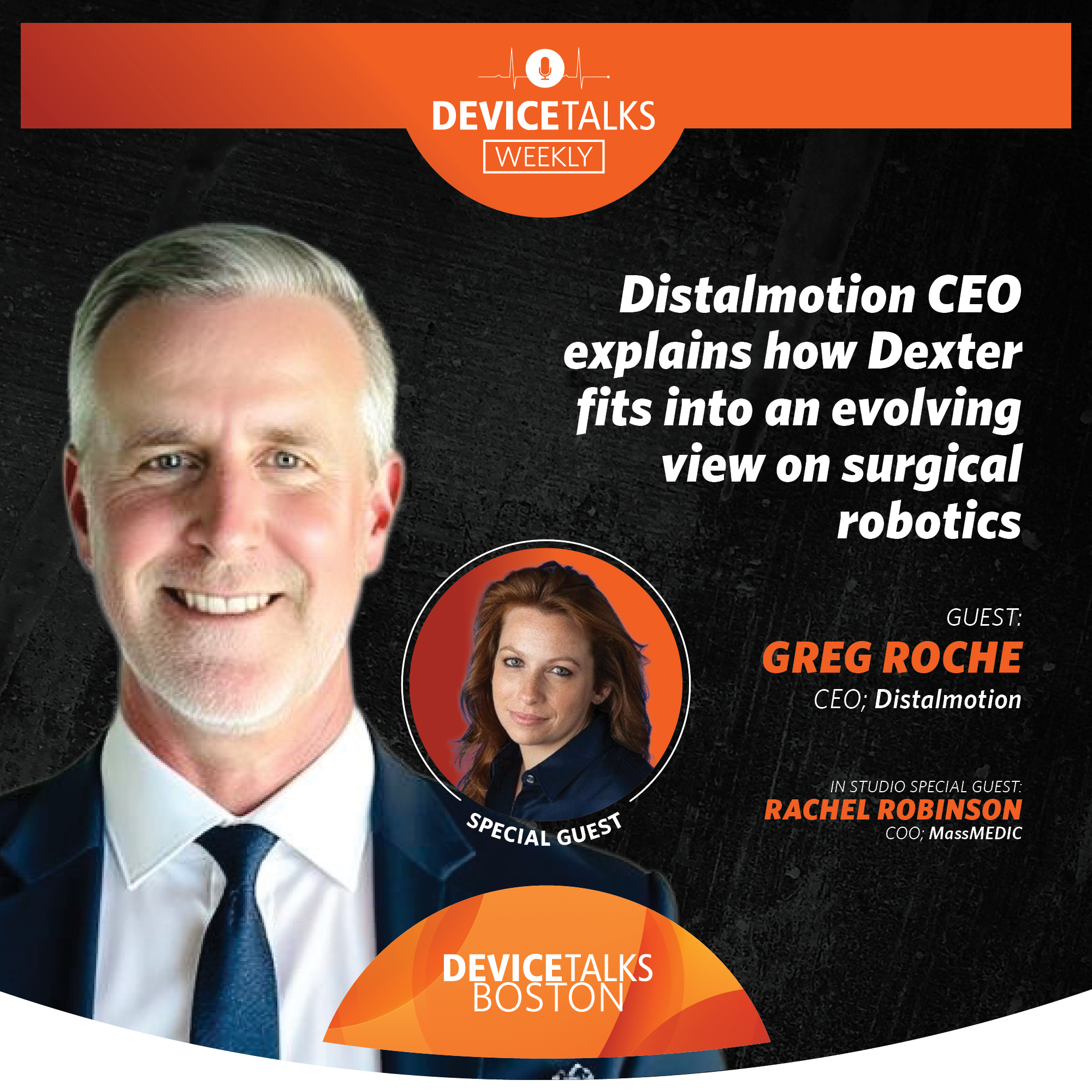
All right, now it's time for our keynote conversation. Again. Our guest is Greg Roach. He's the CEO of Distal Motion. I spoke with Greg a few years ago. We'll have the link to that interview in the show notes. If you want to sort of get a part one of Distal Motion, this is part two. They've had a lot of news going on of late and definitely wanted to catch up on one of these movers and shakers in the surgical robotic space. Let's list.
Well, Greg Roach, welcome back to the podcast.
[00:25:34] Speaker D: Great to be here. Good to see you, Tom.
[00:25:36] Speaker A: Good to have you. So we, we, we talked a few years ago, got into your story how you found your way from the tech industry into medtech and about your love of, of Cleveland, your, your home. So we don't have to cover that. Again, folks can look to the link in the, in the show notes and they can find that previous episode. We're going to go right into the story of Distal Motion. When we spoke last, you folks were, hadn't yet received FDA approval for your Dexter system. You've since gotten that, you've since had a successful rollout. So I thought this was a nice chance just to kind of learn from, learn from doing or from your doing and see what surprises you found. So before we get into that and boy, I'm asking a really long question.
Tell folks about Distal Motion in, in Dexter specifically. So tell us a bit about Distal Motion.
[00:26:22] Speaker D: Yeah, so Distal Motion originated in Switzerland, in lausanne, from the EPFL. So out of academia in 2012 really was, believe it or not, a mechanical solution in the beginning which was converted to robotics in the mid 2010s.
So very interesting. But you know, I've talked a lot about this, which is Distal Motion made a choice 10 years ago on a form factor of a robot which is perfect for the ambulatory surgery center environment. And that choice is something that we've really amplified over the past few years. So this is a soft tissue robotic platform in Europe or approved in urology, gynecology and general surgery. And we're I would say seeking approvals in low acuity, high volume surgery that's done in that outpatient setting today. And we've now have three approvals which we can talk through and have really started to do great things in Europe. And I always talk about Europe being the springboard for this company. A lot of the clinical studies that we've done have originated some of the major Markets of Europe. And now we're about a year and a few months into a launch of Dexter in the US and we can talk through some of the learnings there and why we think we're really poised to win in 2016.
[00:27:44] Speaker A: That's great.
I want to take a moment to just unpack your history just a bit. You joined Dexter, I'm Sorry, you joined DistalMotion in 2023 as CEO.
A few years prior to that you were at Zimmer Biomet. We led up robotics and technology for Zimmer Biomet. So you've got some experience in the surgical robotics industry.
If we can zoom out just a moment and just take a look at the surgical robotics field as a whole. How do you think things are? How would you assess the surgical robotics market today? Or how would you describe it to someone? How has it changed over those five years or so?
[00:28:23] Speaker D: Yeah, so. Well, in one of the experiences in the middle. Tom. So I for two years ran a German soft tissue robotics company called Avatera Medical and I had a thesis when I started there that is much different than the thesis I have today, which I think applies across every discipline, which is you still have to solve a problem. The world doesn't need more robots necessarily. And my thesis four years ago was maybe it did, you know, you have one major player in soft tissue. Maybe the world just needed more robots. And now I would tell you, I think the world needs purpose built robots that solve big problems.
So it, but look, you know, Orthopedics was probably the first. So I take my learnings from Zimmer and the launch of Rosa. Orthopedics was the first frontier where you started to see competition. And you know, I think in, you know, very large companies all having relevant platforms and I think that's gonna happen in soft tissue. But what, what we've seen and what I, I, I still am shocked. When we started that journey in 2017, the number of procedures being done in an, in an outpatient environment were, was very little.
And now, you know, again, I'm, I'm not as close to orthopedics, but I think it's pretty close to half of the procedures are being done in that outpat of, on a robot. I think when you, when you find something that adds value and in that case in orthopedics they were bringing information that no one had.
So I thought in my mind it was less about the robot itself, but the data that the robot provided in soft tissue. You know why, why I love this solution from distal motion and Why I love Dexter is the riddle is being solved by having high dexterity for very complex surgery. So the ability to suture, dissect and work in confined space, that's what wristed instrumentation does. And that's really what allows, you know, why robotics is beneficial in those types of surgery.
What our equation is, is there've been a lot of limiters on bringing robots into the site of care that is probably preferential for the patient and for these types of procedures that we're going after, these lower acuity, high volume surgeries which really we're now seeing, hospitals, payers, physician preference, patient preference, everyone is really pushing these into a less invasive site of care. So again, the decision that distal motion made in 2016, 2017 is the one we're amplifying today. But that's what I see. So whether it's dental or something for cataracts or cardiac, you still have to solve a problem. And our problem that we're solving is access. We're allowing potential partners to access robotics in a new site of care, removing economic and physical barriers that other robotic platforms bring. So that's, you know, that, that to me is the thesis in robotics, generally speaking.
[00:31:19] Speaker A: And the limiters that have kept the robots out of the, the outpatient out of the ASCs are what are size and cost primarily?
[00:31:28] Speaker D: Yeah, well, form factors. 1. So one of the things that we're seeing, especially now in the United States is, but this actually happens even in markets, Switzerland, Germany, France, the mobility of our system. So not only the size, but the ability to not have a room beholden to a robot. And the reason I say that is if you're doing orthopedics on Wednesday and general surgery on Thursday, you can't do orthopedics with some of the room sizes, with a larger form factor sitting in the back of the room, it's just not enough space, you know, Cause you have the tower, the console, the robot itself. I mean, it's a lot of space. So we really free that up.
[00:32:06] Speaker A: Up.
[00:32:06] Speaker D: Sterilization is another big piece. So we've got a single use instrument platform.
The other thing though is workforce. You have some limitations there. In our case, the surgeon is sterile, so they can get to the field, they can do more with less. Meaning they don't necessarily need a sophisticated first assist. If they don't have it, they can, you know, they can do the surgery with a scrub nurse. And I think over the course of time we're really going to push two concepts that I haven't heard much. One is Solo robotics.
So the ability for a surgeon, because they're sterile, to do the surgery on their own, which I'm confident no one else in the world can do. And the other is what I would call flip room robotics. So the ability to move a robot room to room and create a high efficiency.
But that last point you said is also economics.
Bringing enough value in the low acuity procedures where reimbursement is not as generous, but still drive a profit for these facilities. And we know we can do that. So we feel really good about where we are just based on what we see and what we see coming into the marketplace.
[00:33:13] Speaker A: Let me unpack the solo surgery thing for a moment. So by if I'm understanding your point, a surgeon using Dexter is within the sterile field already, whereas with some of the larger robotic systems, they're outside the field, they're using the controllers and things like that.
Why, what's, what is, why is that the design of Dexter and what is a.
Expand a little more on the significance of that, if you will.
[00:33:38] Speaker D: Yeah, so with Dexter was, was, you know, the concept of Dexter was created again, the market was different. There was a transition from laparoscopic surgery to robotics. It's still happening. But I think everyone would agree in our space that robotics is fairly prevalent at this point. But, but we felt from a safety perspective, from an efficacy perspective, the ability for that surgeon to still be able to touch the patient, not sit at a console across the room, was important.
Them not only efficiency relative to the surgery and connectivity relative to the team and to the patient, but it also allows them to choose how they want to approach that particular surgery. So there's preferential tools that they use that they can still use in this environment. You know, stapling and advanced energy. They can use anything they want. You know, and this is where, you know, I really loved distal motion. Distal motion's approach, which was, you know, our approach is one of allowing the surgeon to choose the ecosystem that they, that they present to that patient for that particular procedure. We're not, we're not dictated the ecosystem. And again, that is a much different approach. If you look at all these other systems, they're all closed.
You know that you can use any imaging, you can use any advanced instruments or energy with us where those are necessary components of others ecosystems, which inevitably drives cost.
So, you know, having this flexibility brings clinical flexibility, but it also brings economic flexibility and you have to have boom.
[00:35:18] Speaker A: I asked you to introduce distal motion earlier.
I didn't get into Dexter. Talk a bit about Dexter. Give us A better understanding of its form factor. I should say form factor instead of size and how it fits and then maybe explore your next point, which was the flip the room sort of strategy.
[00:35:39] Speaker D: Yeah, so it's very small form factor intentionally. It's modular, you know, so we have two instrument arms and a camera arm. And then, and then the surgeon sits at a console where they're sterile. But it's minimalistic is probably the best word. And highly mobile. So you can move this in and out of a standard door frame. You know, the team gave me an example the other day. We did a, we did in a 10 by 12 supply closet, which very difficult to do. And when we talk about mobility and kind of this flip broom concept, you know, I've been in multiple, you know, case visitations where we're doing four cases in four different rooms.
And again, if you think about it in an asc, you know, incredibly important for them to be able to do that and to have the flexibility and freedom around block time. But even in a hospital, you know, our European partners utilize this all the time. The concept of having a room designated for a robot goes away.
So this is, really frees up the flexibility. You never lose access to the robot, regardless of site of care. But it's amplified in the ASC market, really amplified because it allows them to do a case wherever they want. Flip room or that concept is you can, you know, be performing a hernia surgery. And when you're done using the robot, you know, and you know, the patient's coming out of anesthesia, et cetera, that robot can be moved.
So you're moving that robot away and now that the next room. So when you talk about driving high efficiency relative to volume, that robot can be moved. And again, we, we have documented evidence. You're talking four minute setup times, you know, and it takes the staff about two hours to learn how to integrate this into their practice. So it's, it's incredibly simple, but again, maximizes what surgeons and providers need to do in that side of care, which is be really efficient.
[00:37:36] Speaker A: Interesting.
So give me a sense of the size of Dexter. Is it smaller than a washing machine? Is there an appliance you could. Is it the size of a dishwasher? Obviously dishwasher is fixed, but give me a sense, give us a sense of the size.
[00:37:50] Speaker B: I think it's like.
[00:37:51] Speaker D: And you're asking the wrong guy. I could probably get somebody on the call, but like 120ft.
[00:37:57] Speaker A: So it's of a size that one person can wheel it in. One person can wheel it out.
[00:38:01] Speaker D: Oh yeah, yeah, yeah, yeah. So it's smaller than, it's thinner than a washing machine, that's for sure.
And again, because it's modular, you're dealing with three small units and then a surgeon console which is really small. I mean, to give you an idea, when we were first launching in the US I have a very small office here in Cleveland and I took it off a truck myself, put it into an elevator and put it into my office. So pretty easy to move around.
[00:38:29] Speaker A: Pretty easy to move around. So let's unpack sort of your experience on the market. You received FDA approval last year, correct? Or two years ago.
[00:38:39] Speaker D: First one was 4Q of 24. So. And that was inguinal hernia. Yeah.
[00:38:45] Speaker A: Okay, so what when we talked last, you had not yet received it. So we were speaking in more speculative terms. So take us to the part two of this story. You got the FDA approval to get started.
How did your commercial rollout start?
And sort of walk us through the past almost year and a half have.
[00:39:03] Speaker D: Yeah. So the we we got a first approval for buenal hernia in November of 24.
We received approval for cholecystectomy in May of 25. And then we received approval for hysterectomy and the latest version of our robot and let's call it we did first cases in October of 25.
And so what we, you know, we got out of the gates really nicely. You know, I look at 25 as really kind of a limited launch for us, but we got some great partners over the course of that year. But for us to have mass adoption, we needed three things.
We needed multiple indications.
When you're trying to build a pro forma for a customer or potential partner on on one particular surgery, that's very difficult.
So having now three very large and with hysterectomy we got approval for several other gynecological procedures. We now have enough that represents about two and a half million procedures total in total in the US and we'll talk about what we're going to do this year. But that gets us enough substance to really build a financial proposition for an ASC that makes sense. So that was step one. Over the course of 25 we built the team all structures we need, obviously clinical support, training. We have three training centers right now in the U.S.
advent Celebration Memorial, Herman and UCSD are where we do our trainings.
We have built a sales team strategic team that helps us serve both the large ASC management groups and IDNs.
And we see a lot of migration of these types of surgeries from the main hospital in an IDN to the asc. So that's a great customer for us. And then this last unlock was the robot. So we actually released this robot first in Europe in early spring.
And to give you just maybe two statistics, we grew a procedural volume in Europe last year, 200%.
So really solid performance. And it was really based around this latest version of the robot, which we got up in the U.S. in October. And even in the U.S. we did the same number of surgeries in 4Q as we did in 1Q, 2Q and 3Q combined in the U.S. okay, so this was for us, kind of the technical unlock. We needed the team and we needed those procedures approved. And now we feel like we're really moving downhill. And why we think 26 is going to be a great year for us.
[00:41:49] Speaker A: Who are you competing with for these ASCs?
[00:41:55] Speaker D: Yeah, I think everyone talks about it.
I think execution is where the rubber meets the road. And what I would say is we feel like we have a very unique opportunity for distal motion only because of all of those limiters that I mentioned that we solve. Mobility, flexibility, sterile console, single use instruments, so no large sterilizers required, no special electrical waiting on the floor, staffing, but then also economics. And when you look at some of the competitive technologies, they may solve one or two of those things, but not all five.
And so you could have a system that's mobile, but if it's $2 million, it's going to be very difficult for you to implement that into an ASC and serve low, you know, that lower complexity surgery. So you really have to have both the clinical components that I mentioned and the economic components.
And right now we feel like there's very few that have both.
So, you know, there are a lot of robots that are going to serve high acuity cases in the hospital. And we do that, of course, but our focus is to create access work.
You can't have it normally with traditional systems. So we feel it's a bit of blue ocean for us for a moment.
[00:43:17] Speaker A: So your view is so intuitive. Medtronic has the Hugo approval. You're seeing those players largely fighting over the larger clinical settings that you're not pursuing.
And you're operating more, focusing more on the ASCs. I mean, there's other companies that are looking at that space as well. Is it becoming competitive? Are you finding a lot of other sales reps in the waiting room? I don't know how Roblox has sold. I don't Know, if you're obviously not sitting there with a bag full of samples trying to get inside side, that's for sure. But what does the field, the competitive field look like for you?
[00:43:56] Speaker D: Well, look, I mean, outside of, you know, the player, everyone knows in the US and I think they've been very clear on their strategy of selling reefer product in the ase, you know, to me, that doesn't solve every issue necessarily. Selling something less expensive doesn't solve size, doesn't solve mobility, doesn't solve, solve the need for staffing, doesn't solve sterilization requirements, electrical requirements, et cetera. So outside of that, yeah, I mean, if you look at just the indications that are approved, maybe with the exception of cmr, it's high acuity stuff that they're going after first so that, you know that that's done in the hospital, that's not done in the ASC.
Generally speaking, there are a few ASCs that do urology and I think I saw somebody post on it yesterday, but I think that's the exception rather than the rule.
[00:44:48] Speaker A: I think it's fair to say the ASCs are the growing market here. I think there are a lot more ASCs being built than large clinical hospitals. For sure.
[00:44:54] Speaker D: Yeah, agree.
[00:44:57] Speaker A: So what sort of success have you had? Give us a sense of, you talked about the numbers of the procedures, the success you had in Q4. What are some other milestones that you're sort of pointing to as signs that you're headed in the right direction?
[00:45:10] Speaker D: Yeah, I mean, you know, we're not obviously given revenue or numbers of robots. But you know, I, I mentioned to you before relative to clinical traction. So I look at utilization as a key indicator of success. And you know, growing the European business by 200% to me is substance. You know, I think you saw we eclipsed 3,000 patients later in the year last year, and we expect to do a lot more this year and it's already trending that way. We, you know, we'll have, have the best quarter we've ever had in the US and globally in Q1.
So we, we feel again now that we, we can apply the learnings we've had and again we got through those three components that I mentioned, which is right robot, right team and right side of care care.
So now we're kind of, you know, slash white procedures. So now that we have the right approvals, we have everything in place. We, like I said, we feel really, really good about where we are. And the, the clinical component for us is the leading indicator you know, the numbers are showing that people are using it and when they buy it, it just, it doesn't sit there. You know, coming out of, coming out of Q4, the average cases per robot per year were the best they've ever been.
And you know, that, that to me is a testament of a product being used.
[00:46:31] Speaker A: Are they buying the, you mentioned the single use devices. Are they buying the new devices from you? Are you selling the devices as well, or are you using other devices, meaning on the consumables? Yes.
[00:46:44] Speaker D: Yeah. So, so we, we, We've done about 50 different types of surgery with five instruments. But again, right now, if they want to integrate, and again, this is probably more of a European statement because of the cases that we do outside of this direct, if they want to use energy or stapling, they use a bedside so that they, they choose, not us. We have five instruments, two graspers, a needle driver, a hook and a scissor, and we can do all of that surgery. So again, this is part of our, our value proposition is keeping. Although robotics are complex and it, you know, it took 12, 13 years to get the product to where it is today, and a tremendous amount of investment, we want to keep it very simple because that allows people to integrate in a much easier fashion. The more you complicate, the harder it is.
So we feel one of the best things that we've seen is a surgeon can get off a robot in a hospital, walk over, get on Dexter, and they have very low mental load.
That is very important in my opinion, to drive adoption option is, you know, they can get off, you know, whatever they're used to using and implement Dexter. And it's, it's simple both for the staff and for the physician to integrate.
[00:48:02] Speaker A: But are they, and forgive me if I'm not grasping it, are they. Are you after selling a system to an ase, are you also then in the business of selling them replacement tools?
[00:48:14] Speaker D: Yeah, they use two to three instruments on every procedure.
Yeah, yeah.
[00:48:20] Speaker A: And you're providing those.
[00:48:21] Speaker D: So, yeah, depending on the surgery, they may use other instruments that come from somebody else.
[00:48:27] Speaker A: So how does that, if you don't mind me? Well, I'll ask and you can share if you want to, but is the. What percentage of your revenue will come from the sale of systems and what portion would come from the sale of supplies or tools used in future surgeries?
[00:48:43] Speaker D: Yeah, so we have three buckets of revenue now.
[00:48:46] Speaker A: Yep.
[00:48:47] Speaker D: Like, like a lot of robotic companies, we have the, the robot itself. We have instruments that are used on a case by case basis and you have service. So the maintenance around the robot, all of which are, I think, pretty standard revenue streams right now. Given where we are in our launch, we're much heavier on the sale of the system, you know, but if you look at maybe the history of some of the bigger robotic companies, it took quite a bit of time to. For that to level out.
We think maybe five to seven years that will start to level out where you have kind of a good healthy split. But it will be in the early years, always a bit heavier on the capital or the robot side until you have an install base. But the service is a nice annuity as well. So that gives you a nice predictable revenue stream. The other piece, for us, that gives us a nice advantage with the ability to do a lot of this low acuity surgery that has tremendous volume. We actually think over time we can get a lot out of each robot. So more surgeries, because these are 30 minute or hour procedures versus six hours.
[00:49:56] Speaker A: Gotcha. Interesting.
So final area I want to cover just sort of the company itself, operations. You've raised some Money. You raised $150 million.
Closed on it. November 2020 5th, you announced your strategic investment from JJ, which was interesting, and the appointment of a new executive chairman. So sort of give us a state of the company in terms of financing and sort of maybe corporate structure and then we can understand where maybe what's next.
[00:50:26] Speaker D: Yeah, well, the fundraise was obviously the tenant around that was commercial expansion and very much focused on, you know, usa. That, that is great because I think anyone would tell you in my role that fundraising is a tremendously large part of your role. So when you can get some of the. Something like that done, and we have fantastic investors around us now that have been incredibly supportive that that's always a great win.
The second piece, it was nice, you know, to add JJDC to the cap table.
You know, they bring a lot of good perspective so that, you know, it was very, I think it was, it was very gratifying also, I think an acknowledgement of the strategy, you know, in the area where we're focused and what we're trying to accomplish, given that, you know, they have a good understanding or a keen understanding of robotics.
So I think that investment just shows that we might be doing something interesting. And then relative to kind of where we are, we Chas Macan, who's now our executive chairman. Chas has been a public company CEO. You know, as we prep in the future for ipo, we knew we needed this type of talent. Chas has had success at multiple companies.
Great success. So Apollo, Endosurgery, Silk Road, both which were acquired by Boston Scientific, but was also CCO at Torax and Intersect ent. So he just brings a great, great experience. He's a. For me, you know, a great sparring partner and for the team as we kind of get ready for our next stage. You know, obviously we have some things to do commercially before we're ready for that. But, you know, again, we think 26 is kind of the launching pad for us relative to that strategy and why Chaz is here.
[00:52:19] Speaker A: Interesting. I'm just trying to think as someone who's.
I wanted to get your sense of this as someone who's been in the industry. I'm thinking as you talked about the potential for an ipo, the last surgical robotics company company to go public was it Mazur. I mean, we haven't really seen a lot of smaller surgical robotics companies go public. So does this.
Yeah, you're right. That was through a spac. Yeah, that's another one. Good point. But does this feel like. And I think we covered this a bit in the last conversation we had. But where. And we'll close out with this. Where is Surgical Robotics sort of heading? Are we moving into sort of a sorting cause? You had success raising money, but on the other hand, I heard other smaller companies, maybe the spigot's drying up a little bit for capital. I think VCs are sort of maybe grouping their bets as opposed to placing a lot of different bets. And if we're going to start seeing some success on the public markets for surgical robotics companies, this feels like it'll be a nice maturation milestone, I think, for the field. Do you think we're reaching that point?
[00:53:19] Speaker D: Yeah, well, relative to the market, I would tell you my observations because I've talked to almost every stakeholder, whether public, private investors, some of the others that would be interested in these types of companies.
You know, I would say I think it's, it's dependent on who you are. And what I, I think the market is ready for is companies that have strong commercial cadence.
So when you, I think the harder part, you know, you got the early stage that I think that investment still exists, but it's, it's kind of the, the companies that are in this limbo between commercial acceleration, which is easy to predict in a genesis of a product.
And that's where we had some success with the fundraise. But before we were ready for a public an ipo, we know we have to get commercial cadence to a place where it's predictable, sustainable, and ready for that.
So that's our focus right now. We believe the product's in the right place. I believe the market. Market is ready for this. You know, I. I think the other example of a company that's actually done, you know, pretty well, maybe in a little lull, is Procept.
[00:54:31] Speaker A: Mm, yep, good point.
[00:54:33] Speaker D: But that was a bit of a different time. But we want to have some flexibility. So, you know, we're thinking about how we get there. Do we do another round of fundraising before we get there? But I think the one thing that we know is, regardless of what we do, we got to focus right now on commercial execution and making sure that that's in a great place. And then the modeling and everything that everyone needs to do is actually much easier. But, yeah, I think over the next couple years, I think we're going to see some folks have success there in different sectors of robotics. I think it's very possible. I mean, Histasonics was another.
Yeah, that was a great outcome for those investors. And I can't remember the number of robots that they had in the marketplace, but it was less than 100.
So I think the market's ready.
You just have to have some evidence.
[00:55:24] Speaker A: Fantastic. All right, well, it's great to catch up on Distal Motion story, and we look forward to tracking your future success. Thanks for joining us on the podcast, Greg.
[00:55:33] Speaker D: Yeah, thanks, Tom. Always good to be here.
[00:55:37] Speaker A: All right, well, that is a wrap. Thanks so much for joining us on this episode of the Device Talks weekly podcast. As always, we would love you to subscribe to the Device Talks podcast now network so you don't miss a future episode. We'd love to see you in person at Device Talks Boston and Device Talks Minnesota. Device Talks Minnesota is happening on May 4th. Device Talks Boston's happening on May 27th and 28th. Use the code DTW25 to save 25% off the price of registration for both of those events. And we'd love to see you in person. If you want to get a little bit of digital insights, little digital discussion, join us on Device Talks Tuesday.
The next one is 4pm this Tuesday at 4pm Eastern. Brought to you by Confluent. You can find out more information@device talks.com that's free. You can ask your questions whether you watch it live or watch it on demand. I hope I do see you at the Mass Medic Gala and symposium, but if I don't see you there, connect with me on LinkedIn. Connect with Chris Newmarker on LinkedIn, connect with Kayleen Brown on LinkedIn, and of course, we'd love you to follow Device Talks and mass device on LinkedIn as well, so we are able to participate in your future MedTech conversations. All right, folks, thanks again for joining us on this episode of the Device Talks weekly podcast.