Episode Transcript
[00:00:00] Speaker A: Hi everyone, this is Tom Salemi of Device Talks. Welcome back to the Device Talks weekly podcast. Great to have you here. Got a great episode for you. We'll have the new markets newsmakers coming up. Chris and I also bring a little value add to the conversation. At least I hope you think so.
Later on I'll speak with Amazer Reitmeier. She's the CEO of Faro Neuro. She previously had been with Medtronic. We'll talk about her career at Medtronic and why she decided to leave to join a very unique startup offering operating rather in a space I hadn't really talked to a lot of people about before. So enjoy that conversation.
Before we begin though, I hope you'll join us at Device Talks Minnesota. It's going to be a great one day event. We've got four keynotes lined up, several panels involved looking at Neuro, looking at structural heart, looking at the use of AI in device development. We'll have some great technical presentations by our chosen by Jim Hammerand Managing Editor of Medical Design and Outsourcing and much, much more. So I hope you'll join us on May 4th. And go to minnesota.devicetalks.com to check out the agenda, the speaker list and to register. And when you do register, make sure you use the code DTW25 to save 25% off the price of registration. That's the gift we like to give our Device Talks listeners.
Also, I hope you'll join us on Tuesday. We've got a great conversation with our friends at Millar on Device talkstuesdays. The title is Common Misconceptions and Sensor Integration and How to Avoid them takes place 4pm Eastern and you can again register at Device Talks Calm. That's free. You can watch live, get your questions answered right away or watch on demand and get your questions answered less than right away. But you will get them answered. So I hope you'll register for that upcoming Device Talks Tuesdays. All right now let's get this podcast started.
Are you ready for this?
[00:02:02] Speaker B: Ready,
[00:02:23] Speaker A: Chris Newmarker how are you sir?
[00:02:25] Speaker B: Doing all right, Tom, Doing all right.
[00:02:29] Speaker A: I'm dragging a little bit this morning. I was at the Mass Medic MedTech Impact Symposium in Gala last night. It was a very good time, but yes.
[00:02:38] Speaker B: Meanwhile it's spring break at the Newmarker household and we decided to see if the kids were old enough we could just wing it. Having them just enjoy the house while we work this week.
I mean it's all right, but I'm a Bit tired. I don't know. I'm slightly tired with this.
I think I hear somebody playing a piano in another room right now.
[00:03:00] Speaker A: I can hear a little bit of music in the background. I'm not sure if our microphones are picking it up, but.
[00:03:04] Speaker B: Good times.
[00:03:06] Speaker A: Yeah. It must be nice to be living in such a vibrant, music filled household.
[00:03:14] Speaker B: It is, it is. It's real. It's, you know, it's, it's keeping my mind active. It's, you know, it's. It's a good time. I'm living the dream, man. I'm living the dream.
[00:03:21] Speaker A: Absolutely, absolutely cherish these moments, Chris Newmarker, because, oh yeah, you'll. You. Once the house is perfectly quiet and you and your wife are enjoying each other's company very much with no distractions, you'll be just missing these days of constant noise and disruption.
[00:03:38] Speaker B: Constant noise, art projects, everything else. Everything else going on. Exactly. It's a good, it's a good time.
[00:03:45] Speaker A: It's a good time.
[00:03:46] Speaker B: I did, I did take a little bit of time off early this week, so got, got the kids to a museum. Got it when I went on a really nice long B ride. You know, it was a. It's good, good times.
[00:03:56] Speaker A: So bike ride. You have bike riding weather there. We still have crappy weather here in New England. You know, one good day on Wednesday. Wednesday was good, actually.
[00:04:05] Speaker B: It was 70 degrees and sunny here on Monday.
But. But now it's in the 40s and cruddy outside today, so I mean, don't, don't worry there.
[00:04:14] Speaker A: Yeah, the poor mathematic folks had. Well, it was not, obviously it was indoors, but it was a rainy raw day yesterday. So Mass Medic is. The Medtech Impact Symposium is not a destination sort of venue.
No one's going to be traveling here for spring in Boston, but it was an excellent event.
Mass Medic does a great job. I got to moderate a panel which was always fun and met lots of fans of the podcast, which is pretty fantastic.
[00:04:44] Speaker B: Mass Medic's run by the founder of Device Talks, Brian Johnson. You were telling me Brian. Now he's made peace with us calling him the godfather of Device Talks. He likes.
[00:04:56] Speaker A: He's embracing it. He's embracing it.
[00:04:57] Speaker B: It's fantastic. Just come on, come on, Brian.
[00:05:00] Speaker A: We'll have an interview with Brian in a little bit. I interviewed him while we were down at the Mulling. I was down in the Mulling studio last week, but yes. And Brian informed me that this is. I don't know if I mentioned this last week but this IS device docs 15th anniversary, so. Yeah. Wow.
[00:05:15] Speaker B: Yeah. So, Brian Johnson, we salute you for getting this started and we just keep this thing going.
[00:05:21] Speaker A: Absolutely.
[00:05:22] Speaker B: Absolutely growing. And just like the audience that you were telling me at Mass Medic event yesterday, like, you know, you. You had a number of people comment about the podcast, and I always do at events as well. So, I mean, just. Just really appreciate our whole audience here and how much they love what we
[00:05:36] Speaker A: do and the caliber of the people too. Someone comes up and says they love the podcast and then learn they have a senior executive at a big medtech company and they're a cardiovascular surgeon. I'm like.
And you, you're. You're saying I do a good job.
I'm an idiot with that.
[00:05:52] Speaker B: Amazing, right?
[00:05:53] Speaker C: Yeah.
[00:05:54] Speaker B: Like, we're like schmoes compared to you.
[00:05:57] Speaker C: What are you?
[00:06:01] Speaker B: We're just some dudes sitting around with headphones. Come on.
[00:06:05] Speaker A: It's pretty, pretty crazy.
[00:06:07] Speaker B: So glad we could spread the information, the news and keep on growing this. This whole, whole wonderful industry. So it's fantastic.
[00:06:14] Speaker A: So, yeah, and I think we need to build into this sort of a.
Based on our number one newsmaker, which we'll get into. Obviously, fitness apps are the thing. So, yes, many people tell us that they listen to us when they jog or things like that, including, yeah. Brent Lavin, friend of ours, friend of device Talk. So maybe keep on going.
[00:06:39] Speaker B: Come on, you can make it, Brent. You can do this, man. Come on.
[00:06:43] Speaker A: I think if we do that throughout the newsmakers, then we can maybe sell this podcast as a.
[00:06:47] Speaker B: Don't you start walking. You can make another mile, man. You could do this. You got this.
[00:06:52] Speaker A: All right, we'll start sounding a bell every 10 minute mark so people can. Well, that's my mile. Brent. Smile is probably much faster than that.
Well, keep going, Brent. Everyone else who's running, peloton, that's right. Whatever you're doing, Heather, hard nut. Paige, if you're listening and running, you go to.
[00:07:11] Speaker B: Come on, you can do this.
[00:07:13] Speaker A: Lots of folks. Keep fit.
Keep fit. All right, so now we're a wellness app and we'll raise money for and get a $10 billion valuation. How's that sound?
[00:07:24] Speaker B: Fantastic. Yeah, I love it. This is the best.
[00:07:30] Speaker A: All right, let's roll into the Newmarkers Newsmakers, AKA Tom and Chris's wellness app.
[00:07:36] Speaker B: Yeah, there we go. So you know the ever healthy Newmarkers newsmakers.
Get your bowl of oatmeal here. Keep on running because we got protein.
[00:07:48] Speaker A: Protein. Go ahead first.
[00:07:49] Speaker B: Protein. You protein. So Anyway, number five, get, get your sausage shake in the blender. And anyway,
[00:08:03] Speaker A: you're ruining our valuation. It just.
[00:08:05] Speaker B: Sorry, half. Don't, don't do that. Yeah, they're like, whoa, wait.
Anyway, number five on the list, people are like, these guys need to stop joking around. Any number five we got, you know, we just had earlier this week ACC 2026 WRAPP in New Orleans. This is the annual American College of Cardiology Scientific sessions. And our senior editor Sean Uli, he was not in New Orleans, but we were covering all the news coming out of that. And Sean put up a really great roundup on Mass device about the biggest cardiology tech stories out of ACC 2026. And this is like all the major results coming out of the big companies like Boston Scientific, Medtronic, Edwards Life Sciences. And we got studies on technologies ranging from heart valves to atrial appendage closure devices to heart pumps and much more.
Just one of the stories that got a lot of attention on our sites from Sean's coverage was Boston Scientific had new Watchmen FLX data and Watchmen, this is one of Boston Scientific's major projects, Left Age Roll appendage closure device. I mean this is basically to close the LAA to reduce risk of strokes in people with afib. And there were 36 months results in this champion af study. And it found, okay, so it was comparing Watchmen to the non vitamin K antagonist oral anticoagulants, the NOACs.
And it found that Watchman FLX was superior. It came to outcomes for people ranging from everything from cardiovascular death to avoiding strokes, systematic embolism, non procedural major bleeding, clinically relevant non major bleeding. I mean the outcomes were better at 36 months with watchman Alpha Alex versus the Noacs. I mean just for procedural and non procedural major Bleeding, it was 5.9 rate with watchmen, it was 6.4% with NOACs. I mean that's a meaningful difference there.
That's just one example of some of the major studies coming out of the event this year. So go check out Sean's roundup.
[00:10:37] Speaker A: Absolutely. It's amazing to me how much of a flex these meetings are becoming. The data that's coming out of these meetings, it seems like companies are really using these as commercial boosting tools, just ways to get out in front of the public at ways to get you and I talking about great devices like the Watchman. So exactly. These clinical meetings are really have become, I mean I think I've heard some of the larger meetings are having a difficulty drawing physicians like aals.
But in terms of the data and the news that these things generate, I don't think these, I can't recall these meetings. They're more influential than ever is what I'm trying to say.
[00:11:17] Speaker B: Yeah, yeah, no, absolutely. Whether it's the ACC meeting or as you said, like aos.
[00:11:23] Speaker A: Hrs. Of course.
[00:11:24] Speaker B: Hrs. Of course. Yeah, yep.
[00:11:26] Speaker A: I mean, with atrial fibrillation taken over, HRS is like I must, a must attend now. So.
[00:11:32] Speaker B: Yeah.
[00:11:33] Speaker A: All right, good. Number five. And let's. Come on, Brent. Run. Jake.
[00:11:37] Speaker B: You can make it, man. Come on.
[00:11:39] Speaker A: All right, number four.
[00:11:41] Speaker B: Number four.
We've got number four. We've got Hisasonics. They're kick, kicking off a study on using their Edison histotripsy system to treat benign prostatic hyperplasia.
But the Edison platform, it's already got de novo authorization in the US to treat liver tumors. So this represents them kicking off a study to expand its use even more. But I mean, this is, I mean, I got to go over and check out their facility, which isn't too far from my house here in Plymouth, Minnesota to check out Edison. Their CEO, Mike Blue was even nice enough to let me do a little test drive. I mean, this is robotic arm that delivers focused ultrasound. You got imaging to show you where you are and what you're going to be delivering that focused ultrasound to. And it, you know, liquefies the, liquefies the tissue.
So just really exciting technology. And you know, people, you know, they've, you know, they've been, you know, they got a significant, they got a syndicate of private and public investors that include money from people like, you know, Peter Thiel that have put, you know, more than $2 billion into them, you know, made a majority investment in them in 2025. So they're really one of the really exciting companies here around the Twin Cities. And now they got their new study. And if you want to find out more about this and much more, I mean, I'm going to be interviewing my blew in front of the crowd at device talks Minnesota on May 4th at the McNamara. So that's going to be just one of many must see keynotes we've got lined up here at that event.
[00:13:22] Speaker A: Absolutely. Yep. No, fantastic. We've got Heather, Nice kicking things off. Kayleen Brown will lead that and you'll have this great conversation with Mike Blue and then I'll wrap up with, well,
[00:13:32] Speaker B: you just posted today Manny Vilafana, the living legend. I mean, yeah, we're going to, it's going to be fantastic. And Then Lisa Earnhardt we're going to be.
Yeah. At least.
[00:13:43] Speaker A: Yeah, we'll hit upon that one a little later in my bet. My bad. But anyway.
All right, everyone hydrate, hydrate, hydrate. Drink water. Hydrate.
[00:13:52] Speaker B: Yeah, water is important. I mean, even if it's not hot outside, you know, it's important to still get some hydration when you're doing this amount of running here. Okay, number three, listen to. You know, it might be good to get some electrolytes in there while you're drinking too. All right, anyway, number, number three on the list we've got Boston Scientific. They completed their acquisition of Valencia.
This is like a coin sized device for treating urinary incontinence.
It's a implantable tibial nerve stimulation device. This is like going down like around the ankle. So it's very similar. It's a similar type of technology to Medtronic's Altaviva, which has been very successful for Medtronic so far. And this really represents Boston Scientific acquiring technology to compete with Medtronic and others in this. In this space.
[00:14:48] Speaker A: Yep, absolutely. Another great acquisition by Boston Scientific.
Keep them coming. All right, let's move on. What's a good note? We're not stretching yet, right? We're still go dig everything.
[00:15:01] Speaker B: Do it, do it.
[00:15:02] Speaker A: You're almost there. We're almost there. Woo. Almost there.
[00:15:06] Speaker B: We're winning this. You got this. All right.
[00:15:09] Speaker A: I'm at the end of a triathlon route in front of my house. So it's always nice to stand in front of people and just say like, almost there, almost there. Because I would certainly like to hear that.
[00:15:18] Speaker B: Do you get to see the water part? Do they jump in water near your house?
[00:15:21] Speaker A: No, it's. It's about a mile from. I could do that, but I actually, I spray them with my hose because it's usually in the summer and they're always very grateful.
[00:15:27] Speaker B: Oh, that's cool. That's really. Yeah.
[00:15:29] Speaker A: If they ask, if they ask some
[00:15:31] Speaker B: people, if they ask, you're all just spraying people like he floss.
[00:15:36] Speaker A: Knocking them over.
[00:15:41] Speaker B: Yeah. What the heck?
[00:15:44] Speaker A: Sorry, number two.
[00:15:45] Speaker B: Sorry about that. Sorry.
Sprayed you.
Anyway, number two on the list we've got.
This is like, you know, more study news out of acc. It was Johnson Johnson Medtech had new clinical findings for its abiomed impella CP system.
This involved, you know, for the first time, like this data that they shared at accident impel. A CP could support the left ventricle for more than 40 minutes prior to reperfusion. And it didn't reduce or increase heart muscle damage. So I mean this is more important evidence to just show the efficacy of Impala cp, these heart pumps that they can run into people's valves and really these pumps provide some meaningful support for people who are undergoing some severe cardiac events. Like you're at the hospital. So good to hear more positive data about it.
[00:16:50] Speaker A: Absolutely. And we've of course to continue plugging our conferences. I'm happy to have Devi Govender at Device Talks Boston. She'll be our opening keynote for that event that's happening on May 27th and May 28th.
And also at the Mass Medic Medtech Impact Symposium in gala. Last night at the gala I sat next to a fan of the podcast, Dr. Sanjeev Agarwal. He is the chief medical officer and vice president of Global Surgical Therapies or at Abiomed, aka Johnson Johnson Medtech Heart Recovery.
[00:17:28] Speaker B: So is he jogging too?
[00:17:31] Speaker A: He's, he's listening. If he's listening to this now, he said he was on his peloton, so.
[00:17:35] Speaker B: Oh, there we go.
[00:17:36] Speaker A: All right, keep it up.
[00:17:37] Speaker B: Keep puzzling away, man. You do this right. Fantastic.
[00:17:42] Speaker A: So all right, our evaluation just went back up. All right, let's keep going.
Number one, all joking aside, like I
[00:17:51] Speaker B: was ready just to give up here and just make a smoothie like, you know, Tom Cruise got me going or you could do this, man. All right, number are the top story today, you know, for the week we've got Abbott joining a $575 million funding round for wearable maker Whoop, which they've developed a wearable technology like 14 day battery life that provides on the wrist that provides all kinds of health tracking from sleep recovery, strain, fitness, longevity.
So Mayo's joining on this round. Interestingly enough, Mayo Clinic joined as well. So fun Minnesota connection there too. So I mean that, that definitely gets people's attention. I think if you get one of the top health providers in the world saying, hey, we see something meaningful in this technology, we're putting some money into it.
[00:18:46] Speaker A: Well, this has something for both of us. Krishna Macrare. WHOOP is a Boston based company. They've got a big site visible from Fenway Park. You can see the WHOOP building.
You mentioned the Mayo Clinic. And of course Abbott will have Lisa Earnhardt at Device Talks Minnesota. She'll be the closing keynote which we alluded to earlier.
[00:19:03] Speaker B: That'll be fantastic talking with her.
[00:19:04] Speaker A: We'll certainly talk about this and this certainly is consistent with Abbott forward facing move. I know you, you had posted a Great article about Lisa last week. Sort of talking about her patient centric consumer customer centric focus.
And this just seems to fit seamlessly into that strategy. So can't wait to.
[00:19:22] Speaker B: Well, yeah, I mean, they have more. Yeah. I mean, Abbott's also been pushing forward. I mean, they have like an over the counter cgm, you know, lingo. So this is kind of cool. They're kind of getting more and more involved in like, kind of this health tracking, digital health space. So, I mean, this. Yeah, very cool.
[00:19:38] Speaker A: And if Abbott and Mayo want to invest in our podcast, by all means, give us a find us on LinkedIn and we are now a wellness app. Podcast. Right.
[00:19:47] Speaker B: Fantastic. Yeah, they can just Venmo too, right?
[00:19:50] Speaker A: Yeah, we do.
Venmo works.
[00:19:53] Speaker B: Son of the old Tom Slemy. Venmo.
Am I getting a piece of the action talk?
[00:20:00] Speaker A: Of course.
[00:20:00] Speaker B: Oh, thank you, Tom.
[00:20:05] Speaker A: You'll get some convertible shares. That'll be worth something someday. No doubt. No doubt.
[00:20:08] Speaker B: Yeah, I can usher the kids in right now to tell them the good news.
[00:20:14] Speaker A: All right, everyone, stop your exercising. Start stretching out, okay?
[00:20:18] Speaker B: Get some good stretching in. You don't want to always injury. Good.
[00:20:22] Speaker A: Exactly.
All right, Chris Newmarker.
[00:20:26] Speaker B: You know, should we encourage them to do some strength training? I mean, strength training is especially good for you, especially as the years go along.
[00:20:32] Speaker A: I think that's a good idea for next week. We'll start talking about some deadlifts and we'll do some, you know, some, some, some bench rows and things like that.
[00:20:41] Speaker B: Is that good? If we can't. We can't spot them, though. I mean, it's not like. I mean, I don't want, I don't want to. I want one of our listeners to have like a, you know, like, like, can you just get this bar? It's like near my chest. Like, I'm sorry, we're, we're, we're talking remotely to you. Like. Yeah, it's can't.
[00:20:55] Speaker A: Yeah, we, we should have a lawyer at the top. State that Chris and Tom are not fitness experts and we're not to be held liable for any sort of injuries that.
That might stupid encouragement.
[00:21:07] Speaker B: I mean, we're both people who probably need fitness.
[00:21:10] Speaker A: I mean, sure, we all need fitness.
[00:21:12] Speaker B: We all need fitness.
[00:21:16] Speaker A: All right.
Great job.
[00:21:18] Speaker B: Hey, it was great as always, man. Hey, and I hope to see many of you at Device Talks Minnesota, May 4th.
[00:21:23] Speaker A: Absolutely. Going to be a great, great time. I hope you enjoyed that installment of the new Markers newsmakers. And I seriously hope you'll join us at Device talks Minnesota on May 4th at the McNamara Alumni center at the University of Minnesota. We had a great time last year. Bringing it back this year really amped up the agenda. Have some great keynotes as we talked about throughout the episode, including Lisa Earnhardt of Abbott. So lots of great networking opportunities, lots of great times to celebrate Minnesota's med tech community and we'd love to see you there. Go to minnesota.devicetalks.com to register and once again use the code podcastlistener DTW25 to save 25% off the price of registration.
DTW stands for Device Talks Weekly.
25 stands for 25% off.
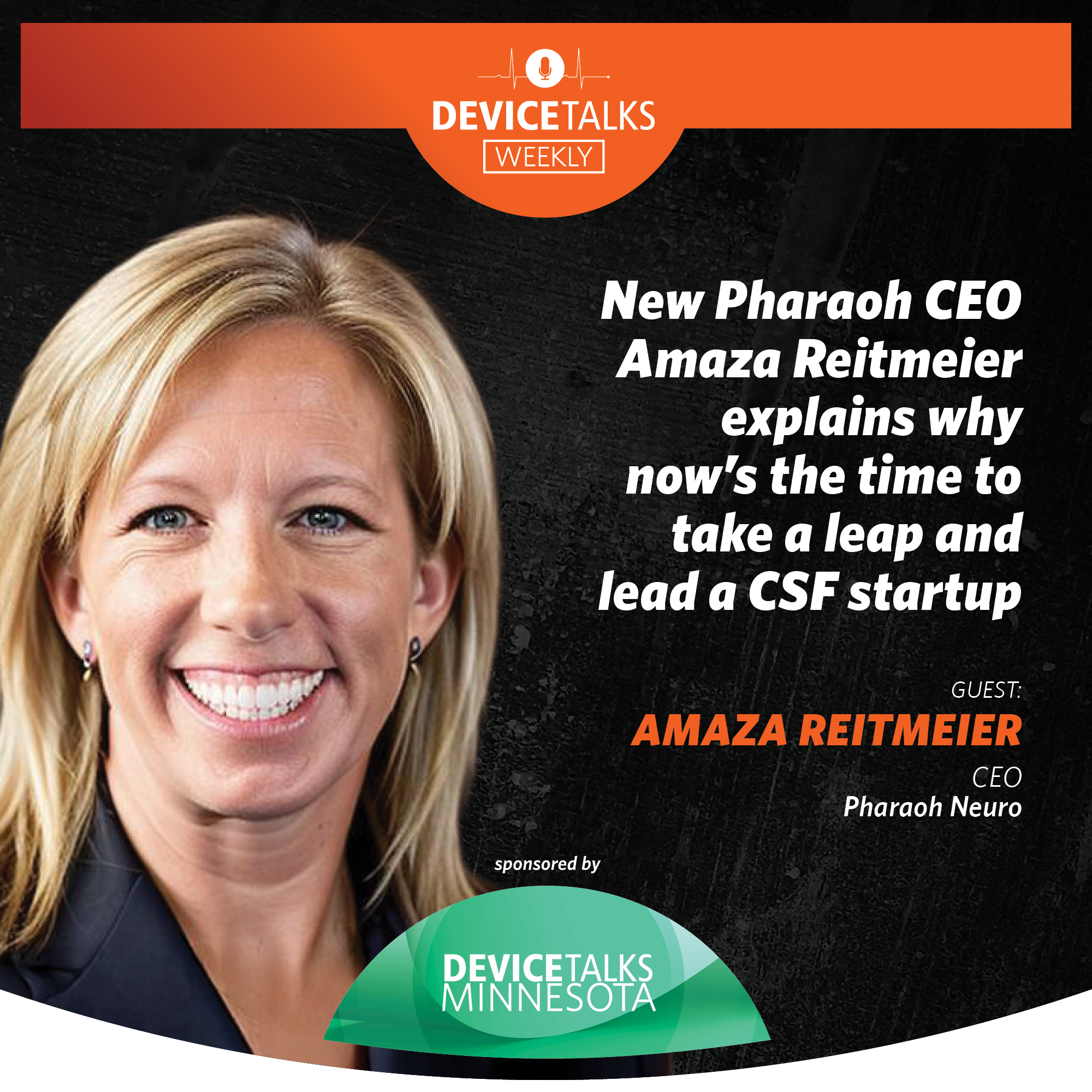
So you don't miss a great time at the McNamara Alumni Center. All right, now it is time for our keynote conversation. I spoke with Amaza Reitmeier of Faro Neuro. She is CEO of this startup. Previously she'd been a Medtronic. We'll go over her career.
She had most recently been VP of Global Brain Health Solutions at Medtronic. So let's hear from Amaza Reitmeyer of Faroneuro.
Well, Amazer Reitmeier, welcome to the podcast.
[00:22:44] Speaker C: Thank you, Tom. Glad to be here.
[00:22:46] Speaker A: Glad to have you. Glad to unpack the offerings at Farrow Neuro, which is the company you just joined. Also interested in learning maybe you know the origin story of the name. We can get into that a little bit later.
[00:22:58] Speaker C: Sounds good.
[00:22:59] Speaker A: We want to find out about your origin story first. Amaza, how'd you get into the medtech industry?
[00:23:05] Speaker C: Well, getting into the medtech industry originally was a little bit of dumb luck as some of the best decisions often are.
[00:23:11] Speaker A: Very true.
[00:23:12] Speaker C: I was working as a salesperson.
I was a wine wholesaler, which is a great job and not a fantastic career.
[00:23:19] Speaker A: You're not the first guest of this podcast to be started a wine wholesaling business. Yeah, it's a real path to medtech, I've learned. So.
[00:23:26] Speaker C: So there you go. So I guess it's well trodden, but a good buddy of mine from college was working here and he had been working at Medtronic, I should say, since college. And we ran into each other and started marathon training together. And one day on a run at lunch, he asked me, you know, have you ever thought about going to work for Medtronic? And I honestly said no. He said, well, it's a great company, you should think about it. And that sort of set me on this amazing career. I basically got in because I was willing to take a job that nobody else wanted, which was contract negotiations.
And I took a 50% pay cut and the leap of faith that the medtech industry would be a great place to build a career. And indeed it has been. And I have never looked back since. I feel really fortunate.
[00:24:11] Speaker A: Yeah, first. First question from that. Did you run the marathon after all?
[00:24:15] Speaker C: Absolutely.
[00:24:16] Speaker A: Okay.
[00:24:16] Speaker C: Yeah.
[00:24:16] Speaker A: Have you run more than one?
[00:24:18] Speaker C: I have run five.
[00:24:19] Speaker A: Five? Good for you.
[00:24:20] Speaker C: Yeah.
[00:24:20] Speaker A: I've only run two half marathons, so I've run a whole marathon, but on in separate years.
[00:24:25] Speaker C: That's probably the smarter way to do it.
[00:24:27] Speaker A: I didn't do it in a row.
And what I. I don't think I've talked in. I mentioned a lot of. Or many of our guests have started the wine industry. I don't know if I've talked to someone who started in contract negotiations. What is that role? Who are you negotiating with and what are the contracts binding of?
[00:24:44] Speaker C: Well, the core skill that I had was business to business selling. As a wholesaler, you're selling to other businesses.
And so my first job was device was pacemaker and defibrillator, contract negotiations with hospitals and healthcare systems around the Midwest region. And it was an interesting time to be doing it because cardiac resynchronization therapy was coming onto the market, but there wasn't reimbursement for the third lead. And so my job was to go in and tell purchasing officials whose job it was to reduce price that they were going to pay more than their reimbursement and that they would thank me for it eventually. Because at that, again, there was no reimbursement for the third lead. And if we hadn't done that and they hadn't gone along the journey with us, we never would have gotten reimbursement for that. So it sort of set that new tech add on, set the foundation for the new tech add on payment, which was really important to a huge growth spurt in the cardiac industry at that time. So early 2000s.
[00:25:40] Speaker A: Is that where many people start or is it jump to the deep end? I'm just imagining someone moving in first day, and they're being.
[00:25:47] Speaker C: I thought that was the deep end. You know, again, I had no idea about pacemakers, defibrillators, heart conditions.
[00:25:53] Speaker A: Feels like it.
[00:25:53] Speaker C: My very first field trip to a hospital, I got to watch a defibrillation system being tested. And to do that, they actually, you know, put the heart into a lethal rhythm and then use the device to bring the patient back. And that was terrifying for someone who had never seen a medical procedure. But I thought, you know, this is pretty amazing work that we get to do if we literally get to save lives with our technology.
[00:26:15] Speaker A: That's amazing. So at what point did you know that this is my career for life? Was there a moment or was it just sort of a slow realization?
[00:26:22] Speaker C: Well, there were two big ones. I mean, actually, that first visit when I got to see what looked like a miracle to me.
This is something worth spending a career on. And then the second was the first time that I saw a deep brain stimulation procedure being performed.
And I got to do that in Australia.
I had just started as the head of marketing for. For DBS. This was 10 years later.
I watched a gentleman who came into the hospital in a wheelchair unable to walk.
You know, during the procedure, they turn the device on and the patient's tremor stops. And I watched him look at his hand and, you know, tears stream down his face as they hand him a glass of water and he takes a drink of it.
[00:27:03] Speaker A: Oh, my God.
[00:27:04] Speaker C: The next day, his neurologist sent me a video of the same gentleman who couldn't walk the day before literally doing jumping jacks in the hallway. And that was the moment I thought, this is what I want to do with the rest of my career, is make miracles like this possible for more people.
And so it was. You know, there were many, but those were two that stand out.
[00:27:24] Speaker A: Do you think you live in the Minnesota area? So med tech's a big part of that space for sure. And a part of the fabric. I think of the community. More so than here in Boston, where we've got a lot of other things going on, including the Red Sox that distract us.
[00:27:39] Speaker C: All the Minnesota sports teams end up
[00:27:41] Speaker A: no knock on the twins. I love the twins.
[00:27:44] Speaker C: Oh, we love them too. They're just not good.
[00:27:47] Speaker A: But do you think medtech gets its due? Because you have these moments like that, these miracles. And you're right, they are miracles.
And we're always. And this is a bugaboo of mine, but we're talking about apps and AI power, this and self driving taxis. It's like, woo, yay. Like this guy couldn't walk 10 minutes ago and now he's doing jumping jacks.
[00:28:07] Speaker C: Yes, well, and you know, when people hear about something like deep brain stimulation, they think, what is this amazing new technology that's been on the market for 30 years?
It's like they're the most amazing companies that nobody's ever heard of.
[00:28:20] Speaker A: Yeah.
[00:28:21] Speaker C: But it's interesting because, you know, right now, brain computer interface technology like DBS is having a moment, and it's because Elon Musk invested.
[00:28:30] Speaker A: Yeah. Right.
[00:28:30] Speaker C: And all of a sudden, it's the cool thing to do.
So we've only been working at it for 25 years here.
35 years. But whatever it takes, you know, as long as it gets the right minds thinking about solving the right problems, that accelerates innovation. That's worth it.
[00:28:46] Speaker A: That's absolutely true. And you're right. Every time I hop on the mass device news site, there's a BCI company that just raised some money, like, literally. And sometimes, too. It's amazing.
[00:28:56] Speaker C: Yeah.
[00:28:57] Speaker A: I was going to say insane, but I changed it to amazing.
So did you. Did you have a sense of a therapeutic focus you wanted to follow? I guess what I'm trying to unpack is, what was the North Star of your career?
I want to do this job or I want to be in this therapy. Or did you just sort of hop from stone to stone to the best next opportunity?
[00:29:20] Speaker C: No, there were. I would call it a couple of chapters. The first 10 years was the first chapter when I really did not know what I wanted to do with my career. And what I did during that time was follow good bosses around. So I had the opportunity to work for really amazing people. And whenever one of them would say, hey, you should come do this instead, I would just say, yes, and go do it and learn as much as I could from them. And so I got to work for people like Chris o' Connell and Steve Osterley and Dan Lemaitre. And they all taught me something incredible.
And that work led me to dbs. So the second chapter was that story I told you earlier about seeing this life transformed through dbs. And that's when I realized, like, this is what I want to do with the rest of my career. And so then I set my sights on basically learning what I would need to learn so they would trust me with running the DBS business, which I got to do.
[00:30:09] Speaker A: Wow.
[00:30:09] Speaker C: And I made it my mission to launch adaptive deep brain stimulation therapy, which, again, we got to do a year ago. And it's transforming the way that DBS therapy is delivered.
So, you know, then it's like, okay, I got to do my dream job. I got to launch this amazing technology now. What? And at the back of my mind that this next dream had formed, that one day I might get to run a small medtech company and bring a new idea to market kind of from scratch and apply everything that I'd learned in the last 20 years to helping a little technology become a big technology and have the kind of impact we hoped it would have, which is part of what opened the door to going to work at Faro. So each chapter sort of built on it. The first 10 years was a little bit random. The second 10 years was very directed. And this third 10 years is like going to be hopefully making another dream come true and bringing a technology market that will help save lives.
[00:31:05] Speaker A: That's great.
I want to get to Farrow in a moment, but you ultimately became VP of global Brain Health Solutions at Medtronic.
We have some people who are, I'm guessing who are younger, kind of at that point that you were where you said, I want to do this, I want to be in this space for the rest of my career and I want to run this business someday.
[00:31:24] Speaker C: Yeah.
[00:31:25] Speaker A: Can you recall? Can you unpack? Can you help people understand? What did you do to learn what you needed to do? Baseline? Are you just reading everything or you're just talking to as many people as you can? Now we have podcasts. Maybe people should listen to podcasts. Like if someone were to say, I really want to follow in your footsteps, what should they do to learn everything they need to learn?
[00:31:43] Speaker C: Well, one thing that you need to do is be extremely clear eyed about what you don't know how to do.
So Medtronic has an unbelievable way of helping to develop talent. And I actually had a little matrix of of basically 10 skills I would need to run a business.
And so I got advice from my mentors saying, well, here's the things you're good at, but here's the things you know nothing about. I didn't know anything about operations. I had never done anything in quality.
I had strong finance background, I had sales, I had marketing. But I hadn't done enough in the global sphere. So I basically looked at that matrix of things and said, how can I put experiences together that helped me learn to do the things that I don't know how to do yet so that when the time comes, I'll be ready to run the business. And then it helped me screen the opportunities and seek the opportunities that would fill in those gaps. So for example, operations was something I hadn't done a lot of. I took a role leading global marketing. Now the title was marketing, but what we were doing is spinning up a first of its kind manufacturing line for wafer scale implantable electronics. And so I took a much more active role in that, that operations scale up than you typically would as ahead of marketing, so that I could learn what it took to get a first of its kind line off the ground to help improve yields, to improve supply. Chain and really meet the demand. So it just was about understanding what you don't know and finding ways to fill in that gap with true experiences. Like, it's not enough to read about it. You have to go in, you have to make mistakes, you have to screw up. You have to have people help you and just be super humble about learning the things that you don't know so that when the time comes and it's your decision to make, you've got some experience to fall back on.
[00:33:28] Speaker A: So you. You really.
Is that. Is that. Do you think that's standard? I mean, it sounds as if. And I'm. And I'm kind of drawing the analogy myself of, like, the. The captain of a ship who could open something up and fix something if they need it to. Like, they know how the ship works. They know.
Absolutely do. A lot of.
[00:33:45] Speaker C: You don't need to be able to fix every little thing, but you need to at least recognize when it's broken. Broken.
[00:33:50] Speaker A: Yeah. Yeah.
[00:33:50] Speaker C: And understand who's got the skills to fix it and ask the right questions and get the right team around you. And it's so much. It's so much easier to do that if you have some sense of what's going on.
[00:34:00] Speaker A: Is that something that everyone does, all leaders do, or do you think that
[00:34:04] Speaker C: was the good ones do?
[00:34:06] Speaker A: Good ones do? Yep. That's the right way to say it. Okay, great. Well, let's. What. Take us to the moment. You're at Medtronic. You're obviously very happy there. And I think everyone who's at Medtronic for a length of time, I think, think will never leave. Really? I mean, they may physically leave before.
[00:34:19] Speaker C: I never thought I would leave. I'll be honest with Medtronics. So.
[00:34:23] Speaker A: So what happened? Let's talk about what happened. What, what, what. What drew you to Pharoah?
[00:34:28] Speaker C: Well, there was a couple of things that came together at the same time. So one, I had gotten to do this really pinnacle experience with launching adaptive dbs, and my boss actually had some interesting advice, and he used this as a way of thinking about his own career journey, which is change when you get to, not when you have to. Meaning, like, things are going well, that's a good time to reassess and say, hey, let's, you know, let's think about what I could do that would be even more exciting or what could make things even better.
And so I had this extremely cool job leading global brain health solutions for Medtronic. I mean, it's a very, very cool job and also his advice encouraged me to stop and think, okay, if I'm going to make one more big career, pivot it.
When should I do that? And upon advice from a lot of different people, it turns out like now was the time. If I was ever going to take that and turn it into leading a small company, I would need enough career Runway to see it through.
I couldn't wait five years. I had to do it now. So that opened my mind to saying, all right, what is a great opportunity out there? And that's when I met the founders of Pharaoh.
And the founders of Faro had a very compelling story because there was a technology that met a very clear, unmet clinical need, has extremely compelling potential economic value, and nobody else is doing it.
And it just. The more I learned about it, the clearer it got that this is a technology that could really make a huge difference for a lot of people.
And it just sort of snapped into place the right time. A phenomenal syndicate of investors believing in it. And, I don't know, it just felt right.
[00:36:16] Speaker A: How hard was that decision? Because you're right, you can hold onto the stock for a little bit too long and you still sell it with a gain. But you said, I wish I got it.
I think most people stay on a little bit too long and they don't leave until things start to maybe downturn a little bit.
[00:36:32] Speaker C: No, I mean, again, I left and it was great. And so.
[00:36:35] Speaker A: So what was it?
[00:36:37] Speaker C: Because of an opportunity that felt so compelling, I couldn't say no. But it took me a year to make the decision. If you think about it, you know, a year, six months of kind of getting ready in my mind to make a change. Six months of evaluating different opportunities to find the right one.
[00:36:54] Speaker A: That's amazing.
[00:36:54] Speaker C: So it was hard to be patient, but I'm glad that I did.
[00:36:59] Speaker A: Was there. Was there.
Was there a moment where you felt that shift, like, from, I. I'm not sure if I should do this to.
I've got no choice. I have to do this. All the. All the best entrepreneurs, I think, say that there's, like, you come to a point where you realize, like, this has to happen and I have to be.
This is.
[00:37:20] Speaker C: You know, this is. This is. I got. I started to feel really possessive of it.
[00:37:25] Speaker A: That's right.
[00:37:29] Speaker C: I got impatient to start and impatient to get going there. You know, there were a few moments. Some of them were kind of emotional, but it was. It was really trusting. It was trusting people that I trusted who told me that this would be the right thing to do. And Developing a personal conviction in the technology.
It's interesting because, you know, I'll say this happened after I started, but it reinforced it. My very first field visit with Farrow, I got a chance to see a patient who would have been a perfect candidate for our technology. And it was like, this is again, this is why I'm here. It's to make that guy's outcomes better.
And it's. Yeah. So I'm.
[00:38:12] Speaker A: Do you have that face?
[00:38:13] Speaker C: I'm so excited now. I'm just impatient for us to make progress and get it on the market and start treating people.
[00:38:19] Speaker A: You only started a month or so ago, so I think you're.
[00:38:21] Speaker C: Yeah, exactly.
[00:38:24] Speaker A: Do you think you'll keep that person like that face in your. In your brain? Is that sort of your.
[00:38:27] Speaker C: Not a doubt.
[00:38:28] Speaker A: No. That's amazing. That's a great.
So talk a bit about Faro, what its technology was. It maybe. Could you. Is there. Is there a significance to the name, or did someone just look out a window and see. I don't know.
[00:38:41] Speaker C: No, no, there's a significance to it. So the technology is active CSF management.
So right now, if someone has, for example, a catastrophic hemorrhagic stroke, you get blood into the CSF and there's no good way to get it out.
The body doesn't clear it well. And having something in the CSF that doesn't belong there can cause all kinds of downstream issues.
[00:39:04] Speaker A: Cerebrospinal fluid. The csf. Yeah.
[00:39:06] Speaker C: Yes. I'm sorry. Sorry, sorry. Cerebrospinal fluid, csf.
Sort of the natural cushion for the brain and spinal cord, but it is pure and it likes to stay pure. And so when you get things into it, it's hard to get them out. There's no technology right now that takes things out of the csf.
The origin of the name was one of our founders, Rich Nazarian, and he had the insight that the ancient Egyptians were the first people to document the presence of fluid around the brain and document its importance in health, well being, and balance. And so we decided to kind of channel that ancient history of the pioneering pharaohs into our company's origin story.
[00:39:51] Speaker A: That certainly works. So talk a bit about the origin of the technology. Was this developed in a lab, in a company, in a garage? Where did it come from?
[00:40:00] Speaker C: So one of our other founders, Dr. Nandan Ladd, who's functional neurosurgeon at Duke, he's amazing.
He was participating in the Stanford Biodesign program, and part of that program is identifying a clinical problem and then inventing something clever to solve it. So the original idea for Neurophoresis came from winning the Stanford Biodesign contest that year.
And so then the challenge became to, you know, develop it, bring it to market. So our early prototype version of the product that will eventually launch was actually developed prior to Covid and used and tested in 40 patients.
And the early results were extremely compelling in terms of reduction in blood in the csf, reduction in protein, reduction in inflammation, shortening of hospital stay. So there's, there's early compelling evidence that it's really going to make a difference in the outcomes of patients.
[00:40:55] Speaker A: So how is it doing that? Talk a bit about the device and the process.
[00:41:00] Speaker C: It's a fairly straightforward concept. You can think of it as dialysis for your cerebrospinal fluid. So you take a dual lumen catheter, the outer lumen of the catheter. It's basically inserted in the lumbar cistern and threaded up the spinal cord to the thoracic cistern. So the fluid is drawn from the lumbar cistern, run through a filter, and then the cleaned CSF is reinserted back into the patient's thoracic area. So you're essentially creating a circulatory loop to clean and filter the csf.
[00:41:33] Speaker A: Wow.
[00:41:34] Speaker C: So it's a super straightforward concept, no fancy understanding required. It's just that nothing does this right now.
[00:41:44] Speaker A: Does anything interact with the CSF like that? Would this be sort of. Are there other devices that draw it out and then put it back in the body for whatever reason?
[00:41:55] Speaker C: No, not at the moment.
[00:41:57] Speaker A: Not at the moment. So what are the unique challenges of that? You mentioned that CSF needs to be clean, needs to be pure.
Talk a bit about the device.
[00:42:05] Speaker C: Obviously you want to make sure that you're not introducing more problems. So you. To make sure that you've got biocompatible materials all throughout the process.
The other thing that you need to manage is pressure, because it's a pressure stable system. So you're trying to make sure that you're not increasing or decreasing pressure in the CSF space. So you don't want to increase pressure in the brain or the spinal cord or decrease it too much. The system can also be used to manage pressure. So if pressure is too high, you could reduce pressure by draining more fluid than you put back in. And that is, that is a. You know, there are systems that are used for that today. So it could have a dual use for those two purposes.
But the unique advantage is filtration.
[00:42:47] Speaker A: So the product that you mentioned that was developed before COVID is that the principal product that you're moving forward with, or is there a second iteration?
[00:42:55] Speaker C: It's the principal product that we're moving forward with, but we're doing some industrial design updates to the product to make it just easier to use.
It was a little bit, I'll call it user unfriendly. So we're just making it a little more streamlined, easier to handle, easier to manage.
[00:43:12] Speaker A: Help place this in the clinical setting for me.
Who are the patients that are being helped by this, your current product, and will be helped, or similar patients will be helped in the future by your next iteration.
[00:43:25] Speaker C: So the beachhead population and the primary population that we'll target when we first launch are those who've had an aneurysmal subarachnoid hemorrhage, or, you know, essentially a bleeding stroke that bursts and you end up with blood in the CSF where it doesn't belong.
So those patients come in and they are emergency treated, typically with coils. And so the aneurysm is either clipped or coiled. So the bleeding is stopped, but the blood remains in the csf. And that's the problem that we're going to solve. So in that same cath lab procedure, when the aneurysm is clipped or coiled, the same physician will essentially use that fluoroscopic guidance to place the catheter in the intrathecal space, and then the patient will be transferred to the neuro ICU where they'll be monitored for the full course of treatment. So our system will only stay in place for maybe three to four days, and then it will have done its job. And what we hope is that will also mean that they get out of the ICU faster because they don't have that ongoing problem from having blood in the csf. So it fits really nicely into the workflow of someone who's already being treated for a severachinoid hemorrhoid. Now, if it can prove the concept, then we also think we may be able to use it to filter other things that don't belong in the csf, for example, bacteria, fungus, toxic protein, et cetera. But that'd be, oh, okay, you know, kind of a line view down the line. Anything that shouldn't be there, we want
[00:44:54] Speaker A: to be able to filter out next. Okay, so someone who doesn't have access to your device, what happens to someone if they have blood in their CSF and it can't be removed?
[00:45:08] Speaker C: So the current course of treatment right now is that People are placed in the ICU and observed for two to three weeks because they're watching for that downstream complication of vasospasm or contractions of the blood vessels that are caused by that inflammatory response.
So the current standard of care is watchful waiting. We don't think that's good enough.
[00:45:28] Speaker A: No. What does the. And forgive me if you cover this, but what does the blood do in. What does the blood in the CSF do to the body?
Why is it creating these problems?
[00:45:40] Speaker C: So it eventually will break down, but the process of trying to break it down in the CSF tends to trigger this inflammatory response and that we call vasospasm. And that just means that the tiny blood vessels in the brain are contracting. And when the blood vessels in the brain contract, you can actually have secondary spasmods.
[00:45:56] Speaker A: I was gonna say you've already got.
[00:45:58] Speaker C: So we want that not to happen. And that tends to happen 10 to 14 days after the initial stroke occurred because it's. The body's trying to break down something in the csf, and there's just not good physiologic processes for breaking down waste products in csf.
It works fine in the blood vessel system, but not in the CSF system.
[00:46:21] Speaker A: That would make sense. If you're in a vulnerable state already and your vasculature is already compromised, then to put it through the stress of. Of waiting two or three weeks and processing all that inflammation, I'm sure is just a ticking time boom of a time bomb of sorts.
[00:46:34] Speaker C: So we try to take the precursor to that out of the equation so the body doesn't have to work as hard to recover.
[00:46:39] Speaker A: Interesting.
So who are the. You mentioned again. Who's performing the procedure? But how are you. Who are you selling this to? Sort of. Who are the customers and the clients that you're targeting?
[00:46:54] Speaker C: Neurointerventionalists. Anyone who's caring for people who have a stroke. So the same people who clip and coil aneurysms would be able to place this device. And then the other people that need to believe in it are the nurses in the icu. So the nurses that are caring for patients. So that's our two primary customer groups.
[00:47:11] Speaker A: Does every stroke victim have blood in their csf? Is it rare? How frequently does this happen when someone has a stroke? Stroke?
[00:47:21] Speaker C: No, it's. It's just certain types of strokes where the aneurysm rupture. So it's not, you know, like. Not the ischemic strokes where there's the clot. You wouldn't be Worrying about it there, it's more the bleeding types of strokes where you end up with, you know, too much bleeding.
[00:47:34] Speaker A: So, just for clarity's sake, you got the approval for the IDE a few years ago. What's the commercial state of the product now? Where are you at in clinical testing and give us a sense of what the next couple years might look like, you hope Looks like.
[00:47:50] Speaker B: Like.
[00:47:51] Speaker C: Yeah, so. So basically what we're doing right now is a redesign of the product so that we have a product that we're able to bring to market.
We are in discussions with FDA about the appropriate clearance pathway for the device, and then we hope to be able to bring it to market within the next two years.
[00:48:09] Speaker A: And is that how. How long do you expect to be focusing on. On that application, the blood and the CSF stuff, before you go into other potential uses? Are you focused 100% on that first, kind of getting that right and then moving on to those other things later?
[00:48:26] Speaker C: So. Well, as we come out of the gate commercially, that'll be our primary focus. But there are so many people already wanting to study it for other things.
So part of our next round of fundraising will be to support other clinical applications and get that early work going. But the only sort of evidence that we have right now is in subarachnoid hemorrhage.
[00:48:47] Speaker A: Interesting. So talk about the other applications in that. I'm not familiar and it doesn't mean anything, but I'm not familiar of contaminants in CSF being an issue. I hadn't heard of that, someone going after that before, to your point, like, no one was doing this.
[00:49:03] Speaker C: Well, again, I don't think anyone is, because the technology doesn't exist to do it. But take, for example, cryptococcal meningitis, where you've got that infection and again, the way to treat it right now is with either antibiotics, antifungal and. But the bacterial or fungal load can overload the body's systems pretty quickly. So if we can help give the body a fighting chance by reducing the load of the pathogen through filtration, that's another super compelling application.
[00:49:33] Speaker A: Does the body have any filtration capabilities of its own? Any natural.
Like the dialysis machines are making up for kidneys. Is there anything the body currently does do, or if your CSF has something in it, you basically have to, again, as you said, treat the whole body with the medicine to try to clear it up?
[00:49:51] Speaker C: Yeah, I'm sure that a physician would say that there are natural clearance mechanisms. The problem is that they're slow.
[00:49:58] Speaker A: Interesting.
[00:49:58] Speaker C: And so you're trying to get ahead of the agent, the pathogen, the toxic agent, whatever it is, and give the body a boost.
[00:50:07] Speaker A: Really, really interesting. So is this something that you had driving back from your Medtronic days, that these conditions that you were aware of or these shortcomings or lack of products that you were sort of mindful of because you did focus a bit on the brain space, or did this sort of space become aware to you, more aware to you as you explored this opportunity with Farrow?
[00:50:31] Speaker C: It was nowhere on my radar screen.
No, I became aware of it through Farrow and became convinced of it through the conversations that I had with the founders.
[00:50:38] Speaker A: I feel better then because I'm kind of. This sounds like.
[00:50:42] Speaker C: Did not know it was a problem.
[00:50:44] Speaker A: This sounds like a huge deal. And it's like, as you said, I think so too.
[00:50:49] Speaker C: That's why I'm so excited about it.
[00:50:50] Speaker A: Absolutely.
[00:50:51] Speaker C: So
[00:50:55] Speaker A: what do you think this company looks like in four or five years? Or pick a timeframe that you want? What do you.
Where do you see the big opportunity here for both patients and yourself and the company?
[00:51:07] Speaker C: Yeah. Again, we're hoping to bring a whole category of therapeutic technology to market around CSF management.
Maybe think of it as like active CSF management, CSF intervention.
There's not that much technology right now that addresses the CSF space directly.
We, my co founder, Nandan, the chief medical officer of our company, we just spent our last weekend at a CSF and VENUS management conference that was really focused in this area.
And I would say, you know, three fourths or more of the discussion was around the Venus system and then this tiny little piece around CSF management.
But all of the principles that were being applied, we could see applications in the space that we're entering.
So we're hopeful that we can become a platform technology company for CSF management and treatment. Again, things that just aren't being treated by anyone today.
So we've got probably more ideas than we have time to unpack them. But we came away from that really inspired to think that there's a whole category of technology waiting to be invented.
[00:52:18] Speaker A: Is there an opportunity to introduce things into CSF that would be therapeutically benefit? Is that another possibility?
[00:52:24] Speaker C: Absolutely, absolutely.
Well, again, you know, right now there's a whole business around intrathecal drug delivery. You could imagine, you know, us playing a role in that at some point in the future.
CSF or dural tears, potentially, we might be able to repair them sort of internally versus coming at it from the Outside. So, again, I'll just call it Baby Ideas. But it was really inspiring to think about what we might be able to do if we can become truly a CSF management company.
[00:52:53] Speaker A: All right, Any questions? I haven't asked anything I'm missing that we should be talking about.
[00:52:59] Speaker C: No, I mean, you ask great questions, Tom. It's fun to talk about. We're just. You know, again, it's really inspiring to think about people who right now just have no good options, potentially being able to offer them something dramatically better.
[00:53:11] Speaker A: And the. The person you referenced earlier who, you know, your technology could help someday.
What. What were they suffering with? Obviously, without giving too many details, but what.
[00:53:22] Speaker C: So they had. Again, this would have been the perfect candidate. He had an aneurysmal subarachnoid hemorrhage. It burst. He had come in in the morning. You know, again, you get the worst headache of your life. You come in and you end up, you know, essentially in icu. That's not how anyone wants their day to go, but we could just see it so clearly, like, this is a gentleman that we could help.
[00:53:42] Speaker A: So how are you approaching this opportunity? I'm drawing back to your moment when you decided you want to run a big business at a big company.
Are you taking that same approach here at the startup? Are you lifting every hood and reading everything you can, or is it a different process or very similar to what you did before?
[00:54:00] Speaker C: Well, I mean, you could say it's a similar process, except that the scale is so much smaller. Again, I ran a $500 million business with a few hundred employees that are. Are 3.2 direct employees of our current company. And everything else is a collection of really skilled contractors. So it's assembling the right talent, the right team, assessing. You know, I get the chance to look at everything under the hood and build the kind of company that I'd want to work for. So for me, another huge piece of it is just to have fun while we work, to make sure people feel valued, seen, motivated.
And, you know, I worked at Medtronic for 20, almost 25 years, and I really did believe in our mission, that we should make a unique and worthy contribution. So I hope that with Pharaoh, we get to make a unique and worthy contribution, that I get to keep living the mission that I've believed in for basically half my life and make that true for Pharaoh as well.
So, you know, we. We try to just. We try to laugh, we try to have a good time. We try to make it a place where you can bring dumb ideas to the table and do crazy things and experiment. I am having the time of my life because we just get to do whatever it is that we think is going to make this technology successful the way we want to do it.
This is so much fun.
[00:55:24] Speaker A: Well, I'm glad you found your way into Medtech and did what you did at Medtronic and you're doing what you're doing now. Thanks so much, Amaza, for joining us on the podcast.
[00:55:31] Speaker C: Thank you, Tom. Really appreciate it.
[00:55:37] Speaker A: All right, well, that is a wrap. Thanks so much for joining us on this episode of the Device Talks Weekly Podcast.
Once again, join us AT Device Talks Minnesota that's happening on May 4th.
Go to minnesota.devicetalks.com for more information about our great speakers and when you register, please use the code DTW25 to save 25% off the price of registration. Please subscribe to Device Talks Podcast Network so you don't miss a future episode of the Device Talks Weekly Podcast. Please also connect with me on LinkedIn, connect with Chris Newmarker on LinkedIn, connect with managing editor Kayleen Brown on LinkedIn, and make sure you follow both Device Talks and Mass Device so you don't miss any future Medtech news. Once again, hope to see you AT Device Talks Minnesota that's happening on May 4th. And join us on Tuesdays for our upcoming Device Talks Tuesdays with our good friends of Millar. Go to device talks.com for more information about that. That one's free, so I hope you'll join us there. Take care, everybody.