Episode Transcript
[00:00:01] Speaker A: Hey, everyone, Tom Salemi here. Welcome back to the Device Talks weekly podcast. We have a jam packed episode for you.
Toward the end of the podcast, we'll hear from Wayne Allen. He's the CEO of Perfuse. In the middle. I'm happy to have on our FOMO studio Yossi Barr. He's the CEO of LEM Surgical. Yossi Bar will be also will be presenting at Device Talks Boston, which is happening on May 27th and 28th. He'll be giving a presentation that I'll detail a little later in the podcast. Of course, we'll kick everything off with the Newmarkers newsmakers. But I did want to invite you once again to join us at Device Talks Boston. We had a great, great event at Device Talks Minnesota. Chris and I will talk about that here. But Device Talks Boston is coming up. It's our biggest event. Can't wait to see you there. And you can save yourself a little bit of money. If you haven't registered yet, use the code DTW25 to save 25%. We'll have keynote conversations with key Debbie Govender, with Ashley McAvoy. I've got a panel centered around the Massachusetts medtech industry. I'll be talking with Brian Miller, now of Silvato, formerly of Intuitive and much, much more. A lot of great technical conversations, a lot of great track discussions centered around the making of medical devices. So it is your place to go. It's your place to listen, to learn, to walk our expo floor and to be part of this great medtech industry. So go to Device Talks or go to boston.device talks.com to register. Now let's get into this episode of the Device Talks weekly podcast.
All right, you ready for this?
[00:01:38] Speaker B: Ready.
[00:01:55] Speaker A: Christian Bucker. How are you, sir?
[00:01:57] Speaker B: Doing all right, Tom. Doing all right, actually. Still feeling great vibes from, from last Monday like we had. I thought it was just a fantastic show at the University of Minnesota on Monday, our Device Talks Minnesota.
[00:02:09] Speaker A: That was a lot of fun. That's a special event. And yeah, still, still feeling it too. Someone was. I was on some calls on Wednesday and people like. Tom, did you come down with something? It's like, no, I'm just, I'm tired. I'm spent. Like to put yourself out there, put that all together and, and then just to kind of come back to the dailies. It's, it's tough because you have a lot of fun seeing folks in person, so.
[00:02:32] Speaker B: Absolutely, yeah. I mean, it takes a lot out of. I mean, I'm not like. I mean, I think I define, like, extrovert versus introvert. That, like, there's some people. Like, you meet a ton of people.
[00:02:42] Speaker A: Yeah.
[00:02:42] Speaker B: You just get the energy, you know, like, you know, kind of like those Bill Clinton type people.
[00:02:48] Speaker C: Yeah.
[00:02:48] Speaker B: There's other people where it's like, I mean, I so much enjoy spending time with people, but at the same time, it's like, wow, that I'm worn out now. I talked. I talked to a lot of people.
[00:02:58] Speaker A: Exactly. I can do it, but it draws a few times during the day. I'd have to kind of just sit into a quiet room for five minutes and just kind of like, you just need to quiet, take a breath.
But, man, that was just. I mean, the opening keynote with Kayleen and Heather Knight and your talk with Mike Blue and Manny's presentation was just an interview, was great. I think probably culminated in the moment of the day when he sort of summarized everything by just praising everyone in the room and explaining that everyone is there for the right reason of saving lives.
And then, of course, Lisa Earnhardt really just brought it all home. And she was walking around the conference during most of the day, which I was really grateful for.
I know a lot of people were able to go up to her and talk to her. I saw her sitting in a lot of sessions. So just a great day. Could not have a lot of.
[00:03:51] Speaker B: I feel fortunate that I'm, you know, that I. That I'm in this industry. I mean, we just got a lot of good, good people in this industry. A lot of people who really, you know, really want to help people out and, you know, so, I mean, there's some industries where you're like, yeah, this is obviously about, you know, making money. And I mean, of course people like to make a living in medtech. And, you know, people do like to make money, but you. But people are also doing a lot of good, and you could probably make money a lot faster if you were doing something other than developing medical devices.
[00:04:20] Speaker A: Absolutely. Not having to rely upon the whims of the FDA or reimbursement codes or all these other artificial hurdles that are in your place.
But going back to the event, just thank you to everyone in Minnesota for opening their MedTech hearts to us. It really felt like everyone seemed to be really happy to be together, and that was really special.
[00:04:44] Speaker B: Yeah, I felt I had that family reunion vibe. I loved it. It was really good. It really did.
Next year, I'll have to bring some deviled eggs.
[00:04:55] Speaker A: I know. I don't know if that was salmon we were serving. I don't know why we didn't have walleye on there.
[00:05:00] Speaker B: Yeah, we should get some walleye next year.
Fried walleye. You know, noodles and beef. You gotta get some noodles and beef.
[00:05:06] Speaker A: We'll work on that. You'll run the food next time you can. It'll be a new marker potluck.
[00:05:11] Speaker B: I'm sitting here describing like a good old fashioned Wisconsin, Minnesota.
[00:05:16] Speaker A: Hey, Kelly, can you whip up food for 300 people? Tom wants me to bring, bring the food.
[00:05:22] Speaker B: Want some nice big newmarker family hot dish, good comfort food.
[00:05:29] Speaker A: All right. I know you have a tight, tight morning. Thanks again to everyone. Thanks again to all our sponsors, speakers, attendees. Just a fantastic day and we're really grateful. And we're on to device talks Boston
[00:05:41] Speaker B: onto device ox Boston right at the end of the month. So we're heading toward that. And that's going to be great. Much larger show, but I mean still just like it's always a great, great get together in Boston.
[00:05:52] Speaker A: Absolutely. A lot of energy.
[00:05:55] Speaker B: Yeah, totally.
[00:05:55] Speaker A: A lot, a lot of opportunities there. So folks will have a different but equally great time there.
[00:06:00] Speaker B: So be great. All right, well, let's go to the new markers news makers.
Number four in the list. We just watched five.
[00:06:11] Speaker A: Number five.
[00:06:12] Speaker B: Man. Tom drinking more coffee.
The old brain still recovering.
I don't know about you, I've been a klutz around the house the last day or two. I mean, I even just accidentally broke a jar of tahini this morning. I'm fumbling around getting stuff out of the pantry. I'm like, what's going on? Come on.
[00:06:31] Speaker A: Anyway, you always have the most interesting foods. You never break a jar of pickles. You're like, oh, it's a homemade tahini that I made.
[00:06:37] Speaker B: Or some, somewhat, some sun dried tomatoes.
Yeah, you hear what I'm feeding my kids? You know, like, I think one time you're on the speaker in my card. You're like, your dad's taking a McDonald's. I was like, we're gonna have a nice homemade lentil soup tonight.
[00:06:53] Speaker A: Number five on the new pieces.
[00:06:58] Speaker B: Number five. We just lentil soup monster, you know. Anyway, we've got our 2026 edition of. Yeah, we got the Mass Device orthopedic device company special report.
If you go to Mass Device's homepage, right now it's in the homepage slider. But if you go to the top, we got a little special reports tab. You just go right there and there's a link to it and it's got a ranking and listings of the 10 largest orthopedic device companies in the world as well as some deep dive features from medical design outsourcing, Rittenbu great associate editor Skyler Rivera that are looking into some of the top technologies that are coming out in the space.
So it's a great report and little tease, there's a new company at the top.
A lot of changes going on.
So. Yeah, go check it out.
[00:07:55] Speaker A: Yeah. And this will be a collector's item because I think it'll be the last time that Depew Synthesis is not a standalone company. So this will.
[00:08:03] Speaker B: It's true.
It's right there in my intro. Yeah, Depew is going to be its own company. So that's so definitely change happened. Lots of changes in the spine space. I mean there's some stuff going on. Stuff's moving around.
[00:08:16] Speaker A: You can download that at Mass Device. And thanks of course to our sponsor of the report sponsored by Jabil. So great to have them as part of Mass Device. All right, Chris Demarker, what is the actual number four?
[00:08:27] Speaker B: Well, number four on the list is we've got Masimo shareholders that gave the green light to the plans to get acquired for $10 billion by Danaher. So that deal is moving forward. So that's going to be one of the major large acquisitions in Medtech this year.
[00:08:47] Speaker A: Yeah, this one strikes me as the deal we'll be talking about a few years down the road. I think Danaher is really announcing its presence with authority with this one.
I think they're going to be going head to head with even more so with Medtronic and Philips and hospital monitoring.
And I think it's just again, a signal the power of technology has for medtech going forward. So good deal by Danaher and by Masimo.
[00:09:14] Speaker B: Yeah, the power of their pulse oximeters. I mean really all the pioneering that Masimo has done in digital health. So yeah, they'll be part of a larger corporation now, but yeah, that should give Danaher some extra mojo.
[00:09:26] Speaker A: Yep. And I know we talked about Apple, whether they should or should not have bought Massimo, but now that all the dust is settled, I'm glad it's it stayed in a medtech company. I think medtech companies are best suited and capable of executing on, on these sort of strategies. So keep those.
[00:09:42] Speaker B: Sure. We have some famous stories of Silicon Valley companies that played it fast and you know, doesn't go well. Those stories don't, don't end well. So.
[00:09:53] Speaker A: Absolutely.
[00:09:54] Speaker B: But next up we've got, you know, more M and A News. We've got ResMed.
It was kind of like tucked into the middle of earnings announcement this week. But they're going to be spending $340 million to acquire Noctrix Health which is. They make non invasive wearable therapy to treat drug refractory restless leg syndrome.
So I mean ResMed has all these products is like a big CPAP company treating sleep apnea. And you know, this is, you know, like, like, I don't know, it seems like it's, it's a good, it seems like it goes well together.
Yeah.
[00:10:41] Speaker A: With what ResMed makes ResMed more of a sleep health sort of company.
Gives them another, another business to sell. We had our panel at device talks Minnesota about neuro stem devices finding their way into new markets into. Into either supplanting pharma or, or complementing pharma or picking up where pharma can help. It certainly fits into that.
I had no idea restless leg syndrome was such a big deal. It's one of those things that sounds like, oh, it doesn't sound so bad, you have a restless leg. But if it's interfering with sleep and I don't mean to diminish it, I honestly don't, don't. Didn't realize it was such a big issue. So for ResMed, I just think it makes perfect sense and really probably is the beginning I would guess if they're moving into, into more sleep technologies like this one. So I mean they've already, they've already got an apnea play. Right. Or they have an. Well, obviously they have the cpap but they have other investments in other apnea technologies.
[00:11:35] Speaker B: They've been making other investments. But yeah, it's going to be neat to see what else they acquire and what they assemble.
[00:11:43] Speaker A: Absolutely.
[00:11:44] Speaker B: Yeah. I think that's a good way to describe it that they're kind of shifting toward right now. I mean I still think of resident like CPAP companies.
[00:11:50] Speaker A: Exactly.
[00:11:51] Speaker B: I mean a lot of digital health and stuff they package in there but still like that's the big thing. But you know, like if we're talking about them in five years we might be talking to more of like hey, the sleep therapy company. Like they're the, you know, I mean they probably won't buy a mattress maker but you know, but they'll be doing a lot.
[00:12:08] Speaker A: But maybe.
[00:12:09] Speaker B: I don't know. Right.
[00:12:11] Speaker A: Of course Massimo bought the speakers a long time ago and we couldn't figure that one out. But yeah, But I think resmed, I mean, I think sleep 10 years from now and I know I keep throwing dates on things but we're going to look at sleep like saying, oh, my gosh, we underestimated its importance previously, its connection to health. I think sleep is going to be the next big health movement. It already is, but I think it's going to grow in emphasis. I think more people are going to acknowledge the need for more of it for quality sleep. So I think ResMed's moving into a smart space.
[00:12:44] Speaker B: Yeah. I mean, as somebody who has, like, little kids and I have a night where I don't get a good night, I can tell the difference.
[00:12:54] Speaker A: I can't help you with that. Chris Newmarker. Sorry, do you have restless kid syndrome?
Could we do something about that, please?
[00:13:04] Speaker B: Start up like, no, like. Or if it was, it would probably not be right.
[00:13:12] Speaker A: Probably not. Be advised.
[00:13:15] Speaker B: I think I remember once driving around hearing like an ad for like kids nyquil and they're kind of suggesting. I was like, no advertising that. That's just like, no.
[00:13:24] Speaker A: You could just, you know, a little bit.
Little Benadryl. Just crumple it over the ice cream right out. There you go.
[00:13:33] Speaker C: No, I won't.
[00:13:33] Speaker B: I won't be doing that. That's not.
God.
[00:13:38] Speaker A: What's number two of the new Marcus
[00:13:39] Speaker B: Newsmaker really getting into trouble anyway?
[00:13:42] Speaker A: We do not drug our children. If anyone's listening to this. No, no, we do not.
Of course my son's going to be able to buy a beer in a couple of weeks, so a couple of months. So there you go. So he can do. He can handle that himself now.
[00:13:57] Speaker B: Be a milestone.
[00:13:58] Speaker A: Yeah, I'm looking forward to that. That'll be fun, actually.
[00:14:00] Speaker B: Yeah.
[00:14:01] Speaker A: All right, what's number two? Nickers? New marker.
[00:14:03] Speaker B: Number two on the list. Jj. They say they met their endpoints in a pivotal bariatric surgery study for their surgical robots. So, man, they are. They are moving forward with this, you know, so, you know, be. It'll be neat to see JJ entering, entering the surgical robotics market with, you know, with their own. In the US with their own robot.
[00:14:27] Speaker A: Yeah, really interesting. Interesting. To make an obesity surgery is kind of a beachhead for them.
Makes a lot of sense with all the. I mean, we talk about sleep 10 years from now. It could be what obesity is now. Obesity is obviously getting a lot of attention.
I just want to see this thing. Like, I want to see how these arms under the bed work. How do you keep those sterile? How do you keep them clean?
Makes great sense, you know, space wise. You know, the ESCs will love them if they don't have all the towers and everything.
But I Just. I'm fascinated. I need to see what these things look like. So if anyone I know.
[00:14:57] Speaker B: Show us the robot.
[00:14:58] Speaker A: Where's the robot?
Where's the robot?
We don't believe you have a robot. You need to show Chris and me the robot we need.
[00:15:07] Speaker B: But they sent me a picture. They sent me a picture. It was just like a big blanket over, like, a sheet. Or it's like, that's not a picture.
[00:15:20] Speaker A: It could be anything.
[00:15:21] Speaker B: Could be.
[00:15:21] Speaker A: Could be a refrigerator under there. We don't know.
[00:15:23] Speaker B: Right? It could be like a.
Could be a freezer underneath that thing. Who knows what it is? Like, Anyway.
[00:15:29] Speaker A: All right, well, good news for JJ and it's obviously an exciting space. We want Medtronics in. In on the field now. We want J and J to be on the field as well, along with Intuitive and the others. So let's go. Let's get it done.
[00:15:41] Speaker B: Let's get it done. It's gonna be fun.
[00:15:43] Speaker A: All right, Chris Newmarker. What's number one? This is. You're a big scoop, right?
[00:15:48] Speaker B: It was. It was a big scoop. We. We. We noticed this being. I mean, the. The Star tripping Minneapolis came out with a story the next day and said, like, here's our big scoop. I'm like, wait a second. We had this news.
[00:16:00] Speaker A: Don Hooley had this way first, everybody.
[00:16:03] Speaker B: That's right. We're really good at getting things first. But, you know, hey, I've got a subscription to the Star Tribune. I, you know, I'm a supporter of a good, good local daily newspaper journalism. So I'm glad they're covering the news. That's. That's good. But, you know, like, scoops a little.
[00:16:20] Speaker A: I'm glad they're covering the news. What a endorsement that is. But, yes, but anyway, to the.
[00:16:28] Speaker C: To the news.
[00:16:28] Speaker A: What's up with Medtronic?
[00:16:30] Speaker B: The number to the top news we've got. We got, like, more kind of reorganization going on at Medtronic as they kind of are merging their cardiac surgery and aortic units into like, an overall, like, cardiovascular surgery business. We have, you know, executive departing from the company, and we've got a new, like, SVP and president over this new cardiovascular surgery business.
So it just seems to be. I mean, man, I've been.
Gosh, I've been with Mass Device and MDO here for, like, you know, about nearly a decade, and I think my whole time we've been consistently covering about things getting shuffled around and reorganized at Medtronic, so it just seems to be continuing over there.
[00:17:18] Speaker A: This makes so much sense, though. I mean, this is the cardiovascular. We talked about sleep, we talked about obesity, but cardiovascular is where all of the action is in medtech right now. So I think it's really hard for Medtronic to be combining their cardiac surgery and with having all their valves and their grafts and the perfusion structural heart technologies together in one group. It just, you know, I didn't really see the value in sort of having things like that separated. So I think it just will give them.
[00:17:50] Speaker B: Get them more organized.
[00:17:51] Speaker A: Get them more organized and give them. Give them a greater opportunity to compete with Edwards and Boston Scientific and the others in the space. So this makes a lot of sense. For sure.
Yeah.
[00:18:00] Speaker B: Abba J and J. I mean, flat out saying, like, this is our focus in medtech as like cardio. I mean, they're like, oh, we got the vision and the cardiovascular. We're really focusing on that.
So, yeah, it makes sense. It gets them more focused.
I'm still really interested under the hood, like, what's going on at Medtronic with them having that investment from Elliot, you know, you know, management kind of having these activists investors more involved. Like, is there a little bit more of like, hey, why aren't you merging these units?
[00:18:31] Speaker A: I'm sure it is.
[00:18:32] Speaker B: Or at least they're sure there is sure that's going on.
[00:18:34] Speaker A: These folks don't just sit idly by and say, oh, no, I know it's my money, but. But you guys do whatever you want
[00:18:40] Speaker B: on doing what you're doing, you know. No, they're. Yeah, there's stuff going on, so.
[00:18:44] Speaker A: All right, well, this is a great top five Chris Newmarker. Yeah, I know you got to go. But we are going to. Our next conversation is going to be on the podcast is going to be about Device Talks Boston. Chris will be. Oh, and I just wanted to say the. Before we get into that, Sean wrote the Massimo story, Skyler Rivera wrote the ResMed story, Sean wrote the J and J story and the Medtronic story. So give. Give the attention where it's due. But we'll all be. The whole team will be at Device Talks Boston on May 27th and 28th. Very excited about that. That's going to be a lot of fun to have everybody together. I can't remember the last time we. We've been able to do that. So folks should definitely come out and see us.
And our next conversation on the podcast will be Holly Scott and me talking with Yossi Barr of Lem Surgical about what his presentation, both about his company but the presentation he'll be giving at Device Talks Boston, so. All right, Christian Marker. I know you gotta go. Great job.
[00:19:41] Speaker B: Yeah. Gotta go. Good. See you, man. Talk to you soon.
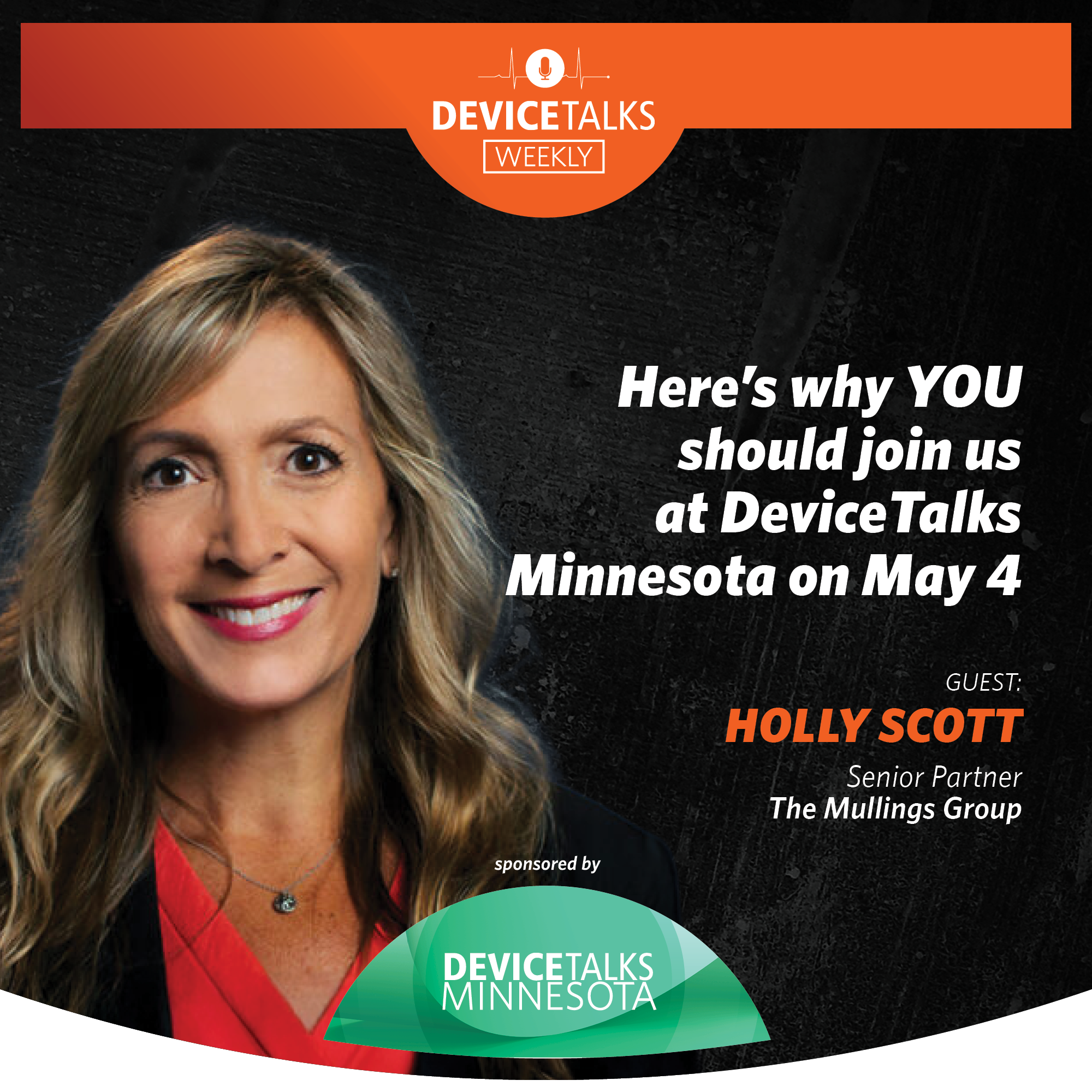
[00:19:51] Speaker A: Hi, everyone. Tom Salemi here of Device Talks. We're here talking about Device Talks Boston at 160 Studios in Delray Beach, Florida. Here with my great friend Holly Scott of the Wellings Group. Holly, thank you for having me down here again.
[00:20:03] Speaker D: Of course. Always a pleasure having you, Tom. Anytime.
[00:20:06] Speaker A: And always a pleasure to have you at Device Talks, boss. And I know you'll be there on the day, both days. I'm hoping that you'll be there to not only meet the great folks there, but also, I think, take part in the Surgical robotics conversations we'll be having there. What's really interesting, I think, about this year is we're seeing Surgical Robotics move up the field a bit. We've got not only we'll have a presentation by Medtronic about Hugo and they're getting their commercial approval or regulatory approval in the U.S. but we're also going to talk about next generation robotics. So we'll have Prash Chopra of Pedal Surgical talking about incisionless surgery. He'll be giving a presentation on May 28th. We'll have Microbot talking about their very, very fascinating endovascular robot that's able to get into very unique places. And we're also going to have a presentation by LEM Surgical. And here today with us is Yossi Barr, the CEO of lem. Yossi, thanks for joining us.
[00:20:57] Speaker D: Hi, Tom. Hi, Ollie. Good to see you.
[00:20:59] Speaker A: So you're going to be giving a talk on day one, one of our FOMO presentations, and we'll be talking about the arrival of humanoid robotics in hard tissue surgical robotics. So, Yossi, LEM Surgical. We had a chance to meet at J.P. morgan. We sat down at one of those lovely little sidewalk tables and you ran me through what I think is a very futuristic vision for surgical robotics. Tell us a bit about lem.
[00:21:24] Speaker D: It's a futuristic one, but it's closer than we think.
LEM Surgical, we're a Swiss company, 50 plus people, headquarters in Bern, Switzerland, and we have a subsidiary in Tampa West.
We want to do in LEM what Intuitive did in soft tissue. Intuitive.
Da Vinci. Everybody knows the core of it, the core of its success. It's a general purpose soft tissue robot. It's not a urology robot. It's not doing one thing in one procedure. It's a general purpose soft tissue robot. And this is the core of success. Nobody did anything like this in heart tissue. Usually you have robots to, to put pedicle screws in spine. You have robots to cut planes in knee, hip. Nobody ever brought a general purpose hard tissue robot. And this is, this is our calling, this is what we're doing here. And in order to do this you need to completely change the form factor. No, no longer this single purpose one arm robots. For this you need an upper torso humanoid robot that can do comprehensive work to be much more comprehensive. We start in spine as a beachhead, but the idea is to do all heart issue. So we start in spine, but this humanoid architecture that can be very comprehensive in all parts of the spine procedure, but then proliferate hip, knee, shoulder, to be much more comprehensive. This is what we're doing.
Sure. Yeah. Well, I saw Nvidia, the Partnership and of course they really put you out in a big way with their showcase.
How are clinicians enveloping the idea of a humanoid robot? It sounds very sci fi and I know that they tend to get excited, but sometimes transitioning to adoption can be different. I'm curious on how you're finding the user experience and the feedback.
And this is the thing, and I've been seeing it for 20 years, everybody always afraid that the clinicians will kick back and say, guys, this is too much. And it's always, it's counterintuitive, but it's always the other way around. Usually the surgeons are the first to adopt. Every time we brought something to the or, they always said, why can't the robot do more? Why do I need to, why the robot cannot drill and why it cannot do this.
So usually they are the first to adopt and the first to tell to the industry. And we were busy apologizing, you know, fda, you know, it's very difficult. So I don't think they are the bottleneck. It's usually us, the industry being able to push more to the or.
But yes, of course it's when you bring more advanced technology, you have to think of adoption. Not only the surgeon, the nurses, the all the economical economic system system behind it, but we do it step by step. So you never bring everything you have in day one. That's why we need to have a clear beach head which is spine and in spine specific parts. And you need the early adopters, you need the innovators, the surgeons that can see a few steps down the road and want to do the ride together with you. It's a process. It's always a process.
It's fascinating.
[00:24:43] Speaker A: And Yosi, you've got some experience in surgical robotics. I'd love to get your take on where things were at 10 years or so ago when you started Mazor and you sold out to Medtronic and where we are today, I mean that sale seems like yesterday to me. But then I look at what you did previously and what you're doing now and it feels like a whole generational leap in terms of technologies and robotics and surgery. How compare the errors if you would.
[00:25:10] Speaker D: Yeah, so with Mazor more than 20 years ago. So we were, you can say the pioneers with spine surgical robotics. And it took us a decade just to make a point that it makes sense to use surgical robots to do certain procedures in spine.
And then after the introduction of the Mazor X which was the first big form factor of the spine surgical robot, and then Medtronic came on board and I would say that the last decade most of the industry are busy catching up. And one of the challenges in hard tissue robotics is. And it challenges and you can say the stagnation point that we in LAMP we want to resolve and to move forward is after 20 years, as you said, after 20 years we came to a stagnation point that today in hard tissue, specifically in spine, robots are no more than a delivery system for proprietary implants.
It's a great business, of course, but robots in spine are responsible to deliver pedicle screws. Proprietary pedicle screws and hip and knee. It's again, it's around the implant. And the problem, which is a great business, but the problem is that it's a low clinical and economic value to the hospital, also to the surgeon.
Different patients require different implants and there are different considerations beside the robot. Not everything can revolve around it.
And this is one of the first things that we want to do is to decouple the robot from, from the implant. And there is a full philosophy about behind the humanoid robotic humanoid is not just you have two hands and a face.
One of the things is the ability to be open to different implants. And by being open, I mean not just being able to drill an accurate hole through which you can put any implant you want is for the robot to be compatible with any third party implant.
We naturally, we are FDA cleared, so I need to be very careful. We call it according to FDA clearances, any qualified.
So the robot has the capability to qualify the screwdriver, the implant, making sure that it's adequate, but open to any third party implant. And this is something very important to do. So you Have a general purpose robot that can do multiple parts of the procedure with multiple implants.
And then you can also. So you do, you can do many things inside the spine surgery, not just the screws, and you can proliferate to other areas, hip and knees, completely different instruments from spine. Right. So, and this is the idea behind general purpose. So you can bring significant clinical value. And also it needs, it needs to have an economic sense to the hospital how many robots we want the hospital to buy with all the rising robots or robots for joints, robots for spine, robots, ent brain, it's not scalable whatever happens today.
So the whole thing needs to also make sense from economic perspective to the hospital.
And this is where we're trying to push it.
Fascinating. That is you've essentially answered the million dollar question, how are you going to compete with the giants that already have the footprint there? The reality is, even the market overall, there's still a lot of unpenetrated ground within the hospital, within the hospital and clinical care landscape that can utilize a brand new robotic platform. But even if you've got the versatility and the diversity and the open architecture to provide support for case and clinical preference, that's really a unique advantage.
Yeah, it's a good question. I would even say it's not the million dollar question, it's the billion dollar question. Yeah, that's for sure.
The idea is, with any good disruptive technology is that you don't try to compete with the same technology or with the same concept. So if you want to be blockbuster, you have to be Netflix. You cannot do the same thing. Right.
And the idea is that with all the footprint that exists today, after I would say plus, minus two decades of operating, it still is a 10% penetration rate in, let's say in span. So with all the work that Medtronic and Globus for example did, it's 10 penetration. So it's still a blue ocean, there's still 90% that are waiting.
So not necessarily you can just enlarge the cake, you don't have to fight for the crumbs. And the idea is to do things differently, to bring clinical value in places that are untapped, so they're not necessarily there today.
And so we, of course, we understand who are we working with and we're not trying to take pedicure business from anyone.
We want to open untapped areas that robots today are not relevant in hard tissue in these areas.
And again, it's most of the areas. So this is where we're going
[00:30:39] Speaker A: that's great. Well, as you said at the top, what I described as futuristic is actually very present day and very real.
You're going to give a great presentation, I know. On May 27th on the future of humanoid robotics in hard tissue. And Yossi Bar, thank you for joining us today and I look forward to seeing you at Device Talks Boston.
[00:31:00] Speaker D: Thank you very much, guys. Looking forward. Likewise. See you there, Yossi. Thanks so much.
[00:31:04] Speaker C: Bye bye.
[00:31:06] Speaker A: And I hope folks will join us there at Device Talks Boston as well. May 27 and May 28 at the Boston Convention Exhibition Center.
[00:31:13] Speaker D: Wouldn't miss it. It's going to be great.
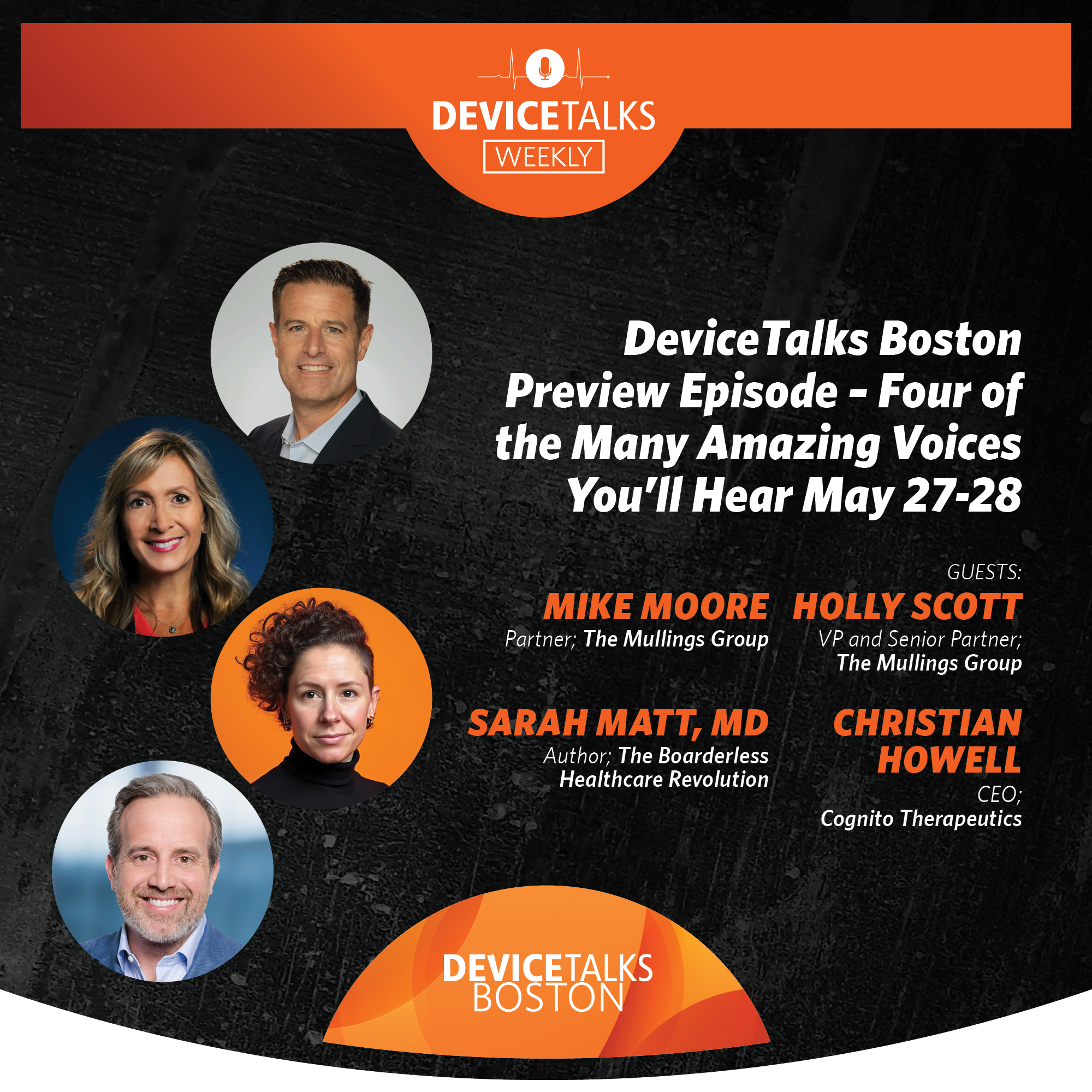
[00:31:22] Speaker A: I hope you enjoyed Yossi Bar's visit to the FOMO studio. I know you'll enjoy his presentation at Device Talks Boston. Furthermore, Holly Scott of the Willings Group will be sitting on our keynote panel at the closing of day one. We'll be focusing on the Massachusetts and New England medtech industry.
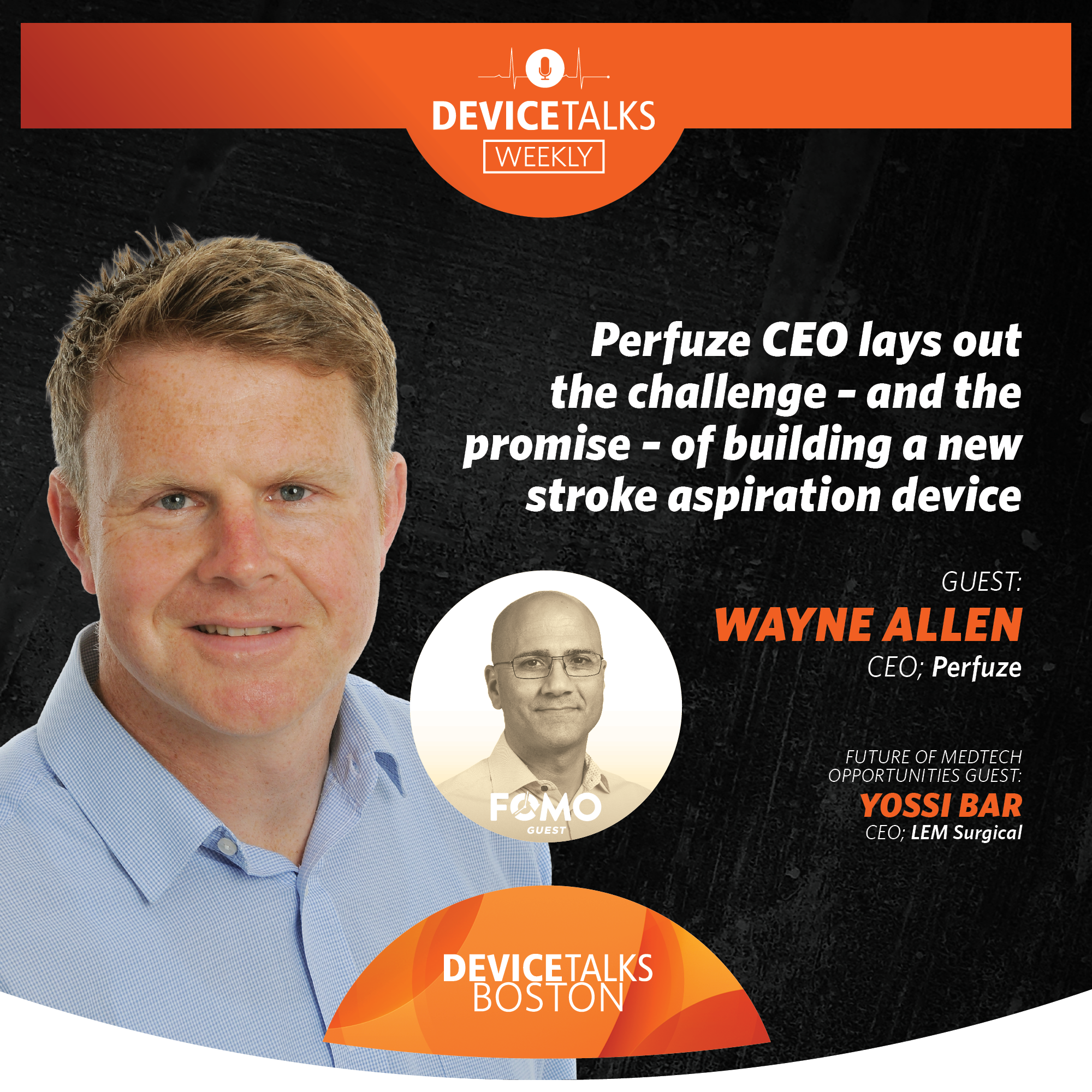
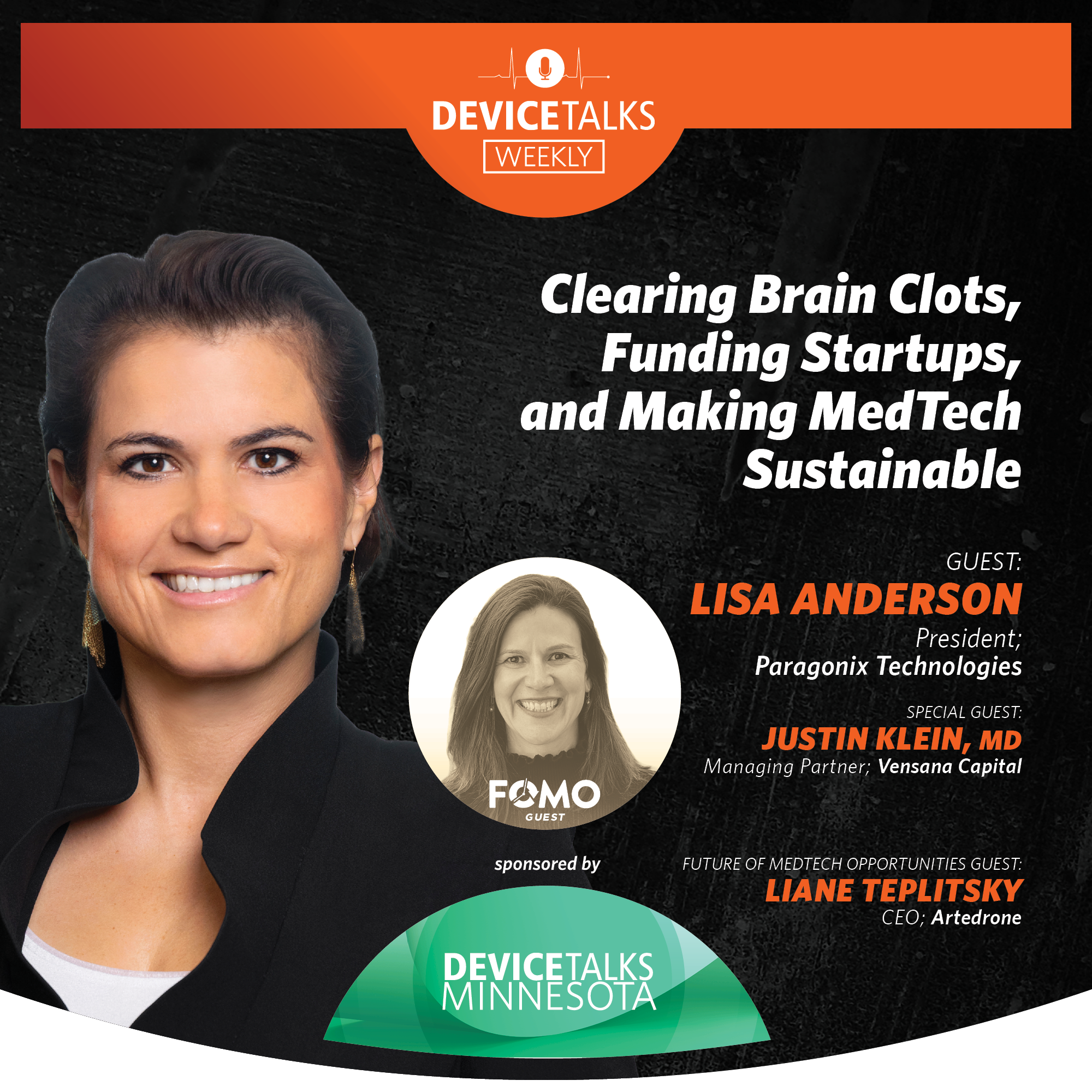
We've got a great panel including Brian Johnson, the godfather of Device Talks, now the president of massmedic. We'll have Lisa Anderson of Paragonics, Maria Berkman of Vensana, and I'm hoping to secure one more panelist to sort of take a look into where medtech is headed in the future. So it's going to be a great day. I hope you'll join us at Device Talks Boston. Now let's get into our keynote conversation of this podcast episode. Let's hear from Wayne Allen, the CEO of Perfuse.
Wayne Allen, welcome to the podcast.
[00:32:18] Speaker C: Thanks, Tom. Great to be with you.
[00:32:20] Speaker A: Great to have you here. Before I push record, you gave me a nice lowdown of the state of Medtech in Galway.
Happy to hear things are going strong there and happy to visit with Perfuse today.
Obviously in a hot space and I really want to see where you fit into it in the future and now.
But before we get to that, Wayne, how did you find your way into the medtech industry?
[00:32:45] Speaker C: Yeah, so pretty fortunate. Not long after graduating to get a job in a company called Synthespine. You're probably familiar.
[00:32:52] Speaker A: Sure.
[00:32:54] Speaker C: In Pennsylvania. So this was pre JJ acquisition. So JJ acquired him for 20 billion. So this is a long time ago, Tom. That's 25 years ago.
Great company. Private company doing about 2 billion, but still a very unique culture. It was rooted in the physician. They were a Swiss company as well, based in the U.S. so you had this kind of merger of these two cultures. But I was a product manager there and eventually had kind of global responsibility for a product line and really Enjoyed that job. I was there. I was in the US for five or six years and spent a lot of time in the field as kind of an between the intersection of the market and the physician and the engineer, which is all. Is always an interesting space because they all speak different languages.
[00:33:43] Speaker A: Yeah, right.
[00:33:45] Speaker C: I like being in that triangle, you know, and it's actually a part of the job I still enjoy to this day. But yeah, that's how I started and I got a kind of an inside view of world class medtech company.
[00:33:58] Speaker A: Did you know what medtech was before that job? Did you have your eye on the medtech industry?
[00:34:03] Speaker C: I didn't.
It was complete serendipity. But I kind of clicked with it straight away, particularly with Cintis because they had a huge campus and everything was on the campus.
So if you had an idea, you went down to the workshop, down to cadaver lab, built up a prototype, brought it over to manufacturing, got some feedback from regulatory marketing. So it was kind of all there. And like, I'm sure other interviewees have said this before, like medtech is very tangible, you know, it's. You're designing something very specific to solve a specific problem. So I think I kind of latched onto that and I still enjoy that
[00:34:42] Speaker A: part of it 100%. When I started covering this, I did both biotech and medtech and I was happy to hand off biotech to someone else because I don't, I can't tell the difference between a small molecule and a large molecule. And I just like, it just, it's not my, not my bag. So how'd you find your way over to the States? You grew up, you, you graduated in, in Ireland. Where'd you go to school?
[00:35:02] Speaker C: I did, yeah, I went to school. I'm, I'm Irish and I went to school in the University of Limerick, which was a local university and I have a degree in biochemistry. I figured out very early that it wasn't for me working in the lab wasn't for me.
And like I said, I, I was, I applied for a job. I was fortunate of those famous H1B visas that are in the news a lot.
[00:35:24] Speaker A: Yeah, we love those.
[00:35:26] Speaker D: Yeah, yeah.
[00:35:27] Speaker A: So I got one of those. I still love them.
[00:35:29] Speaker C: So they're good for six years. So it gave me a six year window in the US But I was always going to come back, you know, it was basically to go out and see what's out there, you know. But yeah, like I said, a lucky bounce to land in synthes.
[00:35:43] Speaker A: Were you surprised that there was an Industry, an established industry in Ireland to go back to. I mean, was it something that, you know, growing up in Ireland, there's a bio. Biomed industry or is it just.
[00:35:55] Speaker C: Yeah, no, I did, to be fair.
And you know, this probably from again, your research.
Very focused foreign direct investment approach by the government in Ireland in certain sectors, Medtech and pharma is one. That's one of the reasons I moved back. I'm not from Galway. I moved back to Galway because of the medtech cluster. So. Yeah, so look, once I got into the space, I became very conscious of it.
And it's not just Galway, you know, there's great medical device companies in Limerick and, and Dublin and other parts of Ireland.
[00:36:27] Speaker A: Great. So I see you went to Viceroy Biomedical for a few years and then you did a bioinnovate fellowship. Bioinnovate Ireland. Tell me about that, that program. Is that like the, the, the Stanford programs and things like that?
[00:36:39] Speaker C: Exactly, yeah.
You know, this, this is kind of the difference that one individual can make. I have to mention him. His name is Ian Quinn. Unfortunately he's no longer with us, but he was, I guess he's not that well known outside of Ireland, but definitely a visionary.
He founded a company called Craigana which is now owned by TE Connectivity. Probably one and a half thousand employees.
But he wanted to move Ireland, I guess further up the food chain and MedTech.
And he saw we have world class manufacturing capability just to move us up, like I said, the value chain and start startups and start, you know, homegrown companies and build them out. So he found, he founded BioInnovate. He was the driver behind it. It is built upon the Stanford biodesign model.
And to continue the thread of Ian Quinn, our first company, Emblemedical, was born out of that program and he was the first investor and he was.
[00:37:41] Speaker A: Yeah, that's amazing.
[00:37:42] Speaker C: So it is amazing. And when he in a room publicly when he said he would invest in us, like that kind of, those moments are etched in my memory. So one of those people that has like a tremendous impact on, on your career, you know.
[00:37:55] Speaker A: So I see you were general Manager Advicera Until 2011, then you went to the program 2011, 2012. And then were you CEO of EMBO Medical at the start?
And if so, that's a, that's a quick pace to become a CEO. Did you know you wanted to be a CEO or did you did a light go off during the, the bioinnovate fellowship?
[00:38:17] Speaker C: So I went to the bioinnovate fellowship. It was the first year of it. They took on eight fellows. And my objective, I had two objectives. I wanted to find an unmet clinical need and I wanted to find a partner. And I saw myself as leading the commercial business side of it. And I was seeking a complimentary engineering technical person. So two guys from that, two engineers, the three of us founded that company and perfused to continue on a few steps. Liam Mullins was the CTO of Embo Medical and he's also the CTO of Perfuse. So there's connectivity there between myself and Liam going all the way back. We met on Bioinnovate and he's a PhD mechanical engineer.
[00:39:06] Speaker A: You accomplished both goals. Good for you. That's very.
That's terrific.
Did you. Did you.
You wanted. But did you want to be a CEO? Was that kind of always.
Do you feel like that's part of your DNA? Was it a calling or did it just happen and now you're just. This is who you are?
[00:39:25] Speaker C: That's a good question. Probably a question I've never thought about. I probably wanted to.
I probably believed I could do it and I wanted to push myself and push myself into it.
It's not an easy role. And definitely when you start from day one, you know, you're learning from day one and I'm still learning, you know.
So, yeah, I guess if I was to answer it directly, I did see myself as CEO.
But always great to have the compliment with a co founder who, you know, makes up for all your deficiencies.
[00:39:59] Speaker A: Amen. So tell me a bit about Embo Medical.
[00:40:03] Speaker C: So Embo was a. We had a vascular occlusion device, so shutting down blood flow.
It's used in loads of indications. Some examples would be internal hemorrhage.
I think it's. And it's so diverse its application. It's used now in. In prostate artery embolization.
So great, great space. And if you look back at a few other successful kind of entrepreneurs. If I look at Josh Maker or his first company was an embolization company. Again, we go back to how tangible this is. What are you trying to do, drop in a device, shut down blood flow? So we had a lovely device. It was like a nitinol, we call it a flower with a little kind of a parachute on the back. And you dropped it into the blood vessel. It shut down blood flow instantly.
And it was an early exit. Less than 4 years with no regulatory clearances.
Mean and lean. We raised 3 million euros.
It was acquired by CR Bard primarily because we did a massive bank of animal studies and the animal is enough of a kind of a surrogate for human blood flow to demonstrate the shutting down of blood flow. So, look, it was good. It was quick. We went through the cycle very quickly, Very small team.
We learned a lot.
[00:41:25] Speaker A: That's interesting about the animal studies. I guess that's just a matter of physics. I mean, it doesn't matter whether it's a human vessel or a pig vessel. Vessel is a vessel and blood is blood.
[00:41:34] Speaker C: Exactly. And picking the right vessels that, you know, replicate the target vessels we were.
We designed the devices for in the humans. So size and blood flow rate, et cetera, that was the key.
And all in all, I can't remember the exact number, but I think we did like 14 or 15 animal studies. So we went deep.
[00:41:56] Speaker A: That's fantastic.
Was there you went through the Biodesign Pro, the bioinnovation program.
It was the same setup where you're sort of working with clinicians to identify problems. I'm curious, was there a moment, an experience that led to you to recognize that this device was needed?
How did you come to settle on this product?
[00:42:21] Speaker C: Yes, there was. And we go back into the Bio Innovate program every year, and I tell the same story. But again, it's one of those memories that you have. So the key component is clinical immersion where you live in the hospital.
So the focus, there's always a clinical focus. For the year, ours was Cardiovascular. We spent two weeks in St. James's Hospital in Dublin.
I remember this day. We were in an interventional radiologist procedure. They were attempting to shut down a portal vein, which is quite a large vein. It behaves like an artery.
And the physician ended up putting I think 15 or 20 of these tiny coils in to shut down blood flow. Took about an hour.
And we had a note in our book and said, has to be a better way. One shot embolization. And that's exactly what we did.
[00:43:12] Speaker A: Wow. All right.
[00:43:14] Speaker C: So very lucky. You know, that doesn't always happen. I talk to the fellows in years gone by and they come out, the end, they're like, I didn't see it, you know, but that doesn't always happen. But we were fortunate again to be there at the right time, right place.
[00:43:26] Speaker A: Fantastic.
So you sold that to Sierra Bard and I see you started perfuse according to. I'm looking at your LinkedIn profile two years later.
[00:43:37] Speaker C: Yeah.
[00:43:37] Speaker A: Did you have some time off in between? Did you. Looking for the next thing? I guess I kind of would love to know how you found the profuse technology that you Built your company around?
[00:43:48] Speaker C: Yeah, we took some time off. Not a huge amount to be honest, because we had to. We were involved with bar transferring the technology.
[00:43:56] Speaker A: Afterwards, we looked.
[00:43:58] Speaker C: Liam and I said we'd go again.
I guess four years is very short period of time.
We thought we had another one in us.
[00:44:06] Speaker A: I was gonna. I'm sorry, was staying at Bard ever.
I know it was an early stage product, so it wasn't like you had a business that you had to run for them. Was staying there ever consideration or were you? Did you? I see yourself as a startup person at that point.
[00:44:19] Speaker C: Yeah, the latter.
[00:44:20] Speaker A: Yeah. Yeah.
[00:44:21] Speaker C: You know, that's our environment.
We, I guess, you know, and with Perfuse we have a culture of like moving fast and doing things as efficiently as possible. So yes, we always wanted to stay in that environment.
So we looked at about 20 disease states. We went on the road, we met. You know, I guess when you've had a success, you come on the radar of folks who have ideas and projects. We looked at about 20 ideas.
We had a list of eight criteria that we wanted our next project to hit and we kept on coming back to stroke and it hit all those criteria.
So we looked. So this is 10, this is 2016, 20 2017.
It's almost 10 years ago and it's, you know, again, you don't control when you come into a space.
So a bit of luck here as well. 2015 was really clinical acceptance of thrombectomy to treat acute ischemic stroke. So we're in a really early space and we were looking at the data and we were looking at the first gen devices and we were saying again, there has to be a better way of doing this. And it's funny, the results have basically.
With the devices that are on the market today, they basically plateaued and stayed the same for the past seven or eight years.
So a bit of good luck coming into the space at the right time. And I guess there was two technologies in there, stentrievers and aspiration catheters. And we looked at both and we said, you know what, we can definitely improve the aspiration catheter space.
So that's how we went for it.
[00:46:04] Speaker A: So you mentioned you had a list. I love that you mentioned you had the list of the areas you wanted to focus on. You had a list when you went into the innovation program as well.
Are you a fan of lists? Is that how you go through life?
I guess I'm not.
Two instances where they come into play. That's true.
[00:46:23] Speaker C: What I like to do is, and it's not about the list. I like to start with the end in mind. So when you're going on a journey and you don't know where the end is, but then you start seeing some semblance of, okay, this looks like what we're trying to do. That kind of gives me, I guess, some assurance that we're on the right path.
[00:46:40] Speaker A: Great.
So again, the perfused technology, how did you come to identify this as well? How did it come to you? You again, could you, could you just, just explore that a bit more?
[00:46:51] Speaker C: So again, like we said, we were looking at the two technologies. It was a stentriver, which is essentially a metallic lattice that you embed in the clot and you pull. Or you have an aspiration catheter, which you're familiar with, you vacuum out the clot out of the brain. And the results, they were both identical. We thought, you know, one of our principles is always ease of use.
It's a kind of a. It's a really common phrase in medtech, but it means so much.
So we thought we could improve the ease of use of aspiration catheters and improve the clinical outcomes. And like eight years later, because we only got 5, 10k on this last month, we can say we've achieved that, but it's actually taken eight years.
[00:47:35] Speaker A: So let's unpack the opportunities in stroke you mentioned. You obviously had your list and you recognize some shortcomings of existing technologies, but there's a lot of significant players out there already with technologies. How does. How do you, as a startup, sort of identify what isn't currently being done and more importantly, figuring out a way that you could do it.
[00:47:56] Speaker C: Great question. It's the bioinnovate biodesign principle.
What work really hard to define the unmet clinical need. And oftentimes the one you start with is not the one you finish with. But basically it can be built around the key metric in stroke thrombectomy today, which is called first pass.
I don't know if you've ever heard of it. It's really simple. It means get the entire clot out in one pass.
So basically do it as quick as possible.
It's clinically proven that you might have heard this phrase, time is brain. So the more time you spend attempting to get the clot out of a patient's brain, the more brain tissue they're losing by the minute. So the first pass effect, like, it's. It's really powerful.
Higher patient, patient functional independence. Shorter ICU stay, shorter total Length of stay, lower complication rates, et cetera, et cetera. So it's a real powerful indicator. So number one, clinically, we wanted to increase the first pass effect rate, which was hovering around 30%. It's not too far above that at the moment.
And secondly, we wanted to simplify the procedure.
So how do we do that? So we had to kind of essentially reimagine what a neurovascular catheter needed to do.
[00:49:16] Speaker A: And what does that 30% represent for 30% of the procedures you're able to get it in the first pass. Is that what that represents?
[00:49:24] Speaker C: Exactly.
[00:49:25] Speaker A: Okay. Okay, great.
[00:49:26] Speaker C: Yeah, yeah.
[00:49:27] Speaker A: A lot of room for upside. Okay.
[00:49:29] Speaker C: Exactly.
[00:49:30] Speaker A: Yeah, yeah, yeah.
[00:49:31] Speaker C: And the, the. And then it's, it's, you know, you keep drilling down into that unmet need. So what is the actual problem? Actually getting into the brain is really difficult to do. All of us have unique anatomy. There's essentially, once you get into the aortic arch, there's like three anatomical hurdles you have to overcome.
And because all our facial structure is different, the arteries move around your face differently. So it's quite a difficult engineering challenge. So we needed something really navigable, really flexible, really pushable.
So complete redesign, blank piece of paper. And we came up with this, essentially this corrugation at the tip, which quite simply over time, three major iterations, is essentially like a vacuum cleaner hose.
So it has that kind of ribs, if you can visualize it, it's two and a half millimeters wide in diameter. It goes into your brain, but it will follow any difficult anatomy and get to the cloud face.
[00:50:29] Speaker A: No, it's in it. The product is the millipede, right? That's the, the. And I, and your, your previous company had the caterpillar. So I like the.
Yeah, that's not a great move though, you know, but anyway, satisfaction from us. So looking at. You've got a very great, you've got a great video on your website, sort of showing the technology, showing the, the millipede and your, your description as a vacuum hose, you've obviously done this before, is a spot on. It's exactly what you see. A high, a high tech vacuum hose.
Is it, Is it? So it's, it's only though at the, the tip of the, of the wire. It's not, it's not throughout. What's the length and how does it sort of fit into. Does it fit into? How, what is the length and how does it fit into the system?
[00:51:15] Speaker C: So essentially you're, you're generally the physician accesses the vasculature at the groin.
So it's, it's about, you know, it's over a meter in length and that's where the physician is pushing from. And it sits on a delivery access catheter we call zipline. So it's just because I should have mentioned as well, we've increased the size. These catheters are called superbore catheters. Now, the 510k we got last month, we're the second to market.
So these superbore catheters, we've increased the size of them. So again, to facilitate the first pass effect. So we've increased size, increased surface area, increased aspiration power, increased chance of getting the entire clot out in one pass.
[00:51:59] Speaker A: By increasing size though, aren't you making it more difficult to get to the clock?
[00:52:04] Speaker C: Well, that's the problem, you see, and that's why the corrugation technology solves that problem. When we started seven or eight years ago, and you can imagine the rudimentary prototype, we had some physicians, we showed them the first prototype and they're like, there's no way I'm putting that into someone's brain. So we had to get over that. Now there's three companies in the space, we're one of three that have done studies and it has been proven safe across all three companies now. So, you know, we're starting to overcome these hurdles that I guess the later adopters would be conscious of and wary of.
[00:52:41] Speaker A: Interesting. So you've got, you mentioned the 510k that you received recently was, what was the. There's another product on the market already
[00:52:51] Speaker C: that was the predicate for that, that Route 92 Medical.
[00:52:54] Speaker A: Okay, okay, great.
So what goes into convincing interventionalists? I assume it's interventional neurologists who are using this or it's not neurosurgeons. Correct.
[00:53:06] Speaker C: It's both.
[00:53:07] Speaker A: Both. Okay. Talk a bit about that community. I mean, obviously they're a tech savvy community and they're fast adopters, I think, of things.
But what is going into clearing that learning curve that needs to demonstrate the effectiveness of this, this type of interventional tool?
[00:53:26] Speaker C: Yeah, that's exactly the point in time we are now. So we're transitioning from clinical to commercial and we have a small sales team in the US early, early days for us. And we kicked off a limited market release about less than a year ago, so. So yeah, we're learning that that's hard yards, you know, and different physicians react to, I guess, different, you know, information and more for some physicians will be clinically driven. Other physicians will need to get their. The device into their hands and try it themselves and prove it to themselves. So that's the process we're going for.
We did a pivotal study last year. 180 patients.
US, Spain, France, 25 hospitals, 55 physicians. So we're focused on the US commercially, and we started with those folks. So that was kind of an easier transition into the market.
But now we're starting to move beyond the pivotal trial study accounts.
And yeah, you know, you go into a hospital, you've got five physicians.
They have their own perspectives, they have their own preferences.
So you start with the data, you put the device into their hands, you demonstrate, I guess, how navigable the catheter is, do a benchtop demo, you work your way through that education process.
[00:54:49] Speaker A: Where is the.
What's the highest hurdle you need to clear in terms of getting physicians comfortable with the interface? Is it as a tool, dramatically different? Are the controls different? Is it a completely different approach to things, or is more or less a minor sort of modification to how you may use other systems?
[00:55:09] Speaker C: Yeah, that's a good question. And again, that will be our design philosophy was don't change current workflow. Don't have to re. Educate physicians. Physicians are taught from, you know, their fellowship how to use catheters.
Their hands are very tactile. So we didn't change anything. We could put this into a physician's hands and they would intuitively know how to use it. Now, there's always nuances, and it's good to point them out before they do their first patient. But having said that, there was a few physicians in the study, it's impossible to manage, you know, 55 physicians in a study, and, you know, sometimes they didn't. Their first patient, they didn't have a huge amount of experience with the device. But the results, the results were so positive. It was a reflection, I guess, of how easy the system is to use.
[00:56:01] Speaker A: How do you see this ultimately fitting into stroke market overall? Is this gonna. Is this something that is an additional tool used only for certain instances? Do you see this as being the future of stroke intervention? And this is gonna, in your vision gradually? This type of technology is gonna gradually be used by everyone all the time. How does this play out in your. In your book?
[00:56:27] Speaker C: Yeah, so we wouldn't have started the company unless we thought it could be. Become the standard of care, and it has the capability to do that.
If you stand back and you look at the market macros, if you look at the two types of technology in the market today, the stentriver use is declining year on year. Now for the past two years, aspiration use is growing.
There's a number of reasons for that, but primarily it's probably rooted in the fact that aspiration catheters are easy to use and a lot of the fellows are trained.
Now it looks like almost exclusively on aspiration catheters. So stentrievers are a bit trickier to use. There's a bit more setup and you have to penetrate the clot.
So we're on the right side of the market. Number one, we're on the aspiration side.
If you go back to what I was talking about, the first pass effect, plateauing around 30%.
So in the middle cerebral artery M1 region, which is where the majority of clots land in the brain, we got 75% first pass effect.
[00:57:31] Speaker A: Oh wow.
[00:57:32] Speaker C: So that's quite a powerful number.
[00:57:34] Speaker A: Yeah.
[00:57:34] Speaker C: So it's, you know, we're a small company, we're competing against bigger companies.
There's a lot of noise in the market. It's going to take some time to get that number out there and educate physicians and get them to try it. But what we've seen so far, we're in about 20 accounts. Once physicians mentally get it, they try two or three patients, they latch onto it, they see the benefit.
[00:57:59] Speaker A: So how do you see, what ultimately do you see happening with profuse in.
I'll ask the question more directly and not politely. Do you get acquired? Is this the ultimate outcome for this? One of these other larger players who has a larger piece of the market suddenly comes around and sees the value of this approach? Or do you see this as a long ground game that you're going to grind it out and you want to get a bigger piece of the pie? Or I'm guessing there's a. I'm guessing both is going to come up, is going to be part of the answer.
[00:58:28] Speaker C: Yeah, look, you know that phrase companies get bought, not sold, right. So it's not up to us when we get acqu. So, you know, of course we're VC backed, investors want to return. If we got a good offer, we
[00:58:41] Speaker A: would, we would engage with it. You know, like, no, I want to be miserable for 10 years and I want to really.
[00:58:49] Speaker C: But we're more than content to build this company out. We've been very capital efficient compared to our peers.
We're currently raising a series B50 million for US commercialization.
Yeah, we've got our contract manufacturers ready to go. Like I said, we've started building A sales team, we've got a great internal team here and we're building it out to prepare for full launch commercialization the end of the year. So I could see us having double digit market ownership in five or six years time. That's our target.
[00:59:21] Speaker A: How much have you raised so far?
[00:59:23] Speaker C: €50. €50 million.
[00:59:26] Speaker A: So you're looking for another 50. Okay, yeah.
So let's talk about the evolution of the stroke space. I mean we're seeing more obviously different forms of imaging coming on. Surgical robotics is entering the space. I think everyone is to your point about time is brain.
Everybody's trying to find ways not only to do it more quickly, but to enable more people to do it from farther away places.
Remote possibilities, telesurgery possibilities, image guided sort of tools are being developed as well.
Where do you see the stroke space sort of developing and how does perfuse fit into that future?
[01:00:01] Speaker C: Yeah, so like if I go back to a comment I made previously, it's really early days, it's only 10 years old and like it's come on leaps and bounds. There's so many things. These physicians are fantastic. They're highly adaptive and they're excellent at putting out the studies and moving quickly, you know. So if I think of even what's happened in the past 10 years and then maybe talk about what's going on to come, like even thrombectomy now it's up to 24 hours. When we started out, it was eight hours. And they're constantly pushing the boundaries on that. You may have heard of a space called mevos. So all the studies we do are lvos, large vessel occlusions. They're the ones that have the most clinical impact on patients. But again, pushing the boundaries of physicians pushing the boundaries, they're going deeper into the brain. The mevo is at a medium vessel occlusions, so they're currently doing studies there to prove thrombectomy is safe and efficacy, the efficacy in those vessels. And those studies are ongoing.
What else? There's tnk, which is thrombolytic, so that's simplified. We'll say they call it drip and ship. When they know a patient has had a stroke, they put them in the ambulance, give them tnk. It's more effective than anything else. Mobile stroke units also, I think this year they come equipped with ct. So like it's always growing and evolving.
And you're right, in about 10 years time I would imagine. You know, robotics is probably the, maybe the flicking the switch on the market today.
You have to get into some form of transport and go to a stroke center. Right.
And we'll probably lose a lot of great results because of that. But if the robotic option, which a lot of companies are focused on it, that's definitely going to happen in the next 10 years and probably in the next 20 years, there won't be any thrombectomy devices. There'll be something else that will dissolve or interact with the clot.
[01:02:07] Speaker A: Compare, if you would, this experience to embo, where you talked about your ability to exit that company so easily because you were able to get the proof you needed from the animal models. Your description of the.
The vasculature in the brain, just how it's different every time, just seems to me to be a complete opposite. As to the experience you had in vascular, how much more complicated has neuro been? More complicated than maybe you thought going in? Did you think the vascular experience was going to carry over and again, kind of unpack the challenges of finding the way to a clot in the brain through all of our own unique sort of highways and byways?
[01:02:48] Speaker C: Yeah, we definitely didn't underestimate the challenge.
No, the brain, it was a more difficult, unmet clinical need, more difficult disease state, a lot more constraints, time being one of them.
So, yeah, definitely didn't underestimate the challenge. It took us a long time to get our head around the space, the anatomy, the nuances of the anatomy, and figuring out where physicians had, you know, where they had trouble and where they had difficulty.
So the second half of your question, what was it getting to the. Can you just rephrase that again?
[01:03:29] Speaker A: Yeah, sure. No, just talk a bit more about the challenges of reaching those difficult to access clots because of our unique vasculature makeups in our brain. Was that that. Did you anticipate that going in and how difficult is it to sort of engineer around the winding ways in our head to find a clot?
[01:03:52] Speaker C: Yeah.
So you've just kind of described the technical journey of perfuse, you know, so number one, we didn't fully understand it. I'll give you an example.
The ophthalmic artery, obviously the artery that feeds your eye, has a ledge, and in some patients that's really pronounced. And in some patients it's so pronounced that the aspiration catheter can't get over it and essentially snags on it, which is not a good thing, can lead to a bad outcome.
So we weren't conscious of that going in. We developed the device called the zipline. I don't know if you see it on your video there. It's very thin, tapered device.
One of our French physicians calls it Le Noodle. So it's noodle like it's very sensitive on the brain tissue. And that device goes up first.
So that leads the way. Then for the superbore catheter, the last thing you want is a huge catheter snagging on that ophthalmic ledge. So that's just one example, probably the primary example that physicians quote and has caused issues over the years for existing technology.
And there's about a 30% bailout today with current technology.
And a lot of it would come down to either not being able to get over the aortic arch. That's too difficult. Or they get snagged on the ophthalmic artery ledge.
[01:05:16] Speaker A: Really interesting. And final question, just your experiences as a CEO, your first go around was a lot shorter than this time.
What lessons have you learned running this company? Taking a product through regulatory approval, which you didn't have to do before, and now moving forward into commercialization.
What's the journey been like for you as a CEO?
Sure.
[01:05:40] Speaker C: The first one is obvious. I guess it's a time horizon. So EMBO was four years old, end to end, and we exited on solid animal data.
So in that kind of timeframe, you can iterate fast in that mode. Perfuse, I guess has been the opposite.
Eight years to key FDA product clearance and three major iterations on the core technology and a pivotal study that you can modify once it's up and running. So I think leading through those years where the finish line is invisible, that's an entirely different job. And I've had to learn that on the fly as we go.
I guess the second is kind of regulatory and regulatory strategy. At embo, we didn't really have to commit because we exited just on animal data alone. So with the pivotal study or engineering decisions for are locked in 12 months before you enroll the first patient. So you won't see human data or an FDA clearance for another three years.
So that demands some discipline and designing for evidence again, that far out. I think that's been one of the biggest professional growths of this stretch. And then finally I think I'm living through right now at the moment, which is commercialization, which is its own sport.
You know, powerful clinical data, it is critical, but there's way more.
You know, people often talk about the quality of data and adoption and driving adoption means painstakingly working through the value analysis committees. Having a clinical champion in the room, the supply chain, hiring the right sales rep. So several elements moving at the same time. So a year in, that's the lesson I'm still learning every week.
[01:07:20] Speaker A: It's amazing. I guess the first trial is always the easy one, right? You think they're all going to be that, that easy to manage and then the second one.
[01:07:28] Speaker C: No, we didn't.
[01:07:29] Speaker A: We didn't.
[01:07:30] Speaker C: We knew.
[01:07:30] Speaker A: You knew it wasn't going to happen again.
[01:07:33] Speaker C: No, but look, it's been a great journey.
[01:07:35] Speaker A: Absolutely. All right, Wayne, thanks so much for joining us on the podcast.
[01:07:38] Speaker C: Thanks, Tom. Appreciate it.
[01:07:44] Speaker A: All right, well, that is a wrap. Thanks so much for joining us on this episode of the Device Talks weekly podcast. Once again, I hope you'll join us at Device Talks Bot Boston is happening on May 27, the 28th. Use the code DTW25. If you haven't registered yet, you'll save 25% off the price of registrations. Going to have a whole line of fomos, including a presentation by Yossi Barr, who you heard today, and we're going to have many, many more. So go to boston.devicetalks.com to register. Lots of great keynotes, lots of great track discussions, lots of great time to spend on our expo floor.
Cannot wait to see you there. Make sure you also subscribe to the Device Talks podcast network so you don't miss a future episode. Also, connect with me on LinkedIn. Connect with Kayleen Brown on LinkedIn. Connect with Chris Newmarker on LinkedIn. Make sure you follow both Mass device and Device Talks. All right, folks, talk to you next week. And thanks for listening to this episode of the Device Talks weekly podcast.