Episode Transcript
[00:00:00] Speaker A: Hey everybody, this is Tom Solomi of Device Talks. Welcome back to the Device Talks weekly podcast. We have just over one week to go to Device Talks Boston, so I'm going to focus this entire episode on our upcoming Device Talks Boston meeting, which is happening on May 27 and May 28 at the Thomas Menino Convention and Exhibition Center. I miss just saying the bcec, but it's going to be a great couple of days. We're going to hit upon some of the highlights in today's podcast, but there's so much more, so many more speakers, so many more topics, so many more people to meet and I hope you'll join us there. Go to boston.devicetalks.com and because we love you so much, podcast listener, we'd love you to save 25% if you haven't registered already. Use the code DTW25KNOX 25% right off the price. Don't wait, register now. Everyone waits. Gives me a heart attack.
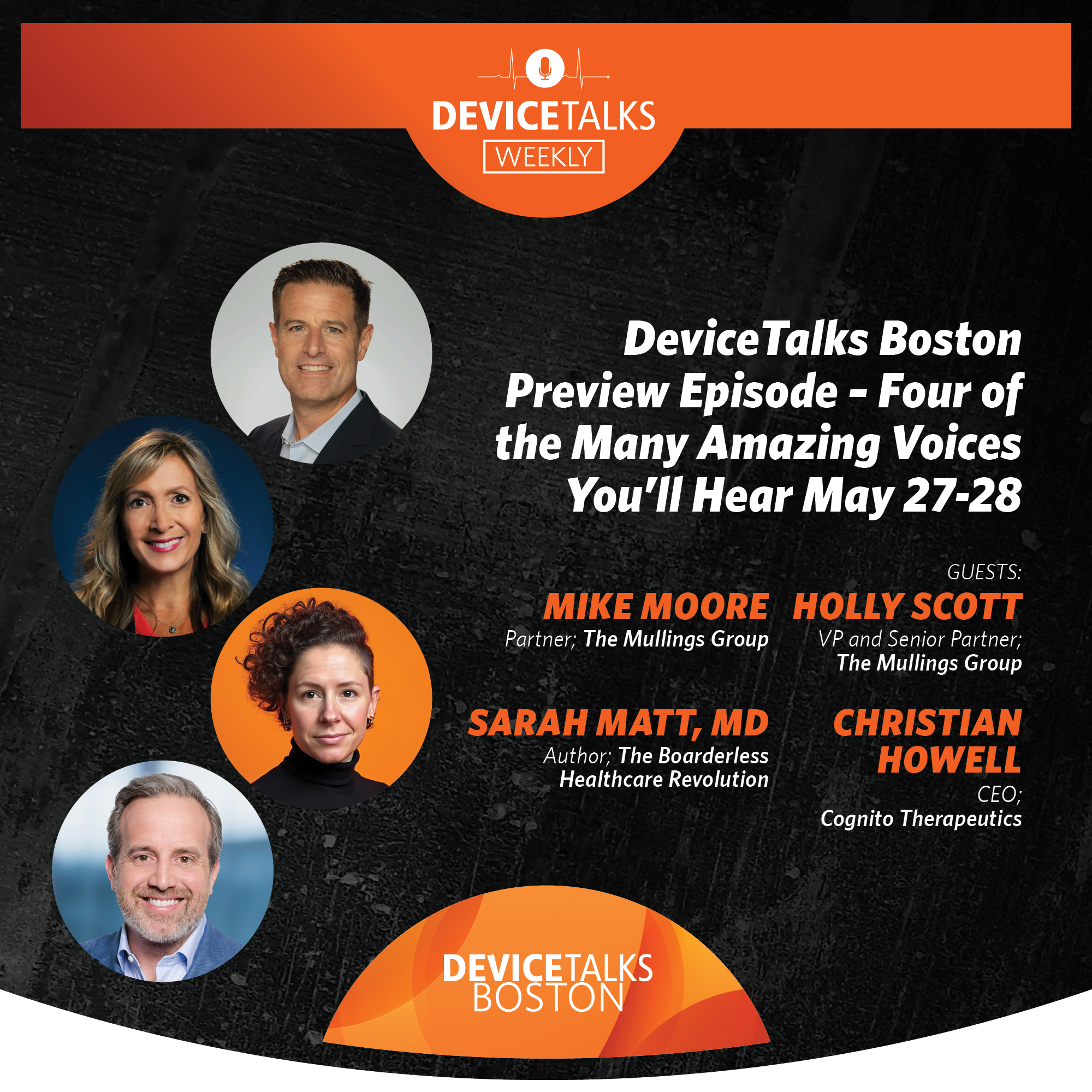
We know people are going to show up, but they wait till the last minute to register. You would do me a great favor, personal favor if you just registered now, if you're planning to come and take the guesswork out for out for me. But although that, that last minute adrenaline surge can be a lot of fun, so, so just come in any case, no matter when you register, we'd love to see you there. So we've got three separate interviews that I'm running today. We recorded them all at The Mulling Studios, 160 Studios in Delray Beach. You'll hear me mention that a few times. I sat down with Mike Moore and Holly Scott of the Mullings Group.
Mike sat in on one conversation, Holly sat in on another, and then Mike, Holly and I sort of did a recap of Device Talks Boston. So we'll open up the conversation with an interview with Christian Howell. He of course, is the CEO of Cognito Therapeutics.
Christian's going to be talking about Cognito's Neuro products, but we're also going to be talking about how they're incorporating AI into startup operations and how it really helped them raise money. They have great success raising capital. They raised $103 million recently, so definitely worth hearing what he has to say about how they were able to streamline their fundraising process.
Christian's kind of part of our innovation quote unquote track. I don't really have that kind of. Well, we have an innovation track, but he is in addition to the Medtech Innovator open rounds presentations which will be taking place in day one. You're going to hear from some great medtech startups. You'll also meet with some great VCs. You'll hear from Maria Berkman. She's a partner at Vensano Capital. She's sitting on our closing keynote. I'll open the whole conference off with my conversation with Abby Hunter Syed. She's a director of Olympus Innovation Ventures. So we'll have innovation and startup management and fundraising sprinkled throughout the conference and I hope you'll join us there. So we're going to kick things off with Christian Howell and, and then I'll hop in in between the Christian Howell and our next talk and talk about that element of the Device Talks Boston agenda. So, once again, I hope you join us at boston.devicetalks.com and use the code DTW25 to save 25%. Let's go.
All right, you ready for this read?
[00:03:45] Speaker B: Hey, everyone, this is Tom Salemi of Device Talks. It's that time of year. I'm down here in Delray Beach, Florida at 160 Studios, talking today about Device Talks Boston with my good friend Mike Moore, partner at the Mullings Group. So, Mike, you're going to be joining us up in Boston. Do you like startups?
[00:04:00] Speaker C: We do, we do, yeah. They're a little bit important to what we do as a business here at the Mullins Groups. Absolutely, we're looking forward to it.
[00:04:06] Speaker B: We love to shine a light on these up and coming companies. We'll have the medtech innovator there in Boston giving their presentations on day one. We'll open up the entire event with my conversation with Abigail Hunter Syed from Olympus Innovation Ventures.
So we'll have a 15 minute conversation talking about the future of corporate investing. But one of the primary, I think, stories on the startup front we're having is we're going to be talking to a friend of yours. We're going to be talking with Christian Howell at Cognito and Christian's joining us today. Christian, welcome to the conversation.
[00:04:38] Speaker D: Yeah, gentlemen, thanks for having me. Two of my favorites. I'm looking forward to talking to you.
[00:04:42] Speaker C: Thanks for joining us.
[00:04:43] Speaker B: Absolutely. So, Christian, you and I have talked a few times in the past. One of the things I like about conferences is I get to talk to people again and again and again. So I feel like I know the Kineto Neuro story very well. But could you take a minute, give folks a sense of what you do and maybe just talk a bit about its origin? Because its origin is from the Boston area.
[00:05:02] Speaker D: Yeah, we love that we're going to be able to take the opportunity to connect in Boston because that's where we got started. And it's tough to call us a startup given that for the last 15 years and about a billion dollars has been invested in this technology. But the origin story is a fascinating one in which, you know, there were two leading neuroscientists at MIT that were really exploring the activity of the brain and understanding when the brain reached certain activity levels, what was the corresponding biology that was expressed. And what they found was that at 40 hertz, which is the gamma band, when the brain is most active, there is this really profound biology that was not only important to preserving brain structure and function, but it was also directly correlated to daily function and cognition. And so then they began to explore, you know, what happens in a neurodegenerative brain. Is the brain able to reach that activity level? And then most importantly, could you actually stimulate the brain to that activity level? And if you did, could you actually modulate that biology?
And then the, I think the most fascinating part of that discovery was that they found that they could use sensory stimulation. So by stimulating the optic and the vestibular cochlear nerve using light and sound, that they could drive this sort of global 40Hz response, which really cracked the code for us on how we're going to be able to bring a non invasive at home therapy for patients in the future. So it's really, it's really one of the more fun stories in medtech and healthcare, candidly, just because they spent so much time and it's been explored now, you know, around the world. There are now 300 plus preclinical trials and large amount of clinical trials exploring what this technology can do for brain health.
[00:06:53] Speaker C: Yeah, along those lines, Christian, you mentioned gamma wave has been researched pretty extensively. Talk a little bit about the clinical, the clinical success you guys have experienced with the spectrus device specifically.
[00:07:06] Speaker D: Yeah, you know, it's really interesting. One of the things I think we're most proud of is that, you know, our north star is the patient. And we know that if we're going to bring therapies that are to be impactful to patients, we have to make sure that we clinically validate what the technology can do. And so, you know, from the beginning there's been a disposition to study this much more like a drug therapy than you would see a traditional device therapy. So we are currently at Cognito, we're in our fifth human study.
We are fully enrolled.
We only have about 30 patients remaining in what is a 67312 month randomized sham controlled trial across 70 sites in the United States studying the preservation of cognition and function in mild to moderate Alzheimer's patients. So by our count, and I think the industry's count, is the largest non pharmacologic study that's ever been done in neurodegenerative disease.
And what we're, you know what, the reason why we were so confident to invest in a study of that size was because we had such a significant readout in our feasibility study Overture.
What we found in the OVERTURE study was that we were able to preserve function at a rate of 77% compared to the sham group.
We were able to preserve cognition at 76% and we were able to preserve brain volume to almost 70%. And what's most exciting is we saw that with no device related adverse events and we had an adherence north of 85%, meaning 85% of participants use the therapy at least 50 minutes a day, at least six days a week. And so we asked patients to wear it every day for an hour. So that's really great. And what's I think even more exciting is we're seeing the same type of numbers in the HOPE study, which is the large pivotal study. So we're really excited about come August when we will deliver the top line results of HOPE and then given our breakthrough de novo status, moving quickly to a submission to the FDA before the end of the year.
[00:09:18] Speaker B: That's terrific progress. And I take your point about, about defining you as a startup, but I think we have some leeway here in Medtech. But one thing you and I talked about off camera that we'll be Talking about on May 27th at Device Talks Boston is the way you used AI to help really build out the startup. There was something you were excited about, something you were very proud of.
Give us an overview of some of the lessons that you've employed at Cognito and some of the ideas that you'll be sharing at Device Talks Boston.
[00:09:51] Speaker D: Yeah, I think it's a fascinating space and the reason why is I think it's oftentimes very easy, sort of cated by the aspiration, meaning what are the things that it can help us do in examic data or identify new targets. But there's also a really what we have found and again I think as a, as a startup, a really practical use of AI, which is every CEO and organization that's at our point of maturity is trying to figure out how can you do more with less. And we, we are constantly thinking about the sort of two legs of the stool of financial capital and human capital. How do we raise and manage financial capital, how do we recruit and develop human capital. But we have to be doing the same thing as it pertains to AI. And so how do we validate and then apply AI? And I will give you just a very real world example. I used it recently. So we announced $105 million Series C recently.
Through that entire process, we used note taking apps when we were presenting to investors. We took that note taking and put it into a GPT. It began to understand where the story was resonating, where we were getting pauses and questions that were being asked, where we had inflection from investors that might raise concerns. And it allowed us to really hone the narrative. And as we think about going forward. Right. So much of what we're doing is about storytelling, is about making sure people understand the science, making sure patients will be comfortable with the technology, making sure regulators understand the diligence and the validation that we went through. And so constantly trying to get better and having a resource like AI to allow us to do that was. Was massive. And we'll continue to try to find new and innovative ways to apply it just so we can continue to overachieve and do more with less, just because of the enormous potential of the technology. We have to, we have to leverage everything at our disposal.
[00:11:52] Speaker C: Yeah, that storytelling definitely applies in the financial markets, but also in the clinical and subsequent stages of development for the company.
Recently you guys announced, I think it was back in November, you announced a brain health collaboratory with the rni, the Rockefeller Neuroscience Institute out of West Virginia, University of West Virginia.
Tell us a little bit about what that is.
You recently announced another one with Ochsner two days ago. So congratulations on that. Tell us a little bit about what that is and why you view that to be so important to the future of the organization.
[00:12:32] Speaker D: Yeah, I mean, I'm not sure I could get more excited about something than this. And both you and Tom and I have had the opportunity to talk about this a great deal, which is, I feel this responsibility in this, of this technology just because I believe it has the opportunity to be so impactful to patients and, you know, all of the potential of this technology, given not just what it can do for the Alzheimer's community and families and patients, but also the potential of it in other diseases and conditions.
We're just not going to be able to answer and solve all of those questions. And possibilities by ourselves. And so what we needed to find were partners that could help us one really understand how to bring it to market in the Alzheimer's population and understand what not only the clinical impact would be, but also what the cost impact would be. Because we think there's an opportunity to demonstrate a significant cost savings for health systems and for payers. And so we'll focus at the Brain Health collaborator is one on building a durable model that allows us to meet the sort of moment there's a huge urgency for this technology. We want to make sure we build that in a way that is really understanding how patients are diagnosed, how they're treated and how we can develop behaviors that allow this to be a long term solution for them. While we're doing that, we also want to explore new indications. So we've begun to explore Parkinson's. We're looking at Ms. And addiction and things like traumatic brain injury. We also want to better understand the translational work, the biomarkers. Right. This is relatively new concepts in the world of device, but you know, we're multi mechanistic, so we're seeing not just synaptic protein expression and myelin, but we're seeing things like lymphatic function and vasoactivity. So we want to make sure we understand how to translate those biomarkers into the clinic. And then we also want to explore new modalities. We designed this current device with the Alzheimer's population in mind, but we think there's ways of looking at not just other sensory stimulations, but either new designs and form factors. And so to do all of those things, we have to find really engaged collaborators. Rockefeller set an amazing bar next Rockefeller but West Virginia University Medicine, West Virginia University. The state has been enormously supportive and I couldn't be more excited about the auctioneer announcement because we're seeing the exact same type of ecosystem. Huge support from their new neuroscience institute, Pete November and the team at Ochsner Health, broadly wanting to lean in and explore ways that we can impact brain health and then the city and the state as well, because we get the opportunity to study not just rural population, but also the urban community in New Orleans. So incredibly excited about this idea and it really does allow us to make sure we get the, we get the launch right.
[00:15:19] Speaker B: That's fantastic. Well, you've got a complete startup story to share at Device Talks Boston. We're really grateful that you're taking the time to join us and to share your success and your insights and your lessons. We'll look forward to seeing you on May 27th.
[00:15:31] Speaker D: Gents, I appreciate the time. Thanks so much.
[00:15:33] Speaker C: Thanks, Christian.
[00:15:36] Speaker A: All right. Well, I hope you enjoyed that conversation with Christian Howell. Our next talk, Holly Scott and I spoke with Sarah Matt, Dr. Sarah Matt. She's author of the Borderless Healthcare Revolution. She's going to be leading a panel that we'll talk about, but she's part of a larger Connected Health theme that we've built into Device Talks Boston. Among the speakers that will be directing or talking about directed health, which by that I mean, of course, the inclusion of technology in medtech, sensors, data collection, things like that, we will have Slawa Kirner. He is the chief digital officer of Olympus. He'll be sitting on the panel with Sara Matt. We'll have Bill Hunter, Dr. Bill Hunter. He's CEO of Canary Medical. We'll have, we'll have A.J. giovanni. He is the Vice President of U.S. and Canada for Baxter's Frontline Care business. We'll also have Alisa Salibra. She is the vice president of marketing strategy and medical affairs at Frontline Care Baxter. And Kayleen Brown will be talking with Carla Goulette Pierron. She is the chief medical officer at Royal Phillips, also talking about Connected Health. She'll be our guest on the Women MedTech Breakfast, which you certainly should check out and sign up for. But Kayleen will be guiding a car conversation with Dr. Prodron immediately after on day two focused on connected Health. So lots of conversations centered around Connected Health. I do hope you'll join us there. Go to boston.devicetalks.com to register. And now let's hear our conversation with Dr. Sarah Matt. Once again, she spoke with me and Holly Scott while Holly and I were at 160 Studios and at the Mullings Group.
[00:17:29] Speaker B: Hi, everyone. This is Tom Salemi. I'm here at 160 Studios in Delray Beach, Florida, giving a preview of Device Talks Boss, which is happening on May 27th and 28th at the Boston Convention and Exhibition Center. And on May 27th, we've got a great panel. It's called the physician's veto, why 90% health tech pilots Never Scale and what device companies keep getting wrong about clinical adoption. It's an important conversation for anyone trying to find their way into the medtech industry.
We're seeing Connected Health enter many different aspects. We'll have conversations involving Insulet, which is used Connected Health tools a great deal in their in their treatments. We'll have conversations with Philips. So Connected Health is everywhere.
So we've brought in our connected health expert Dr. Sara Matt, she is now
[00:18:19] Speaker A: published author of the Bordeaux's Healthcare the
[00:18:22] Speaker B: Definitive Guide to Breaking Geographic barriers through technology.
Dr. Sara Matt, thanks for joining us on this conversation.
[00:18:30] Speaker E: Of course, thanks Tom.
[00:18:31] Speaker B: You have been out in the front lines of healthcare. You're at many meetings. I see you on LinkedIn, posting, posting and posting again. You must have frequent flyer miles that I can't even imagine.
What are you hearing from the front lines? And I guess, what synopsis, what assessment are you going to be bringing to device talks?
[00:18:51] Speaker E: Boston so when we think about the big behemoths that are in medtech right now, they've already scaled. But what we're seeing right now is that in the startup environment and in the mid sector range, a lot of folks are trying to figure out how to take their new products, their new devices to market and actually scale it. One of the things that they're having the most difficulty with is, is clinical adoption. So we have clinicians who are completely burned out in a system that has caused lots of mistrust over the years, not just for patients, but also for the physicians and nurses who are essentially being told that this new transformation is going to fix last year's transformation. And so all that friction means that it's harder and harder for device companies to get their products into the market and make adoption happen. So what we're going to be talking about on the panel is how is that physician veto stopping your adoption trajectory and how can you make sure you can get past it?
[00:19:45] Speaker B: I love the term veto. It does imply that all the power rests with the physicians. And is that how device companies should see it, that you can build something that's obviously consumer patient facing, but you really need to get the buy in of the clinician who's sort of the gatekeeper for these technologies?
[00:20:02] Speaker E: I'd say that it depends on where your device is being, I'd say deployed. So if it's going to be kind of B2C from a consumer perspective, you have to get in front of the patient, you have to make sure they're bought in. If it's going to be utilized by providers, you have to make sure they're bought in. But I think a lot of times we're aiming at the economic buyer only, or we're aiming at the provider or patient only. The companies that are more successful are looking at all of those. It's a really interesting three legged stool between the users which are patients or providers, the buyers, hospital administration, and then the payers which are the insurance companies. So if you don't have your eye on reimbursement, the clinicians, the patients and the hospital administration, you're going to miss something.
[00:20:43] Speaker B: That's great. So once again, you'll be giving this leading this conversation at Device talks Boston on May 27th.
From your conversations both with payers or with providers and with medical devices, I wonder if you could give a grade and I didn't ask you this beforehand, so if you could give a grade to the medtech industry as to how it's including how it's building connected health technologies into its devices and executing on this. How are they doing so far?
[00:21:13] Speaker E: I'd give us a B minus and I'll tell you why.
Right now, things are working. We have great devices out in the world. We have things going through the fda. We have real patients being impacted in a positive fashion.
However, the technology is not the problem. Our tech is evolving at an exponential pace. We will continue to do great things there. I'm not concerned about the tech, however, the adoption piece and the ability for us to actually get clinical institutions to take our new technologies and devices into their organizations and be successful post pilot. That's where we're failing.
[00:21:46] Speaker B: All right. Well, it's an important take, an important perspective. You've added so much to the conversation out there with your book and with your visits and with your talks. And I know you've given many keynotes. Very happy and honored to have you at Device Talks Boston leading this conversation. Thank you for joining us there and thanks for joining us today.
[00:22:05] Speaker E: Of course. I can't wait.
[00:22:07] Speaker A: I'm really excited to have Dr. Sara Matt and her panel at Device Talks Boston. In our next conversation, Mike Moore, Holly Scott and I sort of break down some of the highlights of Device Talks Boston. And a little later in the conversation, Mike and Holly give, I think, great pitches for why conferences are important. But in this conversation, we'll talk about Abiomed. Of course, we've got Devi Kavender. She's a worldwide president of heart recovery for Johnson and Johnson MedTech. She'll be sitting now with Kayleen Brown as our opening keynote conversation.
On day one, we have great presentation by some folks at mit. They've got a new type of defibrillator that they'll be speaking to in our engineering theater.
But we're gonna be focusing some attention on the cardiac space. We'll have opportunities, or a focus rather on orthopedics and spine. I mentioned Dr. Bill Hunter a little earlier. We'll also have Patrick O'. Donnell. He's the CEO of NanoHive which is incorporating canary sensors into their spinal implant. We'll have Yossi Barr, who was on the podcast last week. He's the CEO of LEM Surgical, which is developing a new humanoid spine robot. And we'll have the folks from Bioretech looking at the Ortho space. BioRetech. We had CEO Sarah Huber Fischer on the podcast late last year when she first joined Bioretech. And they'll be giving a presentation or a panel discussion led by Chris Newmarker on BioRetech's Really Cool Absorbable material used in orthopedics. So lots going on in the ortho space and the spine space, of course, surgical robotics. I mentioned Yossi Barr. We'll have Prosteopra of Pedal Surgical. We'll have Brian Miller, the new CEO of Svato. He was formerly of Intuitive Bill Pyne, the vice president in Technology Surgical and founder and lead of Robotic Technology Development center for Medtronic. Dustin Vaughn, the VP of R& D for Ascensus Surgical and more and more and more. So lots of conversations going on at Device Talks Boston. I sincerely hope you'll join us there. Of course. We will also have a great focus on diabetes care as well. We'll have my keynote conversation with Ashley McAvoy kicking things off on day two after the Women at MedTech breakfast. And following Ashley McAvoy's talk with me, Joel Goldsmith will sit down with Mass Device's Sean Hooley. He is the Vice president.
Joel is the vice president of Product Management at Insulet and he'll be talking about their product design. And once again, we tap the folks at mit. We've got a really interesting presentation on day one that is a new non invasive way of measuring glucose in the bloodstream. So a great way to take a look at the future of diabetes care. So lots going on at Device Talks Boston. I hope you'll join us again. Go to boston.devicetalks.com to register. And now let's hear my conversation with Holly Scott and Mike Moore from the Mullings Group.
[00:25:25] Speaker B: Hey everyone, this is Tom Salemi of Device Talks. We're here at 160 Studios at Delray Beach, Florida with our friends from the Mullings Group. We have Mike Moore and Holly Scott. Thanks for having us down here today.
[00:25:35] Speaker C: Absolutely.
[00:25:35] Speaker F: Thanks for coming, Tom. We love having you here.
[00:25:38] Speaker B: Absolutely enjoy being here. So. And I'm going to enjoy hosting you both at the Device Talks Boston. I know the Mullings Group will have a team up there as well and I Wanted to just sort of. You both have great experience in medtech. You both know the Boston scene. You know a lot of our speakers, we've done a lot of interviews today.
I'd love to get your general sense just about the Massachusetts medtech scene overall. We talked with Brian Johnson of massmedic about where things are and where things are headed. What's your feeling? Holly, why don't we start with you about the. Where, where Massachusetts medtech is headed.
[00:26:07] Speaker F: Well, only up. Okay, I'll start there. Because it always has been a lifeline for the medtech ecosystem at large. It's a place where innovation starts. It's where companies are developed, it's where processes and thoughts are built upon and other organizations continue to build from those wins. So it's been, look, as long as we've been in the business, which Mike and I together have, cumulatively over probably 55, 60. A lot of years. A lot of years in medtech either. Neither of us have been rooted in Boston, but it's always been a very, very important part of our business because it's a center for medtech. Absolute leader.
[00:26:49] Speaker B: Mike, you're, you've been in California, I know you're in Texas now, so you've got sort of that far away view. How do you see the Massachusetts medtech scene?
[00:26:56] Speaker C: Yeah, so I think it's really unique from the standpoint of if you look Nationally, almost 20 of the top 25 medtech companies are based out of Massachusetts.
And I would not have thought that, but it just has such a really unique blend of large company and then you just have this robust startup environment and you've obviously got all of the amazing academic institutions up there that are pumping out incredible talent. So I think that for me is one of the unique aspects of it.
And then with massmedic, that brings a totally different dynamic to the equation. Having a local advocacy presence like that, that is, I believe, the largest medtech advocacy regional advocacy group in the country.
That's always kind of a huge tailwind for them. So it's a great place to come and visit and we enjoy doing a lot of work up there.
[00:27:49] Speaker B: That's great. Now you made upon a few interesting things that we will have. For the first time. We're going to have some researchers from MIT and Harvard coming to present sort of the early stage med tech projects that are going on because we often talk about the commercialization and all the startups and things, but these are folks who are right at the start and I'm hoping that these will be companies five years from now and hopefully products 10 or 15 years from now, if not sooner. Let's hope it's sooner.
But the other thing you Talked about was MassMedic. MassMedic is celebrating itself 30th anniversary and we learned that Device Talks, which Brian Johnson, the president of Mass Medic, he founded Device Talks. So Device Talks is celebrating its 15th anniversary. So we have a couple of birthday cakes we'll be distributing or cutting up at by a thousand pieces or so at Device Talks Boston. So a couple of the fixtures in the area are Abiomed and Insulet.
Abiomed, of course, now is Johnson and Johnson MedTech heart rate recovery. Insulet, Insulet. We'll have both represented at Device Talks Boston in keynotes.
Let's talk about those two companies.
Holly, you're familiar with Abiomed. You've done some work with them over time. What's your sense of that company, its role in not only Massachusetts, but in maybe Medtech at large?
[00:29:02] Speaker F: Well, it's a bit of a legacy for a number of reasons. You're talking about a company founded in 81 with the goal of being the first total artificial heart.
Lofty goal, huge undertaking at a time where, look, it hasn't gotten easier, but it certainly was difficult in the 80s and 90s to try to put this kind of a product to market. They actually did get it first to humans at one point.
The reality was the uphill climb was just, it was insurmountable. And when Mike Minot came in and he transitioned the organization by making some very significant acquisitions, including Impella, it really pivoted the organization to this enormous opportunity within the cardiovascular recovery segment versus just looking at the individual who was in late stage heart failure and needed a total replacement. So as an organization seated in New England, it has seen so much transition and change that you really can't touch anyone in medtech who hasn't either directly or indirectly been affected by the Abiomed story. Because now they're here, housed in jj, a darling within the business, continuing to grow, having some of their best players with eyes on it.
We can all learn from it, not only regionally but across the country.
[00:30:20] Speaker B: And it's a remarkable medtech story in that you're right about the pivot. I mean, we're pointing to it as this major success story.
A lot of years it was trying to find its way and when it ultimately did, it took off after a lot of hard work as well. So. But I think it's a real true medtech story. The Other conversation is we'll have with. I'll have a conversation with Ashley McAvoy, CEO of Insulet.
Ashley's newer to the Boston Medtech scene, but Insulet is not. It's a fixture there. Mike, you made an interesting point off camera about sort of the JJ flavor now that Massachusetts Medtech has with Devi Govinder at Abimed and that being part of Johnson Johnson. And now Ashley McAvoy leading Insulet, of course, Chief formally of JJ.
[00:30:59] Speaker C: Yeah, yeah. There's a lot of similarities and a few differences, a few contrasts. Similarities.
We start off just two incredible leaders.
Devi with jj, who's an incredible example of keeping somebody internally promoted that's got the tribal knowledge as to why that organization. Organization was able to grow to a $16 billion acquisition by JJ. And then you contrast that at Insulet with Ashley coming in after managing 60,000 employees and $30 billion in business at JJ MedTech and bringing a different perspective to Insulet. Whether that will chart a completely new path or a slightly new path, it'll be interesting to see, but there's definitely some similarities. One is you can't, you can't turn a blind eye to the fact that the influence JJ has on both organizations. Right.
With Ashley's background, Mike Minogue sits on the board of both organizations. So it's interesting the guidance that he's had in not only those two organizations, but MedTech overall in the community. So, yeah, it'll be interesting to see the juxtaposition of those two organizations at device talks.
[00:32:13] Speaker B: Now, as you were talking, it occurred to me that the flip side is of course JJ is spinning out to BU Synthes, which is, which is based up there. And so J and J's all over. All over Massachusetts. It's a great, great point.
Let's look into some of the smaller technology conversations we'll have. We talked today with Yasi Bar of LEM Surgical about surgical, about humanoid robotics in hard tissue surgery.
He's one of the a few surgical robotics company presenting. We will have Medtronic, of course they got the Hugo FDA approval and I'm now liking sort of the east coast, west coast with intuitive Medtronic sort of counters. So I like that the sector's moving forward. We'll have Prash Choppa of Pedal Surgical talking about their incisionless surgery.
Your colleague, you're tracking the surgical robotics space. I know you're talking with a lot of companies. How excited are you about the progress that you. You're seeing in surgical robotics?
[00:33:06] Speaker F: Well, it's incredibly exciting. It's incredibly well financed. I mean, what, 76 companies competing in the space now, one that's raised a billion plus. I mean, there's a lot of investment interest and excitement. And our conversation with the OC this morning was a great reminder about what can be done. You know, we talk about the competitive landscape. Yes, there are behemoths in the room, but the reality is only 10% of the market still has a robot. There's 90% of the market. The clinical community still doesn't have a robotic platform. So it doesn't necessarily have to be taking out a Medtronic and putting in a LEM or whomever that robotic platform might be. Or an intuitive. It could be tapping and creating opportunities for the clinicians who don't have these tools yet and having better access to them.
[00:33:53] Speaker B: Interesting, interesting. And let's talk about Cognito Neuro. I know we talked with Christian Howell today and that's a great example of, I mean this was technology coming out of Harvard a while ago, but it's moved forward and it's hopefully in a position where it can help lots of folks. What's your take on where Cognito is headed? And Christian's going to be giving a great talk about not only Cognito, but running a startup. He's a really impressive guy.
[00:34:19] Speaker C: Very impressive, very sharp. I'm very humble. I think that organization is a great example of having a technology that's been studied for years in terms of the gamma wave modality, but being able to repurpose that technology into an application in medtech that seemingly is going to impact a significant number of lives. When you look at the early clinical data that's come out of their HOPE trial then and then or Overture and then most recently their HOPE trial that they're doing the pivotal trial right now. So it'll be interesting to see when they get approval or if. But I'm very, very bullish on what they're doing.
[00:35:00] Speaker B: And finally, I want to talk a bit about the startup ecosystem. We love to give startups some time at Device talks Boston. We'll have MedTech Innovator there. They'll have their cadre of startups presenting and selling their more mature startup stories. And we'll have Olympus Innovation Ventures. Actually, I'll interview Abby Hunter Syed to start off the whole event as our kind of opening FOMO conversation to find out where they're going.
Let's talk a bit about Olympus. I mean it's Bob White took over.
That certainly delivered a charge into I think how the company is seen across the industry.
They've gone through a lot of changes as we've seen a lot of reorganization organizations. Give us a sense of where Olympus is headed.
[00:35:41] Speaker F: Well, it's interesting first of all in the Massachusetts sector, Olympus is a known strong entity. They have been for many years.
They doubled down with the commitment in their innovation ventures business. You know, 150 million dedicated earmarked for new technologies. That is a strong signal that they are not only looking to go out, snap up bargains, you know, they're really committed to looking and partnering at a stage with these young players where they can help accelerate the industry overall. This is why Massachusetts is so incredibly robust. We've got not only the academic centers where these entrepreneurs are housed and coming from and these ideas, but you have the, the investment, whether it's from the investors themselves or from the, the major medtech players that are all in the system that are creating these partnerships. You don't have that in every other state. You just don't. It's just not available.
So a company like Olympus can do a lot of good with the investment dollars that are set aside and also their ability to partner with them and help provide guidance.
[00:36:51] Speaker B: Absolutely. She's great to talk to. How about the Medtech Innovator side? What's the value for you, Mike, of seeing these startups and watching them grow?
[00:36:59] Speaker C: Yeah, when I think of the medtech community as a whole, I kind of think of it as three stages. You've got the big stage which is kind of represented by AdvaMed and all of the great work that that organization does both for large scale companies and small. And then you've got the LSI kind of contingent and that's, we'll call it series A through latter stage series. And then you've got MedTech Innovator and that's really when those companies are at their most vulnerable and the impact that they have on everything that happens after that in terms of clinical stage development, commercialization, everything starts at that early stage. And so it's really neat to see Paul Grant and his group and the impact they have on mentorship financing. They've got a venture arm now within that group so it'll be really interesting to see what the latest and greatest with them and what their new cohort looks like.
[00:38:02] Speaker B: Absolutely. Let's talk a bit about the. This is self serving but the value of conferences.
Your teams are conference veterans.
Holly, if you were telling someone about Device talks Boston about conferences in general, what's the value of Going out because there's many reasons not to go to a conference. You sometimes have to find the one reason to go.
What do you find most valuable about going out and seeing medtech with your own eyes?
[00:38:28] Speaker F: It's seeing medtech and engaging with real people that are part of the system and making those connections around tangible discussions that aren't as easily forgotten as the egg email, the zoom, the phone calls, etc. And the device Talk specifically, that's a staple for us. We do not miss Device Talks. And the reason being is you represent the entire ecosystem. As Mike mentioned, we do have players that are very good at one side or the other. They're very good for, they're good for contract manufacturing. Those are, those are good for very early stage startups or good for those that are lobbying focused and such. But the one that really brings it all together, the startup ecosystem, the medtech players, the device companies, the digital health is Device talks. It really does a nice job. And it's, it's, and this is your phrase, Medtech, everybody.
[00:39:22] Speaker B: Med tech for the rest of us.
[00:39:23] Speaker F: Medtech for the rest of us. Thank you. I tried to remember it, but it's a perfect, it's well said and it's, and it's a perfect top description because everyone can attend. It's not cost prohibitive, it doesn't take well, especially since in Boston you're getting a large local crowd. It's not a huge burden to travel there, to be there.
Destination events are fun, but yet not everyone can often attend those. They're just not as accessible. So I like it. You can see students there. You see, you see board professionals, you see investors, you see all walks of life within our space.
[00:40:04] Speaker B: I don't know who wouldn't want a summer in the Seaport district in Boston, by the way.
[00:40:08] Speaker F: 100%.
[00:40:09] Speaker B: It's like the Riviera.
Mike, we talked last night about the miles you had accumulated and how they were applied recently. You're out there, you're going to conference after conference. We just met someone today. We. You met at a conference a few weeks ago.
What's your, what's your.
How do you sell people on making sure they get out and get in front of people and get to conferences like Device Talks Boston.
[00:40:33] Speaker C: Yeah. My first boss at JJ used to say everything changes when you see the whites of their eyes.
And it does. The relationships just galvanize when you shake hands and you see that person live and you have that very real conversation. To Holly's point. Zoom in. Great.
And it serves a very important purpose in our day to day, no doubt. But the dynamics of a relationship change when you get to meet that individual live. And one of the things that I think Device Talks is so unique for is education.
And we send a lot of our, not only our top recruiters, but also a lot of our less tenured recruiters with the mission of just go learn, go listen and go learn. So you do get, you get some discussion around financing, you do get some education, you get clinical, you get robotics. So there's a broad spectrum of content and it's great not only for individuals like us, but some of the people that are coming up early on in the game who maybe aren't working in office and don't get that type of interaction on a regular basis.
[00:41:42] Speaker B: That's great. Now thank you for indulging me and for the kind words about Device Talks. And we couldn't do it without the Mullings group. So we're really grateful. Not only do support today having us down here at 160 Studios, but also on the day. You guys are, you're like a crack squad when you hit the floor, you get to see you everywhere. You're always there out there shaking hands and talking to people. And I'm really happy that you're making Device Talks part of your schedule.
So thanks for indulging me. Also about my questions about medtech, I know we all agree it's the most exciting industry there is and we're happy to support it in our own little way.
[00:42:16] Speaker C: Thank you, thank you, thank you for joining us.
[00:42:18] Speaker B: Yes, and I hope folks will join us at Device Talks Boston again. It's happening on May 27th and 28th at the Boston Convention Exhibition Center. Go to boston.devicetalks.com for more information.
[00:42:31] Speaker A: All right, well, that is a wrap. Thanks so much for joining us on this episode of the Device Talks Weekly podcast. I really do hope you'll join us at Device Talks Boston. Go to boston.devicedocs.com to register. Once again, use the code DTW25 to save 25%.
Before that, you can join us on Tuesday. Our Device Talks Tuesday's episode brought to you by Harmonic Drive. It's called Designing Servo Gear Trains for Zero Compromise Reliability in Surgical Robotics. Talk to three very bright individuals about that topic and looking forward to their presentation. You go to Device Talks to register for that. That is free. Watch it live or on demand. Get your questions answered either way. Please follow Device Talks weekly or subscribe rather to the device to the Device Talks podcast network.
And please Follow Device talks on LinkedIn follow mass device on LinkedIn. Connect with me on LinkedIn. I am Tom Salemi. Connect with Chris Newmarker. He is the editor of Mass Device. And connect with Kayleen Brown, Device Talks Managing Editor. We're all on LinkedIn and would love to be part of your future Medtech conversations. And the entire team will be at Device Talks Boston, including, as I mentioned, Sean Hooley, Jim Hammerand, the Managing Editor of Medical Design and Outsourcing, and Associate Editor Skyler Rivera of Mass Device. So, going to be a great couple of days. I hope you'll join us. Go to boston.devicetalks.com to register. Thanks, folks, for listening to this episode of the Device Talks weekly podcast. We have one more episode coming your way, with a focus on the conference, but also a broader issue about the Massachusetts medtech industry.