Episode Transcript
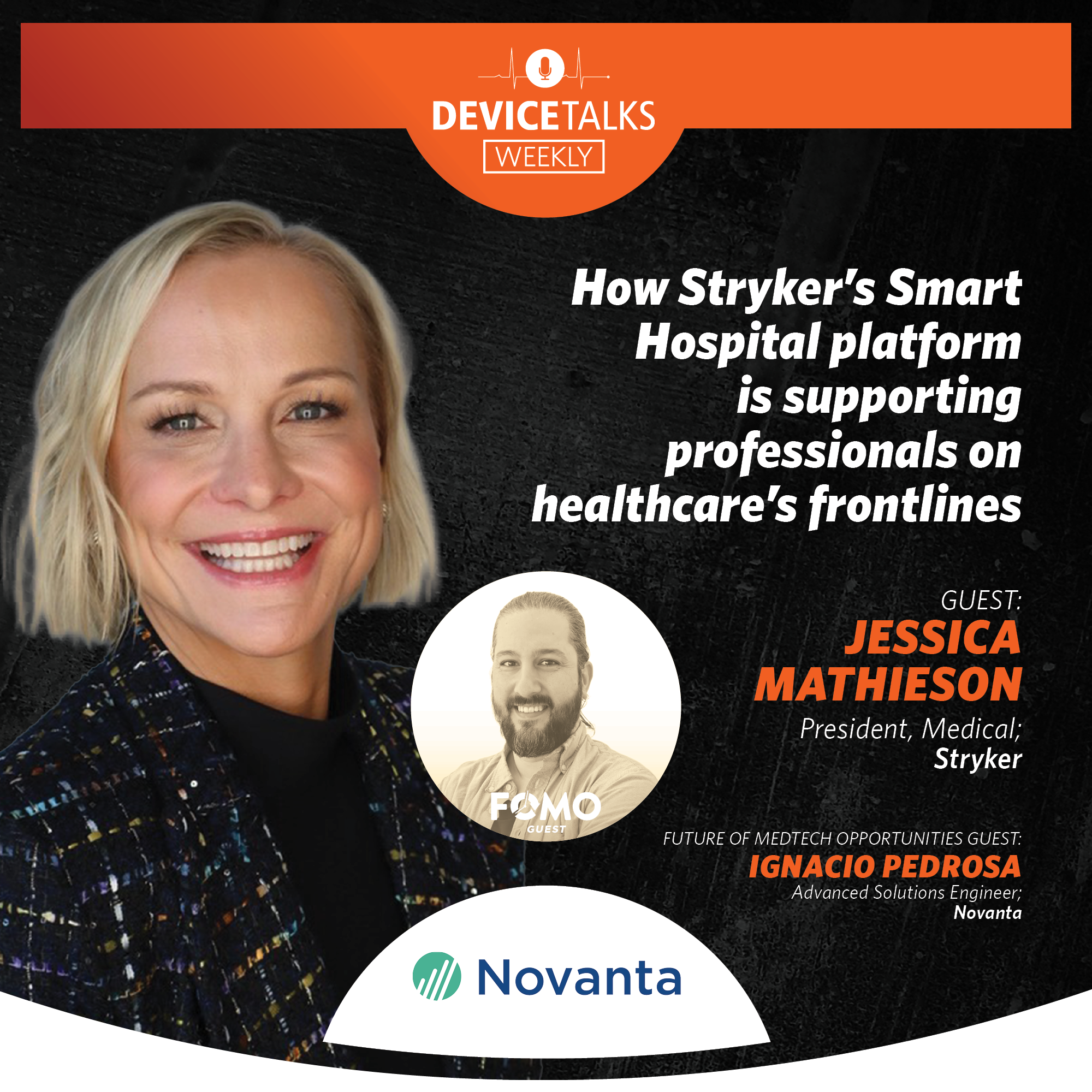
[00:00:00] Speaker A: Hey, everyone, this is Tom Salemi of Device Talks. Welcome back to the Device Talks weekly podcast. We have a great episode coming your way. My keynote conversation will be with Jessica Matheson. She is the president of Stryker's medical business. And we'll talk about Stryker's smart hospital platform and how we can help nurses and other healthcare professionals on the front lines. Before that, Kayleen Brown delivers this week's fomo, brought to you by Novanta. Great conversation about surgical robotics. And of course, we'll kick the whole thing off with our Newmarkers newsmakers. Chris Newmarker and I will unpack the week's events and tell you how you could score some Girl Scout cookies. So don't miss that. Before we get this podcast going, though, please make sure you join us at Device Talks Boston. It's happening on May 27 and May 28 at the Boston Convention and Exhibition Center. I know it's now the Thomas Menino Convention Exhibition center, but I really like saying BCEC.
So we'll be at the BCEC on May 27th, 28th. Go to boston.device talks.com for our agenda and which is continuing to grow, and our speakers. So without any further delay, let's get this podcast started.
All right, you ready for this?
[00:01:20] Speaker B: Ready.
[00:01:40] Speaker A: Why are you, sir.
[00:01:42] Speaker B: Doing well, Tom?
[00:01:43] Speaker A: Doing well because now I, I, I bought four boxes of cookies from your, your daughter, the Girl Scout cookies, so I had to buy four to get them shipped. Yeah, yeah. I think we should, should we put, like, the link in the show notes or we, or do you want. How much, how many cookies does she need to sell, do you think?
[00:01:57] Speaker B: Oh, man.
[00:01:58] Speaker A: We push them on our listeners. What do you think?
I did.
[00:02:01] Speaker B: Let's, let's. I don't want to, like, I mean, I, I mean, really, seriously, by listening this. You don't, you don't have to buy my daughter's Girl Scout cookies. Even though they're delicious. They're especially good. I mean, Thin mints. I mean, come on.
[00:02:15] Speaker A: I went with thin mint cookie.
[00:02:16] Speaker C: Ever.
[00:02:17] Speaker A: I did get the.
What's. What, what was the new cookie? What do they, what do they rename this? The Samoan Samoas.
[00:02:26] Speaker B: Oh, I think they're.
I'd ask Stella when she gets home again. I think it's caramel delights.
[00:02:31] Speaker C: I think.
[00:02:31] Speaker A: Yeah, I think you're right. I think it was like delights, not the lights. Yeah, yeah.
[00:02:35] Speaker B: And there's a new s' mores cookie.
[00:02:37] Speaker A: And I think I got the peanut butter. My son. I don't like peanut butter. I'm not a big peanut butter flavored person. I love peanut butter, but I don't like peanut butter flavored things.
Do you like peanut butter flavored things? Like, no.
[00:02:49] Speaker B: Yeah, I'm with you. I'm with you. I like, I mean, you know, it feels like a very healthy morning to have a nice piece of whole wheat toast with some peanut butter on it. I mean, you know, get a little half of grapefruit. You're like, man, I'm. I'm doing something good for my body here. But, but, but yeah, like something like, ooh, a peanut butter flavor. Whatever. It's just kind of like, yeah, whatever. Yeah.
[00:03:09] Speaker A: Unless it's like, if it's like, like a place that puts like real peanut butter in it, then you can get by. But if it's sort of just mirrors peanut butter or reflects the peanut butter flavor. No, thank you.
[00:03:18] Speaker B: Yeah, no, no. I need to get full. The full on peanut butter. You don't like, don't. You don't mess around with that peanut butter ice cream, you know?
Yeah, it's fun.
[00:03:30] Speaker A: Not my favorite.
[00:03:31] Speaker C: No.
[00:03:31] Speaker A: Yeah, yeah, I'd rather not. So anyway, I ordered the cookies. We'll be getting those. So I'm excited about that and fantastic. She having a good, good, good selling season. How, how's the, how's the market?
[00:03:41] Speaker B: It's doing well. I mean, if you live around the Twin Cities like Cubs, the big chain, and you know, they've been ro.
Rocking her daisy troops been rocking the tables outside the cub grocery store.
[00:03:51] Speaker A: So, yeah, I think as much as it, you know, with the shipping, as much as it costs, I was like, huh, okay, that's high. But then I realized it's less than two bags of popcorn from the Boy Scouts. So I'm feeling pretty good about my purchase. I got four bags, four boxes of cookies, which I'll actually enjoy, versus a large bag of popcorn.
[00:04:10] Speaker B: Were your boys ever in the Boy Scouts?
[00:04:12] Speaker A: Yeah, we talked about this a few episodes ago. We did. Boy Scouts did the fundraising, went door to door selling popcorn. And they just don't.
Popcorn doesn't generate the same enthusiasm as cookies.
[00:04:21] Speaker B: It's like, ooh, chocolate.
[00:04:22] Speaker A: Yeah.
[00:04:22] Speaker B: I mean, it's like, okay, chocolate flavor, chocolate covered popcorn and a wreath. You know, holiday wreaths, just not. Yeah, the cookies. The girl Scouts really.
[00:04:30] Speaker A: They got it.
[00:04:31] Speaker B: They really got it. It's an operation too. I get to watch the, the running of my, my daughter's troop. And I'm like, oh, my gosh. This is, this is. I mean, Girl Scouts do seem like overall, is this this is so that they can like spend time with their friends and learn. Cool, Stu. Like just a cookie selling operation here.
[00:04:53] Speaker A: Are your boys cutting it off?
[00:04:55] Speaker B: Not yet, no. We might get them going on. It's, I mean it's, it's pretty cool. We have a few relatives who made it to Eagle Scout, which, I mean that's like super impressive. You know, you get the impressive.
All right, Eagle Scout. Yeah.
[00:05:07] Speaker A: We will put, I'll put the form in the note.
[00:05:09] Speaker D: Why not?
[00:05:09] Speaker A: We'll put the little online form. People if you, if you need a cookie fix, they deliver. So go there and order.
[00:05:15] Speaker B: There we go. We'll see. But no, no pressure on anybody. I'm not gonna not force them.
[00:05:19] Speaker A: We will not be getting records of people who ordered. We'll have no, no visibility.
[00:05:24] Speaker B: Sounds fantastic.
[00:05:25] Speaker A: We're not here to talk about cookies, though. We do love cookies.
[00:05:28] Speaker B: Sorry people, we're here to talk about
[00:05:29] Speaker A: the medical device industry which is so well covered by my colleagues at Mass Device. So what is, what, what's the big news of the week, Chris? Newmarker. Let's hit those Newmarkers Newsmakers.
[00:05:39] Speaker B: Well, number five on the list is we actually Smith and Nephew, you know, the orthopedic device company, they had a really good Q4 sales beat and things are really looking up over there.
It's been about nearly two years since the Swedish activist investor Sivian Capital bought a stake in them and they're really moving forward with some stuff. Got a big strategic plan going over there.
[00:06:12] Speaker A: Yeah, I posted earlier this week when I saw their report. They had a nice year over year increase of 5%, 5.7%.
Looked at the other ortho businesses pulled out like Stryker pulled out their ortho business and Zimmer Biomet I think was well, of the larger companies was the top performer. 7.2. Stryker's Ortho business grew by 4.3.
Innovis grew by 10%. Globus grew by 18%. Again, it's a, it's a smaller business, but still that's really great. And we talked, we've talked a lot about Deputy Synthesis, which only grew just over 1%, 1.1%. So yeah, whoever buys depusinthes, I have to think there's some, some growth in there. Even if you get that growth up to 3% or 4%, I would guess
[00:06:55] Speaker B: that would be something with it.
[00:06:56] Speaker A: Yeah, a pretty good return.
But Smith and Nephew, it's interesting that you mentioned the activist investor because obviously Medtronic has had their relationship with an activist investor and they're having some success as well. So I don't know, maybe they're bringing some focus to these companies.
[00:07:17] Speaker B: Give them a little more focus, give them a little more mojo.
So they had some good advice to give our companies in our industry.
So yeah, this will be fun to follow. And yeah, stuff going on Medtronic.
Actually we got our top news today is from Medtronic. But we'll move on.
[00:07:34] Speaker A: Let's skip over then and go to number four. Let's keep it moving.
[00:07:38] Speaker B: Keep going here to number four. And number four is.
Well, I mean, Tom, the last article was by senior editor Sean Hooley. This is by associator Skylar Rivera. But Skylar Rivera was covering what this was last week's podcast or the podcast two weeks ago.
[00:07:52] Speaker A: Two weeks ago. Came out two, five.
[00:07:54] Speaker B: Two weeks ago.
[00:07:54] Speaker A: Yeah.
[00:07:55] Speaker B: So I mean this and this is just getting a lot of attention on mass devices.
Like Jenny Barba, the veteran venture capital investor in Medtech had like three tips for first time medtech entrepreneurs. And this is based off her interview with this podcast two weeks ago. But if you didn't have a chance to listen to our episode two weeks ago, Skyler has a really, really nice summary of it. Like, you know, like breaks it down to like three easy points of like advice from Jenny Barbara and you know, like, you know, on entrepreneurship and the device industry.
[00:08:31] Speaker A: Oh, Jenny Barber's a great friend of the podcast. She's a listener and a fan. So I hope she's listening and finding out that she is actually a newsmaker herself.
And she did a great interview with Kayleen Brown, our managing editor, talking about her career, but her work at Futures Capital and Skyler Rivera has done a fantastic job with the write ups of the podcast. So it's, it's really kind of meta having a write up of a podcast interview, being a newsmaker. It's like, whoa.
[00:09:01] Speaker B: Right?
[00:09:02] Speaker A: Yeah. And this, this is actually based on, on, on views. You, I asked you, I'm like, well, are you just giving some love to the podcast? You're like, no, no, it's getting a lot of read. A lot of people are reading it.
[00:09:12] Speaker B: So yeah, hundreds of people have read this at this point. You know, I think, I think when I checked an hour ago, there was like 25 people like reading the article while I was checking.
[00:09:22] Speaker A: That's fantastic. Good. Well, all right. Well, thank you, Skylar Rivera, for giving a new window into what we're trying to do here on the podcast. And Chris Newmarker, thanks for highlighting it as a newsmaker. Let's Roll on to number three anytime, Tom.
[00:09:38] Speaker B: I mean, this podcast has really good information for people and I'm so glad that Skyler's gotten this nice feature going where we're running out weekly articles off of some of the best advice coming out from device talks. And number three on the list, we're talking on Thursday. This came out with, you know, Sean writing an article on Mass device about a science corp which which is led by a Neuralink co founder, Max Hodak. They closed a $230 million Series C to support their BCI tech. So like nearly doubling the total amount of money they've raised so far. I mean, man, BCIs are a hot space right now.
[00:10:17] Speaker A: Absolutely. And this was another LinkedIn post I just put out today. Lightspeed Venture Partners with big. I always saw it as a big tech.
They do have more healthcare investments rather than I realized I think they had close to 30.
But they've all been pharma or biotech. Some healthcare IT some kind of slash services.
One precision medicine oncology test, which I guess could be considered kind of medtechy.
And the other was Free Sparrow, which is a digital therapeutic. So neither of them was true medtech. I think brain computer interface is medtech. I know it's a new technology, but if you're using it to restore someone's vision, to me that's a medical device. So it's great to see Lightspeed Venture Partners move into the medtech space.
Kossla Ventures has been a longtime supporter of science and of synchron, which is interesting. They have two BCI companies. Kossler Ventures also invests similarly to Lightspeed Venture Partners. A lot of biotech, a lot of AI, a lot of digital sort of health. But they do have some more traditional medtech, including some neuro companies in their portfolio. So maybe this will kind of bridge that gap and bring more tech investors into medtech.
[00:11:33] Speaker B: There we go. I mean, really? Yeah, I mean there's just so much excitement kind of in Silicon Valley and like all this tech investors getting into BCIs. Of course they have all this excitement that BCIs could be used by people like you and me if like, you know, I mean I need to actually help moderate a device talks panel. But I'm going to write an article in my head like in between the sessions or whatever.
I could do that if I had a BCI potentially. Right.
But beyond the science fiction, I mean there's some just really positive things that can happen. As you said for people, paralyzed people have blindness. I mean science itself has like a.
They're working on their prima retinal implant that's right now progressing through clinical trials. And Sean has a great picture of it here next to a car key where, I mean, if this was laying next to my car key, I think I, I'd like brush it off the table because I thought it was a grain of sand and this is like a retinal implant. I mean, that's just fantastic.
[00:12:31] Speaker A: So amazing. And they are performing miracles. And we'll have Nolan Arbaugh, who is the world's first Neuralink user. He'll be a keynote interview or keynote guest rather at Device Talks Boston. He's actually our joint with our Robotics Summit at Expo.
So folks attending Device Talks Boston at the conclusion of the event can sit in and, and hear his story and see him use the device to operate a computer. I think he might be playing some chess against someone either in the audience or with Steve Crow of the Robotics Summit and Expo.
So we'll definitely have a great visibility into the BCI space at Device Talks Boston.
[00:13:12] Speaker B: You just got me excited saying chess. I mean, I love chess. All my kids love chess. So that's fantastic. Love it.
In no way am I volunteering to be the one in the crowd who plays that movie.
[00:13:24] Speaker A: What's number two?
[00:13:25] Speaker B: Chris Newmarker number two is Boston Scientific. They want an expanded CE mark for their Ferro pulse field ablation system. And the expansion includes the treatment of persistent afib and yeah, just, you know, a win for Boston Scientific with its Fairpaw system which, you know, you know, seems to have been really one of the, you know, I definitely like it really. It's really seemed like kind of the big player in the, in the PFA space though. I mean, it's kind of fun now to see like Medtronic like advancing all these technologies as well. We have other up and comers like, you know, Abbott and even like Steve Michelson with his field medical and whatnot.
[00:14:12] Speaker A: Pulse bioscience is coming along.
[00:14:14] Speaker B: Yeah. Yeah.
So I mean, this is an exciting space right now, but some positive news for Boston Scientific.
[00:14:21] Speaker A: I think we have a pulse field ablation story probably more often than not on the newsmakers. There's seems to be a big news almost every week, if not every other week surrounding the PFA space.
Am I exaggerating?
[00:14:36] Speaker B: Absolutely. I mean it's definitely really one of the hottest spaces in medtech though.
PFA itself isn't heat based. It's like pulse electric waves. But it's, but the, the tech.
Yeah, right.
[00:14:52] Speaker A: This is one of the hottest wink Wink spaces.
[00:14:55] Speaker B: There you go.
[00:14:57] Speaker A: All right, Chris Newmarker let's roll.
[00:14:59] Speaker B: I have to say I'll, I'll, I'll. Something to add would be this week I, the, the folks over at emrecorp, which is, I mean, can I call them a startup if they've been around since 06?
I mean it's amazing industry that like there's companies that have been working on
[00:15:17] Speaker A: 20 years is kind of stretching this startup. I think it's.
[00:15:20] Speaker B: But I mean, you know, they're, they're traded in Australia now. They've like raised a lot of money in the last year or two and really advancing now finally like on clearances and. But it was really fascinating that they, I know one of the challenges with pulse field ablation is like it looks really good. You know, we actually had a really good, good session at Device Talks Boston a few years ago where Dr. Ken Stein from Boston Scientific was pointing out it looks really good when it's first done, but is it really going to stick or whatnot? And emmercore right now they have these MRI compatible ablation systems right now, mainly rf, but they're working on PFA systems too that could be compatible with mri. But I just had to think, I kind of wonder that may be part of the answer. Like if you're moving those ablation systems from CT scanning over to mri, are you going to get just more insights and kind of like take this to the next level. So it's very fascinating. Plus I got to try out the controls for RF ablation system next to an mri. That's always fun.
[00:16:36] Speaker A: That's always cool. It's always great to play with cool stuff, isn't it?
[00:16:39] Speaker B: That is the favorite part of my job and the fact that I'm here in Minneapolis. I can drive around, just see some really cool stuff.
[00:16:45] Speaker A: I think I've played with, excuse me,
[00:16:47] Speaker C: used
[00:16:49] Speaker A: five or six surgical robotic systems. So that's fun stuff.
[00:16:52] Speaker B: Yeah, that's really fun.
[00:16:54] Speaker A: We got a good gig.
[00:16:54] Speaker B: Chris Newmarker it is fortunate people living the dream, man.
[00:16:58] Speaker A: What's the big number one?
[00:16:59] Speaker B: Chris newmarker Number one on the list. As I said, news from Medtronic.
They've had a strategic alliance with GE Healthcare, but they're saying now that they're going to have a, a significant expansion in what they're doing.
And they're saying a key element of this expanded collaboration comes in the form of they're going to really work for broad integration of what they're describing as clinically advanced patient monitor parameters from Medtronic getting more integration with their nulla core pulse oximetry or microstream capnography. So they're going to get that, you know, like, you know, integrating across GE Healthcare's, you know, monitoring systems, so including like maternal and infant care. So I guess. Really? Yeah, really interesting business partnership. It's been getting a lot of attention
[00:17:57] Speaker A: on Mass Device and Medtronic's been entering into a lot of this particular business into a lot of partnerships with other companies like Philips and Mindray. It seems like there's really kind of a new strategy to of integration. So I hope we'll have an interview coming up in a very, very soon on the podcast to sort of unpack that strategy. So working on that to happen.
[00:18:19] Speaker B: And I'm excited too. Medtronic is actually, we're starting to report about tucking in acquisitions from them again. So that's fantastic to see Medtronic out shopping again as well. So just especially being based outside of Minneapolis, like right here on Medtronic's home turf. Yeah, it's great to see. I don't know, they're just. I was even saying that on LinkedIn earlier this week. Kind of feels like there's some mo mojo right now with Metronic. There's some stuff, stuff on the move over there, which is fantastic.
[00:18:45] Speaker A: Well, they're really based in Ireland though, aren't they, Chris?
[00:18:48] Speaker B: Yeah, technically, that old tax thing are the Irish.
[00:18:53] Speaker A: Just kidding. Just being a little Boston. Boston pain in the butt guy.
[00:18:58] Speaker B: So did you know that Boston Scientific has more people?
[00:19:04] Speaker A: I've always got touche around Boston.
[00:19:08] Speaker B: Like I was just, you know, I just saw that new facility up in Maple Grove the other day. Like, just like I just glanced at it again while I was going on a little, a little business jaunt and I was just like, that is. That thing is huge and it's going to double its size. It's just unbelievable.
[00:19:22] Speaker C: So I think you should.
[00:19:24] Speaker B: You're just taking right at me.
[00:19:28] Speaker A: All right, Chris Newmarker. Well, this is a great top five, but folks don't have to wait for podcasts to get 5 news, right? Chris Newmarker. How can they do that?
[00:19:36] Speaker B: I mean, I always love to have you listen to us, but you know, if you want to get this news every day, you just go right to Mass Device.
Right on the top of our homepage. There's a link to go and subscribe to our daily e newsletter. So you can get the top news in Medtech every day in your inbox just by subscribing to Mass Device Daily E newsletters.
[00:19:54] Speaker A: Why wouldn't you do that? It's just a no brainer to me. People are not signed up. Make it happen.
And in closing, I guess we can tell folks, I'm pulling out the conch.
Blowing out the conch. We're assembling the news team. Yeah, the news team will be at the vice talks, boss, and we're hoping to get everybody there.
Kayleen Brown, Scott Rivera, Jim Hammerand Sean Hooley, Chris Newmarker and myself.
He'll be on hand walking the floor and telling stories and reporting right live from the scene where it's all happening. So if you want to meet us, we haven't assembled in a very long time, so it'll be nice to have the team together.
[00:20:31] Speaker B: You're right. I mean we always had like a good large chunk of our group at different places, but like actually seeing everybody and this is going to be fantastic. And you know, it's, yeah, you want to meet the whole Mastiff Device Talks team, You get over to Device Talks Boston.
[00:20:44] Speaker A: Absolutely. All right, Kristen Marker, Great list of newsmakers. Now. Kayleen Brown, our managing editor, will bring you this week's FOMO from Novanta.
[00:20:54] Speaker D: Ignacio Pedrosa, advanced solutions engineer for Novanta. Welcome to the future of medtech opportunities. I'm so pleased to sit down with you today.
[00:21:03] Speaker C: Hello. Thanks for having me.
[00:21:06] Speaker D: So, Ignacio, I have a lot of questions specifically about miniaturization and heat dissipation in medical devices. But before going into the challenges, the solutions and what we can see in the future, I'm hoping you can share a little bit about your background. What drew you specifically to be an expert in miniaturization dissipation?
[00:21:27] Speaker C: Sure. Well, my, my technical background is in hardware design and power electronics and I also studied control, which is heavily related to robotics. And then as I started at the formerly known as Engenia, a company that was acquired by Novanta 12 years ago. It's been a while and during these 12 years that I've been within the company, I've done, I've done a lot from designing the actual products to caring for the industrialization of those and later on the architecture, hardware wise.
And in the later years I stepped more into a field applications engineer role in which I had the opportunity of having a lot of contact with the current roboticists and top companies in the field by providing support and also trying to find the best solutions for them. And very lately I've been using this know how that I've been able to build up to help within the strategy department of the company and conceptualize, conceptualize the products that we are about to launch in the future.
So I'm kind of looking to the future to understand what's going to be the needs of the next generation of robots so that our products would match.
That's more or less my partner.
[00:22:46] Speaker D: I didn't realize that Novanta worked within this space. Can you help me understand the relationship?
[00:22:51] Speaker C: Yes, well, Noventa is actually very well known company within the medtech in general, but specifically the surgical robotics domain. It provides both equipment and also components in the vertical that I am located. That's robotics and automation. We deal more with the components especially related to motion control and other parts of robotics.
But apart from the components, Novanto will also provide full systems that act during the surgical operations in the theaters and so on and so forth. So yeah, I would say it's a, it's a very solid brand when it comes to surgical robotication.
[00:23:31] Speaker D: We know that there are a lot of challenges when it comes to miniaturization and challenges with heat dissipation.
So can you help us understand what challenges we're facing maybe historically and today?
[00:23:43] Speaker C: Sure. Well, miniaturization, heat dissipation and efficiency are concepts that are bonded together. So you cannot have miniaturization without efficiency because the heat dissipation is going to be excessive. You need more metal, you need more surface to be able to get rid of that, of that heat. So if you want to make it smaller and smaller and smaller, you have to be more efficient.
Now the historical problem here is that surgical robots specifically needs very small actuation.
So generally speaking, you would imagine a robot arm, and in the end of the robot arm you have at the end effector or idu, or sometimes it's even called needle driver that ends up in a very tiny instrument.
So driving this instrument is already a challenge because it has to be touched. So surgeons and nurses or whatever professionals are working in the theater have to deal with the machine without, without having our heat up too hot. And that's in the patient end. But still you need all the imaginable performance when it comes to motion control. In the other end, there's also a very critical system, which is the console that the surgeon would use to drive the robot, to control the robot, and that it entails haptics and force emulation and a lot of sensing. So it's both sensing and actuators going on there. But you need very light, light and small systems that again are cold.
So to, to be able to instrument that and Also to motorize that you need very, very small systems that are very capable. And this is, this has been, generally speaking, a challenge. But as surgical robotics advance, the challenge grow because you keep demanding smaller and more effective, the smaller and more practical, smaller and more capable.
And at some point I would say that our ability to do this smaller and at the same time cold and at the same time intelligent, because smart is another axis of this equation. We are enhancing more and more and more and more the capabilities of the, of the source.
Now, obviously the motorized systems are going to have power driving systems, but also going to have logic to get all this intelligence done, all this intelligence embedded it. And funny thing, we always associate the efficiency or the power demands to the power part. When it comes to these very small systems. It's not the case. It may be counterintuitive, but the element that it's dissipating more heat is actually the logics because those are constantly on, so they integrate along time and become, let's say, bigger portion of the total heat dissertation of the machine.
While in the power part, which is related to the movement of the robot itself, it's going to be burst movement, like you move, then you stop, or it's going to be not full torque all the time.
So generally speaking, it's not going to, it's going to dissipate in a spurious way while the other one is constantly dissipated. So the challenge is not only the power part, the challenge is also being able to do some control systems that are extremely capable when it comes to motion control, but at the same time super, super tiny and efficient.
[00:27:02] Speaker D: Where are we today in terms of finding a solution? And then from there we'll look into the future.
[00:27:10] Speaker C: Sure. Well, these solutions is what Novanta, my company, is trying to deal with constantly in which we have built a lot of expertise. So you are going to need very small sensors that are, are extremely precise. You are going to need very small drives that are simple to embed, but at the same time extremely capable when it comes to motion control. Novanta specializes in this kind of devices and always has an eye into the future. So we have to keep doing them smarter and smaller. Especially now that new ways of controlling these robots that are not fully direct are coming over with AI, with telecontrol of these robots and with others. You are going to require to put more and more, let's say, capabilities into these very tiny, small devices that you need to build up in the robot. So the challenge is being able to provide them, being able to design them and Also being able to make them cost effective.
So there's a debate when it comes to build up a surgical robot in, in which you are going to decide to which extent trust the expertise of a company like Nuvanta or try to develop the technology by yourself. There's less of that debate in, in this specific types of surgical robot that attack something that was not existing before. And it's completely new because being the first to the market, it's very important. So time to market. Market most probably is going to force you to go into getting some off the shelf components for all the other cases in let's say surgeries in the thorax or knee replacement or spinal surgery or many, many, many others, the robots are more or less consolidated. So at the end the debate is to which extent your time is valuably invested in being able to do the proper motion control, which is already difficult enough now in the tiny, tiny, tiny requirements that the procedures have, instead of focusing into the surgery itself, like the machine, the capabilities of the robot. What adds value when it comes to a surgical robotics company.
So I would say this is a huge challenge to be able to deal with these two worlds or this balance
[00:29:32] Speaker D: based off of your experience, what you know and what you hope to see. What, what could we see the state of miniaturization and heat dissipation shift or change or be improved upon.
[00:29:46] Speaker C: So obviously when it comes to miniaturization and microsurgery, the thing is going, in my opinion, it's going to be keep moving forward, being able to reconstruct smaller veins, smaller nerves, smaller everything for which would require smaller equators, smaller equator or actuation in general, like a smaller ibu, smaller instruments. But then the game changer in the recent years that's pointing to the future is obviously AI.
So in my opinion, AI is going to have great impact in surgical robotics by being able to allow the surgeon to not control everything, to have a part of, let's say, autonomy of the robot, or even to be able to use AI to have a response that it's even more perfect or suitable than the input from the surgeon and smooth everything up. So as the robots are going to become more and more capable, especially in the micro domain, better hardware is going to be required, better sensors, better motors, better actuators. And we will try to be there to provide those.
[00:30:52] Speaker D: That was really helpful to think about the future, maybe broader. If we were look to be as specific as possible when it comes to miniaturization and heat dissipation, how could that shift or change in five to 10 years.
[00:31:07] Speaker C: Well, assuming the premise that the capacities of the robot will expand if we make things smaller and smaller and smaller, to be able to defer the thing into the smaller part of the body.
At least when it comes to physical robotics, the problem is that the heat dissipation is a consequence of efficiency of, or a lack of it. So we are going to dissipate a small amount into our controls, but compared to what the motor is doing, it's enormous, related to its size.
So we cannot have it, let's say ultra small without being super efficient. And we are reaching some levels in which we are dealing with crazy efficient, like more than 99.5%.
Now, looking into the future, currently the smallest drive, the motor controller in the market with Ethercat is our Denali drive. But we realize that for the next, let's say, generation of robotics, it is still too big. So we have the responsibility of keep shrinking and shrinking and shrinking, making it more and more small. And this is what we are working in. So in our next generation of products, you would expect to keep the capabilities of, of what our current line of products already had and even expand them, but being able to reach a new level of small by making it even more efficient, both into the logic or control domain and to the power domain.
[00:32:37] Speaker D: Any last thoughts?
[00:32:40] Speaker C: You don't have to do everything. You have to focus in what really matters when it comes to such complex systems as these robots. And I would say, let us walk that path with you. Use our experience, use the experience that we have built for a lot, a lot of years, and let us be your partner in granting the success when it comes to designing these very complex systems.
[00:33:05] Speaker D: Ignacio Pedrosa, advanced solutions engineer for Novanta, thank you so much for joining us on the future of medtech opportunities.
[00:33:15] Speaker C: It's been my pleasure. Thank you very much.
[00:33:18] Speaker A: All right, great job. Kayleen Brown. If you'd like more information about Novanta, please go to its website, novanta.com that's n o v a n t a dot com.
Now is the time for our keynote conversation. Let's hear from Jessica Matheson. She's the president of the medical business at Stryker.
Well, Jessica Mathson, welcome to the podcast.
[00:33:45] Speaker E: Hi, Tom, how are you?
[00:33:46] Speaker A: I'm doing great. I'm very happy to have you back. You were, I think the last time we had you on a podcast was the Stryker Talks podcast and I looked it up. It was three years ago that we talked, which is mind blowing. You were in 2022, and we talked a bit about what we're going to talk about today, but there's certainly a lot has gone on between then and now.
And I typically start off this podcast trying to find out how folks found their way into the medtech industry.
I can summarize a little bit. You started off in Cisco, the food business, which we talked about at the time, and then you went right to Stryker, correct?
[00:34:22] Speaker E: That's correct. And I've been with Stryker for 17
[00:34:24] Speaker A: years, and I did ask you this then, but you've had three years to build on this expertise. How do you recommend or if you're talking to a younger peer or what sort of advice do you give them to move through a company and move up through a company, find ways to advance themselves?
[00:34:41] Speaker E: Yeah, it's a great question. You know, I always tell people, talk less, listen more, and find people that you can learn from, that you can brainstorm with. And I'm fortunate enough at Stryker to have had some incredible mentors that I've had the opportunity to learn from over the years. Years.
[00:35:00] Speaker A: That's great. All right, well, let's get into the matter at hand. I know you'll be at hims next week.
There's a lot of, lot of important topics going on there.
And I want to, I want to take, as I mentioned at the top, we haven't talked in three years. When we talked previously in 2022, this was just after we emerged from the pandemic and we hadn't really quite emerged yet.
The healthcare setting, I would say the environment for healthcare workers had deteriorated considerably then. And we talked about Vocera and how it was going to help sort of close those gaps and make it a more seamless setting for folks to work in and to make communication easier. Give us a sense. I know you talk to a lot of customers and I know you're engaged with the healthcare industry.
How are things today compared to where they were three years ago, not including the virus? I'm just saying in terms of the setting.
And have things gotten better? Are they. Are they. Have they remained challenging? What's it like out there?
[00:36:01] Speaker E: Yeah, Tom, I'm really glad you, you started with that, that question. And healthcare systems across the world are facing unprecedented challenges. And the way in which healthcare is currently being delivered is not sustainable. Clinicians are asked to do more with less. They need it done faster. There's fewer resources, unfortunately.
Fragmented digital tools create noise and confusion. If you look at the micro level challenges, staffing shortages, turnover, rising patient acuity, adverse events, patient satisfaction, workflow, inefficiencies, Cognitive overload, workforce violence, medical errors. And then on the macro level, you know, there's a focus on improving quality of care, reducing the cost of care, restoring safety, reducing variations through driving, standardization, optimizing the workforce we have.
So there's a lot going on. And I believe the medical device industry plays a big role in solving these problems and these challenges and partnering with our customers. And Strykers, because of our breadth and depth across the continuum of care, from the scene of a roadside accident or cardiac arrest in a home into the emergency department into the or the med surg, the ICU is uniquely positioned to partner with our customers to address these challenges. And the Smart Hospital platform is a platform that is focused on addressing all of these challenges I just spoke about.
[00:37:40] Speaker A: Yeah, no, let's unpack that a little bit. These challenges, I mean, there is. There's no one better positioned than MedTech to, I think, to solve these problems.
And I want to get into those solutions in a moment. But as I said in my first question, I think we had tied a lot of those stresses to the pandemic earlier on, but it sounds as if we haven't seen any sort of reset, that we haven't seen any sort of move back, that things have continued to be as challenging as they were back then.
[00:38:11] Speaker C: Then.
[00:38:11] Speaker A: Is that how you see it?
[00:38:12] Speaker E: As well as challenging, if not more challenging, if not more? And I think while there's incredible technology, there are so many disparate systems that do not talk to one another, that are not interoperable, that are creating additional confusion and noise in the system. And unfortunately, that can contribute to delaying care, to adverse events, to medical errors. And so I think we're here three years later, and unfortunately, it has not gotten better. It's gotten worse.
[00:38:49] Speaker A: So did solving those challenges always sit squarely inside Stryker Medical's core mission, or did those changes cause a reassessment in the company and a realization that someone's gonna do something and we're in the best position to do it?
[00:39:08] Speaker C: It?
[00:39:09] Speaker E: Yeah. Across Stryker, all of our innovators have always been focused on understanding our customers across all the different call points, their biggest challenges, how we can make their jobs easier, how they can provide better care to patients.
And so it's always been about what are the tools and resources we can create and innovate around to make make care teams lives easier and help them provide better care across the continuum of care, not just Stryker Medical. If I think about Stryker Medical and the journey we've been on, you know, one adverse event that we've been focused on for years and years and years and it is the number one adverse event. Unfortunately year after year are falls in hospitals.
Obviously you know, that impacts the patient's recovery, it can increase length of stay, it's costly to the healthcare system.
And so we understood that problem. In 2012 we launched the industry's first wireless bed that it helped address the inefficient workflow in. As you think about bed alarms being delivered to the nurse, we followed up with the launch of percuity in 2020.
But what I just talked about is one adverse event and it's one workflow. And we knew we had to think bigger and we had to understand the inefficient workflows that were happening across the continuum of care which, which led us to acquire Vocera in 22, Care AI in 24. We followed up, we innovated around a new Vocera Hands Free badge in and so from a medical standpoint, we've always been focused on bed related falls, but we knew we needed to think bigger. And our other divisions, including Medical have been helping solve our customers problems around adverse events and patient satisfaction and staff safety for years.
[00:41:14] Speaker A: I remember at the time, I think I saw a video or something in one of your company meetings about the hospital bed and, and the way it was presented, it just blew my mind as to how you just think it's a bed and then you see all the things it can do. You're like, oh, this is a medical device. This is not just a bed.
Give me a. Just, just.
I want to get into Vocera in a moment because we keep mentioning it and I sometimes I assume everyone knows the entire Vocera story and I don't want to assume that. I want to unpack that and then I want to get into Care AI but take us to just Stryker Medical in terms of what will we. If you're in a hospital room and you're looking around, what's going to have Stryker on it? What kind of products do you have in there that are directly related to that patient care?
[00:41:57] Speaker E: Oh goodness, Tom.
[00:41:58] Speaker A: I mean maybe top three. Maybe top three.
[00:42:02] Speaker E: I mean of course the bed, as you think about patient furniture, the bedside table, the treatment recliner. Now you know, from a Care AI standpoint, you're going to have a sensor on a wall. Our Sage products that help address hospital acquired infections and safe patient handling are throughout a hospital room. So that's just to name a few.
[00:42:25] Speaker A: Okay, now we get a sense. So you're everywhere. Okay, so Stryker, you've got the Infrastructure in the room. Now let's unpack up a little bit and bring folks back to Vocera.
Talk a bit about what Vocera, what it is as a product. It's a company you acquired in 2021, 2022. But what did it add to all those things that Stryker was already doing?
[00:42:48] Speaker E: Yeah, great, great question, Tom. You know, if you, if you think about Vocera, the, the, the, the portfolio for Vocera starts with our clinical communication endpoints.
So our hands free badges, our mobile application, but also our intelligent workflow, orchestration and middleware, which we call that product Engage.
And that's a really important part of the collective smart hospital platform. Because what that allows us to do is pull important data insights alerts from medical devices, not just Stryker devices, that's really important, but all medical devices and get that information to the right caregiver at the right time. The other part of that is it's getting it to the right caregiver at the right time, but it's also understanding what alerts and what data and information we do not need to send to certain care team members. Because one of the challenges with cognitive burden, and if you stand in the hallway of an OR, or you stand in the hallway of a med surg or ICU or emergency department, you will quickly recognize the amount of information that care teams are receiving every single minute.
Some of that information is critical in regards to the patients that they're responsible for. Some of that information they don't need. So the Age Rules engine helps us get the right information to the right care caregiver, but also filter those alerts so we're not sending additional alerts and alarms and information that caregivers don't need and that helps reduce cognitive burden.
[00:44:25] Speaker A: No, that makes a lot of sense. So the Vocera badges, these are things that the caregivers nurses will wear, I think primarily do doctors wear them as well, but allow for communication. Basically allow them what can those badges, what functions do they perform?
[00:44:41] Speaker E: Well, first and foremost, it provides for hands free communication. Okay, think about a nurse.
[00:44:46] Speaker A: So just like Star Trek, they can just say, that's right.
[00:44:50] Speaker E: Their hands are always full. Their hands are always full. It provides for hands free communication. But what I just talked about with our Engage Rules engine, that's how they're receiving through the badge, important information and alerts. It also has a discreet panic button because unfortunately, workplace violence in hospitals as at an all time high. So if a nurse is in a situation where they feel unsafe or at harm, they can discreetly hit the panic button. And then that message is broadcast to the correct team so they know exactly what's happening in the environment that particular nurse or caregiver might be in. And that's really important.
[00:45:31] Speaker A: Absolutely. Okay, great. So now we have a sense of where you were, what Vocera brought in. And now let's talk about the acquisition and the incorporation of Care AI. Where does Kai fit into well into your portfolio?
[00:45:48] Speaker E: Well, Vocera and Care AI together are our smart hospital platform. And I think it's important to note that the Smart hospital platform is not a single product or solution. It is a foundational platform that brings together five core capabilities. The first one is, is connecting our capital devices, our wireless capital devices. We have 85 plus connected capital devices across the Stryker portfolio.
[00:46:16] Speaker C: Wow.
[00:46:17] Speaker E: So we have the ability to connect those products into the smart hospital platform. The second part we talked about, it's the clinical communication tool. So those are the endpoints, the hands free badge as well as our mobile application. We talked about the intelligent workflow, orchestration and middleware with Engage.
From a Care AI standpoint, our virtual care, virtual nursing and monitoring, that's what Care IA brought to the platform. And what this allows is remote teams can monitor and assess and support patients seamlessly. So this takes the workload off the care teams that are on the floor.
And then also with Care AI, we have ambient intelligence that adds awareness without adding burden. So from an ambient standpoint, we are monitoring environments, whether it's rooms or ORs, and we're understanding what is happening in those environments and then proactively communicating to care teams if there is risk and something must be addressed.
[00:47:22] Speaker A: You referenced the device that's collecting this information earlier. What talk to me about what is in the room that is seeing all these things that is helping caretakers keep a quote unquote eye on patients, even if they're not in the room.
[00:47:36] Speaker E: Yes, it's a camera. So it's a Care AI camera.
And then our ambient intelligent models sit on the sensor so the camera is on the wall.
And again, it's passively monitoring patients to understand if a patient becomes agitated and they're a fall risk.
The, the, the model can recognize that if physical therapy comes in and doesn't turn the bed alarm on, the. The model will recognize this and alert a nurse. I could walk you through workflow after workflow of what the models are recognizing with our Care AA cameras and sensors.
[00:48:17] Speaker A: So is there any feed that's being. Are there, are there there screens in the nurse's station where you actually have a feed or Is this all sort of just going into your AI model that's then just pulling out the important information?
[00:48:33] Speaker E: Great question.
Many hospitals are using care AI as a virtual nursing and monitoring tool.
So many have command centers where you will have a nurse, a virtual nurse, monitoring between 8 and 10 patients.
[00:48:50] Speaker A: Oh, wow. Okay.
[00:48:51] Speaker E: And typically they will. They will admit patients, they will discharge patients. So again, we're taking the workload off the care nurses.
But also if family members come in and want additional information, the virtual nurse can come on screen. So there's a lot of different workflows that the virtual nursing platform enables. And then you also have the ambient intelligence models that are also a part of the care AI portfolio.
[00:49:17] Speaker A: The communication part is amazing because you're in a room and you have a question, you go out and you're looking for the nurse, you know, and you don't want to interrupt anyone because you don't know what they're doing and you don't know who to ask, and they don't know the answer anyway. So that's remarkable.
[00:49:32] Speaker E: You know, Tom, maybe I'll give you another example.
We talked about, unfortunately, inefficient workflows, delaying care.
You think about a large health system that might have a wound care nurse, that wound care nurse might be responsible for five locations.
And so if there is a patient that we're concerned about, skin breakdown, and that wound care nurse might not be at the facility that day, that might. In, you know, a hospital that doesn't have care AI, that means that might not. That might mean that they. They don't see the patient till the following day or two days when they come in. So through this technology, that specialist, that wound care nurse can come in through our virtual nursing platform and see the patient.
[00:50:19] Speaker A: Wow.
So, and we talked about this, I think, at the start, the state of things, but I just want to revisit again, workflow and more important workforce.
It's harder and harder to find people to join this industry.
Do you have a sense of what kind of impact your smart hospital system is able to make in terms of you're able to provide the service of maybe what previously had required? 10 people with five. Do you have any sort of sense of what kind of impact you're making on solving that problem?
[00:50:55] Speaker E: Yeah, I mean, a couple.
A couple different key drivers there. One, if you think about retention of nurses when they have these tools and resources, we are removing burden from their day to day. We're saving them time, we're saving them minutes, and we're able to take some of the, what I would say less clinical tasks off of them.
And so it's very much a retention tool for healthcare systems to keep nurses. The other piece is, as nurses near retirement, what we're seeing is many of them are wanting to move into the virtual nursing department so it will prolong their careers because they now have a pathway to extend their careers through the virtual nursing platform.
[00:51:44] Speaker A: No, that's really smart. If you're at a place that has a smart hospital and you go to another that doesn't, you must feel just, just alone to a degree, or not to a complete degree, but a good part of your vision has been sort of removed. So you could definitely see someone staying at a place for that purpose.
How have you been able to at Stryker, bring all these companies, these technologies together and incorporate them into the single smart hospital system? What has that integration process been like?
[00:52:15] Speaker B: Like?
[00:52:16] Speaker E: Yeah. Well, if you think about our smart hospital platform, it's the fabric of how hospitals get smarter and everything. I walked you through those five core capabilities. They're interoperable, so they all work together.
So we can take devices, integrate them into the platform, use our Engage Rules engine to route the right information to the right caregiver at the right time. So, so we've had a ton of success. I think it's really important to understand that all of our customers are at a different phase of their journey.
And as we think about their smart hospital strategy, we really have to understand the technology they have, what their priorities are, and then partner with them to figure out what is the next step forward in regards to their smart hospital strategy. But we are uniquely positioned because of our breadth and depth of products across the portfolio, our understanding of regulated medical, regulated devices, and again, the smart hospital platform.
[00:53:22] Speaker A: So where are hospitals in terms of being ready for this level of communication? Are most of them kind of gimme, gimme, gimme, or are they sort of, well, let's kind of wade into the water slowly.
What is the reaction you're getting from customers?
[00:53:45] Speaker E: The majority of healthcare systems are at the beginning of the journey, but they understand they need strategic partners to go on this journey with them, a handful of strategic partners to go on this journey with them.
And you know, it's the, we always say that the smart hospital platform, it's more than a platform, it's a partnership and it's a multi year journey for the majority of these healthcare systems. And they want a partner that understands the importance of clinical and operational workflows, that understands the importance of medical devices and hardware play in creating the smart hospital platform and driving more efficient clinical workflows. And again with our 85 plus products, we're uniquely positioned to be that part partner.
[00:54:37] Speaker A: Amazing.
So let's look forward a bit when as I said when we were talking three years ago, you were just brought in Vocera and that was really kind of amazing technology for us to talk about then. Now you've incorporated care AI in your unpacking what that means for this. Where do you see this sort of platform going? Are there other. Well, we'll be talking two years from now about something that I don't know about that is going to take this even further. What's the environment like out there now now for these sort of smart technologies and for these connected health technologies?
[00:55:12] Speaker E: Well, I hope we're talking in two or three years and we've continued to innovate, we'll continue to be acquisitive. You know that Tom.
So absolutely, as a growth company and as a company that's constantly innovating, in three years we'll have additional features and additional innovations as a part of of the smart hospital platform. You know, our customers are faced with systemic challenges across their patient journeys and they again need a handful of strategic partners and we are uniquely positioned to be that partner to our customers and
[00:55:46] Speaker A: just zooming out to the industry. I mean I spend most of my time talking about surgical robotics or intravascular lithotrism and all these things that patients benefit from but don't necessarily aren't really aware of.
I don't spend much of my time and I probably should spend more talking about these patient facing technologies. Give me a sense. Last question.
Where are you're going to himss next week? You're going to walk the floor. You're going to see some what is the pace of innovation like on this side of Medtech? How excited are you about where the future is headed more broadly for this part of the medical technology industry?
[00:56:26] Speaker E: You know what is really exciting in this space is we're moving faster than traditional regulated medical devices and certainly that's a big part of the Stryker portfolio. But in this space, what I just talked to you about, these aren't regulated devices.
And so as a company we are moving faster in this space. We're innovating faster.
As we think about software releases, they are at a pretty significant cadence in regards to how often we we are releasing new features and new upgrades and that's been really exciting to be a part of at Stryker with a company that has traditionally focused on medical device. But the other part of that is that hardware, the medical devices, play such an important part. And I think that's one of the reasons we're well positioned is again, we know the regulated space, but now we understand the HC IT space, the healthcare IT space. And we've got incredible relationships across the continuum of care care which make us a great partner to our customers.
[00:57:32] Speaker A: Fantastic. All right, well, this is an exciting space for sure. As you said, it's hard to keep up with all the advancement that's going on here, and I'm glad we had this chance to reconnect. Jessica, thank you for joining us on the podcast.
[00:57:47] Speaker E: Thanks, Tom.
[00:57:50] Speaker A: All right, well, that is a wrap. Thanks so much for joining us on this episode of the Device Talks Weekly podcast.
I'm really grateful for Novanta for providing this episode's fomo. If you don't want to miss a future episode of the Device Talks Weekly podcast, you have two options. You can either subscribe to Device Talks Weekly on any major podcast player or the Device Talks Podcast Network. I recommend the second option. That way you don't miss any future Device Talks podcast, this one or our other great ones, including the Women in Medtech podcast. Please connect with me on LinkedIn, connect with Chris Newmarker on LinkedIn, connect with Kayleen Brown on LinkedIn, and make sure you also follow mass device and device Talks there as well. Don't forget to join us at Device Talks Boston. It's happening on May 27 and May 28 at the Boston Convention and Exhibition Center. I know they changed the name, but I like the BCEC.
Go to boston.devicetalks.com for more information. All right, folks, thanks so much for being part of the Device Talks Weekly Podcast.