[00:00:00] Speaker A: Hey everybody, this is Tom Salami of Device Talks. Welcome back to the Device Talks weekly podcast.
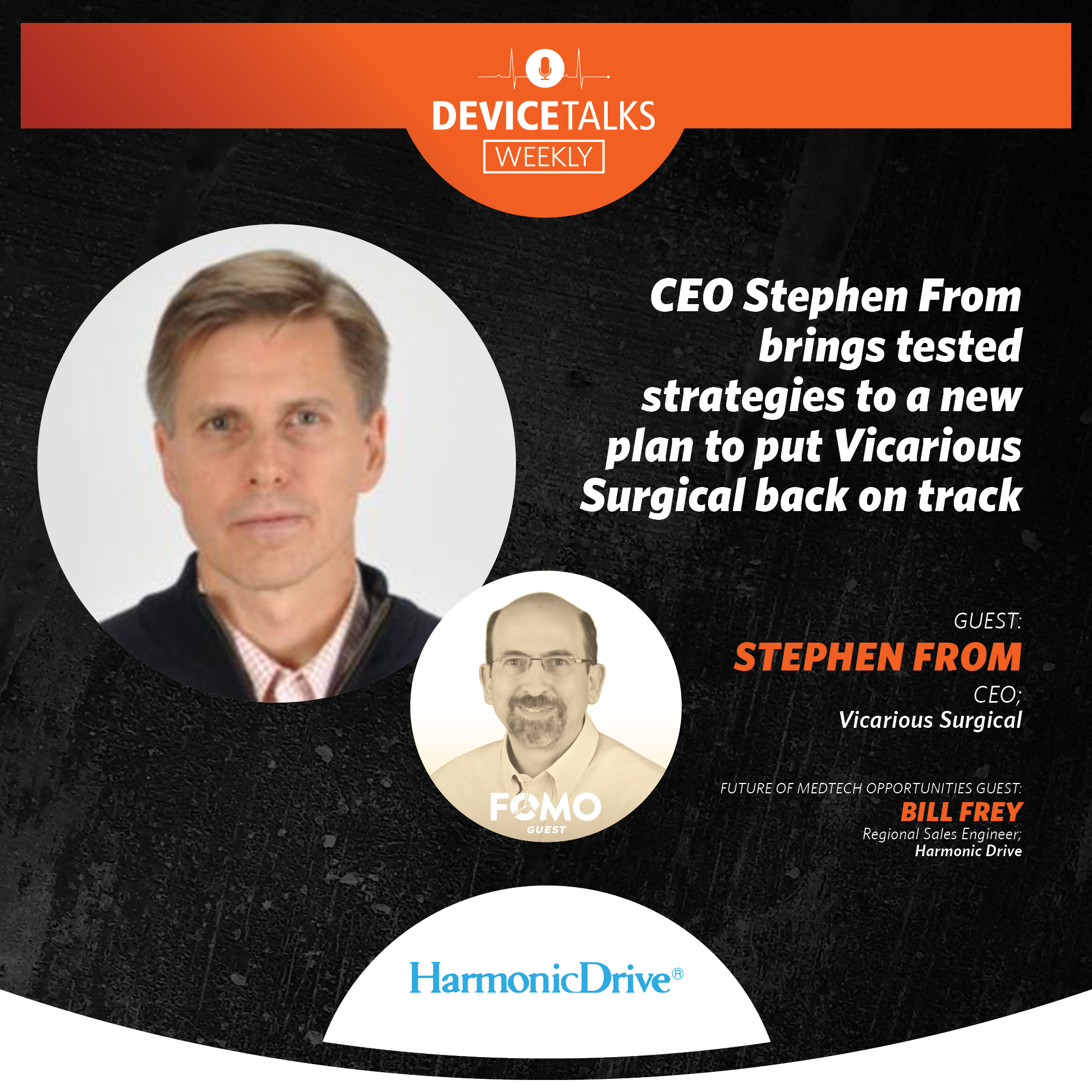
Fantastic episode coming your way. We'll talk a little later in the podcast with Stephen Fromme. He's the new CEO, newish CEO of Vicarious Surgical, which I think is one of the cooler surgical robotics companies out there. Stephen makes a case, makes a great case that it's more of a medical device company than perhaps some of us have given you credit for. So, real conversation about the real business part of Surgical Robotics with Stephen Fromm. So you'll hear that a little later in the podcast.
Just before that, you'll hear our FOMO conversation, my FOMO conversation with the fine folks at Harmonic Drive. Thanks to them for sponsoring this episode and contributing this episode's FOMO interview. And of course, we'll kick the whole thing off with Chris Newmarker, the editor of Mass Device. So we, we'll hear the top news of the week. But before we begin, I'd love to invite you to be part of our in person events. Device Talks Minnesota is coming up on May 4, and of course we'll be at Device Talks Boss on May 27th, 28th. If you haven't registered for either yet, feel free to use this code made especially for you. Device Talks Weekly Podcast listeners go to user code rather DTW device talks weekly DTW 25 for 25% off. So register with the code DTW25 to save yourself a little bit of coin when you register to join us at Device Talks Minnesota and or Device Talks Boston. All right, without any further delay, let's get this podcast started.
All right, you ready for this?
[00:01:43] Speaker B: Ready.
[00:02:01] Speaker A: Chris Newmarker. How are you, sir?
[00:02:03] Speaker B: Doing well, Tom. Doing well.
[00:02:05] Speaker A: Little backstage talk for folks. Chris and I couldn't even get started on this podcast. We couldn't even get our. How you going, sir? Going. So this is going to be a rough one, folks might want to just fast forward through the.
Through the conversation.
[00:02:19] Speaker B: Why don't I even want to listen to this? Yeah, who knows?
[00:02:22] Speaker A: We got an interesting news week for sure.
Lots of, I think, fantastic new technologies, some geopolitical ramifications and a cool acquisition. So you got everything. You got it all on this week's news magazine.
[00:02:40] Speaker B: Yeah. And the geopolitical thing, I mean, the world's so peaceful right now, right, Tom?
[00:02:47] Speaker A: I won't say anything. I won't say anything. Yeah,
[00:02:51] Speaker B: these are, these are interesting times for sure, but however. Okay, so, I mean, let's lighten the mood a bit.
Yes.
Do you have problems with turkeys? In your area in Massachusetts, the country or the bird?
I mean, the country is great.
I mean, Istanbul is definitely on my list of global food.
[00:03:14] Speaker A: So I have no problem with turkey whatsoever. As for the birds, do I have problems with. No, I don't have problems with turkeys.
They are.
They are around and they are often intimidating, but I've never had an encounter with one. Why do you ask?
[00:03:28] Speaker B: Oh, they were intimidating my kids this morning.
[00:03:30] Speaker A: Oh, were they?
[00:03:31] Speaker B: There was a whole group of toms in the driveway gobbling very loud.
[00:03:35] Speaker C: Wow.
[00:03:36] Speaker B: Like, when. When the. When the kids came out. So I had to kind of like, you know, gently usher them. Usher them away. But we. We have large cottonwoods behind our house, and they've really. They've. They've decided to start roosting in our cotton woods at night. So instead a rooster call. I'm getting like a gobble in the morning when I'm waking up.
I mean, really. And, like, it's a great. When the males do that big, like, feather display, like, at the same time. They were all doing that. They were.
[00:04:04] Speaker A: Doesn't that mean they're about to strike? I don't know what happened. I don't know if I've ever seen the feather display. Is that a good thing to see?
[00:04:09] Speaker B: No, that's not. That's a bit aggressive. They're a bit.
Yeah, but at least we don't feed them. I mean, I've heard, like, you. I've actually, I think the state DNR has something on their site here in Minnesota that you shouldn't be friendly to them because, like, in turkey psychology, if you're friendly to them, they think you're part of the flock.
And then the. The head male will attack you to show you his boss. So, you know, you should.
Should just, like, keep some distance. Enjoy. Enjoy the view.
[00:04:36] Speaker A: I mean, turkeys have a look. Like, if you walk by. What is it? What is the group of turkeys? It's not a flock, Right. What is it? It's a. I've heard you can call
[00:04:44] Speaker B: it a parade of turkeys.
[00:04:45] Speaker A: Really? I don't think that's what I'm thinking about. But if you walk by a large group of turkeys in the park and they stare at you, you're like, you're glad they're not carnivores, because if they were, I'm pretty sure they would just go right after you. Like, they have a look. They have a killer look about them. Turkey's got a fearsome glare, I think.
[00:05:03] Speaker B: Yeah. I mean, if they didn't have feathers. It'd be like velociraptors.
[00:05:06] Speaker A: Exactly, exactly.
[00:05:07] Speaker B: They'd be just hunting you down.
That's the way you go. That'd be the last thing you'd hear in your life would be like, that's it. You know, so.
[00:05:18] Speaker A: Well, I'm sorry that the turkeys frightened the tiny new markers, but I'm sure you'll teach them a valuable life lesson from that experience.
[00:05:28] Speaker B: Yeah, it's making them tough. We're just toughing them up. It'll be good.
[00:05:31] Speaker A: Yeah. Tough street kids. Tough street kids, for sure.
[00:05:33] Speaker B: That's right. Tough street kids.
[00:05:37] Speaker A: Did you have bullies? No, we didn't have bullies. We had turkeys.
[00:05:40] Speaker B: I did, like, when we moved a little farther out into the suburbs. My oldest was at the bus stop telling some other kid, like, well, back when I was more in the city, like in St. Louis park, like, I'm like, give me a break, dude. You're still in the suburbs. Like, you're not. No.
[00:05:55] Speaker A: Mean streets of St. Louis Park.
[00:05:58] Speaker B: The mean streets.
You went from inner suburban to just a little less inner suburban.
[00:06:09] Speaker A: It's a big move for a little kid, but. All right, Chris Newmarker, as we mentioned, the top. You get a lot of. A lot of news this week in the newsmakers, which you always do.
[00:06:18] Speaker B: A lot of news.
[00:06:19] Speaker A: Yeah, but. But I think an interesting. An interesting compilation of events. So why don't we absolutely. Stroll over to number five on the new markets newsmakers. Yeah.
[00:06:27] Speaker B: Number five on the list is Petal Surgical adding more funding. They're now like, at like, total. A total of $25 million in funding. And they've, like, added on Fred. Dr. Fred Mole to his board. I'm kind of wondering at this point, Tom, is there a surgical robotic company that does not have Fred Mole on the board? That would almost seem more unusual. I mean. Yeah, it seems.
[00:06:49] Speaker A: I don't think he's on the board. Intuitive, right?
[00:06:52] Speaker B: Well, no, I mean, he co founded it. Yeah, he's not on the.
He's not on the board.
[00:06:56] Speaker A: But is there. Is there a company that he did not touch?
Very few. Now, there's obviously much, but no, he remains very well engaged in this industry he helped create.
[00:07:09] Speaker B: It seems like right now in Surgical Robotics, having Fred Mole on the board seems to be like the stamp of approval. Like, look, we've got Fred Mole on the board, so we got something going on. And Petal is.
[00:07:21] Speaker C: Is.
[00:07:21] Speaker B: I mean, definitely, like, really, really exciting technology. I mean, this is like hippotripsy. I mean, there's Also a company here in the Twin Cities, Histasonics, that's involved with that technology. But you know, this idea of like incisionless surgery using focused ultrasound to like dissolve dissolved tissue inside the body, it's just really exciting stuff.
[00:07:41] Speaker A: I feel like you're just teeing me up, Krishna. You're throwing in these softballs because, you know, we're going to have Prof. Stropro, the CEO of Petal Surgical, giving a FOMO presentation at Device Talks Boston, and you are going to be leading the keynote conversation. Yes, we are. And you're going to be leading the keynote conversation with Mike Blue of Histostonics at.
[00:07:59] Speaker B: Get out of here, man.
Yeah.
[00:08:02] Speaker A: So all. And these are not why these folks are on the new newsmakers. No, sir, they are genuine newsmakers.
[00:08:08] Speaker B: Absolutely not.
[00:08:08] Speaker A: We just, we have nothing but big newsmakers at our Device Talks meetings.
[00:08:13] Speaker B: So I mean, I mean seriously, it's like we're covering this news and it's getting excitement in the industry that informs forms us, you and our decision making and what we bring into these events. So I mean, it's like I just love the relationship we have here that the news and excitement in the industry like informs Device Talks on you know what, we get into the events and vice versa. Then like we bring people into the events and it makes more news. So it's just fantastic. And people can, I strongly encourage people like register for Device Talks Minnesota, Register for Device Talks Boston. You can come and just be part of the magic. It'll be awesome.
[00:08:50] Speaker A: Yes. And of course we have our code for our podcast listeners. Folks can get 25% off the price for listening to the Device Talks weekly podcast. So make sure you use the code that I mentioned at the top of the podcast. Going back to your original point, Chris Newmarker, you also had this week, or Sean Hooley did at least anyway, on Mass Device at Fred Mall, I believe co led around an investment round in xcath, another surgical robotics company. So yeah, not on the board, but he is involved.
[00:09:19] Speaker B: Yeah, I mean, yeah, it's just wild.
I mean I was being a little tongue in cheek, but really it just seems like every up and coming robotics company, it's hard not to see a story that doesn't have Fred Molson name in it at this point. So it's really, really cool to see everything he's doing around the industry.
[00:09:41] Speaker A: All right, well that's a great number five, Chris Newmacher. Let's roll on to number four.
[00:09:44] Speaker B: Hey, number four. This is also from Sean Hooley. Actually, all of our stories this week are from Sean Hooley.
We actually keep an eye out on Mass Device. We've got a Surgical Robotics special report coming out that I've been busily editing. And Sean has been really just keeping Mass Device rolling here this week.
It's just amazing everything he does for us.
[00:10:10] Speaker A: Sean Hooley. Bingo, everybody.
[00:10:12] Speaker B: That's right. Sean Hooley Banks.
[00:10:14] Speaker C: There you go.
[00:10:15] Speaker B: And number four, we've got Abbott completing a $20 billion offering. And this is going to pay for their $21 billion purchase of exact Sciences, which is best known for making the Cologuard test, which especially dudes around our age have a pretty good idea what that's all about. But this just represents a really big expansion of diagnostics at Abbot, a really big diagnostics play for them.
[00:10:46] Speaker A: I've never used the Cologuard. I could go through my colonoscopy story again if you want. Chris Newmarker, do you want to hear that?
[00:10:51] Speaker B: Let's pass.
[00:10:53] Speaker A: Do you want to give us your Cologuard story? You want to share that?
[00:10:58] Speaker B: I mean, it was a pretty user friendly test. They do pester you a lot to get it mailed back to them, so shipped back to them. Like phone calls, texts, emails. Like, hey, like, you know that box you got in there? Yes.
[00:11:14] Speaker A: You're just. Yes. I haven't gone yet. That's all.
[00:11:16] Speaker B: I still always love my late dad. One of his best friends in my hometown was a funeral director and gave my dad lift a colonoscopy. And the doctor was like, do you have somebody to give you a lift home? He's like, yeah, my funeral director's gonna get me after this.
[00:11:34] Speaker A: And the doctor, it's really, you'll be fine. It's not a big deal.
[00:11:38] Speaker B: You didn't really need to do that.
[00:11:42] Speaker A: And once again, we won't be talking about the acquisition of Exact Sciences because this doesn't fall under her pur.
Lisa Earnhardt of Abbott will be our closing keynote at Device Talks, Minnesota.
[00:11:52] Speaker B: Yeah. Super excited for that.
[00:11:54] Speaker A: All right, Chris Newmarker, what is number three?
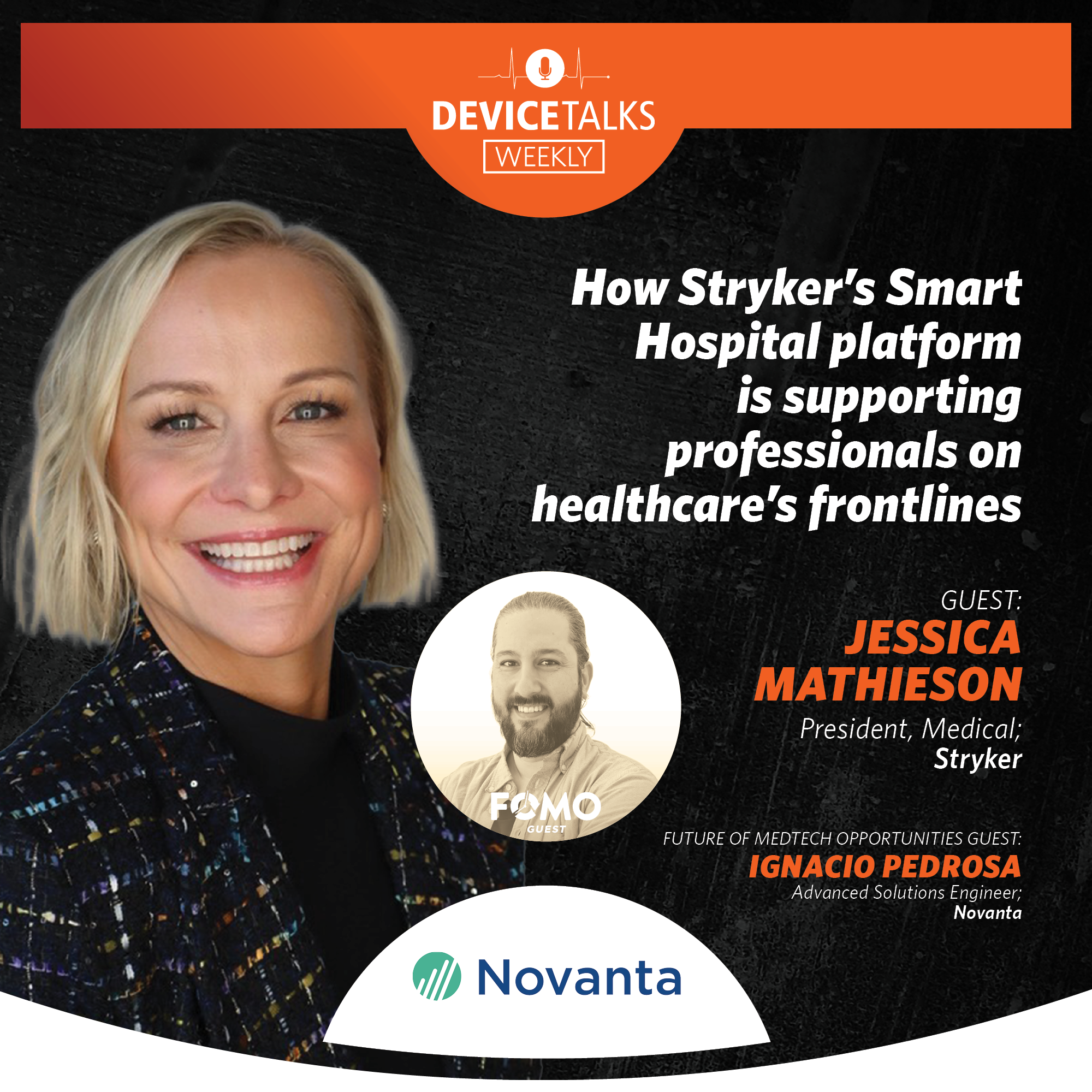
[00:11:57] Speaker B: Hey, number three on the list is Stryker launching their smart hospital platform to elevate care delivery. And you have some really good insights about that on LinkedIn, Tom. I mean, like pointing out this is actually when you think, I mean, even me, when I think of Stryker, I think of Mako Robotics, I think of orthopedic implants, I think of surger surgical tools. But I mean, you're making a point that like, you know, this is like A big point. Part of their business.
[00:12:25] Speaker A: Yeah, no, definitely a big part of Schreger. And you're right. And when you hear about hospital beds and things like that, you're like, well, all right, there's not a lot there or even communication badges for nurses, but if you look at the numbers in there, 10k, it's a big business with high growth. And as Jessica Matheson said last week on the podcast, you know, it's an unregulated industry, so they can innovate faster there and they can move faster there and they can develop new products there. So she was on the podcast talking about the Smart Hospital platform and about the inclusion of Care AI and Vocera in that. And it's really, I'm really loving the stories of these companies that are developing tools that really fit kind of into the hospital workflow and really kind of help make up for the shortfalls that folks are seeing in the workforce.
So I think Smart Hospital is a definite addition to that. So.
And as I said in the podcast last week, I think if you're a nurse who has this badge that you don't need your hands to communicate to your colleagues, and you have these sensors in rooms that allow you to know when a patient got up or didn't get up and just gives you that information, that data, and you have people who are nurses who maybe don't want to walk the floor anymore, but they're in a room somewhere watching all these patients. I mean, it's just a stronger safety net. So it's really just a super platform. So happy to have Stryker, they released that at himss this week, so didn't realize they were announcing it this week.
[00:13:49] Speaker B: And if people want to find out more about this, our associator, Skylar Rivera, she has a draft over to me of an article written off last week's podcast. So we'll be pointing and we're talking on Thursday. We should have that story posted Friday on Mass Device so you can read a really good write up. I mean, Skyler's just been doing a great job writing some really insightful stories off of our podcast interviews. And we'll have another one up off the Stryker interview tomorrow. Like Friday.
[00:14:15] Speaker A: Yeah, for sure.
Skyler's been doing a great job with those write ups. As we talked about last week, the Jenny Barber article was so good, it was a newsmaker unto its own. So let's roll on to number two.
We've had back to backs before with the same companies being newsmakers, but I find this juxtaposition Interesting given that the one we just talked about is focused on connectivity.
[00:14:45] Speaker B: Yeah, they have this new connected hospital system and now. And then next they got Iran back to cyber attack on their business.
Wow.
[00:14:56] Speaker A: Yeah, I didn't see that one coming.
[00:14:57] Speaker B: You know, Sean and Skyler did a great job jumping on the news and you know, having a roundup of everything that unfortunately Stryker's been going through with this stripe, with this cyber attack.
You know, that.
I mean, it looks like, you know, there was, you know, like, you know, attacks on, you know, their Cork, Ireland location and, and more.
So.
Yeah, I mean, this. I, I suspect that, you know, as this war in Iran continues that we're going to see many more American companies getting, getting, getting hit in, in different ways by, by cyber attacks that are, that are backed by Iran.
[00:15:37] Speaker A: Yeah, no, I know you had sent this article out to our internal slack to the editors of our other verticals covering other industries is giving him a heads up that hope you don't see this in your industries, but just so you know, this happened in ours. So I agree with you 100%.
We've got some vulnerabilities. I think everyone does. And I think we'll find out where some of those are over the next weeks or months or however long this goes on for. We're not quite sure.
[00:16:06] Speaker B: And we're not quite sure. There's a lot of different messages on it.
[00:16:09] Speaker A: But before you, I just noticed it was on Mass Device. And Sean has a follow up to this article entitled what Stryker Cyber Attack Could Mean for Medtech and Healthcare. And he talked with Mike Kajewski, the CEO of medcrypt, for that. So folks should, if they haven't already, go on Mass Device and check that out as well for a little more context.
[00:16:32] Speaker B: Yeah, that's fantastic. And we'll be staying on top of this.
[00:16:35] Speaker A: And Chris Newmarker, what's the big number one?
[00:16:38] Speaker B: Hey, the big number one is.
[00:16:41] Speaker C: Wow.
[00:16:41] Speaker B: Like Medtronic continues on this roll with making M and A and business deals. And the Latest one is $550 million for Scientia Vascular, which they're based in Utah, make access products for treating complex neurovascular conditions. But this really looks like a stroke treatment tech play on the part of Medtronic.
[00:17:03] Speaker A: Yeah, really the reading I did on this, it really seemed to be a counter to Boston Scientific's acquisition of Penumbra. Penumbra has a great R and D department that really developed some clever access tools. And I don't know for sure that Medtronic felt they needed Better tools. But this is what Santiago gives them. They give them greater ways to get their already effective stroke devices where they need to be. So definitely seeing a bit of a space race in the stroke space. So I got no problem with that.
[00:17:38] Speaker B: Fantastic.
[00:17:38] Speaker A: It's an area that needs innovation, as you said. Competition breeds innovation, as you like to say all the time. And I think this is another example of that.
[00:17:48] Speaker B: Yeah, it's fantastic. So, yeah, and good news for, I mean, just one of the biggest killers in our country, in the world, and very debilitating as well. So if we can get better treatments out there. Fantastic.
[00:18:01] Speaker A: Absolutely. All right, Chris Newmarker. Great top five folks though. They don't have to wait for this podcast to get top five news of the day, right, Chris?
[00:18:10] Speaker B: Absolutely. Go to Mass Device's homepage right at the top. You can sign up for the Mass Device Daily e newsletters or 5 and 7.
Get this in your inbox every day. But thanks again for listening.
[00:18:20] Speaker A: Absolutely. We're going to again, once again have the entire Mass Device MDO and Device Talks teams at Device Talks Boston.
So excited about that to get the news team together. We'll be there to cover folks at Tech Team Assemble, Ed Tech Team Assemble. We'll be covering some of what goes on in the rooms, but we'll certainly be down on the floor meeting with our great sponsors and presenters down there as well. So make sure you folks join us at Device Talks Boston. And of course, Device Talks Minnesota. Well, Chris Newmarker, thanks again for this week's Newmarkers Newsmakers.
[00:18:51] Speaker B: Great as always, Tom. Take care. Talking soon, man.
[00:18:54] Speaker A: All right, now it's time to bring our FOMO to you. It's brought to you by Harmonic Drive. You can find out more information about Harmonic Drive on their website. Harmonic Drive is your one stop headquarters for miniature speed reducer products designed for applications that require smaller space saving components. You can see a lot
[email protected] that's H A R M O N I C drive.net now we'll have our conversation with Bill Frey of Harmonic Drive. Let's listen. Well, Bill Frey, regional sales engineer at Harmonic Drive, welcome to the podcast.
[00:19:32] Speaker C: Well, thank you, Tom.
[00:19:33] Speaker A: So when people talk about surgical robotics, I think we've been talking a lot more about visualization in software. But give us a sense of how foundational, the mechanical precision layer underneath all of that. How important is that?
[00:19:47] Speaker C: Oh, it's very important. You may have seen a test apparatus where they're simulating an operation by picking up little tiny objects.
And it's very hard for the end effector to actually pick up these objects and operator, the surgeon is operating them remotely. They're not actually, their fingers aren't in there. So the reliability, the repeatability and the backlash is very important.
[00:20:14] Speaker A: So in surgery I think, well, you could either the expert, I may, but surgical robotics, I imagine that the arms, the devices, the instruments that are being used in the procedure need to move more smoothly than in other industries. True or false? Let's unpack that first.
[00:20:33] Speaker C: It is true. There are exceptions. There are some industries where you do want very smooth motion.
[00:20:38] Speaker A: Yeah, sure.
[00:20:39] Speaker C: And if you picture a camera that's looking at an object far away, if there's any vibration, you'll see that in the camera, for example. And that can be fixed up electronically throughout the camera software. But in the case of a medical device, it's very, very important to have smooth motion.
[00:20:58] Speaker A: So Bill, if we could sort of unpack specifically what goes into eliminating the backlash and the vibration. And I guess you could describe it as a herky jerky sort of feel in surgical robotics. Maybe we could sort of talk about the various elements and I guess procedures that you folks do and you folks support and let's just focus on that. And then I have a follow up question. What goes into stabilizing a surgical robotic arm?
[00:21:28] Speaker C: Well, in the case of our products, the gearing itself has a very high accuracy and high transmission accuracy.
So when they're driven by a motor, you tend to have a very smooth output output on the output side from the gear.
And being a, you mentioned an arm, you have that, that extra distance where any kind of lost motion or vibration is amplified by that arm.
[00:21:54] Speaker A: So as we talked about, you've worked in other industries, surgical robotics, I'm sorry, robotics everywhere I think needs to operate at a degree of smoothness and precision. In surgery though, smooth motion, I think it's more critical, no pun intended, more life saving technology. What actually goes into what parts and what process goes into ensuring that you're able to eliminate backlash and vibration and any kind of herky jerky feel. And then maybe after we can sort of unpack. What are some of the products that help us get there?
[00:22:28] Speaker C: Well, there's a few things. So the mechanical transmission for one, so from the motor side into the actual output as well as the position feedback. So the mechanism needs to know where it is at any given moment. So you have some sort of feedback mechanism, for example an encoder. You may have a torque sensor involved as well.
[00:22:51] Speaker A: So with surgical robotics systems and surgical robotics, arms I would think that you're working at a much smaller scale. How difficult it is to build something that had all these components and elements that are necessary for that smooth motion in something that must exist at such a small scale.
[00:23:11] Speaker C: Well, a lot of this is designed by the medical device manufacturer because there's nothing that just exists on the market in this case. Typically a lot of different components are assembled and tested to achieve what they're looking for.
[00:23:28] Speaker A: One thing that's always fascinated me about surgical robotics is that industrial robots, they sort of are executed to program motions that are necessary to sort of complete something, complete a car or now move a box or whatever they're doing in other industries.
Surgical robotics sort of amplify the human hand, the surgeon's hand.
How does this fundamentally change sort of the mechanical requirements of a surgical robotic system? And how does harmonic drive help with that?
[00:23:55] Speaker B: That?
[00:23:56] Speaker C: Well, you have a good point. It's not just a mechanism that's just picking up something, repeating the same motion over and over.
In this case, it's driven by an operator surgeon. And they need to, to be able to, to control the device as if their hands are at the end of factor when, when they want to make a move, they want to have very, very quick and accurate movement on the output, which is to the what the move that they commanded.
In addition, a lot of these devices may have haptic feedback where they actually have some sort of resistance at the control, which is proportional in effect to what's seen on the up on the end effector.
[00:24:38] Speaker A: Let's drill down a little bit on haptic feedback. That's become, obviously, it's been a point of conversation for years, but I think more importantly, more recently, it's become seen as sort of a differentiator between surgical robotics, some surgical robotic systems, one from another, as haptics and force feedback evolve. How important is the sort of the ultra precise gearing that goes into providing that, that enable that surgeon experience, that allow them to sort of quote, unquote, feel the tissue that they're working on?
[00:25:10] Speaker C: It's very important because if you have any kind of backlash or lost motion in the system as you're trying to operate it, you're now missing your spot on the output side on the end factor. So this, you know, applies to even like a pick and place type of unit where if you picture that you're here, you are with a joystick trying to pick something up and you, you, you're trying to go to a certain spot, but you have, you have lost motion, you have Some backlash. You have trouble achieving what you're trying to do.
And it's, it's in this industry, it's even more important than what you might see in other industries.
[00:25:50] Speaker A: Is that sort of feedback unique to surgical robotics, that sort of, you need to feel what you're quote, unquote touching? Or have you seen that in other industries as well?
[00:26:00] Speaker C: Well, typically in an industry where it's a human operating it, yeah, obviously, I suppose, but like a pick and place device or some kind of thing where the operator's actually trying to have dexterity on the output.
[00:26:21] Speaker A: Interesting. So, I mean, we've seen a lot in other industries or in other technologies that things develop faster in industries outside of medical devices for the simple fact that.
Well, I think the stakes are higher maybe here than elsewhere, and it's also highly regulated.
But. And as a result, I think medical device companies are able to learn lessons that have been experienced in other industries.
Final question. What lessons from aerospace or semiconductor precision systems can surgical robotics learn from and maybe adopt more aggressively?
[00:26:59] Speaker C: Well, it's certainly an industry that's growing and utilizing a lot of knowledge from other industries.
And it's a case where the lessons learned from robotics field is being applied into new industries such as this one specifically. There's probably a lot more behind the scenes than I'm aware of. Usually I have, you know, customers asking questions for the various applications, but why they have their requirements, sometimes I'm not fully aware of.
[00:27:33] Speaker A: Do you think other areas within surgical robotics that are blazing new trails and are doing things that you have not seen or others have not seen in other robotics industries? Or are our experiences again, paths that others have already sort of blazed or trails that others have already blazed?
[00:27:52] Speaker C: Certainly there's new developments coming out and new new technology being used and new applications, new types of approach to achieving solutions.
So it's exciting, it's always growing and it's always different.
[00:28:14] Speaker A: And as, again, we're seeing a lot of. Final question. I do that sometimes we're seeing a lot of innovation and a lot of advancement, I think, in surgical robotics of different form factors and different applications over the last five years. In particular, where do you think that energy is coming from that's drawing all of these new technologies, both from larger companies and small, into our consciousness and eventually onto the marketplace in the future? Is it just. Do we see from other industries? Maybe you've seen it before. Do you see a critical mass of great ideas just sort of coming together, coalescing and just pushing an industry forward? And are we at that point with surgical robotics.
[00:28:53] Speaker C: I think we are at that point.
A lot of these ideas have been floated around for years, but now the technology is caught up.
And so now with the products that are available now, the technology, the capability of computers and everything, and also the general acceptance of the concept of medical devices being automated, it's a whole new world now for this.
[00:29:20] Speaker A: That's great. It must be an exciting time for you to be part of Surgical robotics right now.
[00:29:24] Speaker C: Yes, it is.
[00:29:26] Speaker A: Excellent. All right, Bill Frey, well, thanks so much for your vision of the future and for joining us on fomo.
[00:29:32] Speaker C: Thank you, Tom.
[00:29:33] Speaker A: All right, well, thanks again to Harmonic Drive for providing this week's fomo. If you'd like more information about Harmonic Drive, go to its website, harmonicdrive.net that's H A R M O N I C drive.net all right, now it's time for our keynote conversation. I spoke with Stephen Fromm. He is the CEO of Vicarious Surgical. He joined the company last year. We'll get into his history. At the time, I was sort of surprised by the appointment because I've known him from biotech circles and wondered how he fit into Surgical Robotics. But I really enjoyed this conversation with Steven.
Sort of unpacked these companies and these technologies, not as sort of things of wonder, but products of business. And he really, I think, helped me see how to set some priorities. So I hope you'll enjoy this conversation with Steven. I did talk to him back in December, so some time has passed. But I did connect with him. And no, no updates necessary.
There's some news about them of late, but we'll get into the important stuff in this conversation.
Well, Stephen Frahm, welcome to the podcast.
[00:30:51] Speaker D: Thank you for having me, Tom.
[00:30:52] Speaker A: My pleasure. So, full disclosure for folks. Stephen and I have talked, both of us, in our previous professional lives. I was running the OIS podcast. Stephen was the CEO of Eyegate Pharmaceuticals. So we've talked before about a completely different topic, but I'm really happy to be circling back again to talk about Vicarious Surgical. As I told Stephen prior to Pushing Record, I came to know Vicarious and Adam Sachs. I think it was probably April 2020 or so, right around the start of the pandemic. And it was one of those medtech stories that just, I remember, uplifted me because it was just so damn cool and really hopeful. And we want to sort of unpack that spirit and see what's happened over the last five years or so. We've had Adam on a few times since, but happy to have Stephen here to sort of let us know where we're going next. But Stephen, before we get into vicarious story, we'd love to understand your story, but I usually ask people how you got into medtech, but that answer is kind of identical to what we're going to be talking about today. Because this is your first sort of medtech position. You're really a pharma guy, right?
[00:31:59] Speaker D: Yeah, most of my time has been on the biotech space, yes.
[00:32:03] Speaker A: So how did you find your way into the biotech and life sciences industry?
[00:32:07] Speaker D: Well, that is a lot to unpack. I'll try to do it as quick as possible. So I was formally trained in accounting and finance and I'm originally from the Toronto area and I started life as a chartered accountant at Price Waterhouse.
[00:32:20] Speaker A: Wow.
[00:32:21] Speaker D: And after I qualified I actually got seconded to a M and A house in investment banking and so I left accounting and went into that and I did M and A in telecoms to believe it or not. And where I was working got acquired by a bank over in London. So I moved over to London and got into life sciences doing M and A and then equity capital markets. Did that for a little while and then I decided to get out of banking and I left and started working for Aventus in Paris. They were looking to spin out a gene therapy company and I came on board as their CFO and I was on the board of other companies and one of them was a startup that was founded by a French VC in ophthalmology. In fact it was a device, it was iontophoresis delivering device. So we delivered drugs to the back of the eye non invasively and it was just me and one other guy. And so I went out and raised money and on the hope that if I raised money I could move the company to Boston and that's what I did. And I built the company up from nothing and took it public on nasdaq and that became my gate pharmaceutical cycle.
[00:33:28] Speaker A: So what was it about life sciences that, that, that resonated with you? Because if you're, you had a fairly neutral background, you could have applied yourself to much more predictable industries than this one.
What was it that, what was that connection?
[00:33:44] Speaker D: I think in the background I've always loved biology. Right. And I've always really wanted to dig. So in the, in the background I was always reading about that kind of stuff and, and I, it really intrigued me more than telecoms did.
There was an opportunity to get involved on the life science side. I jumped at it and I've Never looked back. I've loved it. And you know, the thing is, running these types of companies, you need multiple different hats and you need to be able to understand multiple different things. Not just the business side, but also the science side. So I've had to do a lot of self learning to really be able to have conversations with the right people in order to understand how to move a company forward in the life science space. But it did start out with a medical device. So I did understand, you know, very quickly with the fda, the CDRH route. And also because we were delivering a drug, I had to understand combination products. And so I had to understand both sides of it very early on.
[00:34:40] Speaker A: Sure. And I can relate to that. I started covering medtech and Life Sciences in 1998 when all my friends were covering dot coms and websites and. And I had no interest in that. But I really love talking about life sciences, so I can certainly relate.
As I mentioned at the top, we talked. When you were with Eyegate Pharmaceuticals, that was different than the company you just referenced. That wasn't just a name change, that was a different ophthalmology company.
[00:35:05] Speaker D: No, it was the same one.
[00:35:06] Speaker A: Oh, it was okay.
[00:35:08] Speaker D: The name was Optus at the time. And then when I moved it to Boston after I did a fundraise, we renamed it Igate Pharmaceutical.
[00:35:16] Speaker A: I should have done my research a little bit better than that. So ophthalmology is definitely an interesting industry to be in.
What was the outcome for Igate?
When did you leave that company?
[00:35:30] Speaker D: So after we went public, I very quickly did a licensing agreement with Bausch and Lo and so then they funded the pivotal studies and so forth for uveitis and other indications. And along the way I did a couple of small acquisitions of smaller startups in the ophthalmology space.
And then I decided to leave. So I became executive chairman for a little while and left and became CEO of a different. I'd spent enough time there. I decided to get out and left and brought on a different CEO and they asked me to stay for a year as executive chairman because this person had never been the CEO of a public company before.
And so that's why I left. And then opportunity came up to be the CEO of another private company, an earlier stage company in regenerative medicine.
And that was really so what I'm. So there are a couple things that really interested me and why I'm bringing that up is what led me to vicarious as well. I had been doing it for so long and I was really looking for a challenge. And I was looking for something new, something that could teach me something that I hadn't known about before. And regenerative medicine was a really exciting area.
And when I first got into this, I was doing some gene therapy for Aventus Sanofi, Aventus over in France. And to have the ability to come back to regenerative medicine because it's evolved so much.
And here was a company that was doing something very unique, and they were having a lot of difficulties trying to understand what the proper business model should be and actually how to get through the FDA with an ind, because there had never been one before. And they were having a lot of difficulties. It was something called Exosomes. And anyhow, so I came on board and figured out the business model, and we got the first IND ever cleared for an exosome from a neural progenitor cell. And it was a lot of work, but it was a lot of fun doing that as well. And then. And another opportunity came up which led me to Vicarious. And there was a similar type of background here. They were having difficulty with something. There was a stage that they were trying to get to, and they were having difficulty getting there. And so I got introduced to this company through the cfo, because she had been at Igate for a little while, and she had mentioned to Adam that he should have a coffee with me. And that started everything.
[00:37:36] Speaker A: Interesting.
[00:37:37] Speaker D: Yeah.
[00:37:39] Speaker A: As you were talking about the.
The gene therapy of the Aruna, you're right. I kind of see now that I see sort of the connection, because vicarious surgical is not the same as. But it's a swing for the fences. I mean, if you go to your website and you look at the robot and you look at this basically tiny implantable surgeon that you want to stick through, you want to insert into a person's abdomen through a single port and have the entire surgeon with wrists and elbows and.
And surgical tools all inside with cameras and lights.
It's really a home run swing. I mean, it's completely different than most other surgical robotic systems out there, which is why it's so compelling. But it's also, I'm guessing, why it's so difficult to sort of get it to where it needs to go, at least as a commercial venture. So when you joined, I was kind of curious as to how this biotech executive, and I did know you from the past, sort of how you got involved with Vicarious. But now as you explain the story, it certainly does. Does make a lot of sense. It's consistent with your past Themes.
[00:38:41] Speaker D: Well, look, there's a lot of early stage life science companies that got initiated through someone that's brilliant, right? From either whether it be engineering or whether it be the science side. Even A.D. aruna, the chief science officer who was the founder, brilliant man when it comes to doing what he did in regenerative medicine. But you know, it doesn't automatically translate always on the business side either, right? And sometimes that's all it takes is it takes someone that has the gray hairs that can come in and understand, is it an engineering issue, is it a technical issue, you know, or is it a business issue here that needs to be resolved? And so that's. They didn't need another smart engineer that had a lot of background in robotics. They needed somebody with a gray here that understood how to actually figure out how to focus and get to the goal line. And I found, even as I mentioned, when I was at Igate, I acquired a couple of three companies I acquired after I took it public.
The opportunities to the acquisitions always came about with companies that had been initiated by these founders that had a brilliant idea and some great science behind them. Their biggest issue was always focus.
There's so much noise coming in every day to a company, whether it's meetings with strategics, larger medical device companies, or pharma companies going out and talking to investors, they're always bringing in new information that you have to learn how to filter and focus your business on. What's the most important thing for a company that has limited resources?
We're a company that does not have a recurring revenue stream.
We get our cash in order to do our development by selling our shares.
So you have to be very careful on how you use that money.
And you are given that money for a reason. And for a company like us, we have one purpose.
And so you have to remember that and you have to maintain a focus on actually accomplishing that one goal. And I know that sounds obvious and easy, but it's not. Because there is a lot of information that's coming at you, especially if you're a CEO that doesn't have a lot of that background. You've got your board members, you've got investors, you've got a lot of people that are trying to tell you what to do and they can take you off of your game.
So you have to remember that there's so much noise out there. What is it we're trying to accomplish and what's the best way to do that? And from an engineering point of view, are we over engineering?
It's one of the things that I've come in here to accomplish.
We know exactly what our first indication is, and it was chosen for a reason. And we can get into that. But put a pin in there.
We need to make sure that the platform that we're developing right now is the right platform for that indication. And currently it doesn't need to be any more than that. It just needs to be the right platform for that indication. And if we can solve that problem and get us to the goal line for doing that, that's where our focus should be. Doesn't need to be any more than that, even if we want it to be more. Doesn't need to be right now.
[00:41:35] Speaker A: Well, let's unpack that. Now. I gave a very clumsy description of your robot, but why don't you help me out and explain it to our listeners and talk about that indication and then I do want to drill a little more into the discipline that you're laying out that's necessary to move forward.
[00:41:52] Speaker D: So the first indication we're going after is called ventral hernia repair. It's a hernia, but ventral. And I'll get into that, but if I just step back and then I'll lead back into the vhr ventral hernia repair. When I had the discussions with Adam and some of the board members and other people here at the company, it's not just them doing due diligence on me, it's me doing due diligence on them as well and on this platform. And the first thing that I need to understand is, is there a reason for us to exist? Why do we exist? Why should anybody care about vicarious? And so again, that sounds obvious, but that's any company. Are we trying to solve a problem that somebody cares about? And so in our space right now, do the surgeons care? Cause there are platforms out there. We have laparoscopy and we have other. The da Vinci, which comes from intuitive. It's been out there for a couple of decade.
Why is it there's another system that's required? And so that's what I focus on. It's the first question I asked anybody I met here, including Dr. Barry Greene, including Adam and Sammy. I want to know why they think we should exist. And what I learned very quickly is the limitations of the current platforms, the limitations of laparoscopy, the limitations of the other robotic assisted surgical platforms. They don't have those freedoms of movement. They don't have. Have the miniaturized robot, the full arms, the seven freedoms of movement that you have In a human arm, we have in a miniaturized robotic with two arms and also the scopes, the two eyes that go fully into the abdomen. Why does that matter?
The reason why it matters is because in the abdominal space, which is where we focus and where hernias are, over 50% of all of those abdominal soft tissue surgical procedures in the US Are still done or completed in an open surgery setting. They're not done with a minimally invasive platform, even though we know what the benefits are. The reason why they aren't done with a minimally invasive platform is due to the limitations of those platforms.
And so what we're doing here is to design a platform that overcomes those limitations, Starting with laparoscopy. It's basically like chopsticks with tools on the end.
Then when you look at the da Vinci or the robotic assisted programs, they put risks on those chopsticks.
And so it's better, but you still don't have full dexterity or freedom of movement. So you have to make a choice as a surgeon. Do you want full access or do you need full access inside the abdomen by doing open surgery, even though it's going to have all those complications and trauma associated with the tissue, or can you complete the surgical procedure properly with the limitations that exist in the current platforms? So a surgeon has to make a choice.
All right. We are trying to develop something so you don't have to make that choice. You don't have to choose between open surgery, which gives you full access, full visual access, and full access from a function point of view, versus a minimally invasive platform. We want you to have an experience like you're doing open surgery with a minimally invasive platform. And that's why it was so important to understand how can we miniaturize the robot and give it all the freedoms of movement that you would get with a human arm and give it the visual perspective you'd get from open surgery.
[00:45:11] Speaker A: So I do encourage people to go to vicarioussurgical.com they have a really great video there showing how the robot works. So you check the box. Why are we doing this? There's definitely a why. I think the next question is, can we do this? Is this something that is possible? You've got, as I said, a very cool robot. But do you determine if it's something that can actually be done or is it just a, forgive me, just a neat science, robotic science project that looks great on a website but won't actually work in the body?
[00:45:45] Speaker D: Yeah. And so this is another reason why I Came in now. So they've been at it for 10 years. The company got started in 2014.
Okay. The first approximately five years.
We're really trying to figure out how to prototype the miniaturized arms for the robot and come up with the scopes as well. The eyes. Took them a long time to do that. It took almost like four and a half, five years to figure out how to do that with multiple different prototypes. Then once you have that, now you got to figure out how to put the whole platform together. You know, we have something called. We have two big, huge pieces of capital equipment. One of them is the surgeon console. Okay. That's where the surgeon sits, and he's got his hand controls and his foot pedals, and he's got his monitor in front of him.
And that controls the robot, which is sitting in something we call a patient cart, which is over at the table or the bed that the pigeon sits in. Okay. So those are two different, separate pieces of capital equipment. Those weren't there. They didn't exist. What the company spent the first four and a half, five years on was really trying to figure out, can we miniaturize these arms and make them work? That took a lot because nobody had ever done that before.
[00:46:47] Speaker A: Yeah, okay.
[00:46:48] Speaker D: It was very complicated. And there were. I heard from the founders here that there were time periods where they didn't think they would be able to do it, but they did. They did. That was the hard part, and they did it. Now, the. I don't want to say the easy part, but where they had to go next was building these pieces of capital equipment so that then the surgeon could control the robotic arms from a distance. And that's what they spent the next few years on. And we, you know, they called those their beta builds. I'd call them an alpha build, but they were called beta builds. So those were the first things that they had just. They really did that right before they went public.
So around the time of going public is when we have the beta builds and they built two systems, okay, Those beta builds. Then they brought in surgeons to play with them to really understand is it doing what the surgeon needs it to do. We're saying we're going to solve a need for the surgeon based on overcoming these limitations. So we got a lot of feedback from the surgeons using the beta models as to what should be different, what they would like to see different, what's working well, what isn't.
And then we try to incorporate those into the next set of builds, which took a couple more years and we call those our engineering builds. So the beta builds are the first time you have the whole platform. You get all the feedback from the surgeons. You incorporate that into your engineering builds, and that's where you're able to push the boundaries as much as you want. You know where we are here in our facility, we even have a machine shop. So if a piece isn't working, we can go to the machine shop and we can do whatever we need to to try and get all those features working at the specifications that the surgeons gave us feedback on that would be perfect for them.
So that goes from the beta build now to the engineering build. We did that. We got everything working. We got surgeons back in to use the engineering build, those platforms, and they loved it. So then your next step is to try and repeat that same build using your quality management system. So now you're using a quality system which is required by the FDA and any other regulatory body, because a quality management system puts handcuffs on you. It's telling you now that you have certain requirements with specifications that can be tested that you have to abide by. You can't just go to your machine shop now and change a part. You have to be able to have traceability and auditability on every component, on everything you're doing in there, on everything that you tested in case there's a problem ultimately in the clinic.
Okay. So in order to go into the clinic and use this on humans, you need to be at the stage where you're doing your builds using your quality system.
And that's when I came in. That's what they. This was the year where we finally did our first builds using that quality system. The first platform with the quality system got done in April. And then they did. They wanted to see if they could do it again, and they did their second system. We did our second system in August, right before I joined.
So we're at that stage now where all of a large part of the pressure testing to see if we can get those features are done. And now we're learning how to build and see if we can maintain those features using these handcuffs, I call handcuffs. We have. We have no choice but to use these requirements with the specifications that are in our quality system. And that's where we are. So we're in that final stage of development.
[00:50:06] Speaker A: A lot of questions what you. You've vicarious, I think has been interesting in that it's got a lot of relationships with, with healthcare systems.
And I don't know how you define those relationships, but their partnerships have been announced and I think have given you relationships and insights from those systems. Talk, if you could, a bit about that engagement with the healthcare industry and how. I know you haven't been around for all of them, but could you characterize for me the response from physicians? Because your. Your surgical robot is just, again, so completely different than everybody else's.
Is there a period of, well, what the heck is this? Or is it more like, oh, my God, this is fantastic. It's probably a blend of two. But how would you characterize surgeon and the healthcare industry's response to the vicarious robot?
[00:50:56] Speaker D: So I think it's really important that you get the feedback from the people that are going to end up using your system. Are we really doing something that you want?
Again, I come back to right from the beginning. Why would I even want to be here if nobody cares? And so they had the foresight to actually build a small OR in the facility we're in, which allows us to actually use our system when we want to. We use synthetic cadavers, and we have the ability to actually use cadavers in here. And so that allows us, then, with these relationships with the hospitals, to have their surgeons come in and play with the system and test it and use it.
Okay. And that's where we get most of our feedback, that usability testing is really important for us with our final stages of development.
All right. We can make sure, like, what we're looking for in this system is its stability. So do we have a system that's really stable. Okay. That's not going to break down or melt down, and the reliability of the arms, those robotic arms, and the scopes that we're using for visual perspective, so it's stable and reliable.
And as we continue to finish and complete the development of the system, we need to make sure we're testing it all the time. And so that's what we do. We do a lot of or. We call it ors because we want to bring these surgeons in, and sometimes we'll bring in younger surgeons that don't have a lot of experience just to see.
So it's not just a matter of having the greater degrees of freedom and being able to operate inside the abdomen. Is this something that's going to be easier for them to learn?
That's also how you're going to get wider adoption. The adoption just isn't on the technical side. It's on the usability side as well.
Okay. And so, of course, we're going to bring in the experts that have done thousands of Procedures using minimally invasive robotic assisted surgical platforms. But we want to bring in the naive ones as well.
Is this going to be easy for them to use?
And that's the whole point here, is I think you're going to get greater adoption and you're going to be able to expand the market so you have less open surgeries done, not just because of the technical ability of the system, but also the usability of it.
You need both of those?
[00:53:02] Speaker A: Definitely. No, that makes sense. So how about your relationship with investors? Vicarious, I think, again, because it's got such, I think, a hopeful approach and a really fascinating technology and a very cool robot. You've got some relation.
The company has raised money from the past from folks like the Kossler Ventures and the Gates Group.
Innovation endeavors still hold stakes. From early on, it underwent a SPAC, was part of a SPAC, I think, in 2021 when those were popular.
Give me a sense of how you're engaging with investors. I imagine there's still a long enough road ahead that you need to understand where the capital could potentially come from.
How do you characterize your relationship with past investors and what are your fundraising plans for the future?
[00:53:53] Speaker D: Future, yeah. So when I joined, and even before I joined, I spoke to some of the investors just to get their understanding and what their level of support is and how they feel about the platform. But yeah, I continue and I ongoingly am speaking with the current investors throughout the process, I think one of the things I learned from the investors was the lack of transparency.
So even what I've just described to you, the different stages of development from the early prototypes of the arms, miniaturizing the ARMS through beta builds, engineering builds, quality builds, actually hasn't been described that way to the even current investors. And a lot of them really misunderstood where we were in the development stage. And a lot of them when I first joined, when I had these calls, they kept asking me, why are we delayed? Why are we delayed? And how many times have I heard that? And so I had to, I had to really understand what it was that kept thinking why they kept thinking we were delayed.
These types of systems, even the ones that aren't as complex as ours, take eight to ten years to build.
Okay, like just take a look at jj, Medtronic and so forth. These things don't happen overnight and they take a lot of money. And so when I started digging into it, what I learned was, is that unfortunately what had been communicated publicly by the company is that we're going to be in the clinic this year. And they've been hearing that for the last few years.
Okay. And they hadn't been told where we were in our development stage, that what we were doing with cadavers or what we were doing with synodic cadavers was being done with either a beta system or with an engineering system. And not a system that can go into the clinic. It was earlier stage.
But the thing is, and I don't take away from management because things were going so well with those earlier builds, it's almost like you feel like you can accelerate the development into a controlled build.
And so that's where you think you are. You think you're going to be able to do that really fast. Unfortunately, it doesn't translate like that in real life.
Going from an engineering build to your build now under quality management system, it rarely works perfect. I've never heard of it working perfectly. There's always going to be hiccups.
[00:56:07] Speaker A: So you're currently publicly traded.
This feels like it's a company that probably would have benefited from not being on the public markets, because public markets, just as you said, these surgical robotics projects are very hard. Medtronic was working at theirs for over a decade and they just finally got their FDA approval recently.
How difficult is it having to have quarterly calls on this, this project?
How does it change what you're trying to do? And I guess I'm wondering if this is something that needs to go private at some point and sort of take on the identity of a more of a traditional medtech startup.
[00:56:48] Speaker D: I agree. It's always difficult. At what point do you decide to take a company public? And obviously the cash needs are a big part of that.
I think when you really dig into it, it's whether you're private or whether you're public. You need the support of some fundamental investors. Okay. And they had that with costly adventures at the beginning. Was it the right thing to go public?
I don't know. I can't go back there. And what was in their head and so forth. Was it the right stage of a company to go public again? It depends on the money that's coming at you. If the money coming at you is a large amount of money that's required and they're telling you that they need the liquidity of being traded on a public market, then I guess you don't have a choice. So I can't go back and say what was in their heads at the time. But yeah, I wish we were private right now. But having said that, even if we were private, you still need an investor to write the check for you.
So it doesn't make it easier to find an investor because I'm private. What it means, though, is that I don't have to share everything that's going on. If we're private, you still have to find your investors, at least when you're public. It doesn't have to be a big fundamental investor right at the beginning. You can find other people that are willing to support you because you do have some liquidity.
So definitely would like to win back the trust of the larger fundamental investors for sure.
[00:58:11] Speaker A: So where do you go from here? It sounds like you've got the quality guidelines in place. It sounds like it's moving forward more as a medtech might.
What is your next step or what are your next goals that you're communicating to investors and to others in the public? And do you foresee any sort of different operational changes in terms of the structure of the company or the size of the company? And I know you're publicly traded, so you can only say so much. But where are we going from here?
[00:58:45] Speaker D: So with the stage we're at right now, there are a lot of things that we're working on as far as making sure we can get all the features working at the specifications we want, using the control, the quality management system for a controlled build.
In order to do that, we need to complete that development. And once we've done that, with all this testing along the way, whether it be usability testing or verification testing, we do that along the way to make sure that the requirements are working the way we want them to be working. Once we've done all that, that we do to what's called the design freeze, design lock, design freeze. That means the development's done, we've got all the features in there, the specifications that we want based on our requirements, and we've done the testing along the way to make sure that they're working the way we want them to. Now we go to what's called design freeze. That means the development stage is done when you're at design freeze, right, you sign off on all your requirements. Now you go into the formal testing, I call it the pre IDE enabling. Because on the device side, we need what's called a de novo clearance for marketing. And in order to go into the clinic, which requires clinical data, in order to go into the clinic, you need to submit an IDE with cdrh. And so you need to get that cleared. So there's formal testing that's required in order to file the ide, and they call that regulatory V and V verification and validation.
And on the validation side, that's going to require some in vivo work. It's going to require cadaver work and also in vivo work work, an animal facility. Okay. And all of the verification showing that you've done all the tests for your requirements and that it's working the way it's supposed to be working, and then that's the package or application you file with the FDA to go into the clinic. And unlike a drug which is an IND for a device, it's an IDE investigative device exemption.
Okay. So once we do the design freeze and we're targeting end of next year for design freeze, then all the development's done and we start doing the formal testing so that we can go into the clinic. We've already done multiple meetings with the fda. We call those pre submission meetings, and the majority of those meetings are around what do those formal tests look like. The protocols get the blessing on those protocols. So we can go into the clinic and then also the clinical trial protocol. We've also gone through the FDA on that design as well. Well, so all that's been figured out. So we know exactly, once we complete the development, we know exactly the testing we need in order to go into the clinic, and we know exactly the clinical trial that needs to be done in order to go commercial.
[01:01:16] Speaker A: Are you identifying any other indications that you might go for or are you focused 100% on hernia right now? And keep your eye on the ball.
[01:01:25] Speaker D: So right now we're gonna focus on the ventral hernia, but we're also trying to make sure that we understand where we could go after that.
There's other hernias, inguinal hernia, and there's other things that we want to be focusing on. Even hysterectomies, you know, those require different tools as well. For ventral hernia repair, there's three tools that we will need in order to, you know, commercialize, and those are the first three. And some of those will allow us to do other, I would say indications within the abdomen, but going to other indications that we want to go after will require different tools.
[01:02:06] Speaker A: And last question for you is CEO, and you kind of hit upon this at the start.
I don't think there's a noisier sector within MedTech than surgical robotics. I mean, it's got a lot of different companies going up to the same indications. There's a lot of people just watching and sort of handicapping winners and losers. I think by and Large, everyone's rooting for more competition and more successful programs. But how do you, as a CEO, how are you able to sort of, as you said earlier, identify what you need to work on next and sort of block out the other stuff that's coming your way, which I'm guessing is a lot of other stuff.
[01:02:46] Speaker D: So I really needed to understand why ventral hernia repair, why was that the first one that we chose? And when you take a look at all of the different procedures within, again, within the abdomen, which is where we're focused right now, it has the highest rate of procedures in the US that are done open surgery. And there's a reason for that. It's really difficult to do with these current platforms. It's really hard. The actual hernia that you're trying to repair is on. It's on the ceiling of the abdomen. And when you're coming in with these tools that have limitations on maneuvering and moving, it's really hard for them to go back up to the ceiling. Whereas we can. We go in through one incision. The whole robot is in there. It can move around to all the quadrants within the abdomen. It can go back up to the ceiling, go down to the floor. It can move all around. We don't have those limitations. So when I talk to investors, what I tell them is we don't need to think about competing against those other companies. They have to compete against each other because the platforms are all very similar. We aren't. There's so much white space, addressable market there. I don't have to think about even replacing what they're doing. I can go after. What do hospitals want to do right now? They want to be able to provide minimally invasive surgery to more of their patients, and that's what we can do for them. So they can continue to use the da Vinci or the other platforms all they want for the current market share they're using them for. We're going to help them address all those patients those systems can't work on.
I don't even have to convince them of that. They know that they want to expand minimally invasive surgery for all those patients the platforms don't work on. And that's where we come in.
[01:04:21] Speaker A: Yeah. No, it's great. I mean, the narrative you're. You're laying out here, this is more a very advanced medical device than a surgical robot. At least that's what I'm hearing. Yep, definitely.
[01:04:34] Speaker D: There's nothing.
Look, I've only been here four months now as CEO, but I can't find anybody doing anything like what we're doing. There are other companies trying to go in through a single port, a single incision. There are other companies trying to miniaturize, but none of them have done it like we have.
And one of the biggest problems you have when you try to go in with a robot through a single incision is having the ability to have the same amount of force for grasping, for cutting.
They have their own limitations. These other single port systems, which we've been able to overcome.
[01:05:08] Speaker A: Really great. All right, well, I'm rooting for you. As I said, I'm a fan of Vicarious now. I'll be a fan of you as well, Stephen.
[01:05:17] Speaker B: Thank you.
[01:05:18] Speaker D: Well, I appreciate it. It was good to see you again because it's been a while.
[01:05:20] Speaker A: It has been a while.
Wish you the best and look forward to visiting you, visiting the headquarters someday.
[01:05:28] Speaker D: Definitely look forward to having you here.
[01:05:34] Speaker A: Well, that is a wrap. Thanks again to Harmonic Drive for contributing this episode's fomo. Thanks, of course, to all of you for being part of the Device Talks Weekly podcast. We'd love to see you at Device Talks Boston and Device Talks Minnesota, because you're the best darn people there are. Please feel free to use the code date stands for device talks weekly. 25% off to get 25% off the price of registration at Device Talks Boston, which is happening on May 27th and 28th, and Device Talks Minnesota, which is happening on May 4th.
Please do us a few things. Subscribe to the Device Talks Podcast network or more directly Device Talks Weekly if you want to do that so you don't miss a future episode. Please follow Device Talks and mass device on LinkedIn. And of course, please connect with us, us as people. I'm Tom Salemi. Connect with Chris Newmarker, Connect with our managing editor, Kayleen Brown, and of course, the entire MedTech news team so you don't miss a future bit of news. We post a lot of stuff up there on LinkedIn so it would behoove you to connect.
All right, without anything left to say, I want to thank you again for being part of the Device Talks weekly podcast. We'll see you next week.