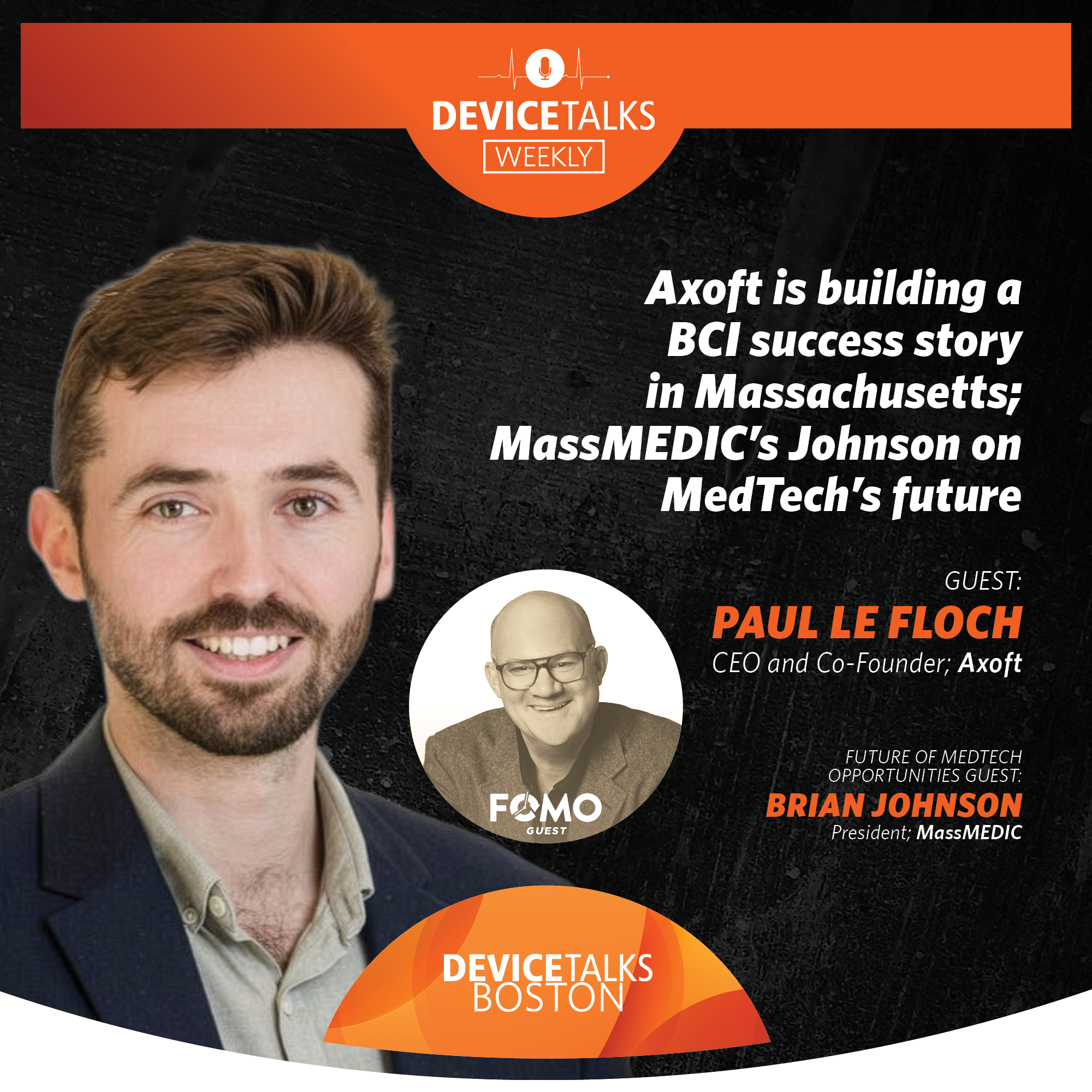
[00:00:00] Speaker A: Hey everybody. Tom Salemi here of Device Talks. Welcome back to the Device Talks weekly podcast. Got a fantastic episode for you today. The ultimate, not the penultimate, but the ultimate episode. It's the final episode before Device Talks Boston. We'll have a conversation in this episode with Paul LaFlach, who's the CEO of Axoft.
They are a Massachusetts based BCI company. We'll talk about not only what they do, what their technology is, but how they're growing a business in Massachusetts.
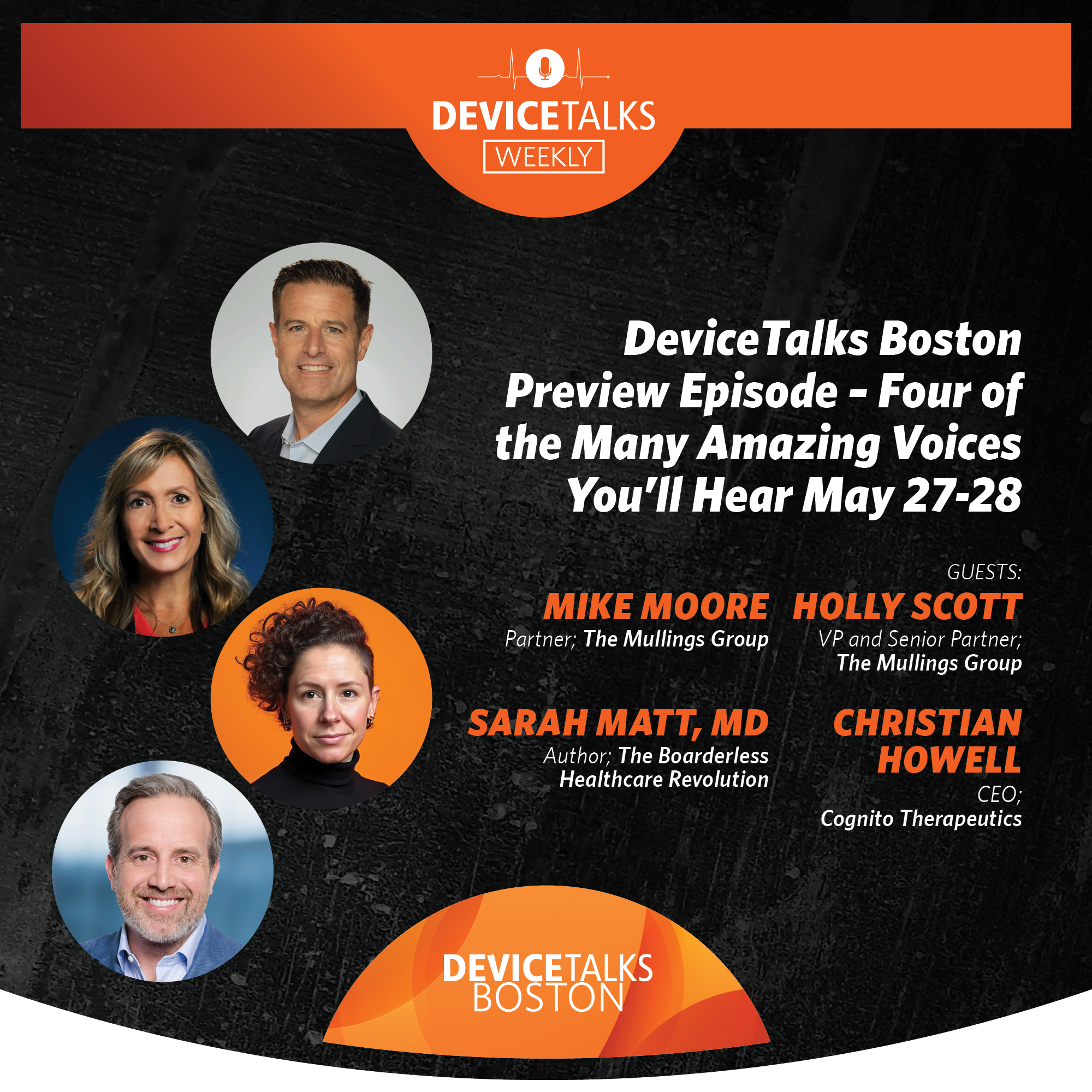
Then before that, of course, we'll have the newmarkers newsmakers, and in between those two is my conversation with Holly Scott and Brian Johnson. We've recorded this at the Mulling Studios about Massachusetts and more on this topic a little later in the podcast. But it certainly will be a central focus of Device Talks Boston, which is happening on May 27th, 28th, aka Wednesday and Thursday at the BCEC. If you haven't yet checked out the agenda, you can do
[email protected] we have two days of great conversations with folks from Abbott Medtronic, Baxter Salvato, Insulet and many more. So go to BostonOTdevicetalks.com to check out all of our speakers. Lots of great conversations about orthopedics, connected health, about cardiovascular. We've got some great folks from MIT presenting some of their technologies as well.
So just a fun sort of medtech fest, so I hope you'll be a part of it. Boston.devicetalks.com, use the code DTW25 to save 25% and and can't wait to see you there. Thank you to everyone who has sponsored Sponsors are amazing sponsors on the floor who will be sharing their sage advice. The sponsors upstairs in the sessions who will be giving killer workshops. Thanks to all our speakers who are making the journey to Boston for Device Talks Boston. I'm really grateful to you and thanks of course to everyone who's registered so far and everyone who will register then and will join us at Device Talks Boston. This is a great opportunity to get the medtech community together.
It's an honor of mine to build this event and cannot wait to see everybody there at the Boston Convention and Exhibition Center, AKA the Thomas Menino Convention and Exhibition center in the seaport. Go to boston.devicetalks.com to register and don't forget to use the code DTW25 to save 25%. All right, let's get this podcast started.
All right, you ready for this?
[00:02:19] Speaker B: Ready.
[00:02:39] Speaker A: It's me, Walker. How are you, sir?
[00:02:41] Speaker B: Doing well Tom doing well.
[00:02:43] Speaker A: We're less than a week away, my friend. It's Thursday. We're recording this on Thursday. We will be next Wednesday at Device Talks Boston.
[00:02:49] Speaker B: Going to be fantastic.
[00:02:50] Speaker C: Woohoo. Woohoo.
[00:02:52] Speaker B: Device Talks Boston man.
[00:02:54] Speaker A: Folks, of course, can still register. Use the code if you haven't registered yet. DTW 25 to save 25%.
And the entire news team will be there and looking forward to News Team assemble.
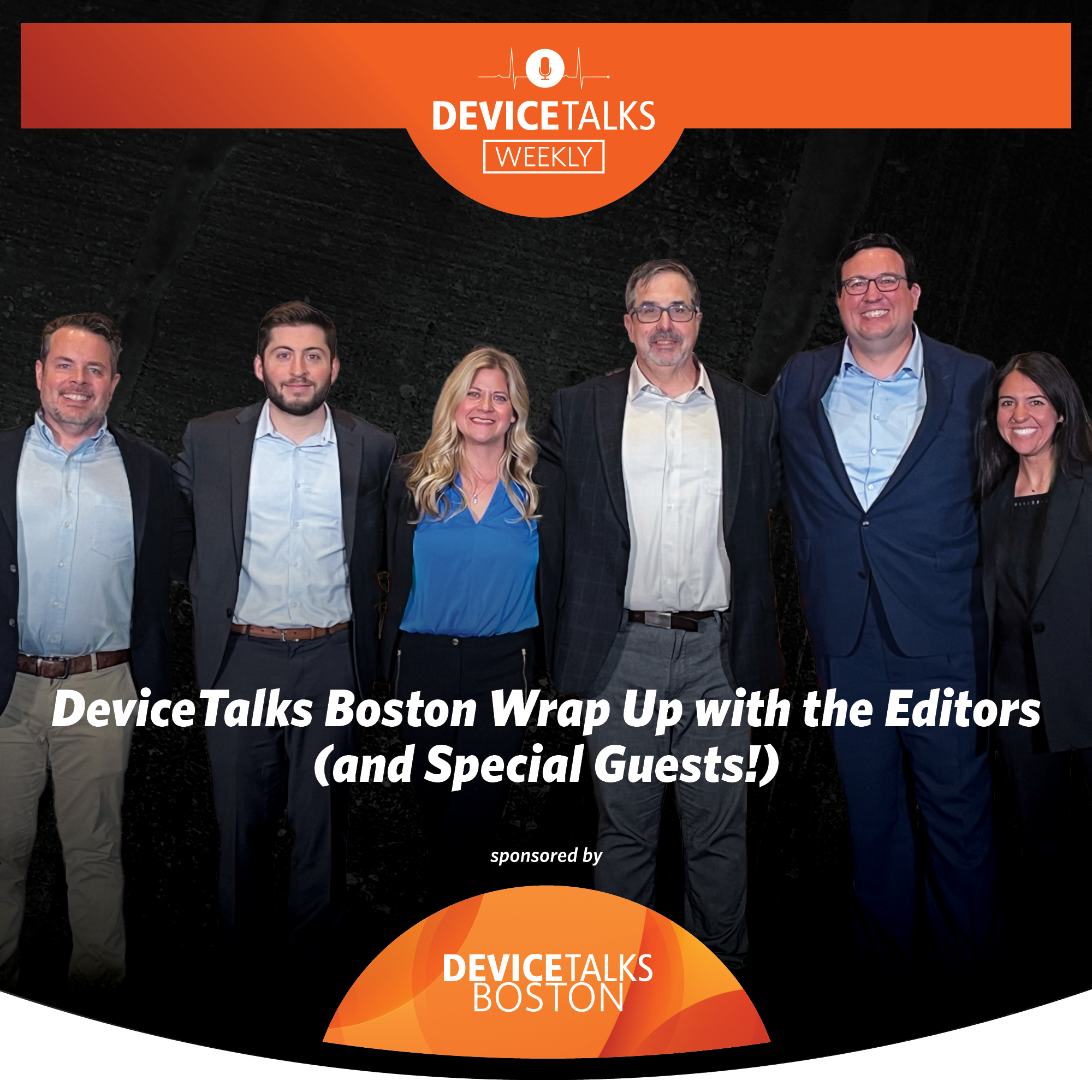
That's right. We'll have Kayleen Brown, of course, you and me, Jim Hammerand Skylar Rivera will make her Device Talks event debut. And Sean Hooley, who of course is a Boston guy, will be there as well.
Yep. So looking forward to that.
[00:03:23] Speaker B: And we'll have a fantastic.
[00:03:25] Speaker A: A lot of great conversations with each other and with our many, many readers and listeners. Looking forward to seeing everybody there.
[00:03:31] Speaker B: It's always. It always just feels like, I mean, the last event or two, the last Device ox Boston or two. It feels like it's a big giant family reunion. I love it.
[00:03:42] Speaker A: Yeah. Speaking of which, we will have the Godfather, Brian Johnson himself. There will be godfather on a. On a closing panel talking about the Massachusetts medtech economy.
[00:03:51] Speaker B: So Brian's gonna bring the garlic bread. You want me to bring the deviled eggs?
[00:03:55] Speaker A: Brian's gonna teach you how to make a. Make a gravy. He's gonna make a good gravy. Yeah, you gotta chop the garlic real thin, you know? You know?
[00:04:03] Speaker B: Yeah, yeah, yeah, real thin. Like little butter. Little butter. It's all right. It's all right. They, you know, they talk about olive oil, a little butter in that, like, in that sauce. It's good, Good stuff.
[00:04:12] Speaker A: Gravy. We call it gravy.
[00:04:13] Speaker B: Gravy. Yeah, sounds good.
Gravy, Little garlic, thinly sliced olive oil. Paper.
[00:04:23] Speaker A: You want to see through it. Yeah, you can see through it.
Anyway, the Godfather will be there as many, many other folks, and I hope folks listening will join us there as well.
[00:04:33] Speaker B: So be fantastic.
[00:04:36] Speaker A: Let's just roll into the new markers Newsmakers.
[00:04:38] Speaker B: All right, number five on the list, we've got Cajun Vascular. They reported their first inhuman cases with their IV, they closed a $41 million Series D. But intravascular lithotripsy is like. It's just one of the most exciting areas of medtech right now. We're just covering all kinds of news and developments around it right now on Mass Device.
[00:05:00] Speaker A: Yeah, no, absolutely. I mean, obviously we saw the AVS acquisition close with Stryker, saw the terms of that released $800 million. I think when all is Said and done.
And, you know, there's others out there. We talked about, you know, Medtronic not having a program. So if they get some. If Cajun gets some good, good human data, then they've got. They've got some leverage and they've got some opportunities. We'll talk a little bit about BD and increasing its interventional program. So who knows? Who knows? We'll be moving into IVL space, but somebody certainly will.
[00:05:35] Speaker B: Yeah, exactly.
[00:05:36] Speaker A: Yep.
[00:05:37] Speaker B: So it's going to be fun to follow and definitely like a technology that's.
That's really offering more hope for people, more treatment options. So that's fantastic.
[00:05:48] Speaker A: And then related to that, of course, Johnson and Johnson announced the launch of their Shockwave Arrow coronary intravascular lithotripsy catheter, their next gen IVL catheter. So the space is continuing to grow. Johnson Johnson MedSec is not standing pat by any means. They're moving forward at full speed.
[00:06:08] Speaker B: Yep. So this Cajun Vascular article is by Sean and Skyler actually has a really good breakdown of this new J and J Shockwave C2 Arrow IVL device on medical design outsourcing. So still we're talking on Thursday morning. It's still on the homepage. Slider on mdo. Check it out.
[00:06:29] Speaker A: All right, good. Number five. What's number four? Chris Newmarker, number four.
[00:06:33] Speaker B: We've had a good amount of personnel news involving higher ups at medical device companies.
Bd.
They've appointed Peter Menziuso as their EVP and a president of Interventional.
And we know Peter, and we had Peter on this podcast just about a year ago.
He's been running JJ Vision.
[00:06:58] Speaker A: Absolutely. No. And you obviously put him in a position to get this job with.
[00:07:05] Speaker B: I think so.
[00:07:05] Speaker A: Yeah.
[00:07:06] Speaker B: I agree.
[00:07:08] Speaker A: They heard the podcast and they said, get Manzu. So we got to get him to lead our.
[00:07:12] Speaker B: If you want to get that step up that new gig.
[00:07:16] Speaker A: This.
[00:07:16] Speaker B: This place is your. This is your, like, rung. This is your stepping, Stepping stone. This is your place. Like, this will queue you up. We'll get you ready. They'll be like, you know, this is who we need. I mean, this. This person's a leader.
[00:07:28] Speaker A: Exactly.
Fend off Chris Newmarker's aggressive questioning. So. No, no good.
[00:07:35] Speaker B: Totally aggressive. I really like. I really like. I mean, I put the pressure on him and, you know, he didn't crack. Yeah, it's good. Yeah.
[00:07:45] Speaker A: So interesting news at bd, you know, with moving into interventional more aggressively, they're reporting strong sales growth there. So maybe as I said as I referenced in the earlier item, maybe we'll see them moving aggressively into other dimensional spaces. So.
[00:08:03] Speaker B: Yeah, absolutely. And you know another big leadership news.
We have another higher up at Medtronic who's, who's heading out.
You know we've, I mean there's, I mean I just did like a, for kicks, just did a Google search on like Medtronic executive departure and mass device and it you know, ran well over a page of search results of, of articles. I mean there's been a lot of changes in the last two years and we have a new one like another long term executive, Brett Wahl is, is leaving.
[00:08:39] Speaker A: I know that's huge news. I mean football to me has been Mr. Medtronic for a long time. So not sure what that means.
He wasn't moving to another position someplace else.
[00:08:52] Speaker B: No word on that, no word from him when he made the announcement on LinkedIn that he's heading out. And Dr. Kwelly Thompson's gonna assume the role over there of EVP and President of Neuroscience, which was Wal's.
[00:09:12] Speaker A: We saw Bob White leave under similar circumstances a few years ago and now he's the CEO of Olympus.
[00:09:18] Speaker B: That's true.
[00:09:19] Speaker A: Would not be surprised to see Brett Wahl emerge someplace else.
[00:09:23] Speaker B: Absolutely. And we're almost getting now this whole, all these former Medtronics executives getting spread out in major leadership positions elsewhere in the industry. Yeah. Teleflex another great example. Their new CEO is Jason Weidman who was in charge of renal denervation over at Medtron.
[00:09:43] Speaker A: Absolutely.
So Medtronic is feeding the management teams of other companies which is I'm sure good for everybody. Good for Medtronic folks to move up and to take that company in new directions. And it's good for the industry at large to be benefiting from Medtronics experience. So interesting. Number four, Chris Newmarker. Let's roll on to number three.
[00:10:05] Speaker B: Number three on the list we've got Endologix. They're acquiring the Pounce thrombectomy system from Surmotics.
Surmotics has go private. They're now part of the private equity portfolio over gtcr.
Sean, in writing this article had a good point that this deal kind of likely enables Sermonics now to move forward with a focus on their surveilled drug coded balloon.
GDCR also has a biocode in their portfolio with its medical coding. So those are complementary. And then Endologix says hey, this is going to strengthen our commercial offering for vascular interventionalists. So each of these companies Getting something out of this deal.
[00:10:53] Speaker A: Yep. Endologics formerly had been really focused on aortic repair. Right. And really on heart repair.
[00:10:59] Speaker B: Yeah. Their focus originally was with more like aortic disorders.
So, yeah, they're definitely kind of branching out more here.
[00:11:11] Speaker A: Yeah, definitely trying to be more of a holistic cardiovascular company. And that's good for their business and certainly will make them an attractive, well, potential supplier and or acquisition target in the future, potentially.
[00:11:26] Speaker B: Yeah. Well, this will be definitely another one to watch.
And going on with kind of the M and A theme, we've got Medtronic announcing that they're gonna acquire SPR therapeutics for roughly 650 million.
And SPR develops this temporary percutaneous peripheral nerve stimulation therapy device, their Sprint PNS system.
So to provide a pain release. So this is kind of an addition to their neuroscience portfolio, which was what Brett Wal's been running since. For years over at the company.
[00:12:12] Speaker A: Absolutely. So interesting that Medtronic is building out the space. They must have some plans with the new leadership.
And I think the interesting part of SPR is that it's just using neuromodulation to create really more durable pain relief without leaving an implant behind, I think is critical. I think we're going to be moving into less implants or less, I should say, less invasive implants going forward. In fact, our guest today on the podcast axoft has got new material, their fluoride material that is designed to be more conducive to brain matter.
So, you know, I think obviously Medtech is moving to this place where implants can have longer lives and leave a lesser imprint or in this case, not have an implant at all. So, yeah, makes perfect sense.
[00:13:11] Speaker B: Fantastic.
Talking about brain implants, we're going to be having the first person to have a neuralink implant, like closing out device talks Boston. So that'll be fantastic.
[00:13:21] Speaker A: Yep. Great. Great. Closing keynote with our friends at the Robotic Seminar Expo. So folks could definitely join us for that.
[00:13:28] Speaker B: Yeah. And then number one on the list, we've got Boston Scientific investing $1.5 billion in TAVR developer Amira. So, I mean, wow. Like, I mean, Buff Scientific making another play here in the TAVR space.
[00:13:47] Speaker A: Yeah, no, this is good to see them get back into the space. It's funny, and I don't often think about Medtech at night, but I was just kind of like waking up, I'm just thinking about things. I'm like, I haven't heard about Boston Scientific in a while. They made a big deal in a little bit. It seems A day later, it was this. I was like, wow, okay. The universe was hinting that there was big news coming. So no, great to have them back in the tavr space. It seems like a good de risk kind of reentry to the market, taking a minority stake, helping to fund development, you know, getting. They have strategic control. Clearly if things go well, they'll buy out. Right. So it seems like a good first step back in the into tavern.
[00:14:29] Speaker B: Yeah. I mean, and they, you know, Boston Scientific, you know, it's, it's been a tough road with that. I mean, they, they had their Lotus valve system that they, you know, retired about five years ago because, you know, there were, there were challenges and problems. And then, you know, their next thing play was with their accurate valve, which they discontinued last year.
So. So yeah, now they're, they're making this big investment in Miras. I think I'm pronouncing that right, Miris. And yeah, hopefully here's the better luck for them this time around.
[00:15:03] Speaker A: All right, well, fantastic stuff, Chris Newmarkel. Looking forward to seeing you and the news team next week at Device Talks Boston. And yeah, and we can make sure we get a picture of me, you and the Godfather, Brian Johnson.
[00:15:15] Speaker B: Absolutely. That sounds great. I'll bring the garlic bread.
[00:15:20] Speaker A: We'll have Brian sitting. The rule is anyone can ask Brian a favor on, on Device Talks Boston Day.
I'm sure the people will be lined up, you know, just looking for, for,
[00:15:33] Speaker B: for the, for the Boston Convention Center. You said, like, I need a room with like a nice, you know, stuffed chair. Like, nice, nice comfortable chair for Brian to sit there. Like, you can ask me any favor on.
[00:15:44] Speaker A: Can you bring him a cat? Bring him a cat to have sitting in.
[00:15:47] Speaker B: It's like, oh, a cat.
I saw some documentary once that Marlon Brando actually had. Had no going to do that. Like when they shot that scene, like,
[00:15:59] Speaker A: I think it was just a stray cat. Right?
[00:16:01] Speaker B: Something off a cat in the studio.
[00:16:03] Speaker A: Might have been a raccoon.
[00:16:04] Speaker C: He's just
[00:16:07] Speaker B: Mar's holding a raccoon over there.
Go with it. Just go with it.
[00:16:11] Speaker A: Just like he's a genius.
[00:16:14] Speaker B: He's like scratching his chin.
[00:16:19] Speaker A: I think I might be thinking of elf. I might be conflating my movie classics needs a hug.
All right, Chris Newmarker, we're getting silly. See you next week at the Vice Socket Boston.
[00:16:32] Speaker B: See you next week, man. Bye.
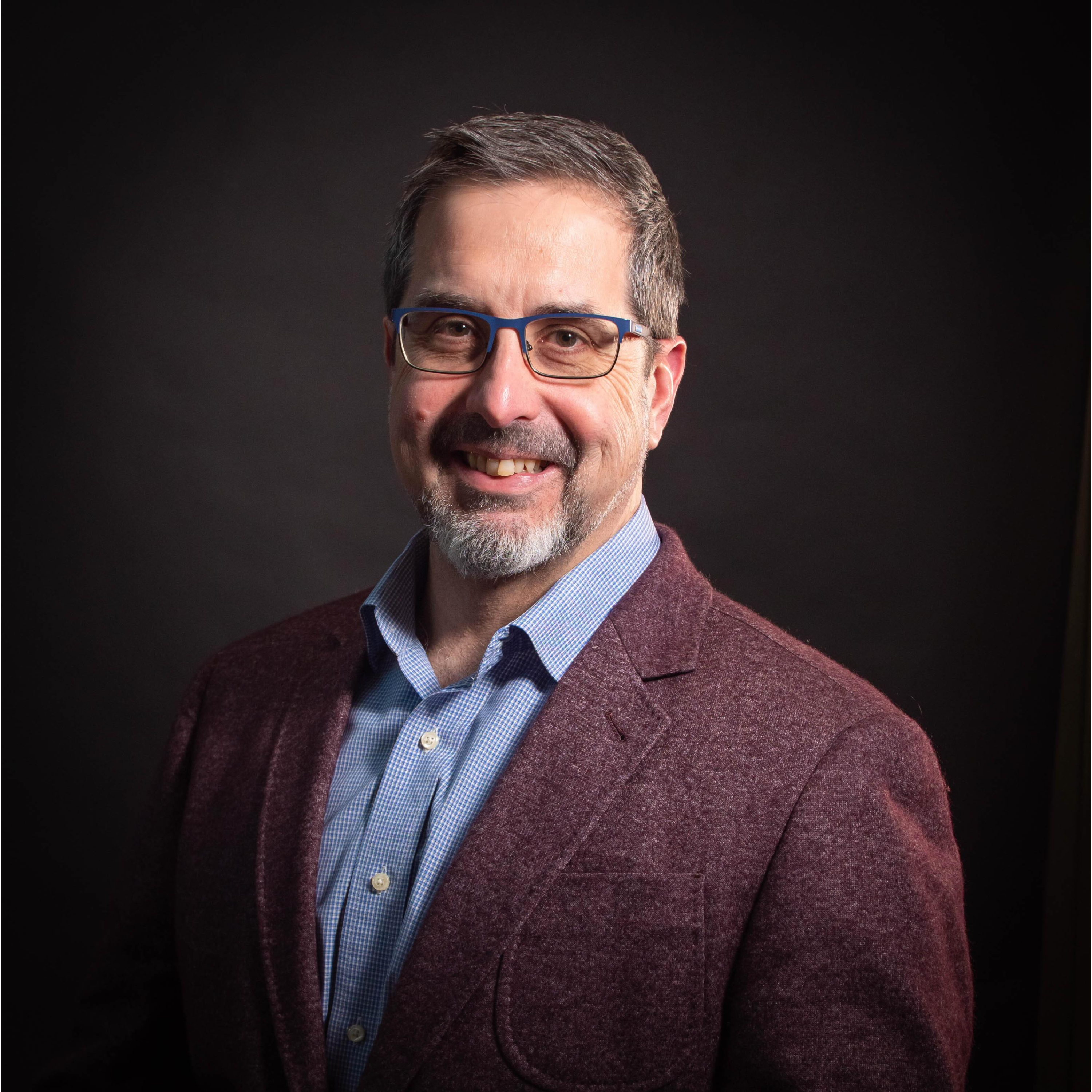
[00:16:34] Speaker A: All right. Great job. Chris Newmarker on the Newmarkers newsmakers. Now let's hear our conversation. This is a conversation I had with Brian Johnson, he's the president of massmedic. He is also, for those who didn't know, he's the co founder of Mass Device and Device Talks. Brian actually recruited me to take this role at Device Talks. So Brian is a community builder and a strong supporter of medtech, and he connected with me and Holly Scott of the Mullings Group when I was down at the Mullings Group studio. You can catch the entire video on LinkedIn. I posted that this week. This is the audio format, obviously, of that conversation. We'll talk about the state of Massachusetts Medtech, and we'll continue this conversation at Device Talks Boston. Brian and Holly will be on a panel with Lisa Anderson of Paragonics, Maria Berkman of Vensana, and John Rennert of Zoll Medical. And we'll talk about where Massachusetts and New England's medtech industry is and where it's going. So if you want to catch that conversation, go to Device Talks Boss and register for it. Now, once again, use the code DTW25 to save 25% and make sure you're part of Massachusetts biggest med tech scene. All right, let's get this conversation started.
Oh, and one more update, folks. We mentioned this conversation with Brian Johnson and Holly Scott that Ashley McAvoy, CEO of Insulet, will be speaking at Device Talks Boston. She is not able to make it, but we're thrilled to have Eric Benjamin, executive vice president and COO of Insulet, on stage Thursday morning to tell Insulet's story. All right, let's get this conversation started.
I'm here with my very good friend Holly Scott of the Mullings Group. Holly, thanks again for having us here.
[00:18:19] Speaker D: Great to have you, Tom.
[00:18:20] Speaker A: Always great to celebrate Device Talks Boston. Great to celebrate Boston. As you know, I've mentioned once or twice, I'm a Boston guy, so it's a great pleasure for me to help organize a meeting that's, I think, an integral part of the medtech scene in Boston. So we actually built a lot of pieces of the agenda centered around Boston companies. We'll have Debbie Govender. She's the opening keynote.
She, of course, of Johnson and Johnson Medtech Abiomed, or Abiomed Johnson and Johnson MedTech, whichever way you want to write it.
The next day, we'll have Ashley McAvoy of Insulet as our opening keynote. And then on the close of day one, we'll have a panel featuring Mr. Medtech himself, Brian Johnson, the president of Massmedic. Brian, thanks for joining us here.
At Device Talks. Have you heard of Device Talks, Brian?
[00:19:04] Speaker E: Pleasure. I've heard a few things.
Great name.
[00:19:10] Speaker A: It is a great name. Brian's responsible for it. Brian Ryan is one of the founders of Device Socks. We like to call him the Godfather. And it's a pleasure to have you back. I know you don't like it when I call you the Godfather.
[00:19:21] Speaker E: I like it.
[00:19:25] Speaker A: It's great to have you back at Device Talk. So can you just talk for a moment about Mass Medic? You're celebrating a big anniversary this year.
[00:19:33] Speaker E: Yeah, sure. Well, first of all, thank you for having me on, everybody. So great to see some great old friends. And it's a pleasure to be here with you guys. Although I'm broadcasting from a closet in Boston.
Not, not down there, but someday I'll come down again.
Massmedic is the trade association for the medtech industry in Massachusetts. So we, we spend all of our time making sure that the 500 or so companies that I call the Commonwealth home have a voice in state federal affairs. We convene the ecosystem through events and education and then we do a lot of sort of one to one blocking and tackling with the companies themselves to ensure that they're able to grow here and grow with as little friction as possible.
2026 is our 30th anniversary as an organization we launched in May of 1996.
So you mentioned some. Some great people in medtech in your opening. Debbie Governor is on our board and our Johnson and Johnson Medtech heart recovery.
And of course, Ashley McAvoy is captaining Insulet, which is one of our brightest stars in our ecosystem. So it's great to hear those folks coming out. So it's a great lineup you have going on for Device Talks, which I think is celebrating year 15 this year.
[00:21:07] Speaker A: Oh, all right. Well, look at that.
[00:21:09] Speaker E: Yeah, it wasn't called Device Talks at first, so. But you know, it was Device Talks goes back to 2011 was the first event that sort of fell underneath that umbrella that became Device talks. So happy 15th, Tom. You don't look at.
You look great for.
[00:21:28] Speaker A: We'll have to get two cakes at Device Talks Boston though. One for us and one for you.
[00:21:32] Speaker E: That's right. That's right.
[00:21:35] Speaker D: A lot to celebrate. 500 I counted as of this morning with my AI help. 573 Massachusetts MedTech companies. Does that sound right to you?
[00:21:45] Speaker E: That sounds about all right, Holly. I mean, I think, you know, sometimes companies in Massachusetts pretend that they're biotech to try and fool investors. But no, you know, I, I think there's so many small companies out here that are incorporated and they're sort of working really hard in the trenches. And so the number can kind of flex depending on how you want to define it. But I sort of settle around 500. But we've seen numbers as high as 600, 650. And then if you want to include contract manufacturers, service providers, it's a much larger ecosystem than you realize. It's sort of always been a topic employer in the life science sector. It's a major exporter, I think. You know, Massachusetts really is a medical technology state. We export more medical technology than any other product out of the commonwealth. So, you know, it's, it's, it's fascinating to me. You know, like EDS and meds is always sort of our calling card, but, you know, we make a lot of technology here and we ship it out to the rest of the world. So. So it's an incredible industry to be sort of fighting on the side of
[00:23:00] Speaker A: and just going over the. I'm amazed also at the breadth you talked about. Johnson Johnson, Medtech, heart recovery. You've talked about deputy synthesis. I mean, you've got ortho, you've got cardio, you can find transmedics, you can find many different other medtech companies. There's not one sort of sector within medtech that is really our core. We've got a little bit of everything. What's your sense of the. The state of Medtech? Massachusetts. The Massachusetts. The medtech industry in Massachusetts?
[00:23:25] Speaker E: Well, I mean, I mean, we're very interconnected to the state of medtech globally. So, I mean, because we have this incredible mix of these huge companies and then we have a lot of very small companies.
You know, you kind of have to sort of average out here where we're at. So as an industry, you know, we're seeing some great growth among certain sectors of our ecosystem.
We have companies, our large companies are growing and they're growing the footprint here. They're moving, you know, I think they're moving some manufacturing domestically. So we're seeing some manufacturing expansions and we're seeing some really interesting facility expansions. You mentioned Transmedics, which is a pioneering company in the organ transplantation space.
Kind of an Amazon of the organ transplant industry in that they, you know, they do the transplant, they follow the transplant operation from sort of start to finish. And their equipment is deeply embedded in every piece of the. Of the operation. And so they do transplantation equipment logistics. They have their own private air force, basically, and then they have an incredible tracking, so they have real time tracking of all their organ donations.
They made a big commitment to the Commonwealth this past year where they moved from Andover down to Assembly Square in Somerville and they took an entire building, a huge piece of lab property off the market, which was a big moment probably, I think it was the, the largest lease of the past 12 months in Massachusetts, which is a big deal.
And you know, they have incredibly exciting plans on how they're going to continue to grow this footprint there. You know, they're sort of in the start of their growth cycle, which is really cool to watch.
And then, you know, we have a lot of other companies, I think, that are trying to, you know, expand their footprint domestically.
They are doing some expansions in the, in Massachusetts. You know, not all of them I can really talk about, but you know, I, I sit on the board of the Massachusetts Life Sciences Center. We do a lot of tax incentives for growth and you know, it's great to see how many med tech companies are on there.
So you know, I, I, I think that's the glass half full look. I think, think the sort of persistent challenges that we face are definitely tariff related and you know, sort of understanding the full breadth of the impact of the tariffs has been a moving target for a while now. And then, you know, our startup companies are sort of, you know, always great technology that comes out of our ecosystem. I think we, we struggle in the same way all startups do in that early funding is hard to come by. So we try to work on areas where we can reduce friction in that area. So are there pieces of the journey that we can help make smoother?
Is there things that we can stimulate on the state end that could be of benefit to startups? I spent a lot of my time trying to think about how we help companies get over that valley of death because, you know, that's really where the rubber meets the road.
But you mentioned something kind of cool about Massachusetts is that we're not a single technology ecosystem.
So that, you know, that means that, you know, we have clinical differentiation across the spectrum. You know, you mentioned, you know, we have a great orthopedic hotbed here. I mean we're not, you know, Warsaw, Indiana or anything, but like we're, we have two of the largest companies in the world here that have really big presences here. Depew and Smith and Nephew, we have, Medtronic, has their robotics center of excellence here. Their headquarters of the robotics division is in Massachusetts.
We have an incredible legacy here of, of optic, optical, surgical equipment. And, and sort of the world in which spawns out of that. And then, you know, of course we have, you know, this, this organ transplantation ecosystem that is growing, which is a whole new industry, you know, with paragonics and transmedics. So it's, it's, it's fun. It's not always easy to kind of encapsulate how everybody's doing because I mean, you know, some markets are up and some are down, but you know, I think it remains an optimistic ecosystem.
[00:28:28] Speaker D: So geography really plays such a, it's so beneficial in these situations because you think about like a transmedics and how it was really an anchor for these other young entrepreneurial organizations that, and there's a number of them that are looking at organ preservation and the lifetime capability of a potential organ and ensuring that, that, that time is seamless. And you think about what goes into it and it's so much easier to have that mind share in a geography where it makes sense to do so. So it's a smart move. And that's what consistently brings us back to Boston. You know, as long as I've been in the business, which is a long time, it does.
Boston continues to be the pulse. It's the pulse because it's diversely represented. You've got core device, you've got digital health, you've got biotech. But let's not lose sight of how diverse, specifically devices, services, things that are regulated as a service. Now more of that comes out of New England and out of that area and even into the greater Tri State area than the west coast. So you're really in this ecosystem that has fueled, contained and helped to evolve these states within MedTech that have been incredibly changing.
[00:29:56] Speaker E: Yeah, you hit the nail right on the head. I think I wish I could take credit for help for the ecosystem, but it's a renewable energy source and it's amazing to watch.
You know, I mean, the story of Massachusetts is always reinvention, right? I mean, but you kind of watch.
You can trace that medtech to all these different core technologies that come out of primarily academic research centers, primarily Mass General, Brigham and mit. So we have two of these incredible core generators sort of powering our flywheel.
And on the end here where we have these companies, that is just the most important part of the flywheel. So the companies produce mentors, they produce.
When those companies eventually are acquired or go public, they create investors, they create talent pipelines that I think is really critical. And, and you know, one thing that I think is always keeps me feeling Good is, is, you know, mostly when companies are acquired here, the acquiring company invests in the physical plant here and they invest in the, because, you know, it's the country itself is, you know, is we have a really great medtech ecosystem, but it is concentrated specific geographies.
So the talent of Massachusetts is the driving force always. But, you know, we, I, we go back to the start of the flywheel is the academic research center. And, and you know, we're, I would say one thing that we do well is that we, a lot of us think about all the time how we make sure the flywheel keeps going. You know, I think it's a, it's, it's hard to sort of pick one thing as to why this works and why that doesn't work. I do think that there's some cultural stuff around competition.
I think that there's some cultural things that work in our advantage and work to our disadvantage, frankly, as an ecosystem. But, you know, it's, it's a pro, that ecosystem issue, something I spent a lot of time on and I think about all the time. It's like, how do we, you know, how do we sort of just not screw this up? You know, we try sometimes.
[00:32:32] Speaker A: Well, we'll, we'll unpack a lot of that at Device Fox Boston on May 27th. Again, we've got a lot of talent on the panel at the end of the day, including yourself. So looking forward to that. And thank you, Brian, for, for starting Device Talks, for Leading Mathematics, for joining us at Device Talks Boston and for joining us today.
[00:32:51] Speaker E: Thank you. It's my pleasure and I hope folks
[00:32:54] Speaker A: will join us at Device talks Boston, May 27 and May 28 at the Boston Convention Exhibition Center. Go to boston.devicetalks.com for more information.
All right, now it's time for our keynote conversation with Paul Leflach, the CEO of Axoff. We'll talk about Axoff's very interesting fluoron material, its technology, his origin story, how he came to be the CEO of a BCI startup. And we'll also talk about how axopt is looking to build its manufacturing practice or facilities in Massachusetts. And it's an interesting, I think, lead into once again, the conversation we'll be having at Device Talks Boston. So now it's time for my conversation with Paul Leflach of axoft.
Well, Paul Laflock, welcome to the podcast.
[00:33:43] Speaker C: Thank you. Happy to be here.
[00:33:45] Speaker A: Excited to learn about axoft. It's a Massachusetts company which I always love to highlight and give attention to, but it's also in the BCI space, which obviously is a hot and interesting area.
So lots to talk about today before we get into the company, though. Paul, how did you find your way into. Into this business and into the medtech industry?
[00:34:08] Speaker C: Like most people, this was not planned at all.
I started my career in research.
I have background in material Science, did my PhD at Harvard.
Prior to that, I was in France. I have an accent. I'm from France.
And one thing leading to another, I got from material science to nanoelectronics to how we apply this to neuroscience. And then that led to going into brain, computer interface and medical devices space.
So it's a succession of choices.
[00:34:39] Speaker A: So what brought you into material sciences? What was your initial interest?
[00:34:44] Speaker C: Yeah, I'm fascinated by molecules and polymers and always thought this would have very unique applications in the future. And always trying to work on something tangible that can have an impact in the world.
I was curious about the medical as well, because everyone is exposed to medical to some extent in their families through health issues of parents, grandparents. And for me, that was also something that when I saw I had an opportunity to contribute to that space, I was like, yeah, it's something I would do.
[00:35:16] Speaker A: That's great. So how did you. Maybe we can move into the origin of Axoff's technology and sort of how you came to find this material or this company. How does the story come together?
[00:35:29] Speaker C: Yeah, so it all happened when I met one of the two other co founders who was my PhD advisor. His name is Jia Liu. He's professor of bioengineering right now at Harvard. And I was the first student in his lab, actually. And we had one simple question we wanted to solve is how do we make brain implants, not damaged brain tissues, to interact with the brain, with the brain in general? And that was mostly in the context of neuroscience in the beginning. And because I'm a material scientist, I wanted to answer this from a material science perspective, which meant develop new materials. And that's where it all started.
[00:36:07] Speaker A: Interesting. So how does that process begin? Do you. You've got an interesting video on your website comparing your material to brain material. Do you start with the brain material? Do you identify its characteristics? What's the process like?
[00:36:20] Speaker C: We. So we, Gia and I had a pretty good understanding of what would be the engineering, technical and biological requirement for material to essentially create less damage. I mean, obviously when you have an implant, it's always like moving stuff around.
So it's always creating a response from the body. It's foreign body response or immune response. And what people started to notice in the last, like two decades is that when you make things smaller, when you make them softer, you can mitigate some of that response, which ends up making a better interface between the tissues and the electronics, which is what you want for these technologies. So we started from there. And the challenge was that in general, the brain is very soft. It's like Jello.
But any material like Jello is not a high performance material. It's not a medical material.
So we had to find the intersection of these two worlds. And it happens that there are very little classes of material that can live at this intersection. And we ended up designing what I would describe as the shoeingum version of Teflon, or material which we called Fluoron. And fluoron has a very. It's a very specific word because it starts with fl, like fluorinated, because material is fluorinated, like ptfe, like Teflon. And fluoron ends with Heron, like Neuron, because it's made to interface with neurons. But it also means flagship in French.
[00:37:57] Speaker A: And I'm from French, really.
[00:37:58] Speaker C: And, you know, it's our flagship technology. It's the first layer of the stack in this brain computer interface, the first line of communication between the electronics and the tissues. So it's called fluoron. And so fluoron is a very soft version of fluorinated polymers. And we designed it so that it's compatible with semiconductor manufacturing, because this whole space of implantable brain computer interface is based on semiconductor processes that are being used to miniaturize sensing and stimulation capabilities. And so that was, I would say, the third element to bake in the design of this material that was like the compatibility with a scalable manufacturing process.
[00:38:46] Speaker A: How did you identify or how has the problem been identified? Because BCIs are emerging technology.
You mentioned there's two decades of sort of experience. We're looking more at more traditional leads and things or other things that have been implanted in the brain as part of maybe a larger neurodevice or some larger device.
Where are you seeing the need for improvement or what has shown you the need for improvement in brain implants?
[00:39:12] Speaker C: Yeah, I think the need for improvement comes from actually not from like the earlier generation of medical leads, like deep brain stimulation leads or stereo eeg actually comes from the microelectrode array that were designed for neuroscience studies, like the Michigan array, for instance, or the Utah array, because these microelectrods demonstrated that we can measure useful signals at single neuron resolution, for instance. And this is Not a learning that really comes from the clinical space. It came from neuroscience studies. But the challenge was that these microelectrode arrays were made of rigid materials. And it's been a known challenge in neuroscience labs. How do you make this interface last for a long time?
Usually you lose signal over time when the implant is rigid. And so there is this trade off between achieving higher resolution of interface with the brain for recording of stimulation, but maintaining this interface over time, which obviously you want to use this as a medical device, it needs to last for a lifetime. So that was the motivation.
[00:40:23] Speaker A: And what are the specific shortcomings? Does the material or do the implants migrate to a different part of the brain? Do they lose connectivity to the brain?
What happens when these don't perform as you want them to?
[00:40:39] Speaker C: Yeah, yeah. So the consequence is that you lose your interface, is that you lose data. You lose track of the same cells or the same regions in the brain. And that originates from three major issues. The first one we already mentioned is the foreign body response. The brain tends to react for multiple months, is trying to, you know, eliminate the foreign body. Just like when you have a splinter, it starts to get red around it.
But if the splinter is small enough or is removed, the tissue can heal completely. So that was the first issue. The second issue is indeed the potential migration of the leads. It's not necessarily something that has been an issue for legacy leads technology because these implants were so large that the scale of the migration was small compared to the size of the device. But when you start looking at micro recording in regions or millimeters, patches of cortex or deep brain tissues, this migration matters because you can have a movement that a drift of the implant in the tissues that multiple times the size of the implant itself. And then the third problem, obviously is if you make something small, very small, very thin out of a rigid and brittle material is going to shatter.
You can't afford to have a lead shatter in the brain of a patient. It's a hazard, it's a safety issue.
And that's been preventing some of the technology used in the neuroscience labs to completely translate into the medical space. And we're still seeing it. We're collaborating with hospitals like Mass General in Boston, where they used kind of like neuroscience electrode arrays that are rigid. They've used it even in human. But they still have this concern that this can shatter at any time. And one thing we can do with having soft implants is preventing this failure mode.
[00:42:35] Speaker A: Do you have you assessed the. Well, actually, just a quick question about the Brain maybe you know this or maybe not. How does the brain try to remove foreign tissue? I mean, there's no, there's no blood there. Right. There's no active sort of biological action that can be taken. What happens when the brain tries to respond?
[00:42:53] Speaker C: Yeah, so we could talk for an hour about this. There's a lot of different types of responses, but you basically have the first thing that was noticed even 20 plus years ago is you have an accumulation of astrocytes and active microbial, which are specific cell types that are not neurons around the implant. The second thing that's also happening is just neural cell death. A lot of cells can be dead around the implant and that creates basically a layer of dead tissues that acts as an insulator and increase what we call the impedance, which is essentially the electrical sensitivity of the implant and the electrodes, which means that we end up not picking up great signals.
So these are part of the response. And then there are a lot of many more mechanisms based on proteins and oxygen and a lot of parameters. So it's still something that's being understood. But we have identified, I mean, not we, but the community has identified in the past a few of these parameters and that's what we're trying to optimize around. Obviously there is more to do than just developing a soft material, but it does help.
[00:44:03] Speaker A: Interesting.
So looking around the BCI space, we're seeing companies emerging with different sorts of different materials. I won't identify companies specifically, but.
And speak as specifically as you'd want to. But what's your assessment of the other BCI startups up there and the materials they're using? Do they fall more in line with traditional, harder materials that may lead to the same problems? Or do you think other BCI companies at your stage of development, earlier stage, are sort of trying to address the same issues that you're raising today?
[00:44:39] Speaker C: Yeah, that's a very good question.
So Axoft was started in 2021. So we started the company at a time where there were already a number of BCI companies out there.
And I think what that means is the first generation of brain computer interface companies really trying to bring the technology to the market without necessarily having the most optimized technology or not trying to solve these problems. And that's more the kind of issues that the new companies are trying to solve. So I think there is a trend to improve the interface with the tissues and hence the quality of the data we can collect.
And there are different approaches and I don't think there is.
There is one Winning solution. A lot of them are going to end up being complementary. We work on the insulating material which insulates the electrically.
All the leads, all the conductive leads into the implant. And why do we do this is because if you look at the mechanics of the implant, most of its mechanical properties are set by the insulation layer, because insulation layer is most of the volume of the implant. It's not the conductor of the.
So that's why this is important. But now then, there are other companies that focus more on maybe using different coating materials that improve properties, such as impedance, which we mentioned.
And that's fine. It's actually very complementary. So I think there will be multiple improvement that comes from material science and semiconductor processing baked into BCI into the future.
[00:46:17] Speaker A: Let's go back to 2021, to the starting of the company.
Did you have this material, fluoron, that you could have applied to different industries and you opted for medical devices? Was it always clearly. I mean, you started off focusing the brain, so I'm guessing that was the direction you were going. But how did you come to say, we're going to use this material to create this company? And if you would sort of unpack that experience a little bit.
[00:46:41] Speaker C: Yeah. So we had a first version of the material which was still, you know, we were doing proof of concept study. We had some very exciting results, which was sufficient to get started, I think.
And in the end, we demonstrated more of that value down the road.
The material has evolved. And axoft is not developing just one material. It's a family of materials. We're commercializing some of them for other applications.
And the choice of the brain, I think it's a little bit personal from the founders that for us in the medical space, the brain is a bit of the last frontier, where the 21st century is a lot about how do we find solutions for neurological disorders, how do we understand the brain better? And I think that was the most appealing opportunity for us.
Obviously not the most straightforward, but this is really what we wanted to develop around.
But indeed, there were many other things that were suggested along the way by us, by advisors, by investors, looking at different, even different kinds of implants, looking at spinal cord interface, looking at stents, looking at peripheral nerve interface. So all of that was mentioned. And as a startup, we have to focus.
And I think we decided to focus on the brain interface because that's what we were passionate about.
But we also realized that, that we could demonstrate the value of our technology by making the material platform available to other users, which is why We've started to commercialize these materials in the early days, like to other research institutions. And now we're partnering with some companies down the road. We hope Fluoron will become a new standard material for medical devices and this is our way to explore this other application. This is also a way for the company to generate more than enough revenue to fund further innovation and further R and D. Axoff aims to be the next company that's developing new medical materials. We don't want to stop at one version, we want to keep improving. So it's been a pretty good engine for innovation and discovery so far. And it's, it brings also a lot of credibility to the company because, you know, being able to sell the material, having other people use it, collect feedback in the BCI space, where the timelines are very, very long. I think it's, it's helpful.
[00:49:13] Speaker A: Fascinating. And did you know you wanted to be the CEO of a, of this company? Was it evident or did it sort of just come to be?
[00:49:20] Speaker C: It just came to be because I was, I was driving the project and also I was lucky enough to find another co founder. We have a third co founder, his name is Tianyang Ye and he's the chief technological officer. And Tianyang comes from another department and lab at Harvard that focused on microelectronics and how we develop ASIC circuits for doing high throughput interface with biological tissues. So again, it's another key problem in BCI is how do we scale up this interface in terms of data exchange. So we had this other core technology from the university and because of that, I think it just felt more natural for him to take on the role of cto.
And yeah, so that's, you know, we ended up being three with two full time founders. So one CEO, one CTO just made sense.
[00:50:12] Speaker A: Looking back now, it's been, I guess, five years since. Were you CEO right from the start? From 2021?
[00:50:17] Speaker C: Yeah, almost. Yeah.
[00:50:18] Speaker A: How much didn't you know going into this? Did you?
[00:50:23] Speaker C: And I didn't know 99.9% of the things I know now I can tell you. And I probably only know one person of what I should be knowing. So it's a continuous learning process. It's very interesting, especially when you just drive this out of academia because no former industry experience or entrepreneurship experience, it's difficult, it's a curse, it's a blessing because you're also a bit naive and you're going after things that people would reasonably not do. But entrepreneurship is not always about being reasonable.
So yeah, I think overall it's been good because we have a very unique technology, very deep tech angle into building a medical device and that requires an unusual approach. So I think so far it's been good.
[00:51:10] Speaker A: Talk about if you would. I think you've hit upon it slightly, briefly, but talk about the applications you're pursuing, the devices you're building, the areas you would like to treat.
[00:51:21] Speaker C: Yeah. So brain computer interface has the promise of being a platform technology to diagnose, to treat, to improve quality of life for a wide range of neurological disorders. In the early days it started more around how do we restore motor function or speech for patients with paralysis. So a lot of the early day companies are going into that direction.
Because we're more of a second generation BCI company, we looked at the space differently, we run a lot of user interviews with a lot of clinicians to really understand where there were pain points and unmet needs that where there would be a strong clinical pull because implantable devices are just difficult to commercialize. So we need to make sure that we're solving a problem that's very important for people.
So we looked at a bunch of things and it took us a few years to kind of finalize our direction.
We notably had a lot of discussion with Mass General Hospital about that, who is leading institution in this type of BCI trials. And we ended up looking at disorders of consciousness which are the states of altered consciousness after a brain injury. So imagine you have like a traumatic brain injury or a stroke and you're going to the hospital and you're being taken care of. But the reality is that in the neuro ICU, 70% of the death is caused by withdrawing life sustaining therapy. It's not caused by the injury. So it was a very unique problem that relates to our inability to communicate, to diagnose, to do prognosis as well, or communication with the brain. So this is something we've identified where we saw much more interest from clinicians around a use case like this than some other BCI applications.
It also was interesting from a technology perspective because it relates to measuring very stable data from brain regions which our technology is suited for.
We have these soft implants that have incredibly stable data from the brain.
So coming back onto the indication piece, we really resonated with that problem because we spent some time at the hospital visiting the neuro ICU trying to understand what's difficult for the patients and the clinicians and families. And the reality is in many cases the situation is a little hopeless because you can't do Anything for the patients? Because there is no good diagnosis for disorders of consciousness. The current standard of care is a behavioral exam, which means you go to the patient with your piece of paper, it's called the Coma Recovery Scale or the Glasgow Scale. And you ask questions to the patient like, oh, can you try to move your eyes or respond to a question? And obviously this scoring leads to a lot of misdiagnosis. Actually it leads to 43% of misdiagnosis.
[00:54:31] Speaker A: Wow.
[00:54:32] Speaker C: And so why standard of care diagnosis with 43% of errors? That's 50.
[00:54:37] Speaker A: 50. Basically, yeah.
[00:54:38] Speaker C: So there was a strong need identified and we basically worked on the clinician on defining how an implant technology could be used in this setting to help the patients.
The goal being to know earlier what's their brain state, are they recovering, are they degrading, should we take care of them? More than we're doing right now, being able to guide them to rehabilitation earlier.
And some of these patients have cognitive ability because we don't see it. So there is also a communication piece here where you would want to be able to, to know if the patient is trying to say yes or no. Very basic communication, not talking in science fiction, but just yes or no.
So this is what led us to work on this direction.
And this is. Yeah, so far we've received a lot of, I would say, interesting feedback on this. So it's something that we think is going to have an impact in the way patients are being taken care of. Yeah.
[00:55:46] Speaker A: So what is the status of that product and give us a sense of your pipeline and sort of where it lies with the FDA and potential commercialization?
[00:55:58] Speaker C: Yeah. So we are aiming to do a first IDE study, an early feasibility study in the US along this, for this indication in 2027 next year.
But prior to that we basically want to get a part of our hardware, the implant part, approved through a 510k path that will only be for subset indication that is basically just being able to monitor brain signals. But that will give us foot in the door to be able to have these follow up studies that will help us collect data to, to show to the FDA that we can help patients with this technology.
So we're taking this step, I would say stepwise approach. And it's in part due to the fact that we're using new material in the brain and it's very important for us to demonstrate the safety of that. So we're trying to go step by step.
In the past we've already been able to do clinical studies working with IRB of different hospitals. So we notably did it with Mass General.
And it's been incredibly useful to collect early safety and usability data from our technology because it's just so new. It's like very different type of implants, a different form factor, and we're learning from the neurosurgeons how they use it, what works well, what doesn't work well. So we keep collecting early clinical data, but in parallel doing the work to be able to submit the first 510 and then do a specific study in disorder of consciousness.
[00:57:39] Speaker A: Really interesting. So you've had some success recently with fundraising. You announced a $55 million Series A.
What was that experience like? Did your success.
Was it tied more to the interest in BCIs, to your platform sort of approach where you're providing materials and you have sort of an ongoing business that could produce revenue?
What was the store you sold? And give us an assessment of. Of the fundraising environment out there.
[00:58:07] Speaker C: Yeah. So first off, fundraising environment is very difficult.
It took us over a year to be able to put this fundraise together.
[00:58:16] Speaker A: Wow.
[00:58:16] Speaker C: Okay. We thought it would be faster. We thought that our first early clinical data would be sufficient, and it was not. We had to do multiple repeats in different clinical sites to convince investors. So I think there is a real, like, the goalpost keeps being moved now for companies, and it's not just about bci, it's companies in general fundraising.
Between the moment you're deciding you're fundraising and the moment you're actually doing it. And when you close, the space has evolved, and so BCI space is moving rapidly. There are some players that are well ahead of us, and so I think that's a challenge. But at the same time, axoft is one of the company that, at the seed stage, was able to show, okay, we can execute.
We have proof of concept data. We have early clinical data. I think that's one thing we solved, is we're able to move fast because the team is incredibly operational and talented and being able to execute against the roadmap.
Yeah. The other part is the story is definitely CIA. Story is the story of opening new market opportunities in medical devices and beyond medical devices. And it's important to pitch that story right to investors so they understand the opportunity, despite the fact that this is a new market. So right now, there is no company who is really making money with bci. So it's multiple pieces put together. And at the end of the day, fundraising is challenging and feel a lot like serendipity when you actually close it. So we're very happy. We're excited because for us that means we can go to the next stage for BCI companies. Series A funding is what gets you to really important milestones like I described. Being able to have first note from the fda, being able to do trials in your key indication and collect this inhuman data that will demonstrate how you can improve standard of care. And finally putting together your manufacturing, which costs a little bit and you don't want to put some money on that too early.
[01:00:23] Speaker A: So for those of us who see the money being raised by BCA companies and declare there's a bubble or over enthusiasm or investors are throwing money at this, that's not the case.
[01:00:35] Speaker C: I mean, time will tell.
It's like these AI companies, right?
They keep raising more and more,
[01:00:45] Speaker A: but you didn't just call someone on the phone and say, hey, I'm a BCI company and they cut you a check. There is some work involved there.
[01:00:51] Speaker C: There is always.
I mean, I can tell you I'm in contact with my peers and nobody is having an easy time to fundraise.
You know, a lot of these companies are like, it's the first time something like this is done or first time founders. And no, it's hard, it's hard out there. But I'm not going to complain because I do think BCI is really hyped and that helps compared to other spaces in medical devices that should be more funded. That's a message for the investors listening to this.
[01:01:22] Speaker A: Listen up everybody. Finally, I want to hit upon, as I mentioned at the top, you're a Massachusetts company. You're based in Cambridgeport.
You were one of the companies that received grants from the state of Massachusetts. I believe it was late last year to build a manufacturing plant. So talk a bit about that, about the grant, what it's going toward. And I'd love to sort of just talk to you about what it's like building a medtech company in Massachusetts.
[01:01:54] Speaker C: Absolutely. So the grant from M2A2 is about funding companies that develop local manufacturing. So it's not necessarily about medical devices, but the idea that we defended in our application is that we're seeing a lot of companies in the greater Boston area that are developing, developing new medical devices using more modern manufacturing, including semiconductor manufacturing. Yet there is no space for these companies.
It's very notorious on the east coast that there are not enough microfabrication, clean rooms. And so we basically pitched this idea that we can build one. Here we are creating jobs and teaching people how to develop these technologies as part of the program. There is also a training program that we're doing with Bunker Hill Community College to train students to these skills that train the workforce and help them to find jobs later in this industry that's growing. I mean, Boston area has a lot of history and potential in medical devices, but also needs to undergo this transformation to a more modern manufacturing to keep up to pace with the west coast or things happening outside of the US as well.
So the grant helps us to fund essentially it's a one to one dollar grant for the tools that we're purchasing. So purchasing tools to do what's called MEMS manufacturing. So these micro devices using all new material fluoron that we develop at axoft. So in this facility we have have chemistry labs or we develop this material and then we bring it to the fabrication clean room where we can use it with these tools. So that's what this program is about.
[01:03:52] Speaker A: Could you speak to maybe in your conversations with counterparts, CEOs of companies in other parts of the country. I wonder how Massachusetts compares to Minnesota to the west coast to Texas in starting and growing a medical advice company.
[01:04:08] Speaker C: Yeah, so Massachusetts is known to be a great place to build very strong team. Like there were so many universities and so many talents flowing through Boston that it's the biggest asset of the region.
That being said, it's also more expensive to build medical device in Massachusetts, especially in the city compared to Minnesota or maybe like Texas.
So in that sense it's comparable to California.
But California also has more history of funding, I think implant medical device companies for instance. And so I think Massachusetts is lacking a little bit of that. And that's why it's great to have the grants like the M2I2 and others that are being set up to help develop this aspect.
Yeah, I think this is the general feeling the challenge for early stage Medtech is is it's difficult to take the decisions to delocalize outside of the state just to bring down cost because then you need to make sure your team will move there.
That just creates inertia. Geography is important.
And here we decided to stay here because we think that the team we're building is absolutely crucial for the success of the mission. Even though this is is definitely not the best place to bring down the cost of R and D or manufacturing.
Yeah, great.
[01:05:40] Speaker A: Nope, that's a honest assessment and rings true. Well, I'm excited to help you share Exoff's story here on the podcast. Paul, thank you for joining us.
[01:05:53] Speaker C: It was a pleasure. Thank you, Tom.
[01:05:57] Speaker A: All right, well that is a wrap. Thanks for joining us on this episode of the Device Talks Weekly podcast. Thanks again to the many sponsors and attendees and speakers speakers of Device Talks Boston. We look forward to seeing everyone next week. I hope you'll join us there as well. Go to boston.devicetalks.com to register. Use the code DTW25 to save 25%. It's going to be a fantastic two days of MedTech discussions and I look forward to seeing you there once again. We'll be recording our next week's episode of Device Talks Weekly live on stage. We'd love to have you as part of that. We always have a good time with those and more important, it really we've got some great stories of folks who attended those and ultimately got jobs and really found their way into medtech because of it. So it's a great opportunity to bring the community together. So I hope you'll join us not only for Device Talks Boston, but also for our live podcast recording with the Mask Device and Device Talk staffs in addition to some guests.
And that'll happen at the end of day two. So go to boston.devicetalks.com to be part of the conference. Use the code DTW25 to save 25%.
And of course subscribe to the Device Talks Podcast network so you don't miss that or a future episode of our Device Talks podcast. Connect with us on LinkedIn Connect with device Talks Follow Device Talks Rather follow Mass Device Connect with me Connect with Chris Newmarker, Connect with Kaylene Brown. Connect with the rest of the editorial team, Sean Hooley, Jim Hammerand and Skylar Rivera. But don't just connect with us on LinkedIn. Come and see us at Device Talks Boston. This is a once in a lifetime opportunity. We don't get the entire team together in one place. So I'm excited to see everybody in Boston next week. So. All right folks, thanks for listening to this episode of the Device Talks Weekly podcast. I do hope we'll see you at Device Talks Boston and have a great day.