[00:00:01] Speaker A: Hey, everyone. I'm Kayleen Brown, managing editor for Device Talks. And welcome back to another episode, Device Talks Weekly.
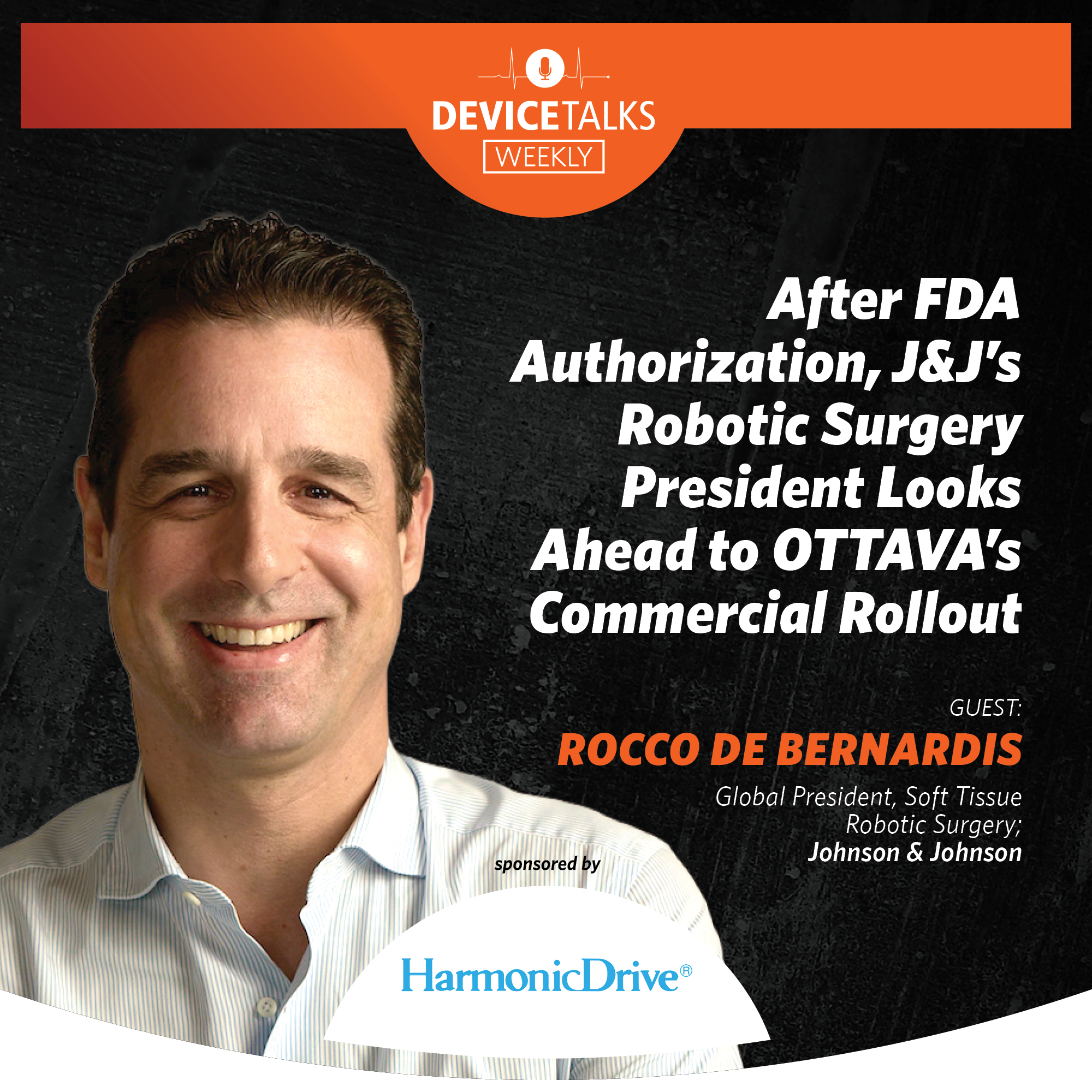
It feels weird for me to say that it feels weird for me to do the introduction, and if it feels weird for me, I'm sure it feels pretty weird for you too. But know that we're in the same boat and we built as a collective Device Talks Weekly to bring medtech Conversations to you. So it is my absolute honor to continue to do that, and with all the love in the world and knowing that this podcast has been beloved by our industry and built by, in my opinion, the king of medtech, Tom Salemi. It's important that we can continue to share these incredible medtech conversations with you. And speaking of incredible medtech conversations, oh, do I got a good one for you. This episode, I have the opportunity of sitting down with Rocco De Bernardis to Johnson and Johnson's global president for soft tissue robotic surgery about the company's OTAVA robotic surgical system. Ba Bam.
In my conversation with Rocco, we discuss why otava's robotic arms are built directly into the operating table. I also ask what's happened since the clinical trial and recent FDA authorization.
And then I finish up with how the systems automation instruments and how polyphonic could shape the future of robotic surgery.
As I say this out loud, I cannot believe that I had the opportunity to conduct that interview. I mean, it makes me really think about all of the opportunities that have come my way because of Tom.
So I'm going to dedicate this episode of Device Talks Weekly to Tom.
Chef, thank you. This one's for you.
[00:01:47] Speaker B: All right, you ready for this?
[00:01:49] Speaker C: Ready. SA.
[00:02:15] Speaker A: Foreign.
We're just minutes away from my interview with JJ's global president for soft tissue robotic surgery. But before we get into all that, Good, good. I wanted to chat through just a couple things this week. I just finished our Connected Health Week, where I got to spend three days with leaders from bd, Carl Stortz, and Phillips. If you missed it, you could catch it on Demand. Go to www.deviceaux.com.
also, join us for upcoming Device Talks Tuesdays. Again, you can go to devicetalks.com to register. And November 10th through the 12th, we're bringing Orthopedic Technologies Week. Another three days of focused content around the orthopedic industry. I will be moderating those webinars. Remember, Device Talks. Com. That's the gold. Go there, register. Cannot wait to see you live.
Let's talk about this episode. And my plan was to bring back the newmarkers newsmakers, but it just so happens that it's mea weekend in Minnesota. I say that, but I have no idea what it means. But Chris assured me that if you're based in Minnesota, it's a really big deal and you'll know exactly what that is. So I promise we'll bring back newsmakers next week. Now, before I kick off my keynote interview, I want to hear from this episode's sponsor, Harmonic Drive.
Lee Gintert, Sales engineering Manager for Harmonic Drive. Welcome to Device Talks Weekly.
[00:03:40] Speaker C: Great. Thanks for having me.
[00:03:42] Speaker A: So, Lee, I always love having Harmonic Drive on the podcast. Let's start at the very top. Can you tell us more about Harmonic Drive?
[00:03:49] Speaker C: Certainly. Harmonic Drive is a global company. We have offices and manufacturing located in the usa, Japan and Germany.
Harmonic Drive came about in the early 1960s as a result of an inventor named Walt Musser who invented what's called a strainwave gear back in the mid-1950s.
And that product line was patented and became a commercial product in the early 60s. And that's when Harmonic Drive formed. Essentially, the strainwave gear is a very unique gearing mechanism that's lightweight, compact, very accurate, and has a high reduction ratio that it can use in many different industries, including medical, aerospace, semiconductor, defense, a variety of industrial applications.
[00:04:44] Speaker A: Let's narrow the scope a little bit more. So how does Harmonic Drive work with medical device companies?
[00:04:51] Speaker C: So Harmonic Drive works with many medical companies. We start off from the ground floor working with engineering in many cases. Many of these medical devices have some custom requirements, and that's where Harmonic Drive shines. Our product line can be highly customizable and we do it quite well. We've been doing it for 50 years. So the really difficult part is the beginning stage is sorting out all the technical and customization requirements and we do it quite well.
[00:05:25] Speaker A: What about your most popular products? Can you tell us more about those?
[00:05:29] Speaker C: Sure. You know, the Harmonic Drive portfolio is, it's quite diverse when it comes to medical applications.
By far our most popular product lines, because it gives the customer the most flexibility for their design, is our, what we call our component sets. And that's the, the, the building block of the strain wave gear. It's essentially three components and it can be highly customized to fit the customer's need. But it gives the, the, the customer and the design engineer the flexibility to design their system around our product.
So by far that that is the most popular approach with our product line. Now, assuming the customer wants more value to that, you know, we have the flexibility now to add perhaps a motor. Maybe the customer didn't want to integrate their motor in with our gearhead. You know, we have the capability and the services to provide that to the customer as more of a turnkey solution.
[00:06:41] Speaker A: I can definitely see why these are some of your most popular products, especially for Medtech.
What can you tell me about some of the more recent products that you've been offering?
[00:06:50] Speaker C: Yeah, so from, from the value add side, one of our newer products that is kind of the next generation of our actuator product line, which is the integrated gear head and motor is what we call our IDT product integrated drive technology.
So that even takes the customer design to the next level and provides ease of use, a complete solution without having to use an external servo drive. And you know, that could support Ethercat Communications, which is becoming more and more popular and we also support CanOpen Network communication as well.
[00:07:31] Speaker A: Last question for you, Lee. Let's look into the future. Where do you see your business going in the next three to five years?
[00:07:38] Speaker C: We're still focusing at this point, heavily focused. For example, we're having the discussions on medical devices here, but the medical industry is one of our top two or three targeted market segments. We see lots of growth, tremendous growth in that marketplace, anywhere from surgical robots to simpler medical devices in general. But we've seen, you know, if you look around all these different startup companies and in the medical industry, and many of them are going to some type of surgical robotic arm mechanism. And we're excited that we have the opportunity to participate in those type of applications and we'll be focused on them and adding resources to support that growth.
[00:08:31] Speaker A: Excellent. Well, time flies when you're having fun. Lee Ginter, Sales Engineering Manager for Harmonic Drive thank you so much for joining me on Device Talks Weekly. I really appreciate it.
[00:08:41] Speaker C: Great. Thank you so much for having me
[00:08:43] Speaker A: and to our audience. To learn more about how Harmonic Drive works with medical device companies, please visit their
[email protected] that's H A R M O N I C drive drive.net Rocco de Bernardes, Global President, Soft Tissue Robotic Surgery for Johnson and Johnson welcome back to Device Talks Weekly.
[00:09:09] Speaker B: Thank you, Kayleen. It's a real pleasure being back with you. Thank you for having me.
[00:09:14] Speaker A: So we have had the pleasure of having you on the podcast in 2023 where we got to know more about you and how you found your way into MedTech. So I'm going to drop that link to that episode into the show notes. So if our listeners missed it, I would be shocked if they did. But if they missed it, they can get that Inside scoop. And that said, I know that our audience is really keen to get an update since you were last on. So I really want to focus our time on the OTAVA robotic surgical system.
But for our listeners who may not be familiar with otava, can you give us a high level overview of that robotic surgical system?
[00:09:50] Speaker B: Of course, my pleasure. It has been an exciting time over the last few months with the FDA approval. I'm going to talk to that in a second. But OTAVA is a new category within the soft tissue robotic space. It's the world's first table integrated soft tissue robotic surgical system.
We've breaking the mold of having robotic arms attached to carts or big booms. The four robotic arms, which we called intelligent robotic arms, are integrated into a standard size surgical table. So it's a world first.
And we're very proud that we are able to make such an incredible engineering feat a reality so that we can bring a new solution to surgeon surgical teams around the world.
[00:10:42] Speaker A: That's a really great place to start because it is for robotic arms. So what was the like, what went into making that choice and having it be part of the operating table? What is like, why was that designed differently? And how do you think that that difference enables better outcomes in the or?
[00:11:00] Speaker B: That's a great question. And of course, you know, we all start with, you know, what are the unmet needs that, that we're trying to solve for.
And really it all starts with the surgeon at the center, the surgical team, the hospitals. And what we learn is that, you know, even the most advanced hospital and clinical teams are trying to advance surgical care while balancing the realities of infrastructure, staffing or efficiency, data access, and a growing demand for robotic surgery. So otava, really, Autaba and Polyphonic, I shall say together are designed to really complement those efforts by leading institutions around the world with features that are intended to help enhance our capacity, streamline workflow, make it easier for surgical staff to use our system, improve visibility to data, and support broader access to robotic assisted surgical care. And so if you think about the ability to integrate four intelligent surgical arms into the table, it's really an idea not only to reduce footprint and space needed by a robotic system in the operating room, really thinks about how that can unlock potentially very different workflows. And the idea is to have a robotic system that as opposed to being at the center of the operating room and everything has to adapt to that robotic system, is to have a surgical robotic system that adapts to those natural workflows that surgical teams would otherwise have as they perform procedures in the operating room. So it's really about adapting into the or, as opposed to forcing upon the OR and the surgical team a technology.
And that's really, you know, how we thought about it.
And, you know, that brings, you know, really, you know, important advantages that I'm very happy to talk about.
[00:13:06] Speaker A: I can definitely see what went into not forcing a workflow or asking the team to adjust to a new workflow, but to adapting to it. So it makes a lot of sense. And when you were on the podcast In November of 2023, you were just heading toward your clinical trials. So now that we have an overview of what OTAVA really is, I want to talk about those clinical trials a bit. The system has now been used in patients, it's received FDA authorization.
Maybe we can start with what have you learned in development and how has that changed your thinking pre our conversation In November of 2023, when you were just entering those clinical trial journey?
[00:13:47] Speaker B: Yeah, I mean, first of all, for us and the team, the fact that we've been able to be in the clinical setting already, and through that obtaining an FDA approval has been an incredible milestone, as you can imagine. We're really turning an R and D program into a new business that has the opportunity to really define what's going to be next in robotic surgery with a very bold ambition.
And so we've learned quite a bit along the journey. I think that the most significant learning, of course, has been the clinical trial itself.
We had a prospective multi center, single arm clinical trial focused on royal en y gastric bypass procedures.
Why? First of all, those procedures, because they're in the general surgery space, which we felt very strongly about, should be our starting point for our venture in otava. But also there a procedure that has a certain level of complexity. So we wanted to demonstrate from the very beginning that OTAVA is indeed a capable, multiport robotic system that can handle highly complex as well as simple procedures. And so that was an important element as we thought about it. And so during the clinical trial, we learned not only about the safety and effectiveness, otherwise we wouldn't have got the approval by the fda, of course, but also the fact that some of our hypotheses for the value proposition of OTAVA was indeed a reality that was confirmed in a clinical setting.
For instance, we had six primary participating institutions, so six different OR environments that ROTAVA was tested. Five of the six never had a robotic system used in those operating rooms. And in one of the cases, we had an operating room that was 243 square feet, so very small one.
So we could really demonstrate that OTAVA indeed can operate also in very small settings.
Think about what that can do in terms of expanding capacity for institutions that are looking to bring robotic surgery to more patients.
And that is because of the fact that ottava is indeed 30 to 50% smaller from a footprint standpoint than other robotic systems in this space.
The other element that we learn is that we had a 20 person post clinical trial survey that we run. And so we had 100% of the participants that agreed that OTAVA could unlock space and allow compact rooms to become robotic suites. 95% agreed its footprint creates workflow efficiencies, and 90% agreed it improved visibility, collaboration and communication. So this is a small sample survey, 20, 20 respondents. But it's definitely encouraging in terms of demonstrating that indeed OTAVA can not only allow smaller or to host robotic systems, but also really change the way communication, visibility, collaboration happens within the operating room and drive really efficiencies in the workflows for everyone.
[00:17:25] Speaker A: The approach here is adapting to the current workflow and adapting to the current footprint. Can you talk to us about that a little bit more? What was the thinking and can you expand on the importance of that in the hospital workflow?
[00:17:39] Speaker B: Yeah, and just, you know, as I, you know, reflect again on the unmet needs and how we're thinking about really bringing meaningful value even to the most advanced robotic programs here in the United States and outside of the US is really driving more capacity and bringing more access to patients from a robotic surgery standpoint. And so the smallest footprint that I talked about, otava has the smallest multipore soft tissue robotic system footprint that exists today in the market that per se, allows hospitals to invest in robotic surgery without having to restructure, refurbish, ors to be larger, to be more advanced, to host robotic system. That's a big advantage. Also, you know, even in existing operating rooms, surgeons, clinical teams have more space to move, communicate.
Surgeons are saying there is better visibility towards what happens around the surgical tables, around the patient. There is a lot of assistance that happens bedside.
So OTAVA creates a lot of space also for the surgical staff and the first assist to support the surgeons behind the console while operating. The second element is that there is a lot of complexity in the operating room. So one of the key elements that we have integrated in our design principles is automation.
Automation from day one.
So there is no need, like in the case for boom base or car based systems, where you need to move stuff around the surgical table to Register it, calibrate it to ensure that the arms have enough space to move and do what they need to do inside the patient's abdomen. OTAVA has automation from day one. It means that the surgeon can select the procedure that he or she is going to perform from the screen, and the arms are going to deploy from underneath the table and go into an initial position for docking of the arms to the torches that have been placed across the minimal incisions. And that maximizes not only the reach and access during the procedure, but also minimizes the amount of work that is being required by surgical staff. Think about training. Today you have a lot of surgical staff highly trained in robotic surgery because it's such a specialized field. Imagine, simplify that to the point where anyone pretty much by press of a button can set up a robotic system. Can you imagine what that can do from a hospital economic standpoint?
Flexibility of deployment of surgical staff, and so on.
The third element is instrumentation. Of course, you can expect company like Johnson and Johnson to deploy its expertise to otava. And this is where we're really bringing the science of tissue management that we've been working on for so many decades to otava, really with the focus of minimizing possible complications, whether it's bleeding, leakages, and postoperative infections. And so that's really a major focus for us, and we believe we can bring a lot of value there. And last but not least, polyphonic as a digital ecosystem, an open ecosystem around Tava, with the intent of taking data that are extremely fragmented in the operating room and integrating them into an open digital ecosystem, secure, that can allow surgical staff to turn those data into meaningful insights for them, whether it's in their training, whether it's, you know, during the procedure, or whether it's, you know, really reviewing after procedure what has happened and trying to improve their own practice.
[00:21:52] Speaker A: So that's. That's a lot. We're talking about automation, we're talking about surgical instrumentation, we're talking about polyphanic, and we were talking about the footprint.
This was a terrific high level. So I'm going to dig into kind of each of those spaces a little bit more.
Let's start with surgical instrumentation. So we were both kind of smiling when we think about J and J. I mean, you have decades of experience when it comes to developing surgical instruments.
So I have to wonder, how did that influence the design of otava? Like, was there one instrument or one surgical task where, where that maybe that experience led to a meaningful design decision?
[00:22:37] Speaker B: Absolutely. I mean, that's one of the key elements of how we bring value ultimately to institutions and surgeons around the world. And our lens has always been that we need to look at surgery holistically, open lab robotic procedures.
We want to drive as a program, we want to drive consistent performance across all of those procedures.
And the idea is to bring innovation not only into the robotics space. Of course, Tava is our leading edge technology, and we want to innovate in support of that technology. But we also believe that while we're innovating for Autava, we should continue innovating across open lab and robotic. And what we've done is really develop technology that are going to deliver that consistent experience across laparoscopic and robotic surgery. For instance, whenever a surgeon is going to use a handheld device or a robotic device, let's take as an example, stapling, that shouldn't be different, right? That same surgeon was using a one morning laparoscopy device, and then in the afternoon, a robotic device. The experience and the performance should be pretty much the same. So that's an important design principle angle that we're taking here. And then the second design principle is that ultimately we're not just simply trying to replicate the current experience in robotic surgery. And we say, okay, there are some other instrumentation that is needed, and we're going to offer that because we understand it's important. We're always challenging the assumptions behind it and look at ways to really serve unmet needs, even within instrumentation. We have designed, for instance, a simple two in one needle driver, A needle driver that allows the needle to be maneuvered and advanced, and at the same time, a needle driver that allows for suture cutting so that every movement of the surgeon is very smooth and optimized, because time is money, and we want to make sure that we're thinking through how we bring efficiency in every single movement that exists already. But what we've done is we've minimized the possibility that inadvertent suture cutting happens. And so we have designed, and surgeons are being very enthusiastic about it, even during. During the clinical trial.
Another thing is simple things, such as the scissors, scissors in the market we've heard, can dull very quickly. And so the ability to perform consistent and complete cuts is something that is important to surgeons. And so we address that need in our design principles. And then, of course, we're going to bring that into the advanced instrumentation, such as advanced energy and stapling devices. And we're very excited about what we're going to be able to bring in this space.
[00:25:56] Speaker A: I feel Like I hit a gold mine with that and I have so many follow up questions, but I want to move us forward a little bit. You had talked at a very high level, Polyphonic. So just to remind our audience, can you just start with what is it exactly and how does it work directly with otava?
[00:26:12] Speaker B: Yeah. So think about. OTAVA is our robotic system. It consists of a console, a tower and a surgical bed with four intelligent arms which are integrated in it. So that's the main hardware component of ottava. Polyphonic is a digital ecosystem around it. Think about kind of a surround digital ecosystem that really allows OTTAVA to capture data, but not only capture data from ottava, capture data from multiple devices within the operating room, from EMR systems, from different systems that today creates a lot of fragmentation from a data generation standpoint in the operating room. And so the idea for Polyphonic or digital ecosystem is to be open.
It means first of all should be open to or agnostic to where data sources are coming from.
So can be otava, can be another J and J device, or technology can be other technologies, third party technologies.
We have the ability to integrate those data into Polyphonic. The other element of polyphonic openness is that, you know, we're not trying to do everything in support of our technologies only. And therefore we believe that all of the innovation is going to come from us.
So Polyphonic is an open digital ecosystem, has intended to allow institutions, startups, third parties to innovate on it. So we want to offer a platform for innovation through Polyphonic that is going to be hopefully very compelling also to others within our industry. And what we're doing is basically we are consolidating those very different data sources, robotic data, video data, video feeds, digital data from other sources, creating a data pool that is going to be organized in a way that, for instance, AI algorithms are going to be developed on it, based upon, on it. And so we're very, very happy with how this is moving. And most importantly, we believe that it's going to create enormous value for institutions that are looking not only to innovate together with us, or third parties are looking to innovate together with us, but also, and most importantly, institutions are looking to have more access to data because they feel that today a lot of the data is not being given back to them in the way they wish and they would like to see companies share the data.
And this is what we're trying to do with Polyphonic.
[00:29:11] Speaker A: So, wow, that is really exciting. And just to make sure that I completely understand so when you do say open, you mean in practice that all of the data and the applications come together across systems. And even if they're different robots, as an example, they don't remain on this like a digital island. So they're all speaking to each other, all shared repository of information, if you will.
[00:29:39] Speaker B: Absolutely, absolutely. And that's why Polyphonic, for instance, is not, you know, it starts with us, right? OTAVA is going to be delivered with Polyphonic, you know, from day one. So there is a full integration between OTAV and Polyphonic. But Polyphony is also going to support Monarch Dualto, our latest generation of energy generator.
Forgive me the duplication words, but also if customers decide to use it on other devices, they might be able to do that. The video feeds might come from a very different laparoscopic tower, for instance, that is available in the operating room. So we're open to, you know, those data sources.
[00:30:27] Speaker A: I love that so much. Was that the intention from the very beginning?
[00:30:32] Speaker B: It was, yes, absolutely, absolutely. Because, you know, it's based upon the recognition that hospital systems do not necessarily want to have again, you know, have to support different digital ecosystem from different companies and those ecosystem being disconnected from each other.
Our proposition is that we want to build a coalition from a data integration standpoint, from a collaboration standpoint, and really be a facilitator of data as opposed to protector of data around a specific technology that we have developed.
[00:31:17] Speaker A: I admire and respect that so much.
I think the last thing I wanted to unpack when you gave that beautiful overview was automation. And you said that automation is part of OTAVA from day one, which really caught my interest here for again, clarification, the automation component is through docking. So from initial setup, the press of a button, it saves time getting it all set up. Is that accurate or is there an extension? Or after that initial docking, is there more automation?
[00:31:53] Speaker B: Yeah. So, you know, as I mentioned, you know, we've made, you know, very unique architectural choices. One of them is to integrate the four intelligent orbs into a table.
Another one, which I haven't talked about, which is really one of the key enablers of automation, is the fact that every joint is motorized and sensorized to a certain extent. So we know at all times where every joint, every arm is in space with respect to the other three arms.
And so think about that, what that can unlock in terms of allowing arms to move in space, for instance, minimizing collisions.
And that's important because if you want to set up a procedure and you have a fixed starting position underneath the Table. You need the arms to move in space in a way that is synchronized and is not colliding while they do so.
And so that the initial value proposition is really that ease of setup and turn down. It's very simple. You press about, you select the procedure, press a button, the arms go into that position, initial position, without, you know, having to register or calibrate cards or booms.
But, you know, as you can imagine, because of that inherent ability and capability with our motorized joints, we going to be able to potentially deliver more, much more in the near future.
So it might extend beyond the setup or tear down of a procedure. It might extend into during the procedure, what that could unlock.
But I think that the key design principle here again is that we want to take a very human centric approach, right? It's not about replacing anyone, is really about making everyone's life a bit simpler in the operating room and making sure that we're setting everyone up for success in the simplest possible way, both the surgeon and the surgical staff. Supporting the surgeon.
[00:34:04] Speaker A: I want to continue that line of thinking here for a moment. So you're absolutely right.
Surgeons are humans. So what would you say would make a surgeon who maybe is already comfortable with another system feel more comfortable adopting otava?
[00:34:23] Speaker B: You'd be surprised how natural the transition has been for some of those leading surgeons that have been with us in the clinical trial and continue supporting us, all thought leaders in this space. And, you know, we're always extremely thankful for all of their contributions to ottava. And the reason for that is that, you know, when we set the roadmap and the architecture for otava, one of the key things that we focus on is to make sure that, you know, we limit the amount of training necessary for surgeons to transition from one platform to the other. We understand that in the future we hospital system will have potentially a multitude of robotic systems. So how do you switch from one or to the other, from one procedure to the other, potentially having different commands, different ways to engage with the robotic system. So we thought very deeply about, okay, how do we make that transition? So simple that a robotic surgeon can transition from one system to the other without, you know, having to relearn every single time the gestures, the commands, the movements, and the feedback that we've got so far is that we've accomplished that. And surgeons are very happy with how little it takes to transition to otava.
[00:35:56] Speaker A: You hit exactly where I was trying to go with it. I mean, if the future goes the way that we think it's going to
[00:36:00] Speaker C: go,
[00:36:02] Speaker A: this is what we want to see. So just a couple last questions for you, Rocco.
I know that you and your team, you plan to launch otava, would select US customers first. So what must those early sites demonstrate? And I want to think about it clinically, operationally and economically before you're ready to expand beyond the U.S.
yeah, I
[00:36:25] Speaker B: mean, OTAVA has a very ambitious goal. You know, we, we're coming to this space because we believe we want to lead in this space. We want to be leaders in robotic surgery.
For us to be able to do that, it starts, everything starts with a strong foundation, a strong foundation in general surgery to begin with.
And, you know, we're very committed to making sure that we continue working together with leading institutions and surgeons here in the US to make sure that we continue confirming our hypothesis in terms of our value proposition to the marketplace while continue gathering additional evidence around our value proposition. Right. Because we've had initial clinical trial in row en y gastric bypass that has given us a FDA approval for 10 procedures in the upper abdomen and general surgery space.
We have already started our second clinical trial in hernia. We want to continue building on that evidence and expand into new specialties. So TAVA has to be a multi specialty, multi port system.
And so you're going to see us move very quickly to expand those indications through addition clinical trials.
And then of course, we have established a very focused commercial organization, service organization.
We want to make sure that everything is ready and we can support the commercial rollout and the speed at which we want to go with that commercial rollout, with the proper commercial models and service organization to do all of that. And last but not least, FDA approved a foundation for us.
And so we're very excited that OTTAVA is just at the very beginning.
And so you're going to see a lot of new innovation coming to otava, whether it's new software, new instrumentation, new visualization capabilities.
OTAVA is going to grow tremendously over time and again. That's all contingent on our architecture, which is an expandable one. We have designed OTAVA so that OTAVA can grow with the capabilities that are going to just enhance the value proposition and the response to those unmet needs that talked at the very beginning.
[00:38:58] Speaker A: My heart is racing just thinking about the possibilities. Congratulations to you and your team. One final question, and this is, Rocco, from your own perspective, not from Johnson and Johnson, but your own perspective, what do you think surgical robotics and the role of systems like OTAVA will look like a decade from now?
[00:39:17] Speaker B: That's a, that's a great question.
It's a big one.
And first of all, I like to say I fundamentally believe that, you know, surgeons are going to continue being at the very center of surgery and technologies will ultimately, you know, serve surgeons and surgical teams to do better and make sure that they do best what they do every single day, which is serve patients.
And so that's really how we're thinking about it. Definitely there's going to be a huge convergence of robotics, software, data, AI, automation. And so I think the robotic system is going to stay at the center of everything, but it's not going to be the only element.
I think the value equation will extend into how we think about the performance of the operating room as a whole. Not just from an angle of a robot, but, you know, look at the operating room as a whole.
And then of course, you know, how we look at the performance of surgery as all along the patient pathway and, you know, the data that we hope, you know, we hope to gather and hoping to get give back to institutions and surgeons are going to be at the very center of that. Right. I think it's that surgical intelligence that we want to build together is going to be key to that.
I think it's, you know, my hope is that ultimately our success is going to be measured by how more accessible robotic surgery is going to be, how more connected and more intelligent to certain extent surgery is going to be to elevate the floor and the ceiling for everyone to a certain extent, or what's possible in surgery through data and insights from those very different data sources that I talked about.
And then ultimately my hope, my wish is that technology is going to be there to again to help surgical teams improve their practice, extend their professional lives.
And if you look at the projections of number of surgeons into the future, technology is going to be needed to ensure that not only we're raising those standards in surgery, but also we're potentially amplifying individual capabilities that surgeons can bring to their institution.
And I fundamentally believe that Ottawa can be a foundation for all of that. Ottava together with Polyphonic, of course.
And we're all very excited about the possibilities of what it could be in the future.
[00:42:18] Speaker A: I can tell you I'm absolutely full of hope and again, congratulations as far as you've made it and I so excited to follow your success. Hopefully we won't have our next conversation three years from now. We'll make it sooner than that. Rocco De Bernardes, Global President for Soft Tissue Robotic Surgery of Johnson and Johnson, thank you so much for joining us on Device Talks Week.
[00:42:41] Speaker B: Thank you, Kayleen. It was a real pleasure. Thanks again for having me. And we're happy to stay in touch.
[00:42:50] Speaker A: And that's a wrap on another episode of Device Talks Weekly. I hope you enjoyed this episode as much as I did, and I hope that you learned something about J&J's Otava Robotic Surgical System. I so appreciate Rocco's time. Thank you so much, J and J. Thank you, Roko. And speaking of thank yous, huge thanks to this episode's sponsor, Harmonic Drive. Again, to learn more about how Harmonic Drive works with medical device companies, please visit their website@harmonic drive drive.net I will bring you another episode of Device Talks Weekly next Friday, so make sure to stay tuned. If you aren't already subscribed to the Device Talks podcast network, please do so. Also, follow me, Kayleen Brown on LinkedIn. And while you're there, follow Device Talks as well. I have loved every moment of this, and again, I so appreciate everything. I will see you all next week, and until then, thanks for listening.