Episode Transcript
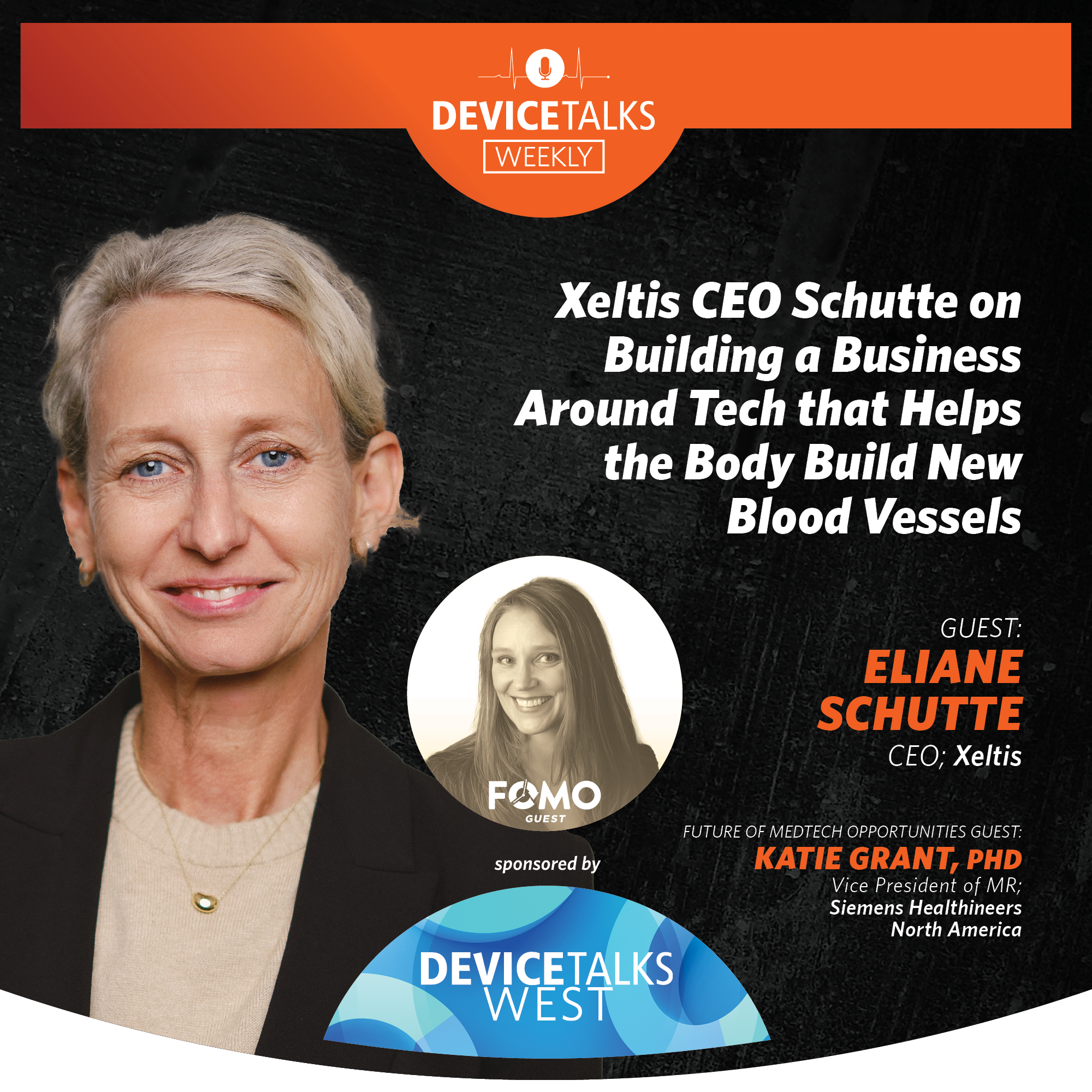
[00:00:00] Speaker A: Hey everyone, Tom Solomi here. Welcome back to the Device Talks weekly podcast. We've got a jam packed episode for you. We'll open up with Chris Newmarker in the Newmarker's newsmakers. The top news from Mass Device. Then we've got a great guest in the FOMO studio. We'll be talking about helium and how it fits into the future of MRIs. And then finally I have a keynote conversation with Eliana Schutte. She is the CEO of Zeltus, which is a very cool, cool company that's built an artificial sort of scaffold that will will help the body grow blood vessels. So they've got some early applications in commercial stage indications for dialysis for folks who are receiving dialysis, but some other bigger plans that you can certainly hear in the interview, which happens at the last third, the later third of the podcast. Before I let you go, I hope you'll join us on Tuesday, September 8th at noon Eastern. Not our normal 4pm start at noon Eastern time. It's a.
It's a Device Talks Tuesdays with our friends at Materialise. And the topic is how medical device companies are scaling personalized devices from innovation to commercial reality. So I hope you'll join us then. And we're starting to roll out. We've opened a registration for Device Talks West. We've moved it out of October. We've moved it out of the Santa Clara Convention Center. We'll be meeting in downtown San Jose at the Signia Hotel.
You can go to west.devicetalks.com to check out the agenda. The agenda is up with some of our speakers. Partial agenda. We've got more coming.
And you can join us on November 30th and December 1st for a great day and a half of medtech conversations. Once Again, go to west.devicetalks.com to register. All right, folks, let's get this podcast started.
All right, you ready for this?
[00:01:52] Speaker B: Ready.
[00:02:11] Speaker A: Chris Newmarker. How are you, sir?
[00:02:13] Speaker B: Doing well, Tom. Doing well.
[00:02:15] Speaker A: I have a seasonal bit of small talk, but I gotta ask, is it the fair this weekend? Do you need to promo the Minnesota State Fair?
[00:02:24] Speaker B: Oh, Minnesota, great. Minnesota get together. Yeah, we'll be.
Family's gonna be there this weekend. Absolutely. So it'll be getting the job.
[00:02:34] Speaker A: Cow shaped cookie. Or was it the glass of milk? What's the big. What's the big.
[00:02:39] Speaker B: Oh, we'll definitely be.
We'll be heading out of the fair with a bucket of warm sweet Martha's chocolate chip cookies.
It'll be good. Good Time.
[00:02:47] Speaker A: Yeah, I saw on LinkedIn a Martha Stewart ad for Starbucks. Pumpkin spice latte. Kristen Mar.
Time for some pumpkin, pumpkin flavor stuff. So folks, get ready.
[00:03:00] Speaker B: It's hot outside still. I haven't gone for the, I mean, I, I, I'll do the pumpkin drink soon. You know, that's, yeah, it's always she got hers hot.
[00:03:08] Speaker A: There was a young actor who, I don't know, Belmont something or other who, who got his iced. He was also in the ad. So you can go both ways, I guess you can get it iced.
[00:03:16] Speaker B: It's hot here in Minnesota. I'm still on a sweet corn kick. I mean you're, I mean you drive around, there's those like little farmer stands with like fresh sweet corn. It's like the, get that on the grill. It's the best thing.
[00:03:27] Speaker A: You just pulled over. Just nod on a cob of corn.
[00:03:30] Speaker B: Yeah, I do. Yeah.
[00:03:31] Speaker A: Pulls you right off.
[00:03:33] Speaker B: Just like, just like, just like, I mean it's good, man. Raw corn off, sweet corn out the cob.
I mean it's usually nice to cook it a bit.
[00:03:47] Speaker A: Well, you can play, you connected it with the heat. So I thought there was some sort of cooling mechanism that I had missed
[00:03:54] Speaker B: actually, you know, like if it was a coal. I mean, this is weird, but I mean, yeah, if it's like a cool, if it's cold, cold like cob of sweet corn, I mean that might be, have a bit of a cooling effect.
[00:04:06] Speaker A: It tastes very hard here at Device Talks Weekly.
[00:04:09] Speaker B: Sorry. People are just like, people are tuning out right now. We're like, why do people get off this call like within two minutes anyway?
[00:04:16] Speaker A: Well, we have lots of news and I know very little time.
[00:04:19] Speaker B: Yes, let's get the news to people, I guess.
[00:04:23] Speaker A: What's number five on the vaunted award winning New Markers Newsmakers?
[00:04:26] Speaker B: New Markers, Newmakers. That's right. All right, number five on the list.
Just doing our weekly checks on layoff notices around the country. I noticed that Zoll Medical is going to be shutting down a plant in Palm Springs, California that it acquired when it bought some ventilator business assets from Vier Medical a few years ago.
But 78 jobs affected. But you know, on the flip side though, I mean, you know, when I reached out to Zoll, you know, they were telling me like these, you know, these manufacturing lines are continuing. They're just going to be moving those to Massachusetts.
[00:05:09] Speaker A: That's right. Chelmsford, baby.
[00:05:10] Speaker B: That's right. So I mean, at least, you know, sometimes you hear news like this and you're like oh, gosh. It's, you know, more. More manufacturing jobs leaving the US but, you know, Zoll actually says, hey, you know, we're mostly in the US and our overall manufacturing jobs are growing. I mean, this is just, you know, more of a, you know, efficiency type thing that they're going to be. So, I mean, it's some tough news for those. Those workers in. In California. But, you know, it looks like, you know, more. More business. You know, it's a win for Massachusetts Medtech hub.
[00:05:40] Speaker A: So you're thinking that they're not going to want to move from Palm Springs, California to Chelmsford, Massachusetts? You'd think that's not likely.
[00:05:47] Speaker B: Hmm. I mean, nice. I think Massachusetts is awesome. So you're going to record that now?
[00:05:55] Speaker A: Oh, yeah. This is going on.
[00:05:58] Speaker B: I think Massachusetts is awesome.
[00:06:01] Speaker A: No, you're right. I don't mean to make light of folks losing their jobs there. Hopefully they'll find something. There's lots of med tech down there, so I'm sure there's opportunities. I'm happy to see Massachusetts get some manufacturing jobs.
We talked with Zol's former CEO, currently Executive Chairman John Rennert, at Device Talks Boston. He was in our Massachusetts panel. We talked about what it takes to bring manufacturing jobs to Boston. I mean, this obviously is. Is more of a re. Redistribution of jobs.
We've had ex off on the. On the podcast earlier. They're building manufacturing facilities. So more jobs is always better than fewer jobs.
But it's, you know, something, I guess Massachusetts will continue to focus on trying to get Medtech and other companies to manufacture here. So, yeah, absolutely, we'll take the win. What. What's number four? Christmas.
[00:06:52] Speaker B: Win. Win for Massachusetts, Win for the Bay State.
What's the state bird of Massachusetts, Tom?
[00:06:58] Speaker A: I believe it's the chickadee. I believe it's the chickadee.
[00:07:00] Speaker B: Chickadee, right.
[00:07:02] Speaker A: We have the loon in Minnesota while you're delivering number four. Really? The loon?
[00:07:06] Speaker B: The loon, yeah. Which. Have you ever heard of a loon? Like.
[00:07:09] Speaker A: Yes. No, we haven't. Here. We have them actually, in my town.
[00:07:13] Speaker B: Yeah, yeah, me too. Like, I sometimes hear, because I'm just a few blocks from a lake right outside the Twin Cities, I could hear their calls occasionally. It's very eerie.
[00:07:22] Speaker A: It is, it is. I think that's how they got the name.
[00:07:24] Speaker B: Like, what the heck is that? Anyway, all right, number four on the list we got. This is also from yours truly.
You know, caught the news that Striker is going to be acquiring Zur Ahmed to boost its Shoulder offerings. And Zuramed has this fiber locker system for rotator cuff cup augmentation. But it's, it's got like, the instrument has like reciprocating needle. It's going to push those implant fibers into the underlying soft tissue.
And you know, this is the whole idea here is it's you know, better, it's securing, you know, it's better securing of the patch across the entire like patch tendon interface, you know. And Andy Pierce, who, you know, Stryker's group president of Med surgery technology speaker at a previous device talks show as well. I mean he was you know, saying, you know, saying that this was like a, a differentiated technology that you know, addresses an important clinical need within, within shoulder care. So really good tucking acquisition over there.
[00:08:30] Speaker A: I don't know if you know, know people who have shoulder surgery or have had social surgery, but, but rotator cuff, that, that there's a long recovery to that. There's a lot of, there's a lot of room for improvement. And, and so I mean you're, you're laid up. My brother was laid up for like five weeks with his arm just kind of slung or, or, or, or held up so it could heal. So I think this is something that, I think Zurmed currently has clinical studies underway that are measuring kind of healing and function times to make the healing go faster. So I think there's a lot of room, a lot of upside in shoulder. So. Smart move by Stryker.
[00:09:05] Speaker B: Yeah, very much so.
[00:09:07] Speaker A: And the state bird is the black capped chickadee. Whoa.
[00:09:10] Speaker B: All right.
[00:09:11] Speaker A: I didn't realize it was only the black capped chickadee. I thought it was all chickadees, but apparently we're very particular. It's a black capped chickadee.
[00:09:17] Speaker B: Black. Don't say it's like another type of chickadee, you know, because like you're just totally out of it. About, about Massachusetts then. Black cap chickadee. I remember that.
So then number three. Number three on the list. I mean this is quite a chickadee. We got Innovis acquiring ecentennial Robotics for 155 million euros.
You had some really interesting thoughts about this on LinkedIn. In fact, you had so many thoughts about this you had to do like multiple posts.
[00:09:47] Speaker A: You had to do two posts.
[00:09:47] Speaker B: Yeah, yeah. You're like, I can't even get this all into one.
[00:09:51] Speaker A: Well, I've just been talking about the hard tissue surgical robotics space. There's been very little activity there. So this is nice that we saw some. The price seems pretty modest.
Unsure how much Equity it actually raised. It had raised $100 million financing essential did a couple of years ago, but a lot of that was debt. So the equity might have been very small and maybe the ROI and the multiples were very strong.
But it was 155 and I think it's going to be like 180 or so with possible earnouts. So not a huge acquisition.
But in my second post I did refer to a conversation I heard with Mark Mackey, who's the senior vice president and GM of Enabling technologies at Innovis. We talked last year for the Ortho Innovation Talks podcast and Surgical Robotics. Obviously Anovus didn't have a play there.
He had said that it gave them an opportunity to move into.
They don't have the obligation of supporting a legacy system so they could move into what they see as sort of the future of Surgical Robotics. I guess they're placing their bet on Essential. They also had their own Arvis augmented reality tech. And maybe there is, I suggest maybe there's going to be a way of combining the two.
I'm not sure I've got some LinkedIn message saying that, you know, perhaps if they're both first generation technologies and one one gen first generational technology plus a second first generational technology doesn't necessarily equal a second generation technology, if that makes any sense.
But clearly Innovis has a plan and they'll, and they'll be able to compete a bit more in the ortho space and they'll have a smaller system that maybe would be more appealing to ASCs. I mean we're seeing things.
Strikers got their handheld. Everyone's going smaller with Ortho Surgical Robotics. So maybe this will give Innovis the opportunity to compete there more effectively.
[00:11:36] Speaker B: Yeah, maybe they saw an opening and this is the point because yeah, of all those like largest orthopedic device companies, they were the one that did not have a robot for Orthopedic.
So yeah, this will be, this will be fun to watch, to see where they go with that now and then. Number two on the list. This was from Jim Hammerand our MDO managing editor. He caught on LinkedIn that JJ was announcing that they're going to be rebranding Shockwave Medical.
So it's going to be.
Yeah, so that name is going away. So I mean JJ's been doing a lot of different rebranding in recent years.
So it's like kind of just trying to keep it consistent with that JJ name.
[00:12:18] Speaker A: Yeah, you can see the wisdom in that. Although we did Have Tim Schmidt at Device Talks west last year and he said they've been very intent upon letting Shockwave be Shockwave and letting Abiomed be Abiomed. But they did rename Abiomed into J and J Med Tech Heart Recovery Shockwave.
Yeah, Again, I think it was a little confusing for me when they were gonna stop calling it Shockwave.
[00:12:38] Speaker B: It's now gonna be J and J Johnson and Johnson Medtech. Circularly it's gonna be the circulatory Restor Technologies and Johnson Johnson met.
[00:12:47] Speaker A: Yeah, I kind of wish they didn't put solutions in. Their solutions just seems like an extra.
[00:12:50] Speaker B: I never like that word solutions.
I mean, no, I mean I, I've been a stickler about that over the years. I mean, you know, like let me know if I actually let that get into a story because I mean companies sell products and services. It's up to the customer to decide whether something's a solution. I mean it's just, it's just a silly marketing term.
[00:13:08] Speaker A: I like heart recovery. I think it's kind of cool. I think circulatory restoration, I think that says it right there. You don't need the solution.
[00:13:14] Speaker B: Says it right there. Didn't need the solution.
[00:13:17] Speaker A: I was thinking about J and J Joe J and J. When we were talking about Innovis.
We haven't really heard anything about the Depew synthesis spin out, have we? Nothing new there yet.
[00:13:26] Speaker B: I mean they've been saying it's on track for mid-2027.
Nothing else new on that. And there were some just rumors that perhaps this was going to get sold to, you know, somebody else.
[00:13:38] Speaker A: Yeah, but, but they announced that last.
Well it was right before device talks west so last October. So it's been a year since they announced it. I didn't realize they had put the, the actual data out to 2027 so that we go.
[00:13:51] Speaker B: But yeah, we'll keep an eye out on it. You know, we're definitely keeping an eye on whether there's news on that. And then number one on the list, you know, you know Medtronic blew past Wall Street's high expectations. I mean a lot of, you know, more double digit re and in their second quarter and major surgical robotics investment. I mean $700 million in cornerstone robotics and it was fun to see surgical robotics expert Steve Ballo.
He was really pumped about this on LinkedIn.
[00:14:26] Speaker A: Yeah. Said $700 million is some serious wonga.
I love reading Steve's posts. They're very fun.
Yeah, no big good. Phil, congratulations. First of all to Medtronic. A lot of arrows flung their way when things weren't going well. So give them credit. Now they're. They're a growth machine. They've made a lot of investments in.
In renal innovation. Yeah, they made a lot of investments in renal innovation. They got the great Hugo news earlier this year, so they're really starting to hit their stride. And yeah, no Quarterstone. I mean, there's another post that I had just sort of basically saying that now JJ reps, they're not only invested in Cornerstone, I think they're going to be distributing Cornerstones Centaur Surgical system, which is more of an armed kind of system like DaVinci, as opposed to the modular system like Hugo.
So now they have a couple of different options that they can offer customers instead of just one. So that makes sense. I mean, JJ has invested in Renovo and Distill Motion, now Hugo, now Metroticus, Hugo and Centaur.
It's going to be interesting to see what Intuitive does if they feel like they need to have a smaller, more modular system. Maybe. I mean, they've got such a strong position. I don't know if they do, but like I said in the post, no one really saw DB5 coming and it kind of just fell on top. Everybody within a couple of months, period between rumors and FDA approval. So maybe you got something cooking over there.
[00:15:59] Speaker B: Kind of feels like Medtronic throwing the gauntlet down and, you know. Yeah, maybe Intuitive is just such a big bad warrior or something like. Yeah, you know, but maybe, you know, they'll. Yeah, they'll be like, yeah, I gotta answer this one. So.
[00:16:11] Speaker A: Yeah, yeah, so. But it's fun to have all three with commercial products now. We don't have to talk about the well someday anymore.
It's a true medtech market, which is. Which is a lot of fun.
[00:16:23] Speaker B: Yeah, very much fun. And it's just great to see all this competition.
I just can't help but think that it's just going to push even more innovation, even something like this. As you were saying, maybe we'll see something from Intuitive sooner, some new offerings, something maybe a little more smaller than getting ASCs as well.
So, yeah, it'll be exciting to continue to cover this.
[00:16:46] Speaker A: Absolutely. All right, Chris Newmecher, great newsmakers as always.
Thanks for bringing the news to the podcast.
[00:16:53] Speaker B: Yep. Fantastic, Tom. Catch you again soon.
[00:16:57] Speaker A: All right, thanks again, Chris Newmarker. Now it's time for our fomo. I've got a great guest from Seaman Health and Ears coming up. We talked about helium and sort of how it factors into MRI scanners and Mr. Technologies.
The helium supply, of course, has come into question with a lot of geopolitical issues and conflicts, which we'll talk about in the interview. Siemens healthineers introduced its helium independent technology for magnetic resonance imaging scanners, known as DryCool technology. In 2021, it got FDA clearance of its magnetome free Max. That's an MRI scanner with a 0.55 Tesla field strength.
This is something that Siemens has been focused on. The company now offers a total of five helium independent MRI scanners. And we'll talk about why that, what that means, how that's done, and what is the future of Mr. Technology. Let's listen.
Hey everyone. This is Tom Salemi. I am joined for this week's FOMO by Katie Grant. She's a biomedical Engineer and she's VP of Mr. Siemens Health and Ayers North America. Katie, thanks for joining us.
[00:18:11] Speaker C: Thanks for having me, Tom. Looking forward to it.
[00:18:13] Speaker A: Yeah, me too. This is an area where, this is kind of one of the few. Well, there's a lot of areas, I think, where geopolitical issues might stray over into medtech, but certainly the supply of helium is one that we've heard this and that about. With all the conflicts with conflict, the war with Iran, the difficulties with getting supplies out of the Strait of Hormuz.
I'd love to understand just what has changed in the global helium supply and has it sort of exposed a vulnerability in the medtech industry and imaging area, imaging industry that perhaps had been unforeseen previously.
[00:18:54] Speaker C: So I'm trying to figure out where to start. So maybe I'll go backwards from your questions. So I don't think it's unseen. I think this is something in, in the med tech space, we always knew helium was a limited quantity. And you know, for decades it's not just Siemens, but I think all the manufacturers have looked for ways to reduce their reliance on helium, knowing that, that it's limited and it's some at some point could come to an end.
But as far as what's changed, I think the conflict as you mentioned in Iran and the inability to get as much helium out of that area has really stressed the global supply of helium. So we in the United States are quite lucky. We are actually the biggest. United States and Canada are the biggest producers of helium globally, followed by Qatar and Russia.
And so we fortunately haven't had too much of an impact here within the United States because we get the majority of our helium supplies from North America.
China is not, not so Fortunate, they can only produce about, I think about 15% of the helium that they need.
So they really rely on those other helium stores and they need to import it.
The Qatar fields, when they were attacked, the, what is it called, the natural gas fields, helium is very often, if not always found within those natural gas supplies as well. So when those natural gas fields in Qatar were attacked, it also really interrupted the supply coming out of Qatar even more than what was already being impacted by the conflict in Iran. Interesting. And then Russia being the other one, there's already plenty going on globally with Russia.
[00:20:55] Speaker A: So the problem has, the problem's been foreseen. Obviously when you're working with something that is ultimately going to run out, you always, well, not always in an ideal situation, you planned for that material to stop being available.
What engineering advances have happened to reduce future demand and necessity or present day demand and necessity for helium.
[00:21:18] Speaker C: So we, I can speak of at Siemens Health in years some of the efforts that we've had ongoing. So I think for almost two decades we have been working on re engineering our magnet designs at our factories to come up with different ways to reduce the overall necessity for helium. So different ways of cooling magnets. So when magnets, when you have MRIs, you have your magnet and then you also have all the gradient coils that create that magnetic field and those gradient coils have to be cooled. So the higher the Tesla strength, so it goes from sub 1 Tesla all the way up to 10 and a half 14 Tesla. But the majority of Tesla strength used in medical imaging is 1.5 and 3 Tesla.
And the higher the Tesla strength, the more heating that you're going to get in those coils and the more cooling that you're going to need. So at Siemens, you'll see we started at 0.55 Tesla because it was a little bit of an easier physics problem to solve. They're at 0.55 Tesla, there's less heat to try to remove from the coils around the magnet, which already reduces your helium consumption.
But as you start going up to 1.5 Tesla, where we now have our flow mag it, that's where, you know, it took a little bit longer to get it right to use the least amount of helium possible.
So in our magnets, we've designed a fully new magnet form that only requires 0.7 liters of helium.
So most modern magnets need about, I don't know, between 1500 and 2000 liters of helium. Wow.
Much, much more. And even older magnets and most of the modern Magnets are sealed for life, meaning they won't need to be refilled as a magnet unless they quench.
So a quench happens if the magnet starts warming up, and then it releases helium gas into the air, which can be kind of dangerous. So in this case, you'd have to refill that magnet, reseal it again.
But some of the older magnets are continuously burning off helium, and so that can get expensive if you think about it. So if you have to constantly refill your magnet versus the new ones, where you only have to refill them if there's a quench versus now, the magnets that we're looking at that require less than a liter of helium, those will never need to refill helium. So the way that these new magnets work, that 0.7 liters of helium is contained within a vessel, and it's constantly brought up to the top of the magnet, and it uses gravity in order to pull that helium back down. As it warms up, it's recaptured in its gas form, and then it's reliqued, and it just continues to be used over and over again.
So it's, it's never released from the magnet.
[00:24:37] Speaker D: So that's.
[00:24:38] Speaker C: Yeah.
[00:24:39] Speaker A: Is the helium used? I obviously thought it was used in the manufacturing of the magnet, but is it used in the operation of the magnet in. Mr. Is that what it's really.
[00:24:47] Speaker C: It is used in the magnet throughout its mag or throughout its medical lifetime as well. So it's hospitals. Like, once you install these in a hospital or an imaging center, they might consistently need access to helium.
[00:25:04] Speaker D: Okay, I'll give an example.
[00:25:05] Speaker C: This was actually really interesting. I, I had the, the opportunity to go up to Alaska to visit a few of our customers, and a few of them have our Freemax, which is our 0.55 Tesla magnet that only has, you know, this wine bottle worth of helium inside of it. And I was really interested to hear why this makes such a big deal to them. Because with, with, with Alaska, they're so far away from, you know, a lot of the, the shipment or the stores of helium that if one of their magnets quenches, it takes at least two weeks to get enough liquid helium back to restore their magnet and get it to functioning. That means that that's two weeks that their patients can't get MRI scans. And so the ability to have it contained all within one unit means they can now have a lot more consistent access to MRI in their communities.
So that's, that's where everybody is going, right? Not just Siemens. So, you know, Phillips ge, Every, everyone is coming up with different types of helium free or less helium needed magnet forms.
[00:26:20] Speaker A: Is there going to be a time when helium can be eliminated altogether?
[00:26:27] Speaker C: That would be a great goal, but
[00:26:28] Speaker A: I
[00:26:30] Speaker C: can't tell you if that's possible or not.
I mean, there are magnets out there now that don't need helium. You know, the pure fixed solid state magnets, but those are usually very heavy as well. Interesting. So we'll see. We'll see where it goes.
I have a gut feeling we'll always need a very minimum amount of helium.
[00:26:53] Speaker A: But always striving for less, though.
[00:26:55] Speaker C: Exactly.
[00:26:56] Speaker A: Just finally, I mean, what are the, what are the benefits? Let's talk a bit about the Mr. Systems. How are they being used? I think they're being used more often than they were.
What is the future? How are they being used today? And maybe we can give a glimpse on what the future of MRI is.
[00:27:14] Speaker C: So the demand for MRI is growing and it's growing globally. Within the United States, it is also growing in a big part due to our aging population, but also because of the different clinical needs for MRI and the uses for mri. One of the cool things about MRI is that it's constantly evolving and there's always new ways to use it or new clinical indications that can be seen or found that we weren't able to see previously.
So one of the benefits of having less helium in the magnet is you can now put the magnet in different places that you weren't able to put it before.
So, for example, our freemax and our flow magnets are a lot lighter than their predecessors, so they weigh a lot less. A big part of that is because you don't have all that liquid helium in it, but that means that you can maybe put it on higher floors than you could have previously instead of having it in the basement. If you notice when you go to, if you ever get a radiology study, radiology is often in the basement of the hospital or it's on ground floor.
[00:28:24] Speaker A: Yeah, that's right.
[00:28:25] Speaker C: The lighter weight allows you to place these magnets or sight them in different areas.
They're also smaller footprints. So you can now perhaps roll them down a hallway or crane them in through a window rather than having to take apart entire departments to put an MRI inside.
Our magnet also does not need a quench pipe. So a quench pipe is what's needed in order to capture that helium gas if there is a quench and remove it from the hospital or away from the room.
Because the helium Gas can be very dangerous if people are exposed to it. So without, since we are not quenching, you don't need that quench pipe anymore. Which means you could also put this not only on higher floors and in smaller areas, but inside of the hospital, maybe in surgical spaces or interventional rooms.
You could use these magnets in a lot of different places where you've never had access to MRI before.
You could also look at places similar to Alaska in rural spaces.
If you look at rural United States, it's not that easy to get helium to those places on short notice, as well as energy consumption. So these systems also consume about 30 to 50% less energy or power than their predecessors.
[00:29:51] Speaker A: Wow.
[00:29:52] Speaker C: So all of those advantages are allowing MRI to be more accessible than it ever was before when it's even higher in demand than it ever was before.
[00:30:04] Speaker A: I think we always look at MRI and MRI as sort of a, a tested and tried and true technology that isn't, maybe doesn't need the R and D and the advance and the technical technological advancement that other areas might need. But that's not how you look at things at all. You're keeping a push, you're pushing the envelope.
[00:30:23] Speaker C: We are, and for good reason.
It is a very, it can be a very complex imaging modality.
But along with the advancements in the, the helium and the technical side, we're also looking at advancements and how do we automate it as much as possible to make it as easy, as easy to use as we can? Because the number of technologists, the number of radiologists are also decreasing while the demand is increasing.
So if we can make push button exams that someone who maybe has an X ray technology background can use, instead of having someone go all the way through Mr. Training, that will only help increase the access to it in the future.
[00:31:07] Speaker A: Fantastic. Well, I've learned a lot about something I didn't think I had a lot to learn about. So I appreciate that. There's always more questions that can be asked. Katie Grant, thank you for joining us on fomo.
[00:31:18] Speaker C: Of course. Thank you so much for having me, Tom. It was my pleasure.
[00:31:21] Speaker A: All right, thanks so much, Katie Grant, for joining us in the FOMO studio. Now it's time for our keynote conversation.
This company, Zeltos, is really very cool. You should check out its website, xeltis.com that's x E-L-T-I s.com they've got, as I mentioned in the interview, they've got a lot of great videos and explainers as to what they're doing. But this is an area that the ability to grow new vessels, basically, or give the body the scaffolding it needs to grow new vessels, I think is just absolutely amazing. And I talked about it in depth with Zeltus CEO Elian Schutte. So let's listen.
Well, Eliana Schutte, welcome to the podcast.
[00:32:07] Speaker D: Thank you. Nice to meet you. Tom, Pleasure to be here.
[00:32:09] Speaker A: Pleasure to have you. Xeltus has a really fascinating technology platform that I think could do a lot of good in the future, and I'm excited to sort of see where that's headed, see where you are in clinical studies, and see what future applications may be.
But with every conversation, we'd like to understand and learn about our guests a little more and find out how they found their way to where they are.
Eliana, how'd you find your way into the medical device industry?
[00:32:35] Speaker D: Well, honestly, I was already in the medical device industry 30 years ago, and this was not that when I did my academic degree, which is medical biology, that I was immediately intrigued by medical devices. But I knew that I wanted to be part of an industry developed, developing something positive for patients and really making an impact. So not something that has been done before, but try to work on something that is revolutionary, something that has not been done before, and making big leaps in progress and benefits to patients.
So that has been my big drive as I started to enter this industry. I started to learn how complex this is, but also super interesting and exciting because there's a lot of good developments that help patients. And just imagine what has happened in 30 years that we've now been able to make cancer chronic in many cases, but also in a medical device space, we've been implanting many more devices into patients that were bringing better lives in hip implants and neuro implants. And now in the situation for Zeltas, we're bringing real living blood vessels to patients that are in desperate need for something that is better than what's out there today.
[00:34:00] Speaker A: Amazing. No, it's looking at your website and you've got a lot of great content on there. Folks want to check out your website. A lot of videos and great explainers of what you do, though, going back into your career. Just a moment. What was that first step into medtech? What was the first job? How did it happen? Did you make it happen? Did someone make it happen for you?
What opened that door?
[00:34:21] Speaker D: Yes. So I happened to know Klaas de Groot, who was one of the best friends of my past, to be frank. He's a very Big name. Unfortunately he passed away last year, but he was working with biomaterials and had, well, had an inspiring talk to me where he said all these materials in the body are stiff or not doing anything. But there's so many biomaterials that have much more to do and are far more body friendly and can actually transition in something more natural. So I got intrigued that he was at that point in time working in a laboratory, test, testing all these medical, new medical devices. And I started to join him to work on testing these devices to be able to implant them into human beings. So from that laboratory environment and testing environment, I was also involved in many animal studies.
And with that I made the jump to the large industry Medtronic. And Medtronic, as you're probably aware that this is one of the larger corporate cardiovascular players in the world that's, you know, developing pacemakers and heart valves. And I joined the research center in the Netherlands where I was working with very early stage innovative technology like deep brain stimulators for patients that were on Parkinson, the latest pacemakers that last much longer, but also new heart valves. So I was very early stage working in research, but also clinical development.
And then what happened? One of the founders of that laboratory started establishing a tissue engineering company. A tissue engineering company, meaning implants that you can actually grow cells on patient's own cells to start mimicking a body part outside of the body. So it's. That sounds really like spooky, right? And how can you generate living body parts with only material, biomaterial and culturing cell it? So that's when I learned how to, you know, how you can actually mimic a lot of the body parts. And I was then developing in, you know, bone, real bone parts that were living bone pieces, cartilage, but also skin for patients that had burn wounds.
And that company was an R and D company developing products that on the back of venture capital. So that's when I first started to learn the business side of it.
I was still very young. I was only 29. I had, you know, my first child was coming and I was, you know, we were raising 100 million. So I was there, you know, the IPO was happening and my son was born two weeks later.
That was sort of an interesting moment that you never forget in your, in your life. So that was a turning point, but that's very exciting. So I like the high pace, a lot of developments.
So that was when I really started developing products that made it to the market.
But also the business side, when venture capital Starts investing money. They also want to return and want to see something that lands with a strategic company to, well, that acquire. And they make profit out of that. Right. So there's a business side to it.
[00:37:46] Speaker A: I was wondering with the timing, looking at your product line, in my mind, for some reason I was taken Back to the 90s, the drug eluting stents, the stent period where we were inserting things in the body that we're having all these reactions that weren't anticipating.
Did the advice you get come from that experience like look, this ain't doing it. These metal stents are not doing the job. We need something better. Was there a direct connection to that or am I making a connection that doesn't necessarily exist?
[00:38:21] Speaker D: You're spot on. I think in that time window there were a lot of companies developing novel innovations. Minimal invasively, but at a certain moment you always reach a plateau of what these foreign materials could do because eventually they stay plastic tubes or they stay metal implants. And your body is much more alive and constantly changing. Whether you're in the bone or whether you're in the heart valve space your body needs, you know, a lot of will have a lot of reaction to those foreign materials. And indeed those drug coated balloons and stents also, you know, initially were giving great results, but also longer term, you've seen that some of these materials give, you know, more reaction in the body than that was anticipated. So this indeed came to the realization we need to do something, you know, better and neck sleep, bring materials that are really body friendly, that the body loves. Right. And really recognize so much.
And it's, it's very much like nature. Right. It changes all the time. And it's not stiff and rigid like a, a plastic tube. Right.
I always say when you put a Teflon tube in a bike, you know, when you have a flat tire and you put a plastic Teflon tube in it, nobody would believe that that would imagine a sense what's initially working like that. It was like almost like a Teflon rigid tube in the vascular structure. So materials were improved and this is, you know, definitely a learning that I had in my career during that time frame.
[00:40:02] Speaker A: Yes, it is amazing how far we've come and where we're going. So I think now would be a great time to share how you came to know about Zeltis. And then maybe within the telling of that story, tell us about what caught your eye about Zeltus and about its platform and its technology.
[00:40:21] Speaker D: And that has a bit of a dual story to it it's a very good question because you also come to realize how much passionate you are improving lives and bringing better solutions to patients. When you enter the business side of it, which I did when I started developing those tissue engineered bone and cartilage.
I also realized that anything that you do that is complex that you do outside of the body, even though it's very noble, it has to make economic sense. And if you make something really expensive because when anything that you do outside of the body, the FDA is heavy regulating that every patient is potentially different. If you're culturing cells outside of the body, it might seem beautiful that you make something outside of the body mimicking patient cells. But heavily regulated cost of goods were tremendous reimbursement non existing.
So the business case for all these complex type of IDs were easily no longer viable from a business end. And I learned that in my career in the tissue engineering and one of the members that was participating there. And I had one sidestep that I joined another company developing a hemostasis product that was a perfect ex that to the venture capitalist. But one of the earlier founders from that company on the tissue engineering started in an investment firm, one of the larger investment firms, EQT that was then at that point in time ls, LSP and EQT is one of the largest life sciences venture capitalists. And he said, Eliana, we invested in this company Zeltas.
They're making heart valves and they're making, you know, a fantastic biomaterial. You know all about biomaterials and they need your help because regulatory wise is is going south, it's not going well. They need you. And the first thing I said to him, we're culturing cells outside of the body. You know, I think this business proposition is, is not going to be viable. I'm not sure I'm interested. But he said, you're going to like this because this is a simple biomaterial where they utilizing the body's own bioreactor. We're not doing anything fancy and spooky outside of the body. We're using the body's own bioreactor to regenerate tissue and to degrade the material. And that intrigued me. I said this could be it, right? There was a Nobel Prize behind it. And this is completely novel material.
So not the Teflon and all the old plastics that we have in our body. Unfortunately for implants, a completely new category of plastics that are much more mimicking nature like a glue. It can be very stiff, but you can Also be very, you know, pliable, and it really mimics much more what the body intends to do.
So that's. That was my story. Right. I was intrigued. I joined, I did a bit, what I've done in my past life, developing the product.
And then the CEO left the company and investors asked me to step up as the CEO of the company.
[00:43:31] Speaker A: So that's amazing.
Had you had designs or plans or thoughts or desires to be a CEO at some time? Was it. Was it on one of a box that you wanted to check or.
[00:43:40] Speaker D: To be frank, no, I am frank. I saw a lot of CEOs that I thought, oh my God, now how can they run a company?
But at a certain moment when you've done the. And I was pretty good in doing development work and creating a company from when there was an idea to FDA approvals and getting that manufactured. Right. I had all of that knowledge done already three times.
So when I was asked to be in this position and I was thinking, well, you know, I think I can do this and why not? And I said, I'm gonna try it for a year, so let's see. So I didn't go in there and must have need to be CEO.
So it was a new, new journey for me and I. You also need to be open if you want to make impact, to grow yourself. And this was an excellent growth opportunity for me.
[00:44:33] Speaker A: Absolutely.
So help us understand the process that you explained a little bit earlier as to how the tissue is grown.
What is the starting point? Are you taking a patient's own tissue and growing something from that? Or do you have a neutral sort of material that then is. Is implanted in the patient? What's the process like?
[00:44:55] Speaker D: Not at all. Not at all. So, you know, I just brought a sample with me.
[00:44:59] Speaker A: There we go.
[00:45:00] Speaker D: This is, you know, it looks like a straw, it looks like a wide plastic tube. But if you would go and look at this. It is a polymer only, but it is made of one single fiber that is, you know, extremely long, but creates a mesh, it creates a scaffold.
So it's completely porous. It has to be porous because what we want to do, we want to bring this as an implant into the human body.
But the body recognizes that and starts and the cells that are in your body. So the blood that goes through this will home, will nest, will populate, will first stop the bleeding and then create fibrin, create micro vessels, create collagen, create eventually a layer inside of this tube that is so called endothelialized, which means the cells are there, the protective cells to avoid all the negative effects that a normal plastic would have. Like, it would thrombose, it would occlude, it would stenose. And all of that should not happen because while the cells are infiltrated, ET is already implanted. Right. So the surgeon implants this stuff, nothing more. But this is what your body does. And if you give it the right infrastructure and eventually after, you know, the first couple of weeks, the material will break down. Already your body is taking over the infrastructure of the wall. But over time, it really becomes a full blood vessel.
[00:46:33] Speaker A: Wow.
[00:46:33] Speaker D: And the material is absorbed. So that's the, the, the patents and the Nobel Prize behind it.
[00:46:41] Speaker A: That's remarkable.
[00:46:42] Speaker B: So
[00:46:45] Speaker A: again, I was taken back to sort of the drug eluting state, period, where you would put drugs on it to prevent growth. Over this den here, you're actually building something that encourages that. Not a plaque, but the vessel itself.
There's a lot of great applications for this. Where have you started focusing? First, you mentioned you've got your business acumen. You know that this idea needs to make money and probably find a way to market sooner rather than later so it can fund future development.
What's your first application of this technology?
[00:47:20] Speaker D: So the application is really in the blood vessels, but you need to have blood vessels all over your body. Right. So the first indication where there's really a need for an additional blood vessel is for patients that are end stage kidney disease. So when you're on kidney disease and you're in the end stage, it means that the dialysis machine will take over the kidney function, Right. It will take the toxins and the fluids out. But these patients need to be connected two, three times to that, you know, artificial kidney that is the dialysis machine.
But you can't just poke the needles directly in a bloodstream, right. I mean, two, three times a week. That, that won't work.
So they an additional shunt, an additional loop from the artery to the vein, which allow the needles to go in, in their blood circulation and be connected to the dialysis machine. So this whole piece goes into a dialysis forearm or an upper arm, depending on where the surgeon believe is the best position.
And what happens then when there is, you know, material in there? After two weeks already or less, the needles can be in there and, you know, can be used for dialysis. So this is an. Already an, an indication that is bringing tremendous benefits for these patients because imagine what they had to go through in the, today's, today's situation.
They have a Plastic tube, a rigid tube, where every time you poke a hole in, the hole will stay, and eventually you'll end up with. With what we call Swiss cheese, right? There will be all types of holes, and the plastic will end up anywhere in your body. And all of it is also pfas, material that is forever in your body circulating, but also that material occludes. It's not nice for the body. So patients are going back to the hospital not for needling and cannulation for the dialysis, but for interventions.
They need to be getting a stent or a balloon to keep all this thing open.
So that's what the patients are facing. And what we have demonstrating with our living blood vessel is that we have far less interventions, three times less already the first year. So patients just have less suffering.
And at the same time, the infection with all the needles that go in for these, you know, other solutions. And imagine if a bacteria would sit on a foreign material, it would stick and it would not let go. It would then basically grow. And then the surgeon has no other option than take the whole piece out now with something living that becomes your own. Your own immune system fights against those bacteria. So in case there is a, you know, an polluted type of needle going in, the. Your own body fights against it. And even if there will be a little bit infection, antibiotics will help to cure.
So this is fantastic, right? It just solves a lot of these problems and patients are very happy. So that's the first application that we have now commercial. This is commercial now in Europe.
[00:50:42] Speaker A: Okay.
[00:50:42] Speaker D: And very close. Hopefully in two years, we'll hit the US Market.
[00:50:47] Speaker A: So I was looking at your website, at your dialysis product, and I guess I didn't realize, I guess completely what goes into dialysis treatment. I thought you were replacing native vessels that had been damaged enough by dialysis by the needles that you were then replacing. But this. Current dialysis procedures actually require the implantation of a, A, Of a plastic tube.
[00:51:14] Speaker D: Yes. A vascular axis.
No, that is a tube. The alternative is there's two other alternatives. There's another alternative is a catheter directly, that is, you know, in your heart. So that means that you need to go and have a catheter in your. On your body every day, I mean, all the time.
So highly prone to infection. Because imagine if you're just changing the catheter, it directly goes in the heart.
You might be dying, right? High chance of mortality and high risk of infection. And the other alternative is that the surgeon creates almost like an additional blood loop by connecting a vein and an artery and letting it grow. So then the vein becomes arterialized, let's say like that, and it becomes strong enough to have an additional loop to start poking the needles in.
[00:52:06] Speaker A: Wow.
[00:52:07] Speaker D: But the problem with that surgical technique is that it needs a couple of months to be strong enough.
But also, you know, in 50% of these cases, it fails because the vein is simply not matured enough to become an artery.
And that means, you know, these patients need desperate help from dialysis. They constantly are on the catheter, so they're almost on double treatments, which is, you know, mentally also very difficult.
So imagine if you have something that is always a success, you implant it and it works. Right. That's what we're after.
[00:52:44] Speaker A: Interesting.
Okay, well, that's an enormous market. What sort of reception are you seeing in Europe since you're commercially available?
[00:52:52] Speaker D: Well, I mean, to be frank, we're ahead of schedule because our CE marking was extremely fast. We had it in four months only, and we were not anticipating to be that fast. So we had to accelerate our commercial activities.
We hired a fantastic team, and we're now launching. We've now launched in Germany, and we are about to launch in Spain and in Germany.
We've had excellent reactions. Right. Our surgeons really want this desperately.
The ones that we already sold and implanted. They're very excited about this.
And the reason why there's not been a lot of innovations in the vascular surgical space, as you know.
You know about this space, right? You know that there's a lot of developments on stands, on interventional devices to. To help curing problems that existed, but something to create.
There's no intervention or no innovations.
So, I mean, they're so happy that finally there is something that is innovative that they can use, that is fitting in their workflow. They don't have to change anything. They're already doing surgeries on grafts. This is exactly the same, a bit more simple.
So they love it.
So, yeah, we have to see. I mean, we have to be as a company that is not a corporate. A big corporate. We have to be very disciplined in how we spend money in commercial.
And our thinking is really to do this, you know, very staged, so focus first. So we have a true. You know, we see the product fit and we're learning, and then we go after the next market. Right. So that. That's what we doing at the moment. Yeah.
[00:54:34] Speaker A: So looking at your future applications. So I'm looking at your site now.
You talk about coronary arterial bypass surgery, peripheral arterial bypass surgery. And pulmonary heart valves, three enormous spaces as well.
Talk a bit about how this would be applied in those spaces. You can take them one at a time or just speak generally about all three. And I'd love to understand how you're balancing.
You've got a great problem, you got regulatory approval very quickly, so you're shifting sort of into a commercial stage company. I think your greater opportunity may be when what you've got down, further down in the pipeline. How are you balancing being commercial and remaining R and D?
[00:55:17] Speaker D: Yeah, and that is a very interesting question and also very difficult because you have to also convert the company and transform the company in a conversation, customer mindset. So we're doing that right now. We're hiring commercial people. It's a different beast. Right. The whole commercial infrastructure, you need to build up. At the same time, we want to continue developing extremely exciting portfolio products as well.
So I think the beauty of it that this is quite scalable. Right. I mean we make the tubes. We already know how to make the tubes. Yes, we make smaller tubes for around the heart, but we actually make the exact same tubes tube only a little bit longer for in the peripheral, for in the leg. So once you know the trick on how to make this. And there are some slight subtle differences for each application obviously, but the majority of the science work is already done because we know when it works here in the arm, it's most likely going to work in the leg because it's a little bit higher flow, but you even don't put needles in.
So it's a less riskful, you know, application and 4 times larger market.
However. Right. The bar is also slightly higher because although the, the plastic tubes that are out there do work, we work better. But to demonstrate that will take a lot of money. So this is going to be for us the next step as well.
[00:56:42] Speaker C: But.
[00:56:42] Speaker D: And then the coronary. So around the heart is what I call, what I say, the extremely exciting program.
And we're now in the world's most advanced.
A lot of companies have tried to nail this. Why would we always unfortunately have to harvest veins from the leg? If you have multi vessel occlusions around the heart, I mean if you have one or two, they put stents in, but with three, four or more.
And these people usually are very sick, have poor veins, they put in poor veins around the heart because there's simply nothing.
So imagine you can put something around the heart that will be as good as veins. That's the holy grail. So, and this will work, but this is More than just simply putting a tube in the. In the body, it's also about exactly knowing the location around the heart. You have. With every heartbeat, there's torque. So there's a lot of challenges around the heart. But this is definitely something that we want to pursue because we are after something that nobody else can do, right.
And really solving big problems. And then I would say this is only the beginning. If we can, if we can fix this around the heart and we can fix it here in the arm, then any blood vessel can. Can be replaced with our material.
And then we can go to more complex body parts like the heart valves. And this is even more complex because of the moving parts.
But there's no reason why this cannot work, because we've already demonstrated in little kids with the pulmonary valve that this can work.
Unfortunately, you know, with me running a company, I need to also focus on those indications that bring most money and have the most volume.
[00:58:30] Speaker C: So.
[00:58:30] Speaker D: And that's unfortunately for the heart valve for kids not being immediately economically viable. So. But if we keep that on the radar are.
[00:58:40] Speaker A: So the heart is a lot going on.
So let me just address the challenge first. So you've held up your material a few times and since this is an audio podcast, I'll tell. It looks very much like you're holding up a straw. It's just a white tube.
So is sort of the R and D, if not completely done, mostly done. Like you have this framework, you have this material, it works. The next challenge is for you to move into these different areas is all going to be the clinical testing and the proving that they work. Is that sort of what your next challenges are? For this, the technology is. You've got that, it works.
[00:59:21] Speaker D: We've got it. We've got the animals. With hundreds of animals. We tested out all configurations. We know this, we got it.
I think now the challenge is getting it to also work in the real world in all the clinicians hands and the CABG will be most interesting to see for every patient, lots of comorbidities. Every patient is different. You know, where is for us the one to focus on? Where is the, you know, the patients that are the best responders to this that we potentially are going to, you know, enter with, especially with difficult indications like around the heart.
So that will be indeed our challenge and the focus to find that and continue to learn?
[01:00:03] Speaker A: I would think peripheral would be the lower hanging fruit. Is it. Is it easier? Is that.
[01:00:07] Speaker D: Yeah, it's easy.
[01:00:08] Speaker A: So is that where you go or is it better to go the Hard kind of get the most difficult challenge out of the way and then the rest will come more quickly. What's the right approach?
[01:00:17] Speaker D: So for us it's almost the book ends, right? We take one which is relatively
[01:00:23] Speaker C: easy,
[01:00:24] Speaker D: which is the vascular axis for dialysis, even though the challenge is the needles. So we feel the value proposition of our material is really there versus where the competition is.
So that's. But you know, we know that this will work. And then the other extreme, super difficult will be around the heart. Anything in between will work.
Yes, you have below the knee, you know, very difficult CLI patients. Right, where they have below the knee difficult veins. That's, that's also a very difficult indication.
But that should also work. Right.
But you can, can't, can't focus on everything. So we focus on the three indications first.
[01:01:05] Speaker A: And you talked about the hard valves, you talked about children as well, and I'll get into that in a moment. But with the hard valves, obviously that's not a tube. That's a different use of the material, different architecture, different framework. No reason to think that this material won't work in sort of a different form than the tube you've shown me.
[01:01:27] Speaker D: Well, no, actually the company started to develop heart valves. This is.
Oh well, when I, at that point in time, I was joining slightly later, but they already had developed a heart valve because they wanted to do something for growing kids that are facing heart valves that are not growing with them and are all vine material that have their problems. And this was beautifully working.
The difficult part was what we saw in the clinical trials is that you have an heart valve comprises in the pulmonary space a tube slightly wider in its thickness than or in its diameter. It's like, you know, a couple of centimeters. Right. And then there's leaflets. So the leaflet, three leaflets have to open and close million times. And also co opt.
And what we did see over time that some of the coaptation was missing. And so the leaflets are more difficult, are more difficult.
And that's what we learned. But we also learned that the tube was so well remodeled into patient's own tissue, that gave me the comfort to move into that blood vessel indication because, you know, the tubes work. Well, now the leaflets will work. It's just the beauty of our polymer technology is to find the right strength of the leaflets and the degradation profile.
And that's what we're currently investigating.
[01:02:53] Speaker A: And final question, is there, what's the largest diameter you can go with this space? I'm wondering, are you looking, is this, can you can you create vessels that are large, large enough for cardiac bypass grafts, sort of the bigger vessels? Can you, can you get that large and, and, and, and attack that market as well?
[01:03:16] Speaker C: We could.
[01:03:16] Speaker D: It depends a bit, you know, the pressures that are necessary because obviously this, this is a porous material. So you need to keep that in mind. Anything, it will stop leaking, but at a certain, you know, pressure and flow, it might leak too much. So we need to find those, those, those barriers because it has, you know, it will stop bleeding because it is intrinsic hemostatic. So it will stop the bleeding, but with a too high pressure and too much flow, it might not. So that's a bit the boundary.
[01:03:48] Speaker A: Yeah, no, that's a great point. And thank you for bringing up the pores. So when you say it's porous, it's first porous. When does it become non porous? When is it able to hold the
[01:03:58] Speaker D: blood immediately in your eyes in surgery? Because what happens, the whole thing starts to ooze.
And we explain to surgeon, don't be afraid, that has to happen. You know, when blood, blood flow through, you've implanted this white polymer implant, then it should ooze, but it will stop. It will stop immediately because that's the first healing step. When you cut yourself, your body is capable of stopping the bleeding. Your correlation system will do. So this is exactly what will happen inside of those pores.
The blood cells will go in. Fibrin is being formed and already with the fiber, fibrin, it stops the bleeding. And then that's when, you know, you can just close up the patient and the surgeon can go, go home.
[01:04:45] Speaker A: Amazing, amazing, great stuff.
Well, Elian, I really, I'm grateful for the time. It's a great story. These are the sort of materials that you. Miraculous materials that get you excited and then you hear about the folks you're able to help with dialysis and what they currently have to go through.
It's is, it's great to think that they'll have an option sometime soon. So thank you for joining us on the podcast.
[01:05:09] Speaker D: Thank you very much, Tom, and thank you for the great question and your interest. So appreciate it.
[01:05:16] Speaker A: All right, well, that is a wrap. Thanks again for joining us on this episode of the Device Talks weekly podcast. Once again, I hope you join us on Tuesday at noon Eastern. Or you can watch it on demand if the time has passed. But the topic is how medical device companies are scaling personalized devices from innovation to commercial reality brought to you by the fine folks Materialize. I hope you'll Join us at Device Talks west that's happening November 30th and December 1st at the Signia Hotel in downtown San Jose.
Please do us a few favors. Subscribe to the Device Talks Podcast network so you don't miss a future episode of the Device Talks Weekly Podcast. Or you can subscribe directly to the Device Talks Weekly Podcast.
Either way, it's the surest way of not missing these great medtech moments.
Please do follow Device Talks and mass device on LinkedIn. And of course, please connect with me on LinkedIn. Connect with Kayleen Brown on LinkedIn. Connect with Chris Newmarker on LinkedIn. We'd love to be part of your future medtech conversations. All right, folks, thanks again for listening to this episode of the Device Talks Weekly Podcast.