Episode Transcript
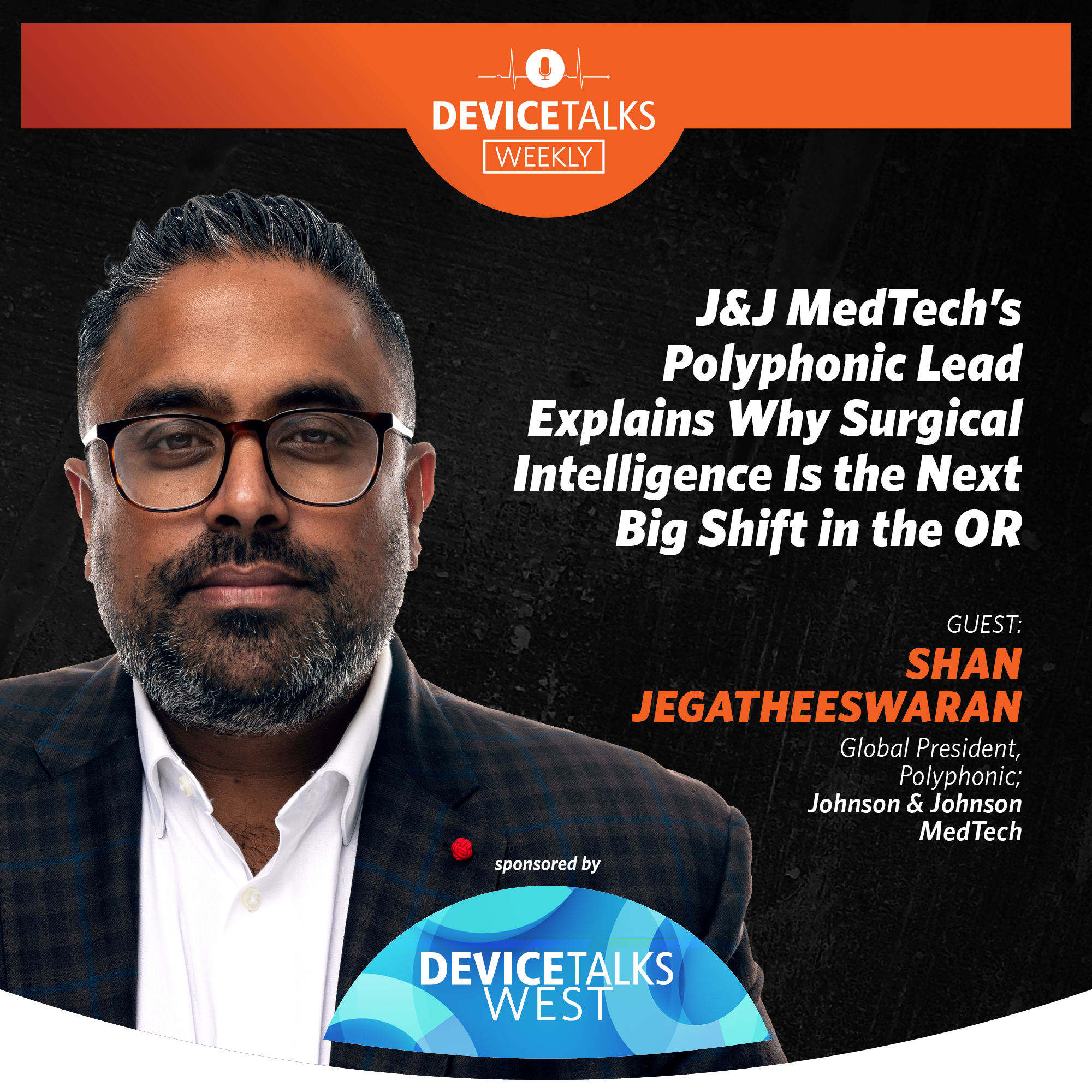
[00:00:01] Speaker A: Hey everyone, Tom Soleman here. Welcome back to the Device Talks weekly podcast. Great show coming your way. It's going to be very Chris Newmarker heavy. Chris Newmarker and I kick things off with our Talk of the Newmarkers Newsmakers, the top five stories from Mass Device. We'll also delve a little bit into our experiences, more Chris's experience in D.C. on the morning of 911 in 2001. Of course, coming up on the 25th. We're here at the 25th anniversary as we recorded this episode's Newsmakers on the morning Friday morning of September 11th. So as I said in our conversation to those folks who had a more direct impact from 911 than we did, hope you found some peace and fond memories on this day. So later on though, Chris Neutenmacher will talk with our main guest. He's leading our keynote conversation as well. Chris spoke with Shan Jiglisswaran. He is the global president of Polyphonic at Johnson and Johnson Medtech. Johnson and Johnson medtech of course, enjoying the approval of Atava a little earlier this year. In this conversation, Chris and Shan will talk about how surgical intelligence is really the next evolution in digital surgery. I mean, the tech is here, but there's a lot of data that needs to be accessed. So there's a lot of, a lot of complicated next steps for everyone in the surgical robotics space. And Johnson and Johnson MedTech has an interesting story with Polyphonic that Chris and Shan will explore.
Before I begin this episode, I want to give a shout out to my great friend and colleague Kayleen Brown, managing editor of Mass Device. Kayleen will be leading the executive interview at MedTech Vision, one of the great shows in MedTech. It's happening on Tuesday, September 15th.
Kayleen will be interviewing Martha Ronson, who is the CEO and president of Merit Medical. So that promises to be a fantastic conversation and I'm just so happy that Kayleen could be part of MedTech vision. It's truly a great show. I've gone the last three or four years. I'm not able to make it this year, unfortunately. But Kayleen and Skyler Rivera, associate editor of Mass Device, will will be representing as well. So make sure if you are one of the lucky ones attending and the show is sold out. So if you don't have your tickets, don't know what to tell you. But if you are one of the folks who were able to get tickets, please say hello to Kayleen and Skylar and make sure you sit down and sit in for Kayleen's Interview with Martha Aronson. So, once again, congratulations to kayleen, congratulations to MedTech Women for putting on such a great event.
And I'm sure it'll be a fantastic time for folks at MedTech. And I am sorry I'm missing it. So without any further delay. Oh, actually, no. I did want to just talk about one other little thing. Our own conference, Device Talks west, is taking place on November 30 and December 1. We've got an early agenda up there with some speakers. I'll continue to add that, but it's always a great time. We have a new venue. We'll be at the Signia Hotel in San Jose. New, new time of year. Excited to be sort of wrapping up the year with Device Talks West. So go to west.devicetalks.com for more information. All right, now with that, let us get this podcast started.
All right, you ready for this?
[00:03:32] Speaker B: Ready.
[00:03:53] Speaker A: Chris Newmacher. How are you, sir?
[00:03:55] Speaker B: Doing all. Doing all right, Tom.
Oh, we're recording this on Friday morning, so. Man, 25 years ago, huh?
[00:04:04] Speaker A: Yeah, just a full transparency. Chris and I were just trying to discuss how.
How much we want to delve into 9 11. I mean, clearly it was my singular day in my lifetime. That sort of has the before and after feel like there was. It's one of those moments that just everything pivoted. So I don't think I need to go into my where was I? Story. It was pretty mundane. In an office, you know, trying to refresh my CNN browser on 2001 technology. And it didn't go well. So ended up going to the Radio Shack under my office and watching everything on tv.
[00:04:39] Speaker B: Goodness.
[00:04:39] Speaker A: But, Chris, you were actually on a scene on that day.
[00:04:44] Speaker B: Yeah. I'd started my journalism internship right after college, a week before 911 in D.C. so I was on the metro coming into the city.
I think I boarded the train just a few minutes after the first tower hit. So I've been walking over, and back then, we didn't have iPhones and stuff, so I just heard people talking on the train about, oh, there was some weird accident.
And then a few stops later, somebody came on and was like, oh, a plane hit the second tower and everybody cleared out of the train pretty much.
[00:05:19] Speaker A: Did they stop the train prematurely?
[00:05:22] Speaker B: It went into the city. I stayed on because I had a news bureau I was interning at, so I thought I could be of help. But it's definitely a weird feeling when you're walking out of a Metro station and you're one of the few people leaving the station. And they were like hundreds of people running into the station to get. Get the heck out of the city, you know.
[00:05:39] Speaker A: And so had the plane hit the Pentagon yet at that point, or was that still to come?
[00:05:42] Speaker B: It had just. I kind of remember getting over the bureau and I could see, like, smoke over the city all of a sudden, like, so smoking had been. Been hit. And when I got in, the Bureau found out the Pentagon had been been hit as well. And one of the top editors at the bureau had actually seen the.
Seen it happen. Like, wow, really driving on the interstate with his wife into town for their jobs and like, was like, wow, that plane's flying low.
[00:06:10] Speaker C: And then, whoa, Saw.
[00:06:12] Speaker B: Saw the explosion. So, yeah, it's. It's something else.
But, yeah. And I remember, yeah, such weird things as. Like, rumors that other stuff around the city had been held hit. Like, the. The bureau chief, like, was like, oh, we've heard something might have happened at the White House. Could you run over there and look at.
[00:06:34] Speaker A: What did they have you do that day? Was it. Do you have anything. Any memory of?
Or did they basically have you just kind of run coffee and keep everybody fed?
[00:06:43] Speaker B: I didn't run out. I was like the intern in the Bureau. I ran out and got sandwiches.
I.
You know, I. Yeah, I made sure the White House still existed.
[00:06:53] Speaker A: So you actually did that? You did that. You ran over to the White House?
[00:06:56] Speaker B: Yes, I ran over the White House to make sure it still was. It still is. I mean, at least part of it. And, you know.
Oh, yes. And like, near the end of the day, actually headed out to Dulles Airport, you know. Cause they wanted to see if we could, you know, talk to any relatives of, you know, people had been killed in the plane that had taken off from Dulles that day. But they kind of cordoned off the reporters from everybody, but they. That. That was pretty grim. So it was.
Yeah. And things. Things totally change. And I still. I still don't forget, you know, like, the weeks afterwards seeing, you know, like, National Guard troops guarding, like, stand. I mean, you'd go to cross the street in D.C. and there'd be somebody in full camo with a assault rifle standing there. That's. That's a very weird, weird sight.
[00:07:47] Speaker A: Yeah.
[00:07:48] Speaker B: Yeah.
[00:07:48] Speaker A: That was a.
Before 9. 11 was a different world than this. We were ignorant and blissfully so. I think of a lot of the dangers and tensions that a lot of the world already lived under.
We were just thought we were automatically immune from everything. And that was.
[00:08:05] Speaker B: It's so weird that, you know, A week before, I had flown to D.C. from a little regional airport in Ohio. And, you know, like, I think it was the airport Dayton, Ohio. Like, you know, Cause I found a deal on an airplane ticket. And I still remember my dad drove me there and, you know, like, I mean, he could walk right to the gate with me, you know, gave me a hug, you know, said, said, you know, good, good luck in D.C. and everything, you know, like that. That was all gone after that, you know.
[00:08:30] Speaker A: So I had to go down to a private equity conference we were hosting a few weeks later, end of September. So it wasn't that close. But taking the train from Boston into New York, not really expecting what to see.
I did walk down to, to,
[00:08:47] Speaker B: to,
[00:08:47] Speaker A: to take a look around. And it was, folks, we're at a point now where there are people listening to this who don't remember to have no memory of it, maybe weren't alive during it. But it was a distinct before and after feeling. And you and I, you were more touched than I was.
Of course, you know, we don't need to delve too long into our sort of secondary experiences, but of course, we want to wish those who were, who lost loved ones either in the attacks or in the rescue attempts after or were impacted. Anyway, I hope today doesn't bring back too many painful memories and perhaps give some peace because it was just probably one of the more important days of my life for sure. So I can't imagine how someone who was directly impacted feels about this day.
[00:09:35] Speaker B: I can't even imagine. Yeah. So, I mean. Yeah, well, 25 years, man. Time go by fast, I think, or we become an older guys. Tom, 25 years, my best efforts.
[00:09:50] Speaker A: Yeah. Yeah.
[00:09:51] Speaker B: There we go. Right.
[00:09:53] Speaker C: All right.
[00:09:54] Speaker A: Well, again, our thoughts and our hearts go out to folks who had direct experiences on 9 11.
[00:10:02] Speaker B: And
[00:10:05] Speaker A: we're directly impacted. And to the rest of us, we're here and we're moving forward and we're going to talk MedTech because it's important.
[00:10:13] Speaker B: Yeah, exactly.
[00:10:15] Speaker A: All right, Chris Newmarker. Let's hit the Newmarkers newsmakers. What's number five?
[00:10:18] Speaker B: Hey, number five on the list. This is from managing editor Jim Hammerand he had a really nice exclusive interview with Petal Surgical, the incisionless surgery company. And we have a good little update on the site about where they're going with the technology, about how they're like, you know, planning, they're moving toward human trials. They're, you know, they said they're moving out of the lab. They gave us a little teaser image of their robotic system that, you know, delivers histotripsy. And yeah, along with a Minneapolis based company, Histosonics. I think this is one of the, one of the most exciting areas of medtech. Actually right now it isn't being talked a lot. I think it's going to be huge.
Well, do I really want to stake my reputation on it? I think this is a big deal. I think it'll be really exciting to watch where this goes over the next 10 years that we're seeing technologies rolling out now that use ultrasound and increasingly sophisticated ways to accomplish things that in the past were only done with radiation or surgery. So it'll be great. But if you want a little tea, little idea, more of where petal surgical is going.
Jim has a really solid story on a mass device about petal surgical saying it's first in human incisionless surgery is coming soon and offering a first glimpse of its system.
[00:11:51] Speaker A: Yeah, they say they're using a millisecond pulse histotripsy. And yeah, you mentioned VistaSonics and insight tech is another company in Florida that's working in this space. We've got three, which makes it a, makes it a trend. And I think you're right. I think, I mean, the potential to, to, to remove harmful tissue from the body without having first cut into it.
I mean, I hope in 25 years we're going to look back at some of the things that we're doing now and say, oh my gosh, can you imagine? They used to have to cut people open to, to, to reduce a tumor.
If I'm, I'm hopeful that someday we're going to look back at a lot of the procedures we're doing and saying, thank God we don't have to do those anymore.
So I agree with you. It's one of the more exciting spaces of medtech. All right, Chris, what's number four?
[00:12:43] Speaker B: Well, number four on the list is this is from yours truly.
There was a SEC filing earlier this week from Boston Scientific that this cybersecurity incident that they went through is going to, that could cause them to miss their guidance for the year. So it seems that sales growth and EPS could be even lower. I mean, they already cut back their guidance during their most recent earnings call on July 29th. It could be even lower now after this global communications outage that hit them in late August. So we're talking on Friday and we just noted that there's a post out from the company about how their processing and shipping is, you know, back, you know, to, you Know, normal operating level. So they're coming back online, but, you know, they're, yeah, they're, you know, they're still, you know, working with, you know, you know, cybersecurity experts to kind of investigate how this happens. You know, so far they've just said that this was like, this involved unauthorized activity that affected access to certain operating systems and business applications. So, yeah, there's just been a real uptick in these types of reports. I mean, and I've, I've been kind of wondering in the, in Medtech and probably in corporations in general. I mean, I've been, I mean, maybe some of this could be, you know, the, the SEC requiring, you know, more, more disclosure of this type of stuff. You know, so, I mean, that could be one thing, but, you know, it certainly doesn't, doesn't help that we have a huge war going on in the Middle east or, you know, other. Other things of that nature.
[00:14:22] Speaker A: Yeah. And also, just I made a point on LinkedIn earlier this week. I mean, one of the promises of Medtech is connected health, connecting devices. Connecting devices for patients to interact with, connecting devices to obviously clinicians to track data. And with every time you add a layer of connectivity, I think you add a layer of exposure. So the very thing that is creating great opportunity for medtech is creating great risk as well.
That happens sometimes, but I think we're going to be hearing more and more of these as Medtech devices. As medical devices get smarter and get connected.
[00:14:59] Speaker B: Exactly.
[00:15:00] Speaker A: Yep.
[00:15:00] Speaker B: So, yeah, totally. So this probably isn't the last time we've reported.
[00:15:04] Speaker A: I don't think so. I don't think so. And certainly not, not isolated to Boston Scientific or Stryker. I mean, everyone's been reporting. I think Boston Scientific and Striker are the first that recorded business impact. I think Intuitive and others have sort of reported that data has been compromised.
And I think, I think most of the big device companies have reported some sort of cybersecurity incident.
So it's not isolated to one company as long as.
[00:15:31] Speaker B: Oh, no, absolutely. Yeah. We had stuff from Medtronic, from Stryker, like all kinds of companies like that.
[00:15:38] Speaker A: All right, what's number three? Chris Newmarker.
[00:15:39] Speaker B: Hell, number three on the list. This is from freelancer Sophie Kurita, who's been helping us out this week.
I think we'll have an announcement soon about a new editor joining our team. But, you know, so thanks again to Sophie. And, you know, she wrote up an article for us about how, how Teleflex just earlier this summer had Medtronic executive Jason Weidman join them. Jason had run coronary and renal denervation over at Medtronic and now Teleflex is adding Sean Salmon to their board who stepped down from Medtronic in September of 2025.
He actually was Jason's boss.
He had president of the career manager before portfolio. So you know that's, you know, I guess, you know, hope they can appreciate the humor but you know, like, you know you're a really good boss when you're, you know, former employee, like gives you a board seat. So that's a good deal, right?
That's really great. But a lot of positive comments on LinkedIn, you know from, from this news that we posted as well. So obviously you could tell like Sean was a very well respected executive over at, over at Medtronic and just it's kind of cool. Looks like Teleflex is kind of like starting to gather kind of some like Medtronic know how over over there. So it's, it's going to be fun to see, you know, see where they go next.
[00:17:09] Speaker A: Absolutely. Medtronic is Medtech's tree of life. From, from what's, what's, what's the big movie? Avatar, Medtronic, Medtronics branches and roots are touching a lot of companies in Medtech.
[00:17:26] Speaker B: So it's definitely true. In the Twin Cities when I'm based, where I'm based, it's hard not to go into any company that doesn't have somebody who was at Medtronic at some point. It's almost like the grad, the super duper extra grad school for exactly people in medtech around here.
So yeah, it's cool that Teleplex is getting a little more of that Medtronic mojo over there. So it'll be fun to watch.
[00:17:49] Speaker A: Absolutely. All right, let's roll into number two, Chris Newman.
[00:17:52] Speaker B: Hey, number two. Talking about kind of like rejiggering and getting new things going.
It looks like Zimmer Biomed, I mean they've got a leadership restructuring going on.
They mentioned that this is coming at the same time they're planning to get a next gen orthro robot out next year.
They're calling it the Monogram system. So that'll be really fun to watch to see where that's going. But Bradley Kessler who's been, you know, already in charge of their, of their robotics, you know, program over there is now getting promoted to president of the Americas for robotics technology and data. And you know, there are two other executives at Zimmer Biomet that are getting Promoted up to president's rules. The flip side is they're letting go of, you know, Kevin Thornhill, the, you know, the former NEVRO CEO who just joined them last year, as, you know, as, you know, as, you know, as their group president, Global business and the Americas. So it kind of looks like, well, it's kind of interesting. It's like, you know, you had, you know, Kevin reporting to the, you know, the CEO, even Tornado. So now, like, Kevin's.
Kevin's leaving. They're bringing up three executives who are all going to, you know, report to Evan. So, you know, you know, it's kind of, kind of maybe getting rid of a layer of management and, you know, obviously you got like a next gen roof robot rolling out next year, maybe just getting the CEO more involved and what's going on down there as they're getting ready.
[00:19:32] Speaker A: Yep, for sure.
These things certainly happen.
Kevin Thurnall, of course, has had great success in the past.
And as I like to note every time he's brought up on the podcast, he was our first interview with someone from one of the larger OEMs.
Talked to him early on when he was at project about the diagnostics they were creating.
[00:19:52] Speaker B: My goodness.
[00:19:53] Speaker A: Yep. During the pandemic.
All right, well, interesting news there.
[00:19:58] Speaker B: I'm excited to see where Kevin goes next. And, you know, it's absolutely, absolutely.
[00:20:03] Speaker A: So get him back on the podcast then.
[00:20:05] Speaker B: Yeah, you can't keep a good man, Dan. We'll see. We'll see where he is next. So we're good.
[00:20:10] Speaker A: What's number one? Chris Newmarker.
[00:20:12] Speaker B: Hey, number one on the list. We've got Abbott earning FDA approval for a new dual energy ablation catheter or the Tectiflex Duo.
So, I mean, these systems are, have really been gaining in popularity. Kind of this idea that you can toggle between kind of this new pulse field ablation technology and RF ablation, like giving electrophysiologists this flexibility. So we've had.
Medtronic has been seeing a lot of success with its Sphere nine, a ferrous system.
We've got J and J Medtech with their thermocool smart touch sf. And now we've got Abbott here on the US Market with tactiflexa Duo. So the competition is just, you know, growing even more. So just, just, just really cool news.
[00:21:04] Speaker A: Absolutely. All right. And it's, it's a, an interesting space as all these companies. I mean, it's amazing to me how quickly the atrial fibrillation and cardiac ablation area is moving. With the introduction of pfa, I mean, just two or three years ago, I mean, that's when the, the FDA approvals first came in. I think it 2023, 2024, and now it seems like several of the big players have their dual systems. And now everyone's integrating mapping and other sort of technologies that can read not only what tissue needs to be ablated, but how it is after it's been ablated. And then of course, the ability to toggle between the RF and pfa. It's just amazing how quickly this space has moved. But I just think as this area gets more and smarter, it gets smarter and smarter.
It's going to be an interesting space for automation, for AI, for surgical robotics, maybe to play a bigger role in this area. So maybe this is a space where Boston Scientific finally gets involved in robotics or Abbott perhaps. So we'll see. Not that you have to apply robotics to everything, but why not? It seems like it's getting smarter and smarter and could be a nice fit for robotics platform in a few years.
[00:22:17] Speaker B: I've heard a lot, especially with pfa. There's kind of like this trying to find the secret sauce of exactly how to deliver.
And you know, maybe these systems that toggle between RF and PFA are like kind of just allowing the, you know, electrophysiologist to kind of experiment even, even more with it right now. So it almost feels a bit right now like an art. There's kind of this art over science thing going on with it a bit right now. But. But yeah, you're, you're kind of right. As they figure out more how to do this well based on different cases and they get the data.
Yeah. Why, why not like have like something like where you have some kind of robotics, you know, play in the EP lab, you know, that, you know, you know, that could like make accessibility of these technologies even wider, perhaps, kind of right.
[00:23:05] Speaker A: Why'd you have to qualify my rightness? Why can't I just be right? I have to be kind of right.
[00:23:09] Speaker B: You want me to say sure, right,
[00:23:11] Speaker A: I'll just delete that. I'm going to edit that out anyway.
I'll.
[00:23:16] Speaker C: Yeah.
[00:23:19] Speaker A: You are so smart, Tom.
[00:23:21] Speaker B: You smart, Tom.
[00:23:25] Speaker A: All right, Chris Newmark, this is the point of the podcast where I generally record my intro for the keynote interview. Because I usually do the keynote interviews, but you are handling this one, Molly, my old friend. So do you want to tell folks who you talk to and what you talked about?
[00:23:41] Speaker B: Yeah, I mean like we recorded an interview earlier this week with Shan Jagathiswaran. He's the president of Johnson and Johnson Medtech's polyphonic digital surgery ecosystem initiative.
But they just recently had a really extensive report come out about surgical intelligence. This is kind of, you know, we've had, like, you know, the rise of robotic surgery. We've had, you know, digital surgery, but now, like, especially with AI, we're moving into this kind of era of surgical intelligence. And, you know, Johnson Johnson really sees itself as like, kind of a leader in this. And it was a really, really, you know, I there. There's some really fun, insightful things that we got out of that, you know, discussion, including, like, you know, even, like, you know, you know, kind of trying to compare what's going on with surgical intelligence right now to how does it compare? How does it not compare with the rise of surgical robotics a few decades ago versus me just talking about this interview. Yeah, everybody can just check this out now.
[00:24:43] Speaker A: Absolutely. No, it's much more fun now that JJ has ATAVA approved and is an active player in surgical robotics.
All right, I will stop talking and let's get this interview started.
[00:24:56] Speaker C: Oh, hi there.
[00:24:57] Speaker B: This is Chris Newmarker. I'm editor in chief of Mass Device, and we're on Device Talks Weekly today.
Some really big terms that have, like, dominated med tech in recent decades. Surgical robotics, digital surgery. But, you know, we have a new term that's really on the rise of, like, kind of the next generation of all the surgical intelligence.
And luckily, like, Johnson Johnson MedTech just recently produced a large, extensively researched report on the sub subject. And I'm lucky enough today to have Shan Jagathiswaran, the president of Johnson and Johnson MedTech's polyphonic digital surgery ecosystem initiative, just announced last year, includes partnerships with such big names as Nvidia and Amazon Web Services.
Shan, welcome to Device Talks Weekly.
[00:25:47] Speaker C: Yeah, it's a pleasure. Thank you for having me, Chris.
[00:25:50] Speaker B: You know, I always like to start out by, like, kind of talking about how people, you know, got into MedTech and, you know, just, you know, looking at your LinkedIn profile, you have an interesting story. I mean, you spent a lot of your career in the energy sector.
Just joining Johnson and Johnson a few years ago. I mean, what drew you to our space?
[00:26:11] Speaker C: Yeah, I mean, I had an atypical path, as you alluded to.
I started my career in capital markets, worked at, in a bunch of industries, and most recently, as you mentioned, in the energy space.
I like to say it prepared me for surgery because it is multidisciplinary. The things I learned along the way Were incredibly applicable.
But net. Net. If I look at the common themes, it's a regulated industry, it's global.
Software in this space needs to work.
There's implications when it does on both human and environmental. So it's important stuff. Excited to be here and working with J and J on it.
[00:26:49] Speaker B: Yeah, that's very true as well. I mean like MedTech Energy is a space where if like something goes wrong, I can go. Go very wrong, you know, and if it goes right, it can go really right for a lot of people, you know, as well. So tell me the story about this report. How, I mean I saw there was a report last year, but I mean, how.
How did you get involved in like really like deciding like we really need to dig into, you know, what surgical intelligence is, what its potential is, what the future of it is.
[00:27:18] Speaker C: Yeah, it feels like we started the report because it feels like a special time, especially now in surgery. There's a lot of sort of converging themes. When you think about devices being more connected, robotics, et cetera, the prevalence of AI and the ubiquity of AI and then also the needs hospitals, surgeons and patients. They're looking for how digital can alleviate some of the things that they're experiencing.
So it just felt like a special time. It felt like there was a lot of amazing work happening in pockets through strategic startups, some of our technology partners in hospitals, governments.
But for me, what was lacking is how do we talk about this with common language, common frameworks, common mental models that enable and accelerate our conversations with each other. And that starts to build out a category. When we can align on simple language and terms, it makes sense. Doing business and doing, building innovation, much, much more simpler and easier. And that's why we started this second version of the report is how exactly the people that are doing this every day, working in surgical intelligence, so to speak, how are they talking about it, how are they thinking about it and how can we coalesce so that we can partner up?
[00:28:26] Speaker B: So just to back up, I mean, what is surgical intelligence?
[00:28:30] Speaker C: So we define surgical intelligence as the. As a clinical knowledge generated when multimodal data is connected across the periopoly of surgical pathway and then analyzed to support clinical decision making and operating performance. So that's sort of the definition in the report, if I were explaining it to someone outside of the industry. It's essentially the culmination of digital, physical and human coming together for the purposes of safer, better surgery.
[00:28:59] Speaker B: So really sounds like getting AI involved in the data analysis and the insights that we could potentially gain from all the data we're increasingly collecting from the operating theater.
[00:29:16] Speaker C: Yeah, exactly. I mean, you're seeing data start to get generated outside of the or. It's pretty prevalent. Right. Like emrs imaging. They've sort of had their maturity curves within surgery. Devices are getting smarter and there's also more data coming into a clinician sort of purview as well as a patient's purview. And what's the infrastructure and the mechanisms around bringing all of this together and adding value or creating value out of it for the purpose of either a clinical or an operating outcome? Right.
[00:29:44] Speaker B: I just got to think the challenges around creating those mechanisms have to be huge. I mean, just because of different health providers using different electronic record systems, all these different devices producing different types of data areas you'd like to get data from, but they're still totally analog on it. And you know, like, it's just, it's just not going to happen. And, and then, you know, I could also just see, you know, the health providers themselves are just busy doing health care. So, you know, you know, why, you know, take time when they could be treating people like, bringing in revenue to their systems to like, you know, grapple with all this data? I mean, am I kind of like, what am I missing here? I mean, this, I mean, am I, am I right thinking that there's just a lot of challenges to kind of, of make this a reality?
[00:30:38] Speaker C: I mean, you're right. When, when you say it's hard, right? It's, it's hard, it's complex, especially in our industry. As you know, there's, there's regulatory elements to it, but then there's also. It has to be right, it has to work and add value almost on day one. To your point, having said that, a lot of things in healthcare are hard and yet innovation is pretty prevalent. And so, so our approach here, at least through the work that we've done with the surgical intelligence report, is it shouldn't be all borne by the hospitals anyway. And so when this thing works and scales, there's a leaning in from medtech players like ourselves, there's a leaning in on the government side, there's a leaning in on startups and big tech.
And I think it's twofold. One is the mission is important, this has patient impact. And so there's a, a altruistic rationale for spending time here.
[00:31:31] Speaker B: Totally.
[00:31:32] Speaker C: But it's also highly valuable when it's right. As you know, surgery is a key driver of revenue as well as complications and cost. For hospitals. And so if you can fix that, it has direct impact on throughput and other areas that are important for the hospital and patients as well.
[00:31:49] Speaker B: Yeah, I mean, it sounds like bringing in data on what. Not just like the immediate outcome of the surgery, but, you know, how the recovery goes. I mean, that's kind of why you're using the phrase perioperative. It's everything from getting ready, from the. For the surgery, doing the surgery. So what's the outcome going to be for this patient down the road?
And we all kind of have a stake in that, too, because if you have more surgical complications, that's more money being spent in the system and more people having more health problems that could have been avoided if there were more insights.
So, I mean, it sounds like there's a tremendous amount of promise if we do it right.
[00:32:27] Speaker C: Agreed. And I think you got to believe in a few things. Right. The North Star for us is, as the report suggests, is collective intelligence. At some point, if you squint into the future, what is that future? It's the convergence of these themes that we talked about. Compute power, AI, the unmet needs clinically and operationally from hospitals, and then devices themselves in medtech are getting more connected. So if you just extrapolate what that looks like 5, 10, 15, 20 years from now, you're going to end up in a space where data does exist, data is being used at scale, and it's finding its way back into clinical workflow. The problem is, or the opportunity for us is from today to that North Star, what is the pathway?
And what I'd like to say is there's no map for this. You sort of have to direct this with a compass, so you get direction of travel, and then you do a few smart things along the way. Some of them are better bets, some of them are not. And you move in that direction.
And what we found was, and what you probably see around in the industry is we tend to focus and index on sort of the technology element and the technology story. And that's what you see in headlines. Right.
But the foundational, I would say the tougher stuff is the mindset part. That's the governance, that's the policies, that's the economic incentives, all of the regulatory bodies that now have to be involved. And how do you even move data around compliantly, let alone in your hospital system, but across state lines, across countries? Those are things that we have to tackle when this thing is going to scale and become real.
[00:34:01] Speaker B: I mean, is there any kind of changes?
Does Congress have A role to play in this. Could there be changes in regulations that could help out? Obviously hipaa. I mean, I was a young man when HIPAA was passed, so I mean, it's been a long. I mean, well, it's not been that long ago. Yeah, I'm still a bit young, but I mean, but I mean, it's been a while. So I mean, you know, could, you know, if you had a wish list for. I mean, I saw you've done work with avamed.
How could the government help facilitate this? Because there seems there could be a lot of positive things that come out of this.
[00:34:41] Speaker C: Yeah, I mean, I think overwhelmingly the feedback from the work that we did was, and we fully believe in this is no one entity is going to figure this out on its own. It's multidisciplinary discipline learning at its heart. So that's one key thing. The second is most respondents, I think just over 70% of them eliminated technology as the main barrier. And the four that sort of bubbled to the top consistently were economic incentives, interoperability of the data and the devices themselves, capabilities of those deploying the technology, but also using the technology. So let's call that change management and then. And the governance of that whole thing. And across these four areas, you see a role for government to play, you see a role for hospitals to play, and you see a role for medtech tech players to play along with your institutions, like your academic institutions, your societies, et cetera. And so that's really what the report has laid out. But that's also the journey that we've been on as polyphonic, but also as jj.
[00:35:43] Speaker B: Yeah, no, absolutely. And like a huge role to play because you're one of the largest surgical tools makers in the world. You're heavily evolved in surgical robotics and digital surgery and other med tech.
The report, I mean, my gosh, 44 interviews with senior leaders, I mean, reviewing more than 100 publications and prior research that involved hundreds of clinicians, administrators, 15 countries, 1566 surgeons, all that research to kind of be like, how could we kind of move this forward? I mean, what was the most surprising thing to you out of this, out of all this research?
[00:36:26] Speaker C: I'll go across both reports, right, because they were both important for different reasons. Last year we went broad close to 700, as you said, about. Between that 700, by the way, we were intentional. About half were clinicians and about half were non clinicians. So administration roles, which are also equally important, I'd say in this space and 15 countries, as you mentioned, across multiple Procedures, multiple also care settings, ASCs, hospitals, academics, et cetera.
For me, the key takeaway on that report was despite country procedure and let's call it respondent flavor, the feedback was homogeneous.
There weren't topics that were prevalent in the US for a particular type of entity versus Abu Dhabi for something else. Across the world there were common issues in surgery that needed to be solved for and that's a good thing because when you solve it it somewhere, you can solve it almost everywhere. And that for us was a hypothesis and a learning.
The second thing that came out of that report was the prevalence of technology already in the or, right? I mean it's on average there are seven software solutions operating in any given procedure, four hardware devices and five unique data streams. That's a great starting point.
It's not like the tech doesn't exist then.
Almost 100% of clinicians interviewed said that data and that value, that juice was inaccessible. So that's really the problem for us to solve, right? And that was last year.
This year we went deep and I'm really proud of the makeup of the 40 plus people that we talked to because it wasn't just medtech players, it was CIOs, it was government officials, it was also in many cases some of our competitors because we truly wanted to get sort of a holistic view here, here and here. I think the key takeaway is number one, that the input cost is improving and reducing at the same time. So that's a sort of a check mark for technology, right? Like Compute performance doubles every 9ish months these days and the cost reduces quarter over quarter.
The prevalence and the acceptance of AI in surgery for me was also a learning.
Hospitals clinicians understand the value of it.
Not only that, they want to participate in the scaling of it as well. It isn't something that is a science project that people sort of shiny object that they see and they want to keep on the shelf. Their first question is how do I use this safely, compliantly and consistently in practice? Because they understand what it's done for them in their personal life.
One can only imagine what this can do at scale in surgery.
And then the third thing for me, which wasn't an aha, but it was nice to break it down into practical steps, was take away the tech challenge for a second. Not that it's simple, but it's simpler. It's the mindset stuff, right? It's like I mentioned, the mechanisms and incentives, how data standards now need to evolve so we can share data in a compliant way. Norms and governance. That helps me internally speak the language within JJ with my counterparts and my functional leaders.
But frankly, it also helps me speak with customers and some of our partners, as you mentioned with AWS and Nvidia, because they've done this and so have I have done this exact play in other industries, right? We went through this journey in energy.
The automotive industry has gone through it itself, capital markets as well. So how do we leverage some of those lessons learned and jump ahead, so to speak? Now, surgery is unique. It has its own nuances for sure. That's why the, the talent and the capability of JJ come in. But there's definitely things that we can learn. So for me, those are the takeaways. And we'll follow up with some of these respondents.
[00:40:10] Speaker B: A lot of times when I look at health providers, I mean, surgeons are kind of like the rock stars of the medical profession. I mean, how do you ensure the fact that in the end, even though you're getting all this insights and suggestions, I'm sure from an AI, like oh, you could try this, you could do this. How do you ensure that, that the surgeons are still in the driver's seat and responsible?
[00:40:32] Speaker C: I mean, I think there's a couple of things that we hear. One is we're not jumping to the most exotic AI use case, right? Like you can go interoperative and apply AI interoperatively. It comes with its regulatory checks and balances and also comes with the need for large training data sets. And both of those are long cycle and hard to do. And it doesn't mean we shouldn't do them, we should start, but the immediate impact and the use and I would say the habit forming behavior where AI can be used in a safe, consistent, scalable way will happen on the outskirts first. And we felt that in our personal lives, right? Like you're not going to be comfortable having AI manage your bank balance tomorrow, but it helps you write up an email or planned travel, lower written stuff. And that's sort of what we, the themes we heard when we were speaking to folks and also how we're approaching our product strategies.
[00:41:29] Speaker B: They told me how to swap out my garbage disposal two weeks ago. I mean, that's good. I mean, you know, I mean it worked, it worked out, it works, but
[00:41:37] Speaker C: it saves you time. And you're like, okay, that worked and you'll expand your sort of usage as time goes. And that's the adoption curve that we're on. And so we heard that from the, from the interviews themselves. And that also of course influences our Strategy in the sense is, can we save time?
What's the highest feasibility, highest impact thing we can do immediately, and we build a muscle and that muscle has to grow and you go from there.
I think we have to recognize this is a long journey.
[00:42:08] Speaker B: Right.
[00:42:09] Speaker C: It's not a tomorrow thing. You got to start, though. And I think everyone's making progress, including ourselves.
[00:42:14] Speaker B: I thought when you say fringe, you know, kind of like it's starting on the fringes. I mean, you know, where on the fringes do you. Do you think it could, you know, the adoption could gather steam, you know, fast? Is it where the cases are, like more high risk, like oncology, or, you know, where it's like, hey, we need to throw everything at this, you know, to try to save someone's life or extend it, or, you know, is it more like things that are more like low risk and, you know, routine, or is it mixed? I mean, where do you see the opportunities for, like, adoption, like, starting?
[00:42:46] Speaker C: Yeah, I think there's two sort of themes. One is, if you're a device manufacturer, you're usually dropping some level of algorithmic value in your device because it's a controlled environment. You have sort of the practices in place to deliver that safely.
And so teams that we work with within Johnson and Johnson do that today. Right. Monarch just released an update to their AI algorithms for their devices. And you see that across the industry, and that's where they tend to focus, because that's a competitive advantage. Right. You own the device, you own the data within that device, or have access to the data within that device.
So that's one theme that has emerged and I would say is safely at scale ish across surgery because it can
[00:43:26] Speaker B: just be deployed across the robot. So as robotic surgery continues to grow, you're just going to see that deployment of AI tools and data tools going with it.
[00:43:36] Speaker C: Exactly. And that's the box of, when you go back to the report, that's the box of institutional intelligence. Right, Right.
It's within an oem, so to speak, ecosystem. And that entire fleet of devices are going to get smarter over time. And we expect that to happen. That's a natural tendency both in medtech, but also other industries. Then there's another theme which is if you're not a device maker, we see areas like scheduling, patient engagement, patient risk profiling, 3D visualization. So for preoperative planning, these are, you know, I would say, logical areas to begin in terms of access to data sets and also value to the surgeon.
Now the question is, and that's What I would imagine is connected intelligence, right, which is it's always fragmented, like it's one off solutions.
Some surgeons use it, some don't. Sometimes it works for procedures, sometimes it doesn't. When you put both together, the question becomes how does it move to the top right, which is collective intelligence. And hospitals need to as simple as not simple, but they need to understand what's the contract that's going to underpin all of this. Like am I going to sign 25 different agreements with suppliers who are giving me digital solutions? How do I manage that? How do I manage single sign on? How do I manage data generated between all of these apps and shared? Those are the real problems I think that the report elevates. And then practically speaking how do we solve for that? Because that is the next sort of of innovation arc after robotics for us.
[00:45:04] Speaker B: It almost comes down the question I hear a lot with any kind of like new medtech, like who, I mean, who pays for it? Who? I mean how, you know, what, what kind? I mean I know there isn't an answer right now, but I mean like what kind of questions do you grapple through to get, get to that answer like who, you know, who pays for this? In the end I mean it's, it sounds like there's a lot of agreement, there's value, but you know, who's willing to, you know, to fund it.
[00:45:29] Speaker C: And that's the chief inhibitor today, right?
When you talk to the folks who are interviewed, economic incentives is a big deal and it's real to solve for.
And that's why I think a lot of the time that I spend with my team is on contract innovation.
How do we measure value in this new world where raw data is value add and then the outcome is also value add.
And how do you adjudicate that value and get a sense of ownership on that value?
That's for me, quote unquote a ledger that hasn't been realized yet in surgery. And that's the type of work that we are doing right now. I'm lucky I can bring my previous experiences to this space. But I have access to some of the best world class talent in government affairs, regulatory compliance, cyber, whatever, that'll functionally important. You need all of these things to all of these humans to sort of weigh in.
And that's why I said that you started this conversation. It's hard.
[00:46:26] Speaker B: Yeah, right.
[00:46:27] Speaker C: I mean it's hard and you've got to have conviction and sort of the appetite to take this on. I think fundamentally as a company we believe that this is happening and will continue to happen. And not only do we want to participate, we want to lead in the space.
Humbly though, we don't know everything. Right. And so that's why the report that we sort of commissioned was one of the things that we're doing to educate ourselves as we're on this journey.
[00:46:53] Speaker B: Yeah, you know, one, you know, one, one like, you know, insight I read in the report that struck out to me was like kind of the comparison to what's going on with surgical intelligence right now to kind of like the early, you know, years of, of, you know, surgical robotics.
Yeah, I mean, I mean it's kind of wild to think that, I mean, Intuitive was getting started with soft tissue surgical robotics like in the 90s. I mean this is a long ramp up to get to where we are now or all of a sudden like, you know, J and J's really getting in the space, Medtronic's really getting in the space. We have like a whole host of companies like doing different things and Intuitive keeps innovating as well. But I mean this was like a 30 year journey.
Is it at least like kind of like reading the report, it kind of sounded like heartening, like, hey, you know, this takes time. But I mean, how did you see that analogy? And what kind of hope does that give you that, you know, like it'll take effort and time but we'll, you know, we'll get there, we'll get to a new level with surgery.
[00:47:57] Speaker C: Yeah. I mean, similar patterns. Right. The diffusion of innovation is really the problem that we're talking about at the challenge.
Robotics was one like as you mentioned in the early 90s. I think the, and I'm sure you'll agree that the window and the cycle time of that, of that change management has accelerated greatly. Right. So I don't think it's the same sort of 30 year journey that we're going to be on, on surgical intelligence.
[00:48:18] Speaker B: Definitely. Like software iteration is like much, much faster than, you know, than. Yeah, than hardware.
[00:48:24] Speaker C: And in the early 90s, affinity with a robot was still pretty foreign in your personal life. Right. But affinity with software, digital AI today, people kind of get what it can do. People also understand when it's uncontrolled and ungoverned how dangerous it can be. So there's a mental model that our surgeons and folks that we work with are already coming in so they know what this thing can be and should be. Now we got to figure out how it's applied to surgery. So it's a Bit of a, A different journey in that regard. But the similarities for me are we've passed now the point of the technical challenge. We need to now start talking about trust, common standards, shared workflows, sustainable business models. Like, that's the work to be done.
The cool part in all of this is there's predicates that we can lean on. Right. Like again, if you look in the early 90s, there weren't too many predicates on how you can build a business model around surgical robotics.
To date, I would say there's a menu of options in terms of how we can approach surgical intelligence. So it's on us to go figure that out and make it useful not only for us, but also for our customers.
[00:49:28] Speaker B: Is there anything in the report that we didn't cover that would be really great for people to know about?
[00:49:36] Speaker C: Listen, I think there's two adages that come to mind. One is we typically tend to, and I think this is like a Bill Gates thing, but one is we overestimate what we can do in a year and underestimate what we can do in 10. And I think that that fits here. There's a lot of amazing work being done, but it's a, it is a journey. And I think we, people, folks in this space need to have the appetite to join up and do this right.
And it's not going to be done by J and J alone. It's not going to be done by a competitor alone. It's not going to be done with anyone alone. It's. So the mentality of how we work together as an industry is going to have to change. And the work that you guys do, Chris and Tom, and the device talk sort of brand is important to that, bringing us together so that we can start talking common language and community. That's important because it's not going to get software on its own. The other one, which we have to go through every day, is on one hand, the healthcare model.
[00:50:33] Speaker B: Thanks, Chan. I appreciate it.
[00:50:36] Speaker C: It's true, it's true. Like, you know, bringing folks together, especially in this case, is important, but in healthcare it's, we always say, you know, do no harm. And then in software it's like move fast and break things. And both those things are different in surgery. When they come together, we have to be very careful that we're being responsible and other thing. And so, yes, speed matters, but so does truck and quality and all those other things that, you know, for the last century we've been, and we've been around with the company so for me, the one thing I'll leave your audience with is this is an important space for us to solve for.
A lot of smart people are in this space already, which is great. I think the sense of community and coopetition is what I would say is something that we need to really push on by working together. And that's a new muscle. Like I would say, we're very good working as individual organizations.
What can we do together for the benefit of a patient or the industry at large?
That's going to be exciting to see over the next one to two years.
[00:51:33] Speaker B: Yeah, I'm excited to be able to continue to cover this and watch this incredible journey. Shan, this was a real pleasure. It was great to have you on here.
[00:51:42] Speaker C: Yeah, excited to be here and happy to come back.
[00:51:46] Speaker A: And that is a wrap. Thanks so much for joining us in this episode of the Device Talks Weekly Podcast. Once again, I hope you're one of the lucky ones attending medtech vision. On September 15, you'll hear Kayleen Brown's interview with Martha Ronson of Merit.
Please do us a few favors about this podcast. Please subscribe to the Device Talks Podcast network so you don't miss a future episode or of this episode. I'm sorry, of this podcast or our other podcasts. Or you can subscribe directly to Device Talks weekly podcast so you don't miss this particular show. But why not get them all for the same low price of nothing? Please make sure you join us at Device Talks west that's happening on November 30th and December 1st.
Go to wes.devicetalks.com to check out that agenda. And of course, please do connect with us on LinkedIn. Connect with me. Connect with Kaylene Brown. Connect with Chris Newmarker. Make sure you follow mass device and LinkedIn on. I'm sorry, mass device and device talks on LinkedIn as well, so you don't miss our future MedTech conversation. So that once again is a wrap, folks. Thanks again for joining us on this episode of the Device Talks Weekly Podcast.