Episode Transcript
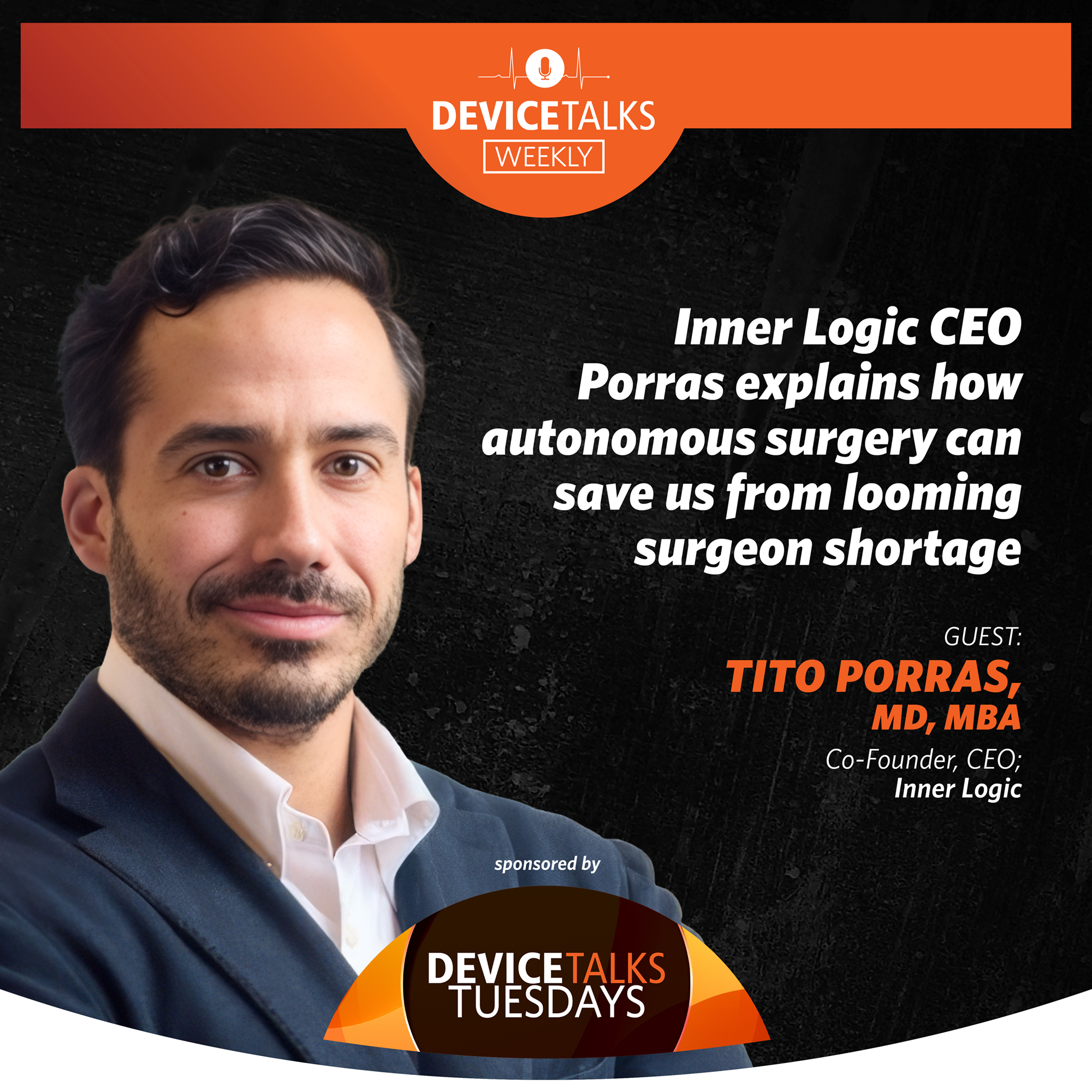
[00:00:00] Speaker A: Hi, everyone. Tom Sulaima here. Welcome back to the Device Talks weekly podcast. We're going to talk about autonomous surgery today, both with surgical robotic systems, but also with medical devices. So I talked with Dr. Tito Portis. He's the CEO and co founder of a company called InnerLogic. And InnerLogic is working with medical device companies of all kinds to sort of help develop autonomous functioning. And Dr. Portis will get into why he why he moved on from being a neurosurgery resident to an entrepreneur and startup founder. He'll explain that he saw a need to find a faster way to pass on the training and knowledge of experienced surgeons and listen to what they're up to at Interlogic. I'm sure you'll see the reason he got excited and diverted his path from medicine to medtech. So happy to have Dr. Porters on the podcast. And just before that, Chris Newmarker of Mass Device will join us for the newmarkers Newsmakers. So make sure you listen to the Newsmakers of the week.
Before we begin the podcast, though, I want to invite you to join us. On Tuesday at 4pm Managing Editor Kaylene Brown will be leading a conversation called Building the Strongest Clinical Evidence in Biocompatibility Strategy for High Risk Implantable and Interventional Devices. She has two great experts from RQM on the panel. Caitlin Lerner, she's vice President of biocompatibility and Scientific Excellence at Jordi Labs, which is an RQM plus company, and Deborah Morley. Dr. Deborah Morley, she's Director of Cardiovascular center of excellence and CV strategy and delivery at RQM plus. So go to devicedocs.com, register for the upcoming Device Docs Tuesdays. Join us live at 4:00pm Eastern for this conversation. Get your questions answered right there. And then if you're unable to join us live, make sure you register and watch on demand. You'll still be able to get your questions answered. Might take a little bit longer, but RQeon plus will still respond to questions. So make sure you're part of that conversation however you can fit it in.
All right? Without any further delay, let's get this podcast started.
All right, you ready for this?
[00:02:19] Speaker B: Ready.
[00:02:39] Speaker A: Bruce Newmarker. How are you, sir?
[00:02:42] Speaker B: Doing well, Tom. Doing well.
[00:02:44] Speaker A: Sorry I had to drag you in from the back porch.
That was.
Chris had cicadas going crazy in the background.
[00:02:53] Speaker B: It was like, what's that hissing sound? What's that? I was like, cicadas, man. There's other cicadas. Like, all I needed was for a hawk to, like, fly across the lawn.
[00:03:02] Speaker A: Like, very bucolic, very, very lovely setting. Just doesn't quite fit the motif for a high medtech technical podcast like this one.
[00:03:13] Speaker B: That is true. It's like. But.
But yes, being very lucky to. To work in a home office here in Minneapolis. And the heat bubble, at least we're talking on Thursday and the heat bubble isn't here. So, you know, it's, it's nice outside right now, so I got to take advantage of that while, while I can before, you know, winter, you know, undoubtedly slams the door on us though, though. I don't know. I know we have a super El Nino, so maybe, who knows, maybe we won't have a winner this year.
[00:03:37] Speaker A: We'll.
[00:03:38] Speaker B: We'll find out. Like, I, I hope we get snow. That'd be nice.
[00:03:41] Speaker A: I'm sure. I'm sure you'll get snow. Let's. Let's.
[00:03:43] Speaker B: I don't know, man.
[00:03:44] Speaker A: This part of the podcast, I think Minnesota will get snow.
Boston likely will get snow. So speaking of working from home, do you have any neighbors and. Or friends who have been called back to the office from some of the med techs that have called people back to the office as of late?
[00:04:02] Speaker B: You know, I would say, like, I mean, I've got, you know, people all up and down the street who work at corporations, including, including Medtechs. And yeah, that's like, it's been a story all up and down the street.
You know, it's like people, people talking about having to get into the office now and, you know, so do they
[00:04:19] Speaker A: hate you because you, you don't get called back to the office. They've given you side eye.
[00:04:23] Speaker B: I try to dial it down. You know, I'm not gonna, I'm not gonna show up at the, at the bus stop with my kids in pajamas, you know, like, you know, I could.
Another 20 minutes, man. I'm just hanging out, you know, like,
[00:04:35] Speaker A: I was trying to record a podcast and the cicadas were going. It was just so beautiful outside. I hated to go inside, but, you know, you know, I had to. But isn't it great working from home? Yeah, no, probably good to tone that down.
[00:04:46] Speaker B: Yeah, yeah, I'm toning that down.
[00:04:48] Speaker A: Yeah.
[00:04:48] Speaker B: Like, make sure to don't.
Don't show them an exercise clothes or something. Like, you know, I'm gonna get a little workout done first before I start here. You know, like, oh, you guys are driving in. Okay. I'm sorry.
[00:05:03] Speaker A: Probably should. Are they. Any of them listen to this podcast, though? They were.
[00:05:06] Speaker B: I hope not. They're probably.
[00:05:11] Speaker A: We should get into our jobs. What do you say?
[00:05:14] Speaker B: That's always been fun, actually. Like on my stream is like some of them do are like, like, you've got a podcast. Really? Like a podcast every week, like a real podcast? I was like, yeah, I sit down and record stuff. I mean, like, like we have like little gatherings at the bonfire. Like, oh, I got 30,000 LinkedIn fires. You got 30,000 LinkedIn kind of a. You're kind of a big deal.
[00:05:35] Speaker A: Yeah, Big deal. Chris Newmarker.
[00:05:37] Speaker B: Sure. There you go. Yeah.
[00:05:39] Speaker A: All right. Well, Mr. Big Deal, let's go to Newmarkers Newsmaker.
[00:05:43] Speaker B: Let's go. Yes.
[00:05:45] Speaker A: Number five, Chris Newmarker, Number five.
[00:05:47] Speaker B: As I said, we're talking about Thursday and Wednesday actually, but.
[00:05:51] Speaker A: Yeah.
[00:05:52] Speaker B: Oh, yeah, you're right.
[00:05:53] Speaker A: Recording this a day early because I'm taking Friday off.
[00:05:55] Speaker B: You messed me up, man.
We're not in the.
It's Wednesday, Tom. What are we doing?
I'm so used to It's Wednesday.
And the president has put out something on a post on Truth Social because that's how we get our news from this administration. Yes. That he's nominated his White House domestic policy official, Dr. Heidi Overton, to be FDA commissioner. So, you know, referred to Heidi as a rock star who will deliver on my priorities.
Can I do a Trump? No, I won't do a priority.
[00:06:38] Speaker A: No, don't do it.
[00:06:40] Speaker B: I don't want to deliver on my priorities of faster cures, increase American innovation, major clinical trial reforms, lower drug prices and even more Maha wins. So that's what we got. So we'll follow how this whole nomination process, process plays out.
[00:06:58] Speaker A: Yeah. And I think, yeah, I don't have a lot. I mean, I think she's, I read somewhere she was the third choice that two other folks turned it down.
[00:07:06] Speaker B: Really?
[00:07:08] Speaker A: Yeah.
[00:07:09] Speaker B: So, you know, of course, the previous FDA commissioner, Martin Macri, left months ago.
[00:07:17] Speaker A: Yeah.
[00:07:18] Speaker B: Reportedly because he, you know, he was against approving flavored E cigarettes, you know, because that could make them, you know, like something that children might want to use. So.
Yeah. Well, it's interesting times, but at the very least, it seems like the device industry has been really good at kind of not getting a ton of attention.
A lot of the stuff, big changes in talk out of this administration has involved pharma and vaccines.
[00:07:52] Speaker A: Yeah. I don't know. I got nothing. I mean, I don't know. I don't know what she's going to do. I don't know what the priority is going to be.
We could say, oh, well, be great for medtech because there'll be less regulation. But that might not happen. I'm not sure. I don't know what the stated preferences are other than the Maha reference.
I don't know. So I'm not even going to pretend to predict.
We'll see what the. I'm sure the nomination hearings will be centered around non medtech things.
[00:08:23] Speaker B: Yep.
[00:08:24] Speaker A: So.
But we'll see what happens. I mean moving on to number four. Yeah. I don't have anything to offer.
[00:08:31] Speaker B: I'm sorry but I mean there we are. We got somebody who's been nominated who's at least the person the president would like to be the new FDA commissioner. So keep on following that and maybe we'll get some more information on what Dr. Overton what kind of priority she could have for medical devices.
Be fantastic.
[00:08:55] Speaker A: Sounds good. Let's roll into number four.
[00:08:57] Speaker B: Hey, number four. This is from like our senior editor Sean Hooley left now just a few weeks ago.
But we have been using some different freelancers on mass device and we have one Connor Hale.
Like just today.
Yes.
[00:09:13] Speaker A: You need to let Sean go.
[00:09:15] Speaker B: I know Sean. Who that guy.
[00:09:19] Speaker A: Last reference of Sean. Sean Hooley.
Enjoy your next stage.
[00:09:24] Speaker B: Best wishes man. Godspee. Anyway,
[00:09:29] Speaker A: continue. Who wrote this story?
[00:09:32] Speaker B: Connor Hale wrote this.
[00:09:34] Speaker A: Connor Hale.
[00:09:34] Speaker B: All right. Yes. And this was news out of Hamenetics that they're reconnecting with C cell plasma with a new deal to supply this plasma donation collection operator with its latest hardware for plasma collection and they used to supply to CSL expired back in 20, wasn't renewed. But this was like over $100 million of business for them in the past.
Right now they're not changing their financial guidance.
There isn't a minimum amount that CSL has to buy from them. But the analysts are thinking this could be another.
This could be 183 to 223 million dollars a year potentially for them. So some good news for him. Andrew.
[00:10:21] Speaker A: Yeah. Apparently it's a good kind of razor. Razor blade sort of business. There's a lot of money to be made in the resuppl.
It's not a space I know of. I've never donated plasma. Obviously I've donated blood and I've donated the red blood cells like the. I forgot what they call it. The power red or something like that where you're there for two hours and kind of having your blood removed and then the plasma reinserted. But I have not done plasma directly. Have you.
[00:10:47] Speaker B: You know? Yeah. I grew up poor Tom. So when I was in college I was also poor.
[00:10:54] Speaker A: But I did not donate plasma. I didn't realize that was required for poor people to donate plasma.
[00:10:59] Speaker B: I mean, yeah, yeah, yeah. Like when, yeah, when I was at Ohio State, like I'd head off of campus and go to a plasma donation center to sell my plasma.
[00:11:09] Speaker A: Sometimes I just, I just waited tables, I guess.
[00:11:12] Speaker B: I guess I did that too. Yeah, whatever it took.
[00:11:15] Speaker A: You made dryers too, I believe, if
[00:11:17] Speaker B: I remember correctly, I did. I spent a year making clothing dryers.
[00:11:19] Speaker A: Yes.
[00:11:23] Speaker B: Or as they said in the. In the whirlpool plant in my hometown, like shooting screws into dryers. I did that.
[00:11:28] Speaker A: There you go.
All right. I can't wait for the Netflix documentary about Chris Newmarker.
It's going to be a real tear jerker. But actually I looked at csl, looked at her local plasma donations and the closest ones are probably about an hour from me in Providence. So I just don't.
Can't say I've ever been driven by a place that said we'll buy your plasma or anything like that. Maybe it's a little obvious, A little less obvious than that, but.
[00:11:54] Speaker B: Yeah, that is true.
Seems to be something you see more in the like. Yeah, yeah, yeah. You don't. Definitely not something you see very easily.
Yeah.
[00:12:04] Speaker A: Yes.
[00:12:05] Speaker B: They don't like the Northeast blood.
[00:12:07] Speaker A: That's right.
We don't want any of that hobbit blood plasma garbage. All right, let's, let's roll out the number.
[00:12:19] Speaker B: Good, good. Corn fed Midwestern plasma. You know,
[00:12:25] Speaker A: rolling the number three.
[00:12:26] Speaker B: Oh, goodness.
All right, next up, people are like, what is up with these guys? Let's just never do this on a Wednesday again.
[00:12:33] Speaker A: All right, I'll try. I'll do my best not to take days off. I'll take Fridays off.
[00:12:38] Speaker B: Yeah. So number three on the list. This is from yours truly.
I caught an SEC filing of that. Setsionics was an activist investor. Sessa Capital's like, like, they take it a pretty sizable stake.
It's giving them basically right up to the limit that they would have with.
They're basically.
They have a percentage of voting rights now up to 9.9%, which is kind of where you hit that blocker provision that companies had prevent investors from owning 10% or more without being subject to SEC insider rules.
That's just very interesting news.
This activist investor now coming in and buying a portion here of Senseonics.
Didn't get any response.
I messaged some of the top people over at cess on LinkedIn asking anything they'd like to say about what their plans are. There and nothing from them yet.
It'll be interesting to see what happens there.
Senseonics did. They had their second quarter results.
Their CEO described it as the strongest quarter in the company's history.
[00:13:55] Speaker A: Q2 revenue more than doubled year over year to 14.5 million. So early Senseonics is doing something right.
[00:14:04] Speaker B: Yeah.
So maybe the activist investors, and this is totally guessing, maybe this is more of a case where it's like, hey, we think we can see some ways they could even juice this even more and do better perhaps.
[00:14:17] Speaker A: I know we want to kind of sound the alarms. Activist investor, but maybe it's just a passive activist.
Passive aggressive activist investor.
They're just betting heavily on the CGM space. Senseonics has success and maybe they're just going along for the ride to ride the stock up. So I'm sure they have their ideas for efficiencies and things like that.
[00:14:37] Speaker B: And really interesting technology. I mean we had held an editorial webinar earlier this year on it. I mean, just this really interesting idea that you can have a Senseonix has. It's a mostly implantable, implantable sensor that is going to measure glucose for a full year for you versus something like Dexcom or whatnot, where you have to be changing charges all the time and swapping out sensors on the skin.
So yeah, it's a cool technology.
[00:15:11] Speaker A: Sounds great. All right, well, welcome.
Is it Sessa? Sessa, welcome Saso to MedTech. Well, I'm sure they have other Medtech properties as well.
[00:15:19] Speaker B: Sure. Yeah.
[00:15:20] Speaker A: All right, let's roll on to number two.
[00:15:24] Speaker B: Yeah. And our next one up is from freelancer Sophie Kurit. And this is Johnson Johnson winning FDA clearance for new robotic bronchoscopic based software.
They're now launching their Monarch Quest 3 software for their Monarch system. And this news comes just like a week after competitor NOAA Medical announced the launch of its Galaxy 2 software.
And just late last year we had intuitive winning clearance for software advancements with its Ion platform, including a system wide AI. So we're just bringing in more and more software capabilities into this kind of exciting space.
There seems to be a lot of promise with using robotic systems to perform bronchoscopies and intuitives even talk about taking it to the next level and getting ablations done as well. You find the cancer in there, you just take care of it right away.
[00:16:20] Speaker A: Absolutely. And I think it's just an opportunity for companies like J and J to really use software as sort of their killer app, so to speak to with these constant regular upgrades making the system Better and better. You know, once they get the system in place, they can really just keep upgrading and amping up and making it more of a software story than a hardware story. So. So interesting news.
[00:16:47] Speaker B: Yeah, absolutely.
[00:16:48] Speaker A: All right, what's the big number one? Chris Newmarker.
[00:16:50] Speaker B: This is also from Sophia. This is Medtronic is now facing a potential injunction in the antitrust lawsuit that Applied Medical filed against it in federal court in Central California. Medtronic lost this case earlier this year with the federal jury saying they needed to pay $382 million in damages to Applied Medical. And now Applied Medical is asking the court for injunction to.
Basically halt a lot of the activities that they say Medtronic has been engaged in kind of using.
They've claimed all along that Medtronic's been using its size to kind of push through legal bundling practices to, you know, like to monopolize US Part market competition for, you know, advanced bipolar devices, you know, that you usually cut tissue, seal blood vessels. So, you know, they're now seeking injunctions against it. It looks like there's going to be a federal court hearing in October to, you know, to, you know, to, in regard to this push for an injunction. So we'll see what happens next. Medtronic says as soon as this gets wrapped up in the US District Court in Central California, they want to appeal this.
[00:18:13] Speaker A: Yeah, so it says here. So if you're right, it said Applied Medical asset hospitals and health systems be able to purchase ABDs from Applied Medical and other suppliers without triggering higher prices, lost rebates or worse, contractual terms when purchasing other products from Medtronic. So in Medtronic contracts, if a hospital or customer tries another product, then it can trigger higher prices and, and lose rebates from Medtronic. So, yeah, that all hinges upon whether the original finding holds up.
But it seems like Applied is really trying to correct some inequities that they see. And as you and I have always said, we're in favor of competition here.
[00:19:01] Speaker B: Absolutely.
[00:19:02] Speaker A: It's only good for everybody. So we'll see how things sort out. And where was this submitted?
[00:19:10] Speaker B: This was, this is in US District Court in Central California.
Yeah, Applied itself is based over in RANCHO Santa Margarita, California.
And interesting, I mean, the privately held company, but $954 million. So this is, they are tiny, but Medtronic, most recent fiscal year, $36 billion. So Medtronic's 36 times larger than them. And they've been arguing that, hey, we really work at innovating surgical tools. This is our business.
But we can't get these sold because Medtronics using these bundling practices. And Medtronics had its own arguments against that.
It looks like the jury found for applied in this case. But yeah, we'll see what happens on appeal. And it's interesting. I mean, we've seen a number of these cases over the years. Like, this argument's kind of been growing, like some of these really large medtechs, like kind of smaller companies saying, hey, we're getting shut out of markets because you're engaging in unfair bundling practices. So, I mean, I think other cases that might be out there, I mean, seeing the supplied medical case would probably hearten those smaller companies making those lawsuits. Or who knows, we'll see if it encourages more of those types of lawsuits as well.
[00:20:37] Speaker A: Yeah, no, I mean, clearly, if someone develops a better mousetrap, then I think the established players need to either develop their better mousetrap that's better than the better mousetrap, or they just need to acquire the better mousetrap company and sell it themselves. That's part of our ecosystem.
[00:20:52] Speaker B: That's right.
[00:20:53] Speaker A: But again, that's how ideally things work. We'll see what the court finds with Applied Medicals regarding Applied Medicals requests. So.
[00:21:03] Speaker B: Yeah.
[00:21:04] Speaker A: All right, Chris Newmarker, great stuff as always.
[00:21:06] Speaker B: Hey, always fun, Tom. Catch you. Catch you again soon.
[00:21:10] Speaker A: All right, thanks, Chris Newmarker. Now it's time for our keynote conversation. Once again, I spoke with Dr. Tito Portis. He is CEO and co founder of Innerlogic. Let's listen.
Well, Tito Potters, welcome to the podcast.
[00:21:27] Speaker C: Thanks for having me.
[00:21:29] Speaker A: My pleasure. This is an area within Medtech and Surgical Robotics that I find fascinating and difficult to comprehend. So I'm glad you're sort of here to walk us through the powers and potential of autonomous surgery and what Interlogic is up to. But before we get into that story, let's unpack your story.
[00:21:49] Speaker B: Your.
[00:21:51] Speaker A: You were training as a neurosurgeon. I don't know how far you went in that. But you're a physician. How did you find your way into the medical industry? What made you want to be a doctor?
[00:21:58] Speaker C: Okay, so great question.
[00:22:00] Speaker A: I know.
[00:22:02] Speaker C: That's right. A lot to unpack.
[00:22:03] Speaker A: Here, take a sip of water.
[00:22:05] Speaker C: Yeah, that's right.
Yeah. You'll want to be seated for this.
You know, so I actually come from a very medical family.
My grandfather was a obstetrician who later became a family physician. My own father, father is a practicing internal medicine physician.
And my mom was a registered nurse. And so Medicine was what I grew up living and breathing in many ways, and there was really never anything else. And that was often, that was just in my DNA, not something forced on me by any means. But I think the big question to me was what I was going to do within medicine.
You know, and this, this is a bit of context here, but it's important because it really did inform a lot of my personality and what I enjoy doing.
I grew up in the desert in El Paso, Texas, and I spent a lot of time actually riding and racing dirt bikes. And this is relevant because it instilled in me two things.
One is a love for calculated risk in adrenaline, and the second was a true enjoyment of using my hands. And that was instilled via, for example, working in the garage on my bike and maintaining and things like that.
And so I had this natural gravitation towards something procedural, something where I could use my hands.
And then in high school, I took a psychology class, and that's really where, for the first time in my life, I learned a little bit about brain science.
And, you know, in hindsight, this was very simplistic and this, this would evolve.
But, you know, in, in those early days, I, I just put two and two together. I said, well, I know I'm going to be a doctor. I know I like to use my hands.
And I know now that, you know, the brain is the most interesting thing that exists. And so why not put those things together and, and pursue neurosurgery? And, you know, the rest sort of took care of itself from there.
[00:24:13] Speaker B: There.
[00:24:13] Speaker A: That's amazing. So what, what did that path look like? Where did you go to school? I know you ultimately went to medical school up here in New England. You're up at Dartmouth, right? Found your way in the Northeast.
[00:24:23] Speaker C: That's correct. So that's correct. So I got my start with my undergraduate in Texas at the University of Texas at Austin. You know, I was on the pre med track there.
Spent a little bit of time, you know, doing some research, learning about what it's like to work in a lab as well. And then ultimately was very fortunate to get med school at Dartmouth and so moved to New England, and I spent four years there. But during my med school training, I actually took a gap year to do research, and that was done in Baltimore at Johns Hopkins. And that was really my first introduction to that institution. I was doing basically neuronal development research. But during that time, I also pursued clinical research with the department of Neurosurgery. And that's really what you know, set a foundation for my relationship and ultimately my matching into residency at Johns Hopkins.
[00:25:23] Speaker A: So let's follow your journey. So you're on the train headed toward being a neurosurgeon. Obviously at some point the track switched and you became an entrepreneur and a CEO. Take us to that moment.
What convinced you to take a different direction?
I'll get another drink of water. It sounds like a big story.
[00:25:43] Speaker C: This is indeed, yes.
[00:25:46] Speaker B: So,
[00:25:48] Speaker C: you know, I, I spent seven years total in, in my neurosurgery training, which is actually the intended duration of neurosurgery training. And it started with, you know, the typical clinical exposure.
I was very much boots on the ground, in the trenches, learning how to be a surgeon. And during that path, you know, something that I saw was the, the limit of how we train surgeons.
And there's something about that because Johns Hopkins is really where modern surgery training was born from. William Halstead, he is the one who actually created this residency training model that we still use to this day.
But as I mentioned, I did experience firsthand both the elegance and how well that training works and, you know, how artisanal and historic it is, but also the fact that it has its limitations, you know, and there's, there's something about having to transmit knowledge and experience to surgeons one surgeon at a time over the course of several years. And it's a very anecdotal process filled with, you know, bias and other factors that ultimately just leave room for improvement.
[00:27:14] Speaker A: Then give us a time, if you would, just so our listeners know what period of what year is, are we talking about?
[00:27:21] Speaker C: A lot of this is really coming to bear in, I would say, especially my third and fourth years of training. So, you know, the first year of training, internship, you're rotating through many different specialties, non surgical and surgical. And so your goal in life is just to truly understand and practice the language of medicine, but you're not yet being honed into a surgeon. And then at Hopkins, you know, your second and your third years are really where you start to get into the operating room. But you're, you're a junior resident at that time and you start as a junior in a much more, let me say a much less hands on surgical position.
And you're really the person taking care of the patients, manning the pager, things like that, that, but that, that balance starts to shift as you become more and more senior and you get toward that end of your third year.
And as I progress toward the end of my third year, that's, that's really where you start to earn the trust of your attending surgeons and where you start to see those early glimpses of, of your coming into your own as a surgical trainee. And then in the fourth year at Hopkins, that's where you get your first chief resident experiences where you Hopkins sister hospital called Bayview Hospital and you are the chief resident.
And so it was really this, this point where a lot of these concepts came to, to really crystallize in my mind that there was this incredible opportunity and need to think a little bit more about how we, you know, train and improve surgeons.
[00:29:06] Speaker A: Now I want to get to the moment, but calendar wise, what year are we looking at this? 10 years ago, 5 years ago? What year? What, what time frame?
[00:29:13] Speaker C: Let's see. So I started in 2018 as an intern. And so I would say, you know, the, the rough, you know, these thoughts, all of these concepts are starting to Coalesce somewhere around 2023, 2024.
[00:29:28] Speaker A: So very recent. Okay, great.
[00:29:29] Speaker C: Not, not, not, not too long ago.
[00:29:31] Speaker A: Exactly. So, so take us to the, the, the moment you were again on the very success, successful surgeon, I'm sure, in a very distinguished field and you decided on doing something different.
[00:29:44] Speaker C: Yep. So, so, you know, here's the thing is I saw this, this exciting opportunity to think about surgeon training and really there was, I was at Hopkins, right, And I was incredibly fortunate to be there because I was a part of a huge ecosystem with a myriad of resources that I could tap into into.
And I thought to myself, okay, well, you know, if I'm interested in surgeon education as a research topic, I should think about leveraging the Hopkins ecosystem to study that. And what better way than to consider, for example, collaborating with the Department of Computer Science, where if I'm interested in objectivity, then they will help me to study and measure surgeon performance, codify that, and then figure out ways to disseminate that. And the idea was you could actually improve training, make it less subjective and really democratize access to excellent education.
And so I pursued that during the research phase of my residency as a NIH funded postdoctorate in the lab of my now co founder, Matthias Umberath.
And in that process, two things became clear.
One is that an individual can only do so much. And so even perfect training, if you were to actually measure and codify and transmit that to surgeons, it doesn't change the fact that you're not creating more surgeons and you're also not changing access to those surgeons. And so there was this interesting problem where the training piece of all this was downstream of something Much bigger, which was effectively access.
And this is where that moment starts to occur, where the realization was our research that we were doing was building effectively AI that could watch a procedure and give surgeons objective feedback.
But if the software could start to actually judge an operation, then in spirit, right, that that was halfway to software that could actually help perform a procedure. And that same intelligence that we were looking to measure and capture could not only be transmitted and live within individuals, but it could even start to live within systems.
And the idea there was that now suddenly these limits around surgeon training, surgeon access, could stop being locked behind a decades long training pipeline and geography, but rather you could almost start to shift it into infrastructure, something that you could actually build and solve for on a much nearer timeline. And that really became the impetus for a lot of the thinking behind inner logic. And part of what drove me to make my career decisions.
[00:32:47] Speaker A: And just to sort of underline the state of today, you're not in. Logic is not just a hammer with no nail. You've identified. There's.
How would you define or how would you characterize the state of surgeon training today?
Do we have a problem? Could it just be better?
Is it a dire situation? How would you, when you're talking to folks, how do you describe it?
[00:33:11] Speaker C: I think that, you know, there's many, many ways that you can approach this. You can look to the literature to find the total number of procedures performed every year, but the gap in access to procedures, you can also look at, you know, surgeon shortage numbers and all of these things put together tell you one story, which is that we have demand in excess of supply.
And so, so what I want to say is that I think that there is nothing wrong with the surgeons that we graduate. To be clear, these are highly trained professionals who are training on the body of a training corpus that has existed for a century.
And they're very good at what they do. But the issue just is that we cannot not produce enough surgeons to reach all of the patients who need help.
And I mean, if you think about this, right, like to bring a little color to this even outside of conventional surgery, think of a patient who lives in a rural environment and has, for example, a stroke.
That stroke might be managed by medication, but often it can't be. And the best decision at that point is some kind of procedure that is done through blood vessels by an interventionalist.
And often the issue is that that patient does not live within proximity to a qualified interventionalist to get that done. So you must now transfer the patient from one hospital to Another.
And with stroke, you know, time is brain. And so the question here is how can we think about that is just one example of demand not having requisite supply.
And that is the big gap.
Yes, like training is, is fine. It's. Well, there's many things to improve, but, but there's, there's just these downstream aspects that are, that are broken and need creative solutions.
[00:35:17] Speaker A: No, that's, that's great. And it's, it's something we hear frequently at industry meetings and such that the surgeons shortage.
This is a problem that medical device companies, surgical robotics companies are seeking to, to alleviate.
Well, let's. And I love the fact you brought up stroke. We talk about that problem a lot on the podcast.
One solution has been the rise of telesurgery. Have the expertise in Boston and deliver it in Bangor, Maine.
The other that we've talked about is transferring the knowledge to Bangor, Maine and having a system in place that can assist someone up there and perform the procedure up there. There's some companies that are doing that. Let's talk about Interlogic, though. I don't want to get too far down what we've talked about previously. Let's talk about what your.
How did you come to. The company was previously called Semaphore. I don't know if that was the company that you started or. But now it's Interlogic. Talk a bit about the creation of the company and what your, your mission was or is.
[00:36:20] Speaker C: Great.
So.
So Semaphore is a company that, that I had started and for a bit of history, you know, I mentioned that I was doing this research in the lab of Matthias Umberath, who is now a co.
There are three total co founders there. There is myself, Matthias, and then Axel Krieger.
Now, in the very early days, it was Matthias and myself and we had not yet settled on what would ultimately become the final company thesis, so to speak. And so the first name we had was, was Semaphore, which was a play on the protein that was discovered by my PI when I did neuronal development research in med school. So that's. It was a bit of a homage. It had some relevance in that, you know, the name means hand signaling for trains, basically. And there was some, some thought that, you know, hey, we're, we're building intelligence that can provide some guidance, you know, to the operating room in some capacity. And so, you know, initially Matthias and I were thinking more about the operational use of the intelligence that we were building. Matthias is very much an expert in computer vision and perception. And so we were very good at taking surgical video, whether that's point of view or even ambient level, and extracting insights either at the surgeon level or even more, as I mentioned, at the operational level, thinking about what was happening around the surgeon.
And this is a concept that is not new and has been well trained tread by companies like Artesite, Theater, Surgical Safety Technologies, et cetera.
And ultimately we decided that our expertise and the opportunity was elsewhere. And there was this very exciting grant that had come up with the individual who would become our third co founder, Axel Krieger, where we were basically thinking about autonomy concepts.
And you know, that that was when we realized that actually the very interesting opportunity was not just to think about the operational aspects and not just to think about, you know, surgeon performance measurement, but rather to think of again, how do you back up all these concepts and get them into systems?
And very simply, you know, the initial thought was can we effectively productize the intelligence layer that would eventually lead to autonomy on surgical devices?
And that effectively became the core thesis from which the current company expanded and the name change.
Effectively. I think we moved from semaphore to interlogic for several reasons, but we also just felt that inner logic ended up better capturing the essence of what we do, which is, you know, within the machine we support. By providing really something that is core and underlying the device's intelligence, whatever it is that the OEM that is in question is productizing, we help provide a layer underneath all of that that is truly within.
And I could talk a little bit more about, of course, what inner logic, but that's some of that historical context for you.
[00:39:57] Speaker A: Yeah, no, let's unpack that. But just for the sake of listeners understanding, define, we know what autonomy means, but what does it mean in the context of autonomous surgical, autonomous surgery? What does that look like? What are we ultimately talking about? This being.
[00:40:16] Speaker C: So autonomy in surgery isn't necessarily new if you think about it. Lasik, for example, is ablating corneas by a machine.
We have radiation systems and orthopedic robots that execute plans every day. And so there's a distinction to be made here today. By and large, the surgeon makes the plan and then you have a machine that executes deterministically and that's really automated.
Now the gap that we have to think about here is automation versus autonomy. And what we mean there is instead of just executing a surgeon driven plan, can the machine get to a point where it perceives it reasons and then adapts and acts to what it finds?
And that's this big next inflection point that we have to think about and today know pretty much almost 100%. So you know, surgeons are the ones who are controlling, you know, the show, so to speak.
And to be clear, you know, this, this path to the latter point, this, this true autonomy is going to be very much a staged process where we will have to crawl, we will have to walk, we will have to run. And so you will go through, you know, things like assistance and then you will have subtasks and each step must earn the next. There's a tremendous burden of proof, of course, within medicine, but that is this autonomy that we think about.
[00:41:58] Speaker A: Great. And how is interlogic going to help the industry get there?
[00:42:03] Speaker C: Okay, so our company, we sit at the intersection of physical AI and medicine. And I think one thing that we should get across upfront is the fact that we are not a hardware company, you know, so we are not building a surgical robot, we're not building an imaging device, nothing like that.
Rather we, we are developing, we are building computational development infrastructure for procedural devices. And so the idea is, is that manufacturers, they, they design, they, they test and they prove their devices across thousands of virtual patients using our, our technology, all before ever reaching a real patient.
And there's something important here which is yes, surgical robots get a lot of attention and autonomy is a huge part of this. That is our long term crown jewel application.
But the mission here is really procedural devices in general.
Whether we're talking about a full self driving surgical robot or even something like a conventional heart valve or catheter.
So what that means is that anywhere a device meets a patient, from cerebrovascular to cardiovascular, from orthopedics to general surgery, we are supporting OEMs today with a development loop underneath all of those clinical domains, all of those product types, so that they can really build this next generation of devices in a more cost efficient, time efficient and safe manner.
[00:43:40] Speaker B: Manner.
[00:43:41] Speaker A: So what is it that Interlogic is providing to the OEMs? And I mean that physically, are you, are you, is this a place where their robots are sent to be tested? Is it, is it a box of software or a download that is being shared, something on the cloud?
What are you providing them?
[00:43:59] Speaker C: Yep, so it's really more of the latter. So the idea is that manufacturers bring their device, they bring their data, and we give them effectively three things.
So there's the concept of a virtual patient and that patient is derived effectively from two things. One is real data. So if you as a device manufacturer have a body of Real data we can support by structuring it into a usable searchable form.
But that data alone is not sufficient to generate and test safe clinical devices. You need to extend it.
And the extension occurs through synthetic data.
That way you get these edge cases, these failures, these rare scenarios that, you know, just a traditional clinical archive by definition would won't provide you at least reliably. So that's the first thing is virtual patients as derived from the combination of real and synthetic data.
The next is an environment within which you can have your device run against those patients. And that's this concept of a simulation environment.
And so you've got thousands of cases basically that, that you can test against, that you would otherwise never be able to stage, certainly in a time or cost effective manner physically.
And then underneath all of that effectively is evidence. So you need a record that is always building and accumulating so that you understand at each step what was done, what data was used, the lineage and the provenance attached to that, et cetera, et cetera.
[00:45:52] Speaker A: So are you working exclusively with surgical robotics companies or are you working with other devices as well? Who uses your service?
[00:46:02] Speaker C: We work with multiple strategic types within the medtech ecosystem. And so conventional surgical robotics, absolutely, that's a big part of it. But the reality actually is that, that the technology that we have is most mature in an endovascular and an orthopedic context. And so what that means is that we are working with MedTech OEMs who span for example imaging devices, so C arms for example, all the way to those who are building catheters for endovascular use, or screws and implants for orthopedics.
We really are able to span the gamut of medtech customer. It's just that the technology is more mature, more ready to deploy in these endovascular and orthopedic contexts. Whereas in soft tissue surgery, for example, there is still science that needs development before that becomes as mature and capable as what we have in these other clinical domains.
[00:47:12] Speaker A: But the, the autonomy only applies to, is to the surgical robotic systems. Or, or is there a degree of autonomy with the orthopedic and, and endovascular?
Absolutely.
[00:47:22] Speaker C: This, this, this idea, this idea of autonomy actually is, is applicable across all of these clinical domains. And so you know, this, this is actually where it's effectively the imagination that constrains you. Because regardless of device form factor, if, if it can be automated, that's something that we, for example, Axel Krieger's lab has automated not only a conventional soft tissue robot to perform live gallbladder removal in a pig model.
But he's also been able to show that you can leverage a similar framework to advance a catheter in blood vessels, for example. And in Matthias's lab, a C ARM device, an imaging device used intraoperatively, has been actually programmed and controlled entirely through natural language, trained entirely on synthetic data to assist with pelvic fixation workflows in an orthopedic context.
So there really is a myriad of devices that can be automated. And of course, I know this is a topic that is increasingly of intrigue in the ecosystem, which is, for example, even humanoids. And what role will that device form factor play?
They are also, of course, in play and capable of being automated and need to be automated.
So really we touch multiple device types is the bottom line.
[00:48:59] Speaker A: It's interesting you bring that up. Yeah, that's something else we've been talking about frequently, humanoid robotics. And I've been in the camp that, that it seems to be unnecessary to have a humanoid.
A surgical robotic system doesn't need to be shaped like a surgeon, it just needs to be able to perform surgery.
Is the shape.
Does this technology, does this capability make humanoid robotics suddenly, I guess, more sensible and more having that form factor more necessary? Do you see that?
[00:49:32] Speaker C: Um, I think ultimately in the long run it's, it's difficult to speculate exactly all the spaces within which humanoids will find a home. Obviously there, there are people who very verbally and, and within their spheres of influence will declare that humanoids will outperform human surgeons, you know, on a shockingly close timeline.
And, you know, I think this sentiment is shared with my co founders that actually, you know, a humanoid form factor may not be the best way to, you know, perform all surgeries. And that the reality is that humanoids are very good at tasks like, for example, supply chain management and in general, operating room management.
And increasingly you have device manufacturers building incredibly sophisticated surgical robotic form factors that once automated, I think, will not require, for example, a humanoid form factor to drive them necessarily.
And so it may be that in the future, humanoid form factors will absolutely play a role in the actual performing of surgery.
But I think in the nearer term, you know, to us at least use the same infrastructure that we're talking about for, you know, surgical automation development, but don't try to fit a square peg into a round hole necessarily and allow the humanoid to function more elegantly in a different context where it can actually provide some impact in a much more ready fashion.
[00:51:14] Speaker A: Forgive me Humanoid Robotics has become one of my favorite rabbit holes. So thanks for indulging me, but we don't need to go too much further down there.
[00:51:21] Speaker B: Sure.
[00:51:22] Speaker A: Let's look to the future of what this may be. So you set out to sort of revisit, redesign surgeon training to make it more efficient.
You started this company, you've raised some capital recently, so you have a vision for the future. You have a sense of where you'd like Interlogic to be and where you'd like the field to be. And I'll say 10 years, because this is a big project. Project. What does that look like? What does autonomous surgery look like? Where, where are we? Where are we headed?
[00:51:52] Speaker C: Okay, so I love another, another sip of water question. Exactly. So, so I, I actually think that if, if we're thinking about a 10 year timeline, for the most part, the, the operating room is going to look approximately be.
It's going to look very familiar.
And you're going to have a patient, you're going to have a team, and you're going to have a responsible surgeon. And underneath that though, things will be interesting because every device in that room will have been developed differently.
So you will have leveraged technology like that being developed in Interlogic to test those devices across thousands of virtual patients.
And effectively what you'll have is this crash simulation that thought a lot about how cars are made, for example, being applied within a surgical procedural context.
And so what that means is that you will have all of these devices that we think of expanding on the roles that they can play today.
And this is interesting because you'll have intelligence that is very capable of doing many things, but, but it'll be largely bounded. But that's okay because we will be using it to support surgeons in very exciting ways. And I think one of the biggest things to think about is of course, the fact that, you know, computer perception will never get tired and you'll have concepts like guidance just very intrinsically woven into surgeon workflows. And there will be certain subtasks that run under supervision.
And a lot of this is going to happen in increments. And so yes, if you peer 10 years down the line from our vantage point today, things will look similar, but they'll be very different. But that shift is going to happen very incrementally. So it won't feel as dramatic as perhaps the imagination conjures today. And I think the biggest place where all of this can impact is going to be, you know, sort of what we started our discussion, which, with which is this Access this access question.
You know, today a lot of excellent surgical capability lives within a handful of centers of excellence.
And now suddenly, because we will be taking a lot of the intelligence and moving it into a systems level, we will be able to benefit, for example, those rural community hospitals with technologies that really help the surgeon do a better job or perform for longer democratized access, et cetera.
And the biggest reason for this shift is just that. Development itself, development of procedural devices will start to increasingly move at software speed.
And the distance from a good idea to something being proven and device capable will not be measured in at times decades, but rather a matter of an evening, even.
[00:55:13] Speaker A: Fascinating. Final question, a bit of a personal one.
How does your family take your departure from the traditional medicine track? Do they see the wisdom of what you're doing, or do they sort of roll their eyes and say, oh God, Tito's on talking about autonomous care again.
[00:55:33] Speaker C: I would say that I've been very fortunate to have a family that supported my decision making at every step and has always known that what I choose to do is generally well thought out and comes from a place of conviction.
And so I think when you speak to, for example, my parents, they realize that this is all the same personality.
This is who I am, just manifest as the next logical stage, which is always trying to think of what comes next and how to really take things to the next level. And I, I miss my surgical training dearly. I miss being a doctor, I miss my colleagues, I miss patients.
But then again, I also know that this company and this idea, it's mission driven. And the whole point is taking the academic potential within my technical co founders and trying to get that to a point where it can actually be scaled and made accessible to the mass, masses. And if we succeed in even doing a fraction of that, then I think from just an impact perspective, it really, for me, at a personal level, it becomes deeply meaningful. And because of that, I am able to sleep at night with the decisions I've made. And I feel confident in the path that I'm pursuing, even if it took me a long time to come to the realization that this was the best thing for me to do. And it's still something that I think about every single day, all day.
[00:57:23] Speaker A: That's great. And no, I didn't mean to fit your script, but I think final, final question. I always have a second final question.
Your, your former classmates, your colleagues, other surgeons, or do they see, do they hear what you're doing and say, yes, please, we need this right away, or they do they not see what you do not do. They not share your vision yet. And they. And they don't. I'm just curious as to how the medical world views this movement.
[00:57:47] Speaker C: I think that if you asked that question five years ago, show, people would have been stuck a little bit more on, you know, for example, the. The anxiety around even being recorded and measured in any capacity, and these questions of, you know, replacement of the workforce.
I think we would have been asking them without the benefit of having seen how these technologies are playing out in other context.
And so I think that, for example, the automotive industry has created an excellent precedent where there's a realization that just because we say the word autonomy does not mean, you know, that you're. You're having a Waymo moment in surgery tomorrow. And, you know, we're not gonna have a surgical robot performing cholecystectomies, you know, A to Z by themselves for a very long time.
And so we as a society, we. We as, you know, surgeons, device manufacturers, patients, all the stakeholders, have the opportunity to walk that path in a very iterative fashion and define for ourselves what the burden of proof at each stage is and what we're comfortable with and how best it does improve things like access to that care.
I think that that has made a lot of this a lot more palatable and also inevitably habitable. People realize that you can't continue doing things the way we've always done it because you have an aging population.
You're never going to solve the question of geography, for example, by just trying to train more surgeons. We have to get more creative. We have to be more pragmatic. And so as long as we walk that path thoughtfully and responsibly, then people get it.
And with that realization, I think they've been incredibly supportive, which has been really humbling and really validating of what we're up to.
[00:59:48] Speaker A: That's great. My brothers and cousins are on a text line where they've been arguing about autonomous cars for probably 15 years now. And I've always been one of the holdouts, but I enjoyed my first Waymo ride in San Francisco earlier this year, so I'm on board. So it's scary to be early sometimes, but it's sweet when you're right, and I think you're right. This seems like 5 years ago this would have been.
This would have raised a lot more eyebrows than it does today, for sure. So, well, excellent conversation. Great view of the future. Tito Potus, thank you for joining us on the podcast.
[01:00:25] Speaker C: Thank you so much. And looking forward to talking more as the future unravels here.
[01:00:32] Speaker A: All right, well, that is a wrap. Thanks so much for joining us on this episode of the Device Talks Weekly Podcast.
Please remember to register for the upcoming Device Talks Tuesdays sponsored by rqm.
Please also remember to subscribe to the Device Talks Podcast Network so you don't miss a future episode of the Device Talks Weekly Podcast or our other great podcasts. And finally, please connect with me.
Please connect with Chris Newmarker, please connect with Kayleen Brown on LinkedIn, and make sure you follow Device Talks and Mass Device Sessions as well. All right, folks, thanks again for joining us on this episode of the Device Talks Weekly Podcast.