Episode Transcript
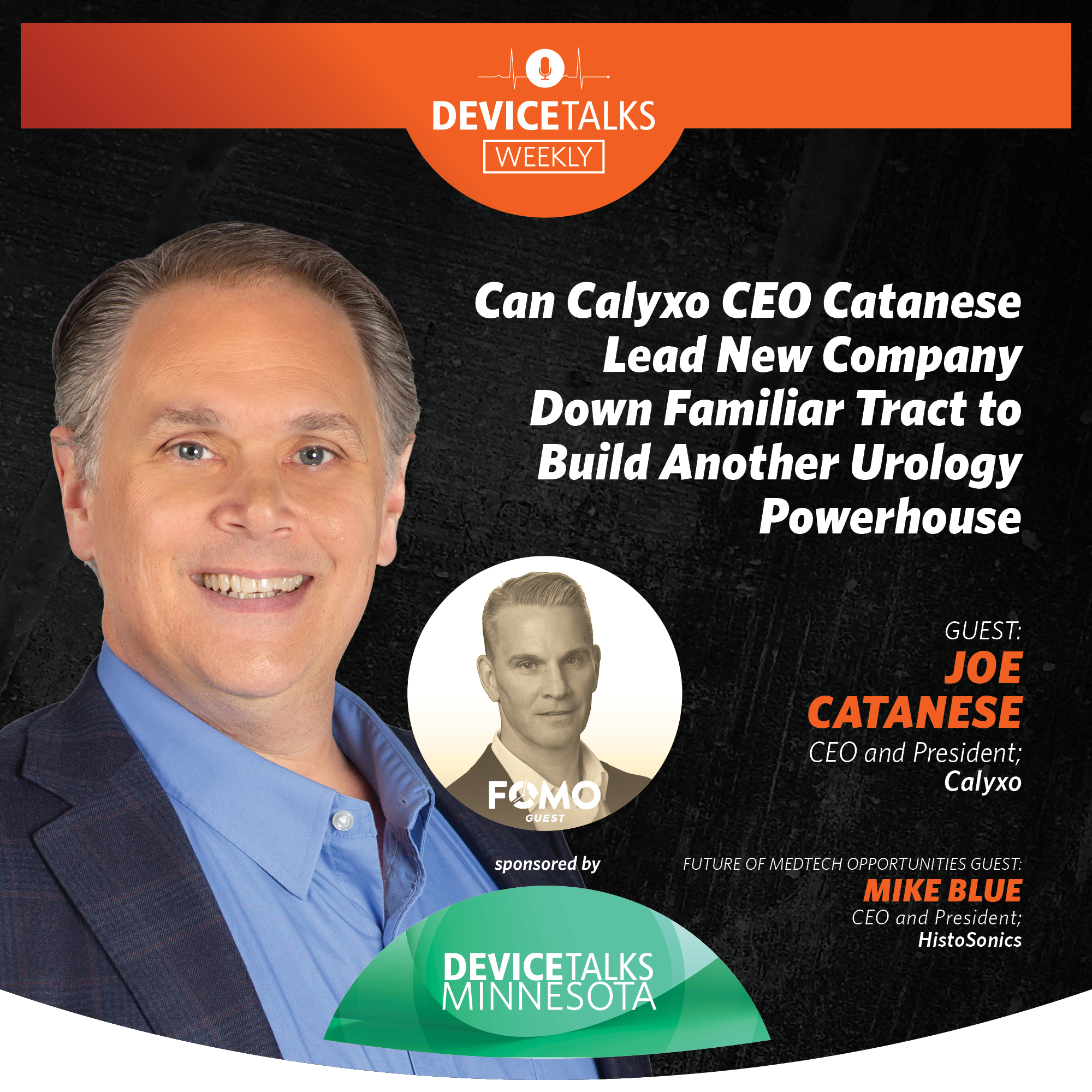
[00:00:00] Speaker A: Hi everyone, this is Tom Salemi. Welcome back to the Device Talks weekly podcast. What an episode coming your way. A little later in the podcast you'll hear from Joe Catanese, the CEO of Calixo, which is a very important company focused on the removal. The destruction and removal of kidney stones gave me something else to worry about and I'm glad Calixo is on the case. We'll hear about Joe's very impressive entrepreneurial story and what the plans for Calixo are. Before that, I'm going to play an excerpt from Chris Numericker's conversation with Mike Blue, the CEO of histasonics.
They spoke at Device Talks, Minnesota. The conversation was a lot longer than what I'm playing today, but I really wanted to focus on sort of the big picture value of histotripsy.
I cut out some of the testimonials from patients, but you should really go to histosonics website and check these out. The results are miraculous. And histotripsy is just one of those technologies that is just really easy. It easily captures your imagination and gives you a sense of what will be. And in this excerpt you'll hear not only from Mike and Chris, but some questions from the audience that I think led to some really fascinating answers. So enjoy that conversation and of course we'll kick the whole thing off with the newsmakers. We're joined by Jim Hammerand he is the managing editor of Metal Design and Outsourcing. And Jim and I kick around AI in Medtech is sort of the buzz behind us.
Is the hype diminishing? But what is the future for AI in metal devices? I mean, clearly there is one. Clearly it's important.
Jim, though, is taking a good deep look at AI's influence on metal devices and we had what I thought was a really interesting and far reaching conversation. So we'll kick the whole thing off with that one piece of housekeeping. I will be on vacation next week, so we will not be putting out a Device talks weekly on July 3rd. We'll be back the following week, which I guess would be July 10, but we'll be off next week. So I'll miss you terribly, but I hope you understand.
I just need a vacation.
But we'll be back again in two weeks. So enjoy the break from me.
Enjoy your holiday, your July 4th holiday with friends and family and look forward to reconnecting with you in a couple of weeks. And now let's get this podcast started.
All right, you ready for this?
[00:02:44] Speaker B: Ready,
[00:03:03] Speaker A: Jim Hammer.
[00:03:04] Speaker C: And welcome to the podcast Tom, thanks for having me. Always great to be here.
[00:03:08] Speaker A: Great to have you once again filling in for Chris Newmarker, who will return in our next episode. Folks, we won't have an episode next week. I'll be off next week. So no device talks weekly on Friday. But, Jim, it's summertime here in Boston. I'm pretty sure where you are as well in the Pacific Northwest.
Any big plans this summer? Any trips planned?
[00:03:29] Speaker C: Yeah, this is our first summer where we've got a summer break. Maddie, our oldest daughter, she just graduated kindergarten. So for the first time, we're kind of scrambling. Okay, what do we do? So she started some camps this week. She's loving it.
Her, her little brother James is very jealous that he doesn't get to go to the camps and has to stay in, you know, boring old daycare. But we're going to stay close to home. You know, in Seattle, we try to take advantage of the beautiful weather in the summer when we have it. So we'll go out to, you know, we'll get into the mountains, we'll go out to the lakes. We are planning to come your way in August, though. Yeah. My. We've got a bat mitzvah on the wife's side. So we're going to be taking the whole fam damly cross country flight. This will be the longest flight we've done with them since taking them down to Disney in California. But I think they'll be fine. You know, put an iPad in their hands, give them snacks, and then I'm kind of, I'm okay with it because I won't have someone, you know, sitting next to me who's too, too big, taking my armrest, taking the space. I'll be able to take up, you know, one and a half seats on a long flight out there.
[00:04:26] Speaker A: Yeah. I always feel bad for those parents who feel self conscious about having kids on planes. It's like, we're fine. Like, I've got my headphones. Don't worry about it. Anyone who gives you a hard time can go to heck. Really?
[00:04:37] Speaker C: Yeah. Ever since I became a parent, I just have nothing but patience. And, you know, I blame the kids if anything else. But again, they're just kids. No one wants to be sitting in a tube for hours at a time. It's getting harder to fly, so I've learned how to be patient and also to tune out a lot as a dad.
[00:04:52] Speaker A: Exactly. Speaking of tubes, in Boston, I read in the Globe this morning one of the biggest tourist destinations is the cop slide. Are you familiar with the cop slide.
[00:05:00] Speaker C: I am familiar with the cop slide. I saw the bagpipers going down it for the World Cup. And when we were in Boston for device talks, actually, one of our newest editors, Skyla Rivera, she made a pilgrimage to the wonderful, wonderful little landmark you've got there. I try to stay out of those tubes, but you know, I'm not interested in that. Maybe next time I'll bring the kids and fire them down.
[00:05:25] Speaker A: I hope you are able to check that out.
So we've had a kind of an interesting week here in Medtech. I actually had a conversation with my brother. We have a text chat thread that we talk about. Usually they go on and on about autonomous cars and AI and they're big thinkers. But this week we talked a bit about medtech because of the Mid Journey announcement. They actually asked what I thought about the Mid Journey ultrasound CT scan and kind of brought, I think Medtech in the mainstream a bit, which was kind of fun. I know you had a post about Mid Journey that was actually last week and I know you made like the LinkedIn whatever the news roundup thing.
[00:06:08] Speaker C: Yeah, yeah. Where, where all the crazy people come to your LinkedIn profile and you get, you get a biggest spike in, in comments when you, when you get that. Yeah, that was, I think that was on Friday. And it's funny. Yeah, we get, every week we get some other families over at our house for pizza night where no one has to cook, no one has to clean. We just put all the kids in front of a Disney movie with pizza. And some of the parents are, we've got some parents that work in software and AI. Some of the parents, we've got doctors, nurses. And it was, it was a topic of conversation around us too, because it is a pre, you know, I originally kind of thought it was an unbelievable plan. I'm, I'm a little bit less skeptical now that I see the involvement of butterfly networks in it. But yeah, a hot topic of conversation just because of what they want to do. And it was funny on LinkedIn initially you see this announcement. So for anyone that doesn't know what, what the news was, and it felt like it was everywhere. But this is Midjourney. They're a general generative AI company. So they use these large language models to make things their, their, you know, focus is on photos, images, videos. And so they say they're going to first AI powered medical imaging spa and offer rapid whole body ultrasonic CT scans in 2027. So that's coming up quick.
[00:07:19] Speaker B: Right.
[00:07:19] Speaker A: Yeah.
[00:07:20] Speaker C: And so right off the bat, you know, medtech pros are going to say, good luck with that. Initially all the AI boosters were saying, oh, this is going to be great. This is going to be a, you know, a new frontier. But medtech pros, they say, okay, well let's see what the FDA has to say. Let's see how you can do a full body scan using ultrasound, which can't penetrate bones. You're not going to get anything of the brain. It can't penetrate, you know, it can't see through air and gas. So there. And, and you know, midjourney, they're being careful not to make medical claims. They're saying they're going to offer these detailed body composition maps. So originally I just said this is unbelievable, this is incredible. But they are working with Butterfly Networks. They have this ultrasound on chip technology. We've, we've written about it at Medical Design Outsourcing because it's enabling handheld ultrasound. And what they're doing is they want to make this ring of chips. So Butterfly Networks is selling them the chips, working on it with them, where it's a big ring of these chips. They're going to bounce ultrasound at you at thousands of times per second as you go into this, lowered into this bath.
And I briefly chatted last week with Butterfly Networks VP of Global Quality, Regulatory and Clinical affairs and he says it's real.
And so I thought, okay, well you know, that, that, that's interesting. But then the medical professionals start weighing in, the physicians, the med tech pros who are saying, you know, it's going to take a lot to get this to happen.
At what point do you cross just general wellness of oh, hey, it's kind of neat to have these, you know, imaging maps of your body. And at what point do you actually say, hey, something came up, I'm going to go in and get a scan. I don't think there's anyone, medtech that thinks that there's, that we need more imaging. As far as, you know, the radiologists are over overwhelmed. We know very well documented the risks of overimaging. So, you know, if people just want to go get weekly body scans, it's probably going to flag a lot of things that are better off left Al and then what's the cost going to be for this? I mean if they're, they're talking about huge volumes of data to process these, stitch these images together to save them, to analyze them, I mean that ain't cheap. And we're starting now actually to get a look at just how Expensive. Some of this LLM and AI technology is.
And there's a bigger story here and a trend kind of. We've been looking at mdo, which is. I don't know if you felt it, Tom, but it kind of feels like there's this vibe shift around. AI generally feels like the public's kind of pushing back.
[00:09:33] Speaker A: I mean you've been, you've been, I think pushing back earlier than a lot of people. I know you've been, you've asked good questions.
And I do think that we're starting to see some of the numbers from the big companies and starting to see there's not a lot of there there.
I have not yet seen sort of changes in positioning or pitches for stories or things like that. I don't know if you have. I think people are still AI forward at this moment. But would I be surprised if three weeks from now I don't get any sort of AI discussions or we're not talking about the power of AI and digital surgery as much as we were six months ago? No, I would not. Because I do think we're at a point where, yeah, you know, yes, AI can do a great deal, but we just don't know what yet and we need to stop getting excited about it until we know what that is. And I think the mid journey thing was a perfect example and it was a case I made to my brothers. I'm like, look, how does this, this thing find its way into an emr? Like what use does it have? Do I bring it at my doctor? He doesn't even care what's on my Apple watch. I'm going to show him a 3D image of myself and suddenly it's going to say, oh well, this is slightly out of place.
No, it doesn't make any sense. So what's fascinating about standing where we stand, I think is that we have all the technology excitement like the Medtech Bros reference you're talking about, but all the excitement of technology and then it just slams into the wall of healthcare reality of who's gonna pay for this.
Oh good. Some motivated people who have a lot of money are gonna pay for it. Well, that's not gonna do anything to bring down healthcare expenditures or improve healthcare overall.
So I think AI, getting back to your original point, I think it's starting to hit that wall as well.
[00:11:16] Speaker B: Yeah.
[00:11:16] Speaker C: And I think, you know, there's a lot of really good use cases for AI in MedTech and it's tough because, you know, people getting fed up over the hype. It has Everything to do with these LLMs, these large language models like OpenAI, artificial intelligence right now is really just a marketing term. And it covers things like computer vision, it covers things like machine learning, where there are really good applications in MedTech. But the LLMs, they just don't seem to be good for medtech right now. But they're the ones that are hoovering up all the venture capital money. And so, for example, these LLMs, we've experimented a lot too, to see, hey, is this the kind of thing that could help us get ourselves smarter on a topic quickly? Could it help us prepare for interviews? Could it help us generate content?
And the answer is LLMs can crank out a lot of text if you're not too worried about how, how accurate it is. And it can generate software code really fast, which is helpful if you're looking for quantity over quality.
But, you know, I mean, what I'm seeing is tons of, you know, spam and even scams in my inbox. And then we're hearing more about cyber threats and AI risks for medical devices and healthcare providers. And so now that we're, you know, you mentioned the financials. You know, we've seen SpaceX IPOS financials, which is basically an LLM company with rockets and satellites, and then OpenAI, those financials just leaked. And both show that these LLMs are massively unprofitable. So when you're thinking about how can you apply them in medtech, we know it's got to pencil out. We know that we've got to consider reimbursement and who's going to actually pay for it. And it's not just the capital expenditures to buy these chips and build these data centers, but these LLMs, unlike other kinds of software, they have ongoing costs of constantly training the models and to run them. It's incredible how expensive it is.
So Brian Miller, you just had him on stage at Device Talks, Boston to discuss the big telesurgery opportunity. AI plays a role in that. I interviewed him earlier in the year when he made the move from intuitive to savato and making the jump into telesurgery. And I asked him, like, what are the, are these vibe coding services like? Claude Again, another LM, are they suitable for MedTech software yet? He says it's helpful kind of as a tool for testing. It's fun to play around with, but you have to constantly scrutinize and supervise it. And outside of medtech, we're increasingly hearing these major tech companies like Uber that just can't justify the spend and so that's hard for, you know, medical device companies when they're really trying to figure out where do we focus our R and D, where are we going to get the most bang for our buck? A couple years ago, I was talking with medical device executives who were joking about going to their CEO and their CFO to make the case for here's what our R and D budget should be. And one executive joked, I gotta lead with everything AI, otherwise I'm not gonna get the money I need. Not hearing that as much anymore now that organizations are really getting a taste of how, how expensive these LLMs are. I think Uber ran through their entire quarterly, their entire annual budget in a quarter because these things just, you know, they're not getting cheaper. Maybe the cost of tokens are getting cheaper, but the cost of actually doing things on these models and how many token tokens you have to use, it's getting more expensive. And so that's, you know, again, that's getting kind of into the weeds. But there's a lot of people saying, hey, this money could be better spent elsewhere. There's certainly a need for more VC funding in MedTech.
But back to the medicine we're looking at MDO.
How do patients and physicians feel about AI? How can you build trust? We recently published the latest Future Health index from Philips, and they surveyed patients and physicians across the globe. And so 65% of doctors say they've had to correct AI generated misinformation from patients. And then 33% of doctors say they've seen patients lose trust in their care after learning AI was involved. And again, they're good applications of AI, like machine learning, computer vision. But how do we, you know, how do device developers prove that they're worth using?
And even with those, you know, one of the big questions we're looking at right now at MDO is questions of deskilling. Do doctors using AI get worse at their jobs without AI? There's one troubling study that said clinical evidence showing AI improved polyp detection during colonoscop might have only shown that superiority because the doctors have been de skilled from their use of the software and they actually got worse spotting polyps without the software.
So the two big questions at MDO were talking about is where can AI show ROI in medtech? And how can device developers build trust in AI?
[00:15:25] Speaker A: So, of course, yeah, I hear your point about the doctors and I bump up against. We know that there's a declining number of doctors in the future, you and I, as we need our medical Care as we get older will be screwed.
You know, I talked to my primary care, he's a little bit older than I am. I got two years left before I have to go back out into the wilderness and find someone I can trust.
As those numbers get lower and lower, I think we're going to need AI. I think we may need these full body scans. I think we're going to need these doctors to cover more territory. Maybe I pop in a scan every month and I only go to the doctor when something pops up. I think you and I are saying, like, there's a there, there someday, but we can't get there right now. So it's really hard to kind of straddle these two worlds of you want to be forward thinking, you want to be optimistic, but you also don't want to be sensational. And you don't want to be. And you don't want to be wrong either. You don't want to go too far on a limb and say this is never going to happen. But we've had similar conversations about surgical robotics 20 years ago where this is a gimmick, this is never going to work.
Say what you want about, I'm a believer now, but it's an industry, it's here, it's not going anywhere. And I think it is actually going to be able to do a lot of good. So that climb up that hill where technologies get adopted is long and arduous and it might be faster for AI than it was for surgical robotics, I don't know. But it's still going to be long.
[00:16:47] Speaker C: Well, in the end, the question how do you do it right? How do you build trust in AI? Just like how did you build trust in surgical robotics? It's roi. You got to have results.
And it does get to can you increase efficiency of doctors, of their care teams? So, for example, JJ just launched their vellus hip navigation AI assistance. So that's software that can shave a few minutes off of each hip replacement by automating image landmarking. You know, where the doctor is matching up the pre op and current images to make sure that they're putting this implant in exactly the right place. So if you're shaving off two, three minutes per procedure, that's time that adds up over the course of a day or a month or a year for a single surgeon. So I interviewed the leader of the team that developed that software and his advice for building trust in AI was just don't lead with AI. AI for his own sake doesn't mean anything. He Says you have to start with talking to surgeons about real problems and things that would meaningfully change how they think about patient care. And they've got the data they can show. With our software, you can eliminate 2 to 3. I think it was 2.33 minutes or something like that off of the 5 minutes of the, the landmarking time during procedure. I mean, that is the kind of evidence you need to be able to bring to customers to say, hey, this is why you should be using it. The other thing is explainable AI, I don't know if you've ever heard, but it's just this idea that you've got to be able to explain how the AI works. It's almost impossible to do with LLMs, for example, because these are black boxes where outcomes are rarely repeatable just by their probabilistic nature. So if you can't tell a doctor how your AI works in a way that they can explain to the patient, no one's going to trust it, they're not going to use it.
And then the last thing is human in the loop. You got to keep humans in charge.
It's critical. You can't let an algorithm or machine learning model make the decisions for the doctor because they're ultimately responsible and they're the expert and neither they nor the patients want it. Outsource that and it goes back to, you know, this, this Phillips Future Health index survey found 93% of physicians insist on, you know, human in the loop. They want to be making the decisions. And so we talked with Philip's evp Shez Partovi about who oversees an annual report about building trust. And patients say, you know, if the technology you're using is for operational things like scheduling and check in, I'll trust it more. But if you're using this AI embedded technology to diagnose me, to treat me, to give me a prognosis, I will trust it more if there's a doctor in the loop, if there's a nurse in the loop. So these things device developers need to keep in mind when they're trying to figure out, okay, where am I going to apply AI and how am I going to. Once we've got a solution that we can show results, how do we build trust in it and make sure that does actually get adopted and used and can help reduce costs and improve outcomes.
[00:19:22] Speaker A: No, that's really a great point. And I think it goes to one of the strengths and I don't know if it's a weakness, but of MedTech, one of our limitations is that there's no margin for error.
You can't break stuff. You can't move fast and break stuff and fix it later. You can't, you know, you can't. And learn through sending up a rocket that you're not 100% sure isn't going to blow up.
You need to be absolutely certain and you need to make sure there are no ramifications or unfortunate outcomes or else you're back five or ten years.
So I don't know if I'm still debating because you and I had a conversation about the mid journey announcement and we were both sort of initially skeptical and then you sort of opened up to the idea and I followed you a bit, but I was. But I'm trying to decide whether these kind of conversations are helpful or harmful for Medtech because I love the attention, I love the infusion of excitement. But if you don't deliver, it's just gonna, it's gonna set us back. How do you feel about that?
[00:20:25] Speaker C: Well, here's the thing. They could make, they could have this technology pencil out if it's not FDA regulated. If all they're doing is selling weekly body scans to, you know, let's say San Francisco billion, who for them, $100,000 a week is nothing, you know, or something like that. And if they're not actively making decisions, but they just want this map and they want to do it like, you know, you hear crazy stories about people getting blood transfusions from younger people and you know, if you can cater to the triple comma club, you know, there's even a trillionaire now and you know, who might be so inclined, I could see him as exactly the kind of person that would be stepping into these submersible ultrasound baths and getting himself scanned regularly. I mean, if you can do that, I think that maybe this pencils out and you can make some money. But is it actually going to help anyone's health? Is it actually going to be a viable business that can be replicable? Is it the kind of thing that, to your point, can actually, you know, feed into, you know, electronic health records and actually help many, many people be healthier? I don't know. And the, the heart, the, the risk is that, yeah, this hype could then make people say, oh, well, they couldn't do this. Why are they, why is this other thing any differently? And you know, you talk about the safety aspect of medical devices and as a parent and as a person, really one of the biggest things that scares me about these LLMs is we've seen Repeatedly now stories where some of these chatbots, you know, they encourage people, they engage with people who are feeling suicidal. And we've seen now that in some cases they've encouraged them to hide it from people, to actually give them the information they need to carry it out. Could you imagine the massive recall if any piece of medical device software regulated by the FDA did any part of that? And so I think if anyone does try to get too close to what would you the FDA defines as a medical device? Does it treat a diagnose, does it prevent, does it mitigate all these different things for health issues? You get it anywhere close to that and I think you're going to run into the buzzsaw of the FDA and I think that could be really problematic for the kinds of things that they're hoping to do. And so time will tell. I'm not betting on them, I'm not betting on the LLMs as far as beyond what my retirement funds and index funds may invest in SpaceX.
But I'm firmly believer that medtech there's great uses for AI and MedTech as long as we figure out what those are and we develop them in a way that we can show the right evidence, build trust in them and ultimately make sure that patients are being treated safely and effectively. And that's the whole game.
[00:22:56] Speaker A: Absolutely. Great conversation. I feel like we could continue going on and on, but folks should know about medical design and outsourcing magazines coming out. We're now recording this on June 24th.
When's the next issue of MDO coming out? We had Skyler on on last week kind of highlighting her contribution and she did a great job. Anything folks should know about the upcoming issue?
[00:23:16] Speaker C: Yeah, absolutely. July. It's a surgical robotics magazine. Skylar and I worked on a feature story about the race for telesurgical stroke therapies. Talked with a whole bunch of startups about who thinks they have what it takes to remotely treat stroke. One of the biggest opportunities in medtech. But a lot of other good, good pieces in that magazine, including some excerpts from our interview with Brian Miller mentioned earlier. We' got an exclusive contribution from Intuitive and a lot of really good stuff. So keep an eye out for that at our website and going out in the mailboxes in July. And then yeah, a lot of great stuff coming from mdo. Again we're just really trying to focus on success in medtech innovation and what other medical device developers can learn from that. Specifically the engineers and designers, the technical hands on pros who really like to get into the nitty gritty. I don't think there's anyone else doing that kind of coverage like we are. And we're just so, so grateful to have a good team and to have the relationships we do with the OEMs and all of our great sponsors in the medtech world to make it happen.
[00:24:16] Speaker A: Fantastic. All right, Jim Amaran, thank you so much for joining us on the podcast.
[00:24:20] Speaker C: Thanks for having me, as always.
[00:24:21] Speaker A: Now, let's roll into the conversation that Chris Neuberger had with Mike Blue at Histasonics. For those who didn't see the news this week, Histasonics closed on a new financing with its value reaching 3.75 billion. It's just a huge technology with a big idea.
It has investors, including Jeff Bezos and Peter Thiel, and Reed Jobs has joined the round in its recent round of financing. So, so much to talk about, so much potential.
Mike Blue gave a great presentation at Device Talks, Minnesota.
We'll try to have him on the podcast a little later. The presentation sort of doesn't lend itself to a podcast interview, but this portion of his conversation with Chris Newmarker, that was really enlightening. So. So Jim and I talked about Midjourney and its application of AI and ultrasound. Histosonics, of course, is using ultrasound energy in a different way, but there's really an interesting opportunity, I think, as Mike lays out for ways that ultrasound energy can be used for scanning and for treating in the future. All right, we'll pick up this conversation between Chris and Mike Blue going back to the summer of 2025. Last summer, just before Histasonics announced its huge deal where it sold the majority of its stake for $2.25 billion.
Chris asked about the rumors at the time, which centered around possible acquisition of histasonics, and Mike Blue explains how they instead chose this different path that gave them the capital and the new syndicate and the power to move forward and to build something really big. And one more note, I did make some small edits to this audio recording. I cut out a few questions just to make the conversation more concise. Let's listen.
[00:26:18] Speaker D: Since joining the company, the prior chairman and I would always talk about my role being to create options for the company. And I always saw my role that way.
I was telling the story and creating options for the company, and generally that's different financings.
Ultimately, it became needing a liquidity event for investors.
The company was founded in 2009, so now we're in 2024, entering 2025, you've got investors who are at it for 15 years. These are small and mid sized venture capitalists. They need a liquidity event of some type. And so we had aligned after a year of commercial and realization that we would be ready to be a public company. And so we selected bankers that became not really don't know how, but became pretty public and was printed and then had an unsolicited offer to take us off that path and to acquire us.
And we had multiple strategic investors and there's pros and cons to that.
One of the realities was was there was a rofin, a right of first at least notice with one of those strategic investors. So almost by definition it created a process. We had an unsolicited offer which triggered the rofin. Now you've got two companies presuming that the second would want to submit a bid or an offer. And so then we started a targeted M and a process and then created a third option which would potentially be another private financing for us. It would have been a series E.
And as it turns out it was some of those who were going to, going to submit a series E term sheet that ended up being the acquirers of the company.
And so we created I think some competitive tension amongst all these groups to include the bankers who wanted to get a deal done, whether they were representing the IPO side or someone on the M and A side or potentially this series E term sheet. And it turned into a group of private investors who wanted to solve for the problem that we had which was providing liquidity to these venture capitalists. But, but also there were, we had a lot of investors who, who didn't want to liquidate that even at 2 billion. Our vision is that we see this company at hundreds of billions of dollars and we really believe that we're the next intuitive surgical and beyond.
And so we had to solve for multiple problems but this group believed that they had the ability to do that through their networks around the world. And so it was a tall task quite honestly the heart hardest part of what I had to do was convince the board that this was a legitimate offer that you, even though the names are Peter Thiel and Jeff Bezos and some others, are they truly going to fund this? I mean it almost seems unbelievable, right? Especially in med device. And none of these groups, including the consortium that really connected and put me in touch with those people, they had never done a medical device in investment. So it, it felt almost unbelievable and, and so tough conversation especially because that's
[00:29:40] Speaker B: something I've heard, you know, around The Twin Cities here's over the years is like, oh, we have so much talent here. There's, you know, so, so many interesting innovations around here. You know, we get ignored by the, by the coast. So I mean this was, this was kind of like a really neat, neat story for our community here.
[00:29:56] Speaker D: And we had talked about the same. I, I had said for many years, you know, if this, if this company was in the Bay Area and being run by Jeff Bezos or Peter Thiel or Elon Musk, I think it would have gotten to where it is today much sooner. I think this does prove though, if you do it, if you do it a certain way, not necessarily the right way. There's lots of right ways to do it. But, but we did have big plans and we, we, we could have made this a single indication product. In fact, we, Josh Topek, our CTO and I, we often talk about a blessing. It was that the BPH study didn't work. That was a device that had a transrectal ultrasound probe. It was only going to be used in the prostate. It was not a true platform.
And so we took that opportunity to create truly a non invasive platform that can be moved and delivered the beam therapy throughout the entire body. That was not the original product configuration. So we were blessed by that. But we did go big. I mean we, we decided to really sell the full platform opportunity and not limit it at one indication or two indications. And that has challenges with it as well. But I think ultimately it was rewarded for going big. And I look back at the two previous companies that I was with, Super Dimension, which got acquired by Covid, and New Wave, which got acquired by J and J and I, we could have gone bigger. I mean that's a choice that, that early stage companies have. Focus is important.
But I think a lot of these technologies do have the opportunity to be more than one thing. Whatever it is, they, they do. And those two companies, I look back and I wasn't the decision maker. I, I kind of wish we, we would have thought bigger about how big those technologies could have been.
[00:31:44] Speaker B: I suspect it would be tough in, in the early stages of the startups because you're just trying to stay afloat. You're, you know, you're mortgaging the house, you're asking relatives for money, even potentially so to, you know, to be like, let's go big. I mean, but I mean it sounds like to kind of have that fearlessness in a way.
[00:32:03] Speaker D: And I think timing is important too. I think if you're trying to Be too much too early. And you haven't proven that one thing. It can be tough. And so I think we were thoughtful prior to getting our first regulatory clearance that the, the tech was designed to not need a lot, a lot of other R D investment.
We had to prove that one thing, the one thing I learned throughout this journey, you don't get credit for anything that you're not doing at a clinical stage, period. We cure cancer in all sorts of mice, in rats, all sorts of cancers.
[00:32:36] Speaker B: The mice community thanks you for around man.
[00:32:39] Speaker D: We got mice running around this world that were all cured by histotripsy. No one cares. You gotta cure, you gotta do it.
[00:32:46] Speaker B: I think my cat cares.
[00:32:47] Speaker D: You gotta do it in. In. We do it in animals. We've got a, actually a wonder, a wonderful veterinarian program down at Virginia Tech using histotripsy to treat cool canines.
But if it's designed appropriately on the front end, once you get that first indication and you got commercial success. And we, you know, the blessing, one of the blessings that it took us so long to get to where we were is we had some extra time. I don't know, the board saw it that way or investors saw it that way. We had some extra time to really think through the commercials. Commercials or commercialization piece. And so a lot of effort went into the pricing and how that fed into reimbursement strategy. How the business model worked for hospital was going to be critical for selling a million and a half dollar robots, getting a pipeline of customers queued up to be ready for the regulatory clearance. And then once we showed that commercial traction and how quickly it could happen, it became then easy to convince investors to go quickly after that next group of applications and then come in last summer a group of investors who, you know, money is of no object and now it's, it's.
There's an emotional connection to all of these investors about getting into brain and treating glioblastoma, getting into brain and treating epilepsy, treating afib, on and on and on. And you've got to prove it to get there. But if you're set up on the front end to once you prove it to go fast, I think there's a lot of value in that. Wow.
[00:34:20] Speaker B: We got 10 minutes left. Let's get some some questions going here.
[00:34:26] Speaker E: Thanks for the presentation, Mike.
In the spirit of thinking big and you know, like Chris said, you're balancing a lot of day to day problems as well. But in the spirit of thinking big, have you considered expanding your offering to diagnostics in the future. So like a histotripsy pod, I walk in, I get diagnosed and treated in the same go.
Since you're being backed by Jeff Bezos and Peter Thiel, you know, and they're kind of forward thinking in that way. So I'm wondering if that's been discussed or if you're allowed to share.
[00:35:00] Speaker D: That's an awesome question. So, yes, and it's interesting that you mentioned. So when I was, it's almost surreal to say, when I was pitching to Jeff and he was awesome, we had 45 minutes. We ended up talking an hour and a half. Half his mind went right to, why would I ever need to biopsy a patient again if, you know, he said, I just had my full body 40, MRI, if I had anything, why wouldn't I just Histotripsy. And you never have to worry about sticking a needle or taking a biopsy again. Now that's a bit altruistic. Something like that, like breast cancer, requires a lot of additional testing to understand the mutations and everything to figure out what the right treatment is. But you can definitely envision a world at some point where.
So we're collecting at multiple sites a lot of blood. We take blood prehistotripsy and post histotripsy. And you can absolutely see an immune response, T cell and other lymphocyte activation after the histotripsy. So you could imagine you could, you could hit a tumor with histotripsy. You've got circulating Connecticut DNA and other lymphocytes with the blood that you could easily draw blood from and biopsy and potentially diagnose as well. So, yeah, the future there is potentially endless as well. It's a great question.
[00:36:28] Speaker E: Be a great way to capture more revenue on the diagnostic side of things.
[00:36:32] Speaker D: And the company loves revenue. We absolutely love Reven. And so we. And we also envision a day where there's histotripsy centers and clinics that you could, you can come in and get your scan or maybe not a scan, but you could do all of these workup diagnostics with histotripsy to include also treatment and leaving without your disease as well. So. Yeah,
[00:36:58] Speaker F: thank you. Great presentation. So my question is on competition, right? So right now you guys are, you know, the big play in the market.
So I, I was a relevant employee. I think some of my former colleagues are with you guys.
So how do you plan for competition? Like, what's top of mind for you? And just, you know, how are you thinking about that
[00:37:23] Speaker D: competition today? And it's a stiff One is standard of care. I mean to move, to move a medical oncologist to reef changing their referral patterns is like the hardest thing I've ever had to do in my career. It's going to require an extensive amount of clinical evidence. We're blessed. These same investors that we've mentioned, and there are many more that don't have the names of some of these others, they are convinced, convicted to build this company the right way as if they were building SpaceX and you've got to build that the right way. No, you cannot cut corners. This is the same they really believe in, in significantly investing in, in clinical studies that build the clinical evidence that it's going to be required to move a medical oncologist to say, not necessarily the stage four candidates because they're going to find histotripsy on their own. They're desperate. Like everybody patient there. But how do you move an early stage, stage one who can be cured, whether with surgery or some other intervention? Those are the tougher ones to move. And so we'll build that clinical evidence. So right now it's the standard of care and it will be for kidney and it will be for pancreas and it will be for prostate and then everything else we do beyond that, in terms of company competitors, we are super maniacal about creating the biggest moat we can. So what we do is unbelievably complex histotripsy and the way that we deliver it, you've got hundreds of beams coming from elements within a transducer that are hitting skin, overlying tissue, organs, critical structures, all at slightly, a different time.
We need to in real time adjust those beams so that all of them collapse, collide at the same focal point. At the same time they're colliding at thousands of pulses per millisecond.
It's unbelievably complex. It defies conventional ultrasound wisdom, whether it's diagnostic ultrasound or therapeutic ultrasound.
So it's going to be really tough. Even if, even if, and we're maniacal about our intellectual property, we're even more maniac about what we don't file in the public domain and what we the know how and what we keep as trade secret. If it can't be reversed, engineered and is not obvious when you, when you reverse engineer it, it's trade secret. We have more trade secret in the company than we do intellectual property, which is something for early stage companies to really think long and hard about. So we feel really great about our position. We're not naive to think that Someone isn't going to care about our investors intellectual property portfolio and try to overcome all of that. But we feel like we've got an enormous head start. It's incredibly complex what we do.
[00:40:09] Speaker B: This is fantastic.
[00:40:10] Speaker D: Well, thank you, Chris. Thank you everybody.
[00:40:15] Speaker A: All right, well, I hope you enjoyed that conversation. Histasonics again, it's just one of those amazing stories. Congratulations to the folks there for the money they're raising and the good they're doing.
And once again, I do really recommend you go to histasonics website and just check out some of the patient testimonials.
They'll make the hair on your arm stand up. And it's just amazing, important work. So look forward to hearing much more from Mr. Sonics in the future. Okay, now we're going to cover a topic that causes the hair on the back of my neck to stand up.
We talked about kidney stones with Joe Kesennese. He's the CEO of Calixa. So Calixo is really sort of finding a really creating a better way for removing broken kidney stones, which can obviously are safer than the larger kidney stones, but the pieces can still create problems and the way they're retrieved right now is now is just, I think, wildly inefficient. And Calixo just seems to have a better way of getting this done and they're seeing some success us and we'll talk about that. So now enjoy this conversation with Joe Cantonese. He's the president and CEO of Calixo.
Well, Joe Canse, welcome to the podcast.
[00:41:36] Speaker G: Thanks Tom. It's great to be here. Appreciate the opportunity.
[00:41:39] Speaker A: Looking forward to unpacking this Calixo story. You've obviously built a great name for yourself founding another successful company, Neo Track. We'll unpack that as well. Well, I love the startup journey. What was the origin of your journey to medtech? How did you find your way here? Because it looks like from your early days in education, you were set upon bioengineering and doing what you're doing.
[00:42:04] Speaker G: Yeah, that's right. Back when I was in college was the very, very early days of bioengineering as an academic discipline and where I was studying, they didn't have a bioengineering degree at that time and knew pretty much early on that I was going to likely focus on mechanical engineering and found my way to a really great research advisor, Don Bartell, who was doing early work in hip implants and learned that from him. That really getting a good foundation in a traditional engineering discipline and then applying that to biological problems. Was a sound way to go. So again, likely due to the very nascent stage of bioengineering as an academic discipline then and so decided to focus on bioengineering, but from a mechanical engineering background and then moved on to graduate school in a PhD program in bioengineering, but with still a heavy focus on mechanical engineering. So I worked in orthopedic biomechanics and had a home lab that was in, in the mechanical engineering department at Cal.
[00:43:12] Speaker A: What was the draw to Medtech? This was in the 90s.
The medtech industry was not the first place that folks were spending their time. Their tech industry was booming. There was a lot more interest elsewhere. Why did you choose MedTech?
[00:43:28] Speaker G: I think the sense of purpose, the ability to really improve lives was a big draw for me. And I had friends leaving Cal, whether it was at undergraduate level or those with graduate degrees. You know, a lot of them going into academia, a lot of them going industry. And the pace of industry versus academia was very exciting to me. And the ability broadly from a med tech standpoint to really change patients lives was, was appealing. Right, the sense of purpose.
[00:43:57] Speaker A: And did you see startups as your, your primary path? I know you were involved early on with, with, in your career early on with Transvascular.
Did you ever set your sight on being part of a bigger company or did you know you wanted to have your sleeves rolled up and be involved in a lot of different things at a startup?
[00:44:14] Speaker G: You know, when you're coming out of school at any level, I think you just want to get a job. Right.
I wouldn't say I had a particular bias at that point, although got very, very fortunate to get connected with the folks at Transvascular, specifically Josh Machauer and Ted Lampson who were there at the time. Obviously Josh founded that company company and go in there and see what a startup was like. I had worked as a co op student at a larger company and very quickly realized yeah, startup is a much more dynamic and suitable environment for me. So I don't know that I knew it ahead of time, but was able to get connected with some great people and see that that was a path that was going to be likely a more enjoyable career journey for me.
[00:45:02] Speaker A: It's a great, great person to start with. Was Josh Machauer easily identified as Josh Machauer back then? I mean this was now he's of course not only at Stanford, but he's led with a lot of policy. He's an industry leader. Did you recognize early on that this is going to be a person? I'M happy to be connected to and want to be affiliated with for sure.
[00:45:23] Speaker G: Yeah. I mean, of course Josh is fantastic. And this was only his second, second company, Transvascular, and so very early days in terms of his. His whole overall experience. But it was clear that his approach to things, which, you know, at that time really predated the. The biodesign program was.
Was visionary and had the opportunity to really create a lot of change.
[00:45:49] Speaker A: So Transvascular would go on to be acquired by Medtronics. You had a taste of the larger company.
Any temptation to stay there, or did you sort of, sort of recognize that you wanted to get back to the startup world?
[00:46:01] Speaker G: I recognized I wanted to get back and really, really enjoyed my time at Medtronic. I think big companies, when done well, do a lot of things really well. They had. Medtronic had a great program to invest in leadership development. And even though I was there for a short time, I got to really enjoy a couple of those programs and work with a lot of dynamite people. And I wouldn't trade that experience for anything. I think in part right for those experiences.
But the other thing it really gave me visibility to is how does a larger company look at a new technology, whether it's at an early stage or maybe, you know, an early revenue stage, and think about integrating that into their business and what makes it appealing and had the opportunity to serve as the integration lead from the transvascular side. So really saw a lot of the integration activities, activities firsthand and a lot of things that maybe we could have done a little differently at Transvascular that would have smoothed that transition.
And so there are some important lessons there for me that I really value. So it was clear that I would move back to a startup in my mind, but really valued that time and wasn't necessarily in a rush to move through it.
[00:47:14] Speaker A: Give us shine some light on the neo tracked experience. You're a founder of the technology.
Interesting approach to.
To helping treating the prostate rather than removing the tissue, sort of moving it. How did you come to identify that as an area you wanted to work and how did you recognize or see the potential for such an approach in technology?
[00:47:41] Speaker G: So Ted and I both, Ted Lampson and I both went up to Medtronic Vascular in Santa Rosa as part of the NeoTrac, the transvascular acquisition into Medtronic. And Ted left and joined Josh at the explorement incubator three or four months before I did. And he was starting to look in a few different areas, including orthopedics, which as I mentioned that was my area of research in graduate school. And so we had stayed in touch, and they knew I'd be leaving Medtronic at some point and started to have those discussions when they were thinking about orthopedic projects. And so I started working through my exit at Medtronic, anticipating showing up at Explore Med and starting to work on orthopedics. And I got there, and they said, hey, we're looking at the prostate instead. So a little bit of a surprise, but it was fine. You roll with the punches. And it was fascinating to get into a different disease state and learn something new and understand it. And we. We had a really dynamite consultant who did a lot of work around all the prior minimally invasive BPH therapies. And she came in and told us, you guys shouldn't go into this space because there's a lot of broken glass, there's a lot of things that have worked for a bit and then kind of fizzled. And urologists have been burned on this before.
[00:49:08] Speaker B: And.
[00:49:09] Speaker G: And we said, okay. So we talked to a lot of urologists, and we really sought to understand why. Why didn't those other technologies work? And it was really digging in on why didn't those other technologies work and what's causing the obstruction. And I think, in large part, our lack of knowledge in that space, if you will, Right. In terms of urology and prostate, that allowed us to think pretty differently. And the original idea in terms of the approach to pinning open the prostate actually came from my time in orthopedics. And I had thought, what if we could actually use something like a K wire, which is a small bone fixation device, and we could send it in transdermally, kind of actually map it all the way into the urethra through outside the pelvis. And it was a totally crazy idea. But the idea was, could you get something into the urethra and then pull back the tissue just to mechanically open the.
The prostate or the urethra?
And we joked a lot about that, right? We took who could potentially anchor it to the bone, and, you know, would that be comfortable? And so forth. And when you started looking at where things would line up, it turned out that, like, in all likelihood, you know, if you lifted your leg, the urethra would open more. And so we kind of joke that guys could pee like dogs.
But.
But we. We kept hammering on that idea, and we ended up talking to a doctor, a urologist over at Stanford, and he said, you know, this is kind of interesting, but, guys, there's an Easier way to get to the prostate, you could try the front door.
And so obviously there is a natural orifice, easily accessible, that provides you the access to the prostate.
And so we started hammering on that idea and ultimately that became urolift, right where we turned the direction of the pinning around. We started on the urethral side and we didn't need to go all the way to the bone. It turns out the capsule outside the prostate is really firm and that that can provide an appropriate anchoring surface. So a lot of trials and tribulations to get that to work, but that was the nidus for it all.
[00:51:12] Speaker A: That's amazing.
The term broken glass is interesting to me and it's one that I think would be a deterrent to many. How do you see when you see a lot of broken glass? Do you. Is there always an opportunity there? Is there always a way to step around it or is it. Sometimes it is an area that you need to avoid. How do you look at that sort of dynamic?
[00:51:32] Speaker G: I think it's always worth studying.
Right.
I don't know that there's always a solution, but I think a lot of folks where you come in with entrenched ideas or tribal knowledge of how things have been done, that can be blinders right to your thinking.
And so if you really dig in and understand why have these things failed or why. Why hasn't anybody been able to solve this? It could be because they don't have the constraints. Right. It could be because they haven't fully really defined the problem and drilled down deep enough. So I think those.
It's never an area that I necessarily shy away from, but it's a question. It leads to why, you know, why. Why is there broken glass? Why isn't NBP able to traverse this course?
[00:52:24] Speaker A: So. So Neotrac would of course go on to be acquired by. By Teleflex.
You were able to make that possible, the company was, by building a business and by engaging the physicians. What was the. This is a completely different approach than for BPH than had been done previously.
And you were in charge of professional education. What was that lift like trying, no pun intended, getting physicians to see this different approach as a, as an alternative.
[00:52:54] Speaker G: You know, occasionally it was easy and usually it was hard, meaning that there were some doctors who again were just open to a new idea.
And you'd say, look, we're going to move tissue out of the way way. And the primary objection for those who are open minded was still if we leave something in the urine stream, it's going to encrust. But by the time we were commercializing, we had implanted hundreds of patients and we had really strong evidence that under appropriate installation of the implant, they didn't encrust. And importantly, we also had information that if they weren't installed correctly, they did encrust. Right. So you can tell the surgeon, you are correct, that things in the urine stream will encrust. However, if these are installed correctly, they're going to pull into the tissue deeply enough that there's nothing exposed to standing urine and it won't encrust. So that was the primary objection from the doctors who kind of intrinsically understood it, that you don't need to remove tissue, you need to move it out of the way.
But that was a minority, probably, you know, between 2 and 3% of our customers or something like that.
Most really took more convincing that this could work.
And it was a challenge. And the, the challenge evolves in large part, right, based on how much experience you have with the product in the market. Right. Year one of a launch is very, very different than year three, four, five, when you've treated thousands of patients and you have that kind of social proof from some of their peers and so forth. So that evolves over time. I would say the biggest element really was as more and more payers came on board that really allowed us to position things as all or majority of the payers in your area are now paying. This is becoming part of the standard of care and really shifting the mindset for those surgeons who are maybe open to the idea, but open to it for a very, very narrow patient set.
And how do we, how do we change their mind? So, you know, I was responsible at that point for both professional education training surgeons and our sales training program. And so it was an interesting time to try and bring engineering principles and process to, to a sales process and change that behavior. Because ultimately the lift, I think, for a lot of technologies, for disruptive technologies, and in that one in particular, particular for a doctor to use Urolift, they needed to change how they educated a patient in that 10 to 15 minute patient consult. And we don't get to be in the room, right? So you're really changing their behavior.
And it's a, it's a challenging thing to do. But most who went through that process were grateful because they did deliver impactful outcomes to their patients. They got a lot of their patients off one of their medications and, and improve their quality of life beyond what the medications were.
[00:55:54] Speaker A: And I was curious as to what role the patients played in that. I mean, if I was presented with this choice where you're not destroying tissue and the risks that come with that, it seems like something I'd be completely open to. Were patients a big part of the cell or did you have to access the patients through the surgeons?
[00:56:14] Speaker G: So as we scaled, we certainly set up direct to patient programs. And that was the huge part, right? It was a huge part, actually, in terms of the. I would say the middle stages of some of the urologists coming on board saying, I've had three patients come in this month and ask me about it, so I think I better. I better learn how to do it.
And so the patients were a huge part. One measure of that. And I'm not an expert in the digital marketing side of things by any means, but I recall at that time we did have an expert and his view was, you know, was that the cost per click was incredibly low in that space, which is an indication that there's a strong interest from the patient population. Right. They're doing a lot of the searching and I guess that drives down the cost per click, as it were.
[00:57:01] Speaker A: So interesting. So once again, you were with Teleflex, vice president of innovation and operations for a few years.
How did the Calixo opportunity to come to you and did you have in your mind that I want to be CEO, I want to run a company? Was that something. A box you wanted to check?
[00:57:20] Speaker G: It wasn't so much a box that I wanted to check, but I would say in the middle years at Neotrakt, I thought it was a role that would be engaging and exciting for me.
And so after a few years under Teleflex, which was also a great experience there again integrating one company into another and making that transition, I reached a point where I realized the next thing for me wasn't there. I wasn't at Teleflex. And my passion is developing new technology and growing them, I think. We announced that we had treated 400,000 patients with the Eurolift system. And I just couldn't look in the mirror anymore and say, this is still new, right? And that product still had a long Runway ahead of it. And that was what Teleflex wanted for the product line, which is fine.
And so I made the decision to leave separate from what was next. I wasn't in a hurry to leave. I was really enjoying what I was doing. And Dave Emerson, who was the CEO of NeoTrack for many years and was the GM of our business president at that time for the business with Intelliflex you know, I gave him lots of notice and not, not running out the door. But the next thing's not here. And at some point over the next year I'll. I'll probably head out. I was hoping to take the summer off after a pretty long run with with Neotrakt in it was planning to leave in early 2020 and take the summer off. And in mid-2019 was introduced to G Shin. She's the founder of Calixo and GE told me the.
The work that she had done and showed me the feasibility study from the first generation CVAC product. And I found it very compelling.
As it happens. I also had a kidney stone and I knew a lot of urologists for my work at Neotract and I had a kidney stone that wasn't causing me any problems.
And I knew that if I got treated that kidney stone would be broken down into lots of small pieces. Some of them would be removed, some of them wouldn't, based on the technology that was available at the time.
And any one of those stones could have dropped into my ureter and caused me a problem. And I was traveling a lot and said I'll kind of sit tight and do nothing.
So I was already pretty aware of kidney stones and the treatment options. So I met G. She walked me through what the Gen1 technology was and the early feasibility data and I was intrigued and she asked me to help her out. At that time she was running it largely as a virtual company company. She had our.
The CFO from NeoTrack, Doug Hughes, who is our CFO here at Calixa now. He was involved with GE at that time and an advisory and more than advisory role. He was helping her out a fair bit. But it was GE full time, Doug part time and then a bunch of consultants, largely a virtual company. She asked me to help out as an advisor. They were having some struggles with their contract manufacturer and wanted my input. I didn't know at the time, but G and Doug had alternative plans in terms of me joining. As the CEO conveyed to me, that was never my intent.
It was something new. And so I let folks know and one night a week she would send me some questions or some documents to review and I'd give feedback. And about six months later she said we're about to raise money and for this company to be successful we need someone who, who's been through this more.
G is dynamite. Still involved with the company day to day and a critical part of the organization. But she had come from a venture background. She hadn't Been in an operating role at a company. And so when we raised the, she raised the series B when I joined the company. And I think my official start date was March 2nd of 2020, just about a week before the shelter in place order went in effect here in Alameda County. So really interesting time to jump into a new business.
[01:01:23] Speaker A: So talk a bit about the company and about the CVAC system.
[01:01:28] Speaker G: Yeah, so the CVAC system is a stone clearance device. So prior to CVAC and we're now using our second generation system which launched in 202024 at AUA. So it's just been on the market for about two years now. The AUA is the American Urological Association Annual Meeting, which is in May every year.
Prior to that, we had a first generation system which was a steerable vacuum aspiration catheter. And so when a surgeon treats, don't they have three different treatment options? But overwhelmingly more than 70% are done ureteroscopically. So natural orifice, a ureteroscope, which is a specialized endoscope, is fed through the urethra blast bladder and then up through the ureter and into the kidney. And then a laser is put through the working channel to break down the stone. And over the past decade, the lasers have gotten significantly better. So doctors are really good at breaking the stone, but the only tool historically that they've had to remove the stone is a wire basket, which is pretty clumsy. It's a two person operation and you've got to fish each piece out kind of one, maybe you can grab two, two at a time. And it's really tedious because you've got to pull the whole instruments, instrumentation set out of the patient. Right. It's 18 to 24 inches into the patient, taking it all out, releasing the stones, going back in, navigating within the complex anatomy of the kidney, grabbing more stones, et cetera. So as the lasers have gotten better, doctors have said, let me just break the stone into smaller pieces.
They'll all be smaller than the ureter. And then the patient can pass the, the stones.
The issue is the patients will pass some, but not necessarily all. And especially patients with larger stones. When you see all that stone dust, you don't know if everything is small. And so some of those things are big enough to cause problems. And so there's been a migration over the past decade from trying to fish out all of these stone pieces, which was tedious and not terribly effective, but some of the stone was coming out to dusting the stones. And so the timing was really great. When our first generation product came on, because it could have evacuated, evacuate all of these smaller fragments and dust, the challenge was it was performed under fluoroscopy. And while fluoroscopy was already present in the procedure, it was challenging to navigate the complex of anatomy of the kidney with that. And so every doctor who used the product said, if you add imaging, you'll have a game changer.
Our team, our engineering team did a dynamite job, not just accepting that customer input, which was critical, critical, but really paying attention to when it, when the product works, our Gen1 product, when it works, why does it work? And when it doesn't work, why not?
And it wasn't only the imaging.
We could convince ourselves that sometimes we knew we were in the right location, which is what imaging would solve for you. But we still didn't get the stone out. And ultimately we learned that the fluid mechanics of the system are also equally important. So we did a ton of work in iterating into what we now call the micro jets at the tip of the device. So our second generation system has many, many innovations compared to the first. But the two big ones are adding imaging, which is quite easy to see, no pun intended for everybody, and these micro jets, which really change the fluid dynamics and enable the surgeon to fully clear the stone. So today, when you use RC system, the laser is threaded through the device, some of the stone dust comes out while the surgeon is breaking down the stone, and then they remove the laser and remove the rest of the stone fragments and dust so they can fully clear the kidney. So now really, for the first time, you can have a minimally invasive procedure that offers you an outcome more in line with a much more invasive procedure called a PCNL or percutaneous necrototomy, which comes with a big puncture through the back into the kidney and a lot of comorbidities.
[01:05:23] Speaker A: So, so is, is the laser yours or are you, is it someone else? You're just providing access for someone else's laser?
[01:05:30] Speaker G: Yeah, we work with the full installed base of lasers.
[01:05:35] Speaker A: So this is an interesting sort of contrast to neotract. I mean, this seems to be, you know, there's a lot of puns, punning opportunities here. I was going to say go with the flow, but you're, you're, you're working with the workflow. You're creating an approval improvement of an existing workflow. You're not asking surgeons to do something different. So what has the introduction of this been like compared to your previous experiences?
What bumps are you still, I'm sure There are bumps. What are they?
[01:06:04] Speaker G: No, it's a great insight in terms of the workflow and I'd say the Urolift was creating a whole new treatment paradigm and practice flow for those, particularly those that wanted to treat patients in their office, which was possible and quite Common. Common with UroList. With the first generation CVAC device, you were altering the workflow. Right. Surgeon was breaking down the stone and if they had, let's say a medium sized stone that they were just going to dust, they would be done. And they said, but I could get this dust out, then they would bring in cvac. Right. So there's a second phase of the procedure. So you work altering the workflow with the Gen1 product and if the patient had a larger stone and if the surgeon was again of that right mindset to say, hey, I can do the right thing for the patient here, here and willing to invest that extra time that worked, but it was disruptive to the workflow, it took them more time and it was a little fussy to use.
Our second generation product now absolutely works right into their workflow.
There are some really important differences because they're managing the fluid within the kidney differently and they need to learn how to do that. It's not a steep learning curve, but the reality is if someone, someone's. If we have a surgeon who has the, you know, an appropriate patient for training and they're willing to give us 15 or 20 minutes at the scrub sink, we can appropriately get them trained and coach them through it and have a really great outcome in their very first procedure where broadly they're using the same skills they've learned in their residency with a few minor adjustments.
[01:07:40] Speaker A: And talk a bit about the success you've had. I mean, you've had a number of procedures that have been done, I'm sure trying to find the number on your website, but it's in the sense of thousands, if I recall.
[01:07:49] Speaker G: Yeah, we announced 40,000 procedures treated just about a month ago, which was a great milestone for the company and that's with the second generation system. So over the past two years we've treated over 40,000 patients. And you asked about the differences in launch, you know, we at the American Urological association, meaning two years ago when we first debuted the product, we had done around 150 patients, treated around 150 patients, patients prior to that. So we had a pretty good understanding that the Gen 2 product was doing everything we thought it was going to do. The early users were very, very happy with the outcomes and excited about using the product. And we had people come to our booth at the aua, which starts on a Friday every year, literally came, they saw the product, and they would call them, this is a urologist. They would call their materials manager at their hospital saying, I'm having the rep send you the packet right now. This needs to be on this month VAC approval process to get the product into the hospital.
So it was.
It very, very clearly met a need. Right. If you. If you ask a surgeon at that point and today, would you like to get more stone out of your kidney stone patients? Absolutely. They will all say yes, and they will all say, that's a pain point. So it solved a very clear unmet need that they already knew they had. By contrast, UroLift saw an unmet need, but they didn't necessarily know they had had it, because for most urologists at that time treating BPH patients, a patient on medicine with BPH came in for a prescription renewal. Their question is, how are you doing? If the patient said, I'm doing fine. Do you want to try anything different? No. They would write their prescription. But if instead they said, how are you doing? I'm doing fine. Would you like to get off your medication? The patient said, well, yeah, how would I do that? And then you can have a very different conversation. Right. So it's subtle, but it does take more time for the surgeon to have that education component component. And again, that's a place where behavior change is hard.
[01:09:43] Speaker A: Well, have patients played a role in your success here? I mean, anyone or almost everyone listening to this podcast, I think is a potential patient. And I know I'd like to know about this.
Have you engaged the patient population? Do you need to?
[01:10:00] Speaker G: We're in the very early part of that journey.
So we now have have enough surgeons using the product around the country where mobilizing patient education starts to make sense. So it's had a small impact.
We launched a physician finder on our website earlier this year, and actually we just heard a story a week or so ago about a patient in an area that didn't have a surgeon close to them, but made an appointment and actually traveled two hours specifically to make sure they saw a surgeon who had access to cvac and that surgeon treated the patient and they got a great outcome and the patient was thrilled. Obviously, we'd like to have patients not needing to drive two hours for care, but all things in time.
[01:10:46] Speaker A: Final question or a couple of questions? Just looking at Calixo's future.
In April, you announced the raising of a series F40 million. A couple of interesting investors. Ally Bridge, Janice Henderson, and they sound like pre IPO sort of investors to me. Anyway, what do the next couple of years look like for Calixo? Do you have other products that you're rolling out or is your focus primarily on this new generation or iteration of the CVAC system?
[01:11:15] Speaker G: So we will have new products rolling out, largely what I'll call in our core. Right. So continuing to innovate and improve upon what we already have. Right. We have our product today is suitable for a wide range of stone patients, but obviously not all. And so those are things we're exploring. I can't speak to specifically in terms of pipeline, but we're interested in expanding more broadly across kidney stones and have a lot of things in motion. We've significantly increased the size of our product development team internally. That was part of the use of proceeds there.
So a lot of exciting things to come. But I can't get into too much specifics.
[01:11:55] Speaker A: What is it?
Different types of kidney stones that you may not be used for or other stones.
[01:12:02] Speaker G: Yeah. So our focus will remain kidney stones.
[01:12:05] Speaker A: Okay.
[01:12:06] Speaker G: But there are, for instance, there are stones in the distal ureter that don't necessarily need cvac. CVAC is really well suited for stones that are still in the kidney. As stones move into the ureter, there may be different solutions that fix could be helpful for those patients.
[01:12:22] Speaker A: So more of a location of the stone than the type of stone.
[01:12:25] Speaker G: Yeah. Correct. Yep.
[01:12:26] Speaker A: And again, the financing, I mean, is this. Is IPO possible? Can you speak to that at all or what's next?
[01:12:32] Speaker G: Yeah, certainly. We see that as a possibility and we're beginning those.
We're in. We have begun those preparations with regard to becoming public company ready in terms of all of the back office element. We're not in a rush. We've had ready access to capital and have a great group of investors around the table that have a very long term outlook and are committed to supporting the growth of the business.
So we are, we're grateful for the new investors and our existing investors as well. It's been a great journey. So we absolutely see IPO as a possibility, but not necessarily in any respect. Rush. So we're interested in building a great business and that event will happen when time is right.
Great.
[01:13:20] Speaker A: Final question about you. Just circling back to your beginnings. A couple of times you identified yourself as an orthopedics person who kind of got pulled into this area early on. And then later again, do you still feel like you're an orthopedics person who's doing urology, or are you completely urology person now?
[01:13:36] Speaker D: Yeah, I know.
[01:13:36] Speaker G: I've been in urology since 2005.
I'm a urologist person for sure. And, and, you know, I've really enjoyed it here.
While it wasn't a hard requirement leaving NeoTrack Teleflex for the next thing to be in urology, it was high, high on the wish list and I'm very grateful. It's really been dynamite working with urologists. They're a really innovative bunch and a lot of fun. So really enjoyed the space and hope to finish my career there.
[01:14:05] Speaker A: Yeah, excellent. Well, knowing you're out there and knowing that this is available will make me breathe easier and I don't have any issues at all. But it's good to know you're out there. So, Joe, thank you for the work you've done and for joining us today on the podcast.
[01:14:20] Speaker G: All right, thanks so much, Tom. Really appreciate the opportunity. Take care.
[01:14:27] Speaker A: All right, well, that is a wrap. Thanks again for joining us on this episode of the Device Talks weekly podcast. Please do subscribe to the Device Talks podcast network so you don't miss a future episode. Also would love to be connected with you on LinkedIn. Please connect with me, please connect with Jim, please connect with Chris Newmarker and Kayleen Brown, and of course, follow Mass Device, Device Talks and medical design and outsourcing.
We again will be taking the next week off.
So no podcast on July 3rd.
Yes, July 3rd. But we'll be back on July 10th. So I do hope that you folks have a great holiday. Enjoy the full forth.
Lots to be grateful and thankful for and so happy to have you as part of Device Talks. Thanks for listening and we'll talk to you in two weeks.