Episode Transcript
[00:00:00] Speaker A: Hey, everybody, this is Tom's Columbia Device Talks. Welcome back to the Device Talks weekly podcast. This is the day, day one after Device Talks Boston. It's Friday afternoon. I'm home recording this in my bedroom.
Great couple of days. Thank you to everyone who participated. Thank you to our speakers, our sponsors, and of course, our amazing attendees.
The warmest, most wonderful folks I've ever met. And I'm so grateful to be part of this community and to bring you this show and our other Device Talks shows.
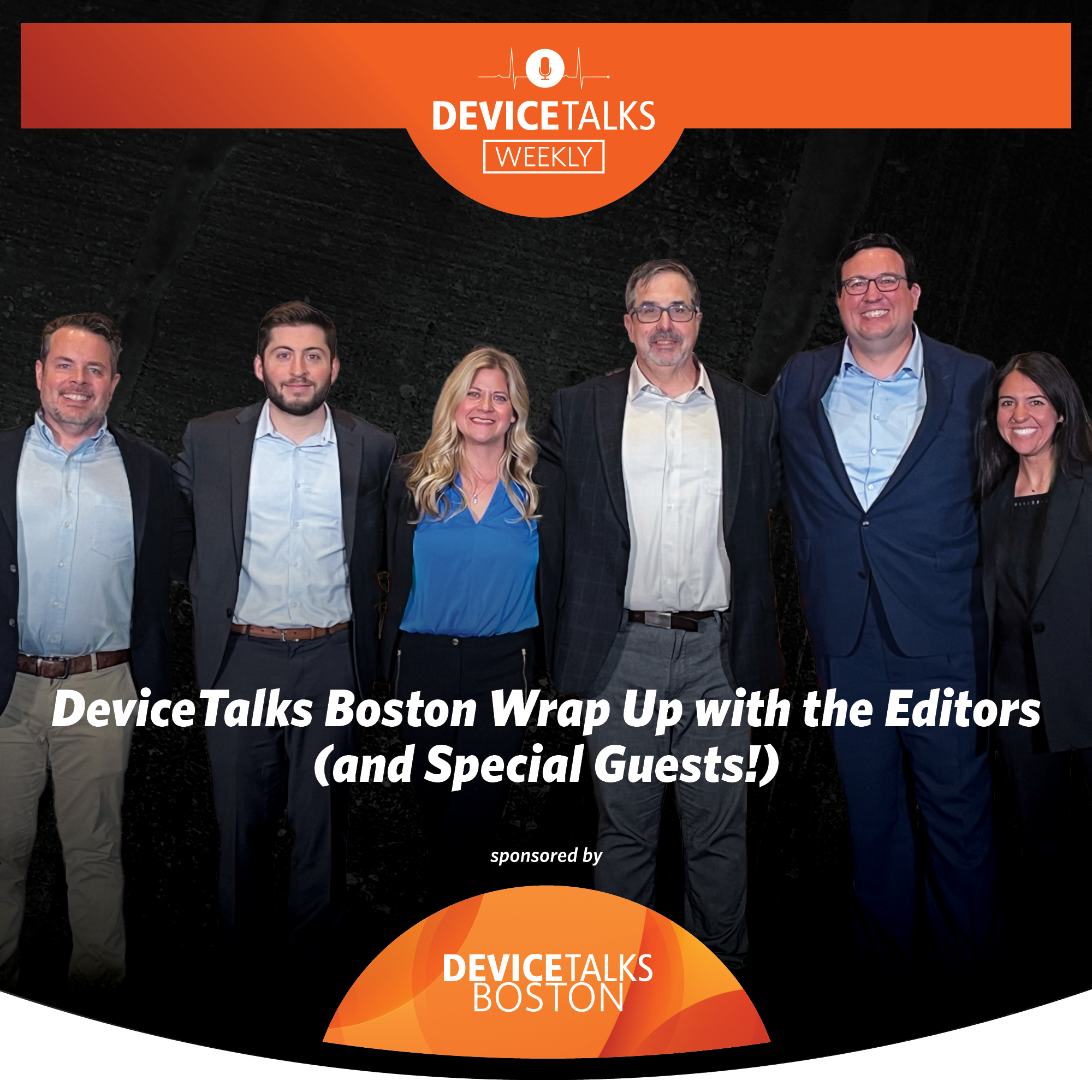
Thank you to the editorial team, Chris Newmarker, Kayleen Brown, Jim Hammerand Skylar Rivera and Sean Hooley. It was the first time we had everybody at one meeting and what a difference it made to just have those folks alongside and putting together this event.
Thanks, of course, to our sales team and our operation teams for the work they do behind the scenes. But my eyes are focused forward our medtech community and when they come together, it's just a rewarding experience. I've received some very nice messages from folks who needed the pick me up, who needed the lift, who needed the boost, and glad to be able to help provide that in our own way. So thank you to everyone who was there. I'm sorry if you were not able to attend. Perhaps we'll see you at a future event, but it really was fantastic. So as always, we ended the podcast with our.
I'm sorry, we ended the conference with our live podcast recording on stage.
Thanks to the AV team for staying late.
This was recorded at 4:15 on Thursday.
My brain was mush, the adrenaline was gone from my body. Caffeine had absolutely no impact or effect on me. I could not process anymore.
So I'll trip up here and there. I forgot Eric Benjamin's name at one point. Eric Benjamin of Insulet, who was my morning keynote. I couldn't come up with his last name. Eric, apologies. If you're listening to this, I of
[00:02:09] Speaker B: course know you and appreciate you.
[00:02:10] Speaker A: Thanks for stepping up and kicking off day two in such an important fashion and just had a fun conversation with our editorial team and some very special guests. So we'll leave it at that. And that's all, folks.
This is a great, great joy to bring you this podcast, bring you this event and we will, we will move onward. And no, no ending comments from me this time around. We'll just, we'll end the podcast with the. The end of our conversation. So thanks so much for being part of Device Talks.
[00:02:48] Speaker B: All right, you ready for this?
[00:02:50] Speaker C: Ready.
[00:03:10] Speaker B: Chris Newmacher. How are you, sir?
[00:03:12] Speaker C: Doing well, Tom.
[00:03:12] Speaker B: Doing well, we're here live at the end of Device Talks Boston, other successful event.
[00:03:17] Speaker C: It's fantastic, man.
[00:03:19] Speaker B: Chris, we're gonna, we're gonna try feeling the energy.
[00:03:20] Speaker C: It was just the glow. It's just great.
[00:03:23] Speaker B: We're gonna try a little experiment in time shifting. So next week, someone on this panel is having a very big birthday.
I think we need to sing Happy Birthday to her now.
[00:03:34] Speaker A: So then next week she can listen to it and she can feel all warm and glowy.
[00:03:38] Speaker B: Sean Hooley, senior editor of Mass Device. Skylar Rivera, associate of Master Vice managing editor of Metal Design and Outsourcing, Jim Hammerand, and of course, Chris Newmarker of Mass Device. We're going to sing Happy Birthday. Ready, everybody? Happy birthday to you.
[00:03:54] Speaker D: Happy birthday to you.
Happy birthday, Kayleen.
Happy birthday to you.
And many more on Channel 4.
[00:04:11] Speaker E: Thank you.
[00:04:12] Speaker F: Big plans for your 30th?
[00:04:14] Speaker G: For my 40th, believe it or not.
[00:04:16] Speaker F: Don't look at me over 29.
[00:04:17] Speaker G: I'm Benjamin Button. I'm age backwards. Did you not know this?
Actually, I do have big plans. At the end of the year, I'm going to be going to New York City for a Broadway show tour. It's going to be three, four days, two shows a day.
[00:04:31] Speaker B: Fantastic. It won't be as Device Talks Boston.
[00:04:36] Speaker G: Of course, nothing will. Nothing can possibly compete.
[00:04:39] Speaker B: So we had a great two days here.
[00:04:41] Speaker A: I was hoping the editorial team could
[00:04:43] Speaker B: just take a few minutes to give us some of their highlights.
[00:04:45] Speaker A: I'm happy to. Oh, great.
[00:04:47] Speaker B: Our audience is here and some of our special guests. Thank you, everyone, for coming in. We've got some colleagues in the back. The amazing Matt Clanting, who creates all our beautiful podcast graphics and many, many more graphics. It's great to have him on site.
[00:04:59] Speaker C: Gosh, this room is packed now, Tom. You can just hear it in the background all.
Yeah, we are fantastic.
[00:05:04] Speaker F: We'll have to edit the crowd noise out for the podcast.
[00:05:06] Speaker B: Yeah, I'll add that later, man. Yeah, believe me, it'll sound packed. So, Chris Newmarker, you're the man to my right that makes you qualified to go first.
[00:05:15] Speaker D: What was your plan, man?
[00:05:16] Speaker B: What was your highlight of the, of the, of the conference?
[00:05:20] Speaker C: You know, it's more of a sensibility or at least. Yeah, I guess my sensibility of the, of the conference this year was that, I mean, we. We generally have at least, I guess, maybe a bit of a serious crowd here in medtech. I mean, after all, we're doing, you know, ser work, we're designing technology that, you know, improves and Saves people's lives. But I, I definitely, you know, felt this year with all the talks and even like the discussions there was there, there's more of the personal, there was more of the human.
I think all of our keynotes had, you know, someone sharing like some kind of personal story and how it related to what they do in this industry.
I mean, you know, and just generally I'm just feeling just more of, more of a driver. People like to really understand that human connection of what we do. I mean maybe it's a reaction to artificial intelligence. I mean the robots are out to get us so we gotta like, you know, like double down on who we are as human beings. I mean maybe it's just all the craziness going on in the world that we need to just show some more kindness, talk about the good that we're seeking to do. But, but yeah, that was kind of like my overall just feeling about the event this year.
[00:06:35] Speaker A: Kayleen, you look like you're about to burst.
[00:06:37] Speaker B: I know you have an opinion on this.
[00:06:38] Speaker G: Oh, I have the all eyes.
I mean, you're absolutely right, Chris. I mean I've had the pleasure of sitting in on device talks conferences for now nearly four years. And the sessions that keep coming back to me that our amazing audience tells me still resonates with them are always the sessions that have storytelling in them. That was something that was really important, important for Tom and I to bring in about two years ago. And we ensure now that we try to bookend all of our events with a powerful patient story or a powerful story of connection and then we end the event with a story. And I think that what that does more than anything else is it just reminds us that collaboration and connection is the only way that we can move forward in medtech. So I'm just so big hearted thinking that that's something that you saw and that you connected to, but it's the only way we're going to be able to make it through this.
[00:07:35] Speaker B: Absolutely. No, that's a great point. And I think, you know, we had the conversation with Eric.
[00:07:42] Speaker A: Good God, sorry.
[00:07:43] Speaker B: My brain is.
[00:07:43] Speaker C: Oh, you know, even like. Yeah, you know, you had the interview with Eric Benjamin, the insulin coo and because I wrote notes, Tom, before we did this.
[00:07:52] Speaker D: But anyway, you had the interview with.
[00:07:54] Speaker A: Why don't you call attention to Mike,
[00:07:56] Speaker B: the thing that was gonna be edited out. That's super helpful, Chris, thanks, continue. Thanks for saving me and then throwing me into the bus.
[00:08:01] Speaker H: Throw a little shade, Tom. Come.
[00:08:03] Speaker C: Come on. No, but I mean, no, I mean it just like, through. Through the whole show, there was Eric Benjamin, the insulin. You know, coo. Like, you know, there's that story about the. The, you know, the charity dinner.
[00:08:12] Speaker B: Point your pen at me.
[00:08:13] Speaker C: So there is that story about the. There we go. Nice. Like, wave down.
There's that story about the charity dinner, you know, and how he was, you know, he, you know, just. Just somebody is, like, randomly talking to. At the charity dinner, you know, had, you know, was. Was an Omnipod user, used their insulin pumps and, you know, was, you know, it was just such an.
Of her life. And we had David Govender, who's the president of abioham at Johnson Johnson. I mean, she was talking about how her father and his whole experience with heart failure and, I mean, it just goes on. And we're even wrapping up the conference here with an interview with Nolan Harbaugh, who was the first Neuralink patient. And, I mean, my gosh, how much that brain computer interface that's transformed his life. So, I mean, just so many stories that just hearing over and over again through this conference, like, the, you know, the stories of, you know, like, we're so busy, like, making the technology, but, you know, it's really, you know, at its best, it's improving and saving people's lives.
[00:09:17] Speaker B: It's very, very well put, and it
[00:09:19] Speaker A: must be nice to be able to
[00:09:20] Speaker B: sit in the audience and take notes while, you know, some of us are leading conversations.
[00:09:24] Speaker H: Anyway.
[00:09:25] Speaker A: Scott, Sean Hooley, what was your highlight of the two days?
[00:09:32] Speaker I: I am Massachusetts born and raised, so. And guilty of the sort of Massachusetts exceptionalism that was discussed during yesterday's closing panel. So I enjoyed that conversation because it felt pretty candid and honest about sort of the situation and how the med. And I think it translates to other areas of life, whether other industries, other markets, other, you know, things like that.
It was cool to listen. I think it was a departure from some of the typical conversations we would have here. So I just really enjoyed hearing people give honest opinions about the state of the industry here and what better place to do it.
[00:10:10] Speaker B: Yeah, that was delivered by Brian Johnson, who we lovingly call the Godfather. And it was perfect because he was sitting in the middle chair and he had that same passion that I get when I rail about the Mookie Bets trade.
He was like, enough.
I'm declaring that Massachusetts is getting an A plus, and we've got a war to wage. And it was actually a very good, rousing end to the conversation. So it was great to have Brian Johnson, of course, Chris Knows is the co founder of Device Talks and Mass Device. Device Talks is celebrating its 15th year.
[00:10:45] Speaker C: It's unbelievable.
[00:10:46] Speaker A: Yeah.
[00:10:47] Speaker B: No, and that was a great panel overall. And I think Massachusetts got B pluses for the most part. And I think that's a fair assessment. We have some improvement to do, but it was a good way to end. Chris.
[00:10:58] Speaker C: I liked how Brian Johnson got a little feisty. That was great. I like it.
Like the spirits.
[00:11:05] Speaker B: Skyler Rivera, this is your very first Device Talks meeting of all time. So did your life feel empty before this? Do you know?
[00:11:13] Speaker E: Honestly? Yes. Because I saw the robot do karate earlier today and it was life changing.
They're not out to get us, they're just out to entertain us.
[00:11:24] Speaker D: So far we're just teaching the martial arts.
[00:11:28] Speaker E: No, but Device Talks was really great.
This was my first Device Talks. I'm pretty new to the medical device industry.
I had worked at Edwards as a technical writer, but I'd never been in a community like this before. I'd never been to a conference like this. I came from sports journalism.
The Women in Medtech breakfast has to be the highlight.
It was just such a rich community and uplifting, especially with the Latina leader speaking. I'm being a Hispanic from Los Angeles. It was really inspiring to see her lead like that. The one thing about that breakfast was it wasn't just about being a woman in a male dominated field. It was about insightful conversation and the leadership skills and just everything that earned these ladies a seat at the table. It wasn't just about being a woman. It was about innovation and expertise. It's great.
[00:12:24] Speaker B: And we can cut this out if you don't want to share it, Skyler, but you came to us from sports journalism, and part of the story you've shared with us is the imbalance. You certainly felt it and you didn't want to be part of it.
[00:12:36] Speaker E: Yeah, no, that's true.
Amy and I worked so hard to, you know, change the industry and you can't do it alone. And in the sports industry, I felt unfortunately like I was alone. No matter what. How smart you are, there's always going to be a commenter in the story that's, oh, you don't know anything. You're just a girl.
And I didn't want to waste my time on that anymore.
When I came to this industry, it was so refreshing. I had excellent colleagues, excellent colleagues at Edwards, excellent colleagues here, all you guys. Kayleen's been instrumental in welcoming me into this community.
But yeah, it's just so uplifting and there had been women who have done the work before me to change the industry. And I was speaking with Carla earlier today, and she. I asked her, what is it gonna take for us to see, you know, change in action, whether that be healthcare equity or, you know, closing the gap in women's healthcare. And she said, it's already in action. We're just, like, going forward. And that's. I was looking back.
[00:13:37] Speaker G: That's.
[00:13:38] Speaker E: That's what's going on. It's already in action here. And, yeah, it was. It's evident here.
[00:13:43] Speaker B: I like to give Chris Newmercher a hard time, but I have to commend him for bringing Skyler aboard on our team. You've been an amazing addition.
Instrumental part of the confession.
[00:13:54] Speaker E: Oh, thank you.
[00:13:54] Speaker B: Yeah, you really have.
[00:13:55] Speaker E: Too kind.
[00:13:56] Speaker D: Just kicking us up to an even more awesome level.
[00:13:59] Speaker C: It's fantastic.
[00:14:00] Speaker E: Thank you.
[00:14:01] Speaker B: Great overview, Kayleen Brown. My brain is faltering.
I know. The Women of MedTech breakfast was just chosen. I don't know if that was your pick or not. I'm guessing you have another one, though. I bet you've had a few favorite moments.
[00:14:13] Speaker G: Well, I never just go with the ask. I always do the ask. And so I will just second, Skylar.
Dr. Carla Guttlart Perrone was incredible. And we talked about designing medtech for reality, not just ideal conditions. And we had crafted this, this theme for the Women in MedTech breakfast based off of her experiences at OB GYN in Brazil and connected it to personal stories of the our ladies and the allies in the audience in my own personal story. And it was a theme that actually kept cropping up all day today. And when I was on stage or even listening to people on stage, they kept saying, designing for reality, not just ideal conditions, or communicating for reality, not just for ideal conditions. So it's a theme that I hope resonated with everyone, and I know it certainly did with me. And then the energy and the buzz of the women Med Tech Breakfast is always just. It's everything.
And then I'm looking at two of our amazing discussion leaders right now, and just having this, the theme and unpacking it from perspectives that come from different learned experiences and different walks of life, I think just widens and that broadens that perspective that we need to come together as a community in collaboration, to your point. And again, this is all through storytelling. And it was such a privilege to listen in on these conversations. I kind of pop it and I listen and I love it. And the second highlight, actually would be the opening for Device Talks Boston with Debbie Govender, the worldwide president for Johnson and Johnson Heart Recovery, or Johnson and Johnson MedTech Heart Recovery. And besides Debbie being a force, just I could have put her on the stage and walked away, and she would have just taken the house down. Is incredible.
I had asked her, kind of similar to you, Skylar, like, what is the goal? I asked her, what do you want to see your most hopeful expectation for the industry? And she said she wants to change the narrative, which really caught my ear because I'm a storyteller. This is what we do. And I said, well, how do you do that and what do you want that narrative to be? And it was the transition from heart failure to heart recovery. And in that moment, I made a commitment, and I stand by that commitment. And that commitment was seconded shortly thereafter by managing editor for MDO Jim Hammer. And it is not heart failure. It is heart recovery. And the first thing that Jim said to me after is, once we get back, back to the office, I'm going to go to the MDO and master by sites, and we're going to transition from heart failure to heart recovery. So I'm going to connect those two things here.
Bringing a community of women together is incredible, and it's powerful and it's changing our industry. So we are designing med tech for all body types, not just ideal conditions, but it's our allies who are pushing us forward in a way that. That I've never seen before.
So those are my two takeaways. We've been unstoppable, but together, there's nothing we can't do.
[00:17:14] Speaker B: Powerful words, and it was a powerful start to the conference. I was sitting there just watching this unfold. I'm like, this is a fastball.
This is a good way to start. So I think it sent the right message. Jim, do you have to wait to get back to the office? Can you have done it last night in between preparing for sessions?
All right, we'll give you some time.
[00:17:33] Speaker F: Yeah, we've got more important things to handle out here, and we're not really pumping out a whole lot of heart recovery content while we're off tonight anyway, so we will get that updated soon and get the word out to all the editors.
But yeah, like Skyler, this was my first device talks Boston as well. I've been with a company for a few years. I've been MedTech for a few years, but we are a remote company. You know, Sean and Tom are in the Boston. Skyler and Kayleen are on the West Coast. I'm also on the West Coast. Chris in Minneapolis. We've got the hubs covered, but I'm maybe the most remote of the remote workers up in. You go Seattle, go further north, and then that's where you'll find me as far as Alaska.
[00:18:11] Speaker H: But.
[00:18:11] Speaker F: So I've been to our other events and I kind of knew what to. To expect. I've also been to some other manufacturing shows, medical device shows, where there's a sea of people. But what just blew me away was the. Just the, the community building here, the. The dedication to the purpose of Medtech. And it struck me, I think this is the first time we've had everybody, our entire editorial team in one place at one time. And this is hopefully the first of many more. But it really is just a testament to the community that, you know, has been built by you, Tom and Aileen and everybody up here who's contributing to the panels and the interviews and bringing people in and spreading the word of the mission and ultimately saying, hey, let's celebrate success in the industry. Let's share what we've learned to help others similarly succeed and avoid all those pitfalls.
And let's really try to bring the industry up a little bit, bring more attention, to bring more people in, keep more people in, and just help each other solve problems together. So, again, I was really blown away by my first time here in Device Talks Boston over hope that we could make this a yearly thing where the entire team gets together. And yeah, you know, I love the Women of Medtech Breakfast because that is just the best encapsulation of it because it's, you know, you're sitting in small groups, real honest conversations that are meaningful and making good connections. And I still keep up with the people that I met at last year's My First Women in Medtech Breakfast. Just great people. And it really is just a great forum for making the connections that are so important to our industry and ultimately the patients we serve. So. So, yeah, this is great. Can't wait for the next one saying,
[00:19:41] Speaker D: I can't wait, man. We gotta keep. Keep the group together, like, do even more of these. I think this was fantastic.
[00:19:46] Speaker B: Absolutely. So we're gonna go for a podcast record here. We're going to try to have as many speakers as possible. So we're bringing up some of our guests to the conference.
We've got Saul Marquez here of the outcomes rocket. Saul, you are a podcast brother. I think you and I launched our podcast at the same time when we realized we weren't going to get to see people anymore for an indefinite amount of time.
Thank you for being part of talks both in Minnesota and here.
I'd love to get your takeaways to some of the key things you saw over the past two days.
[00:20:17] Speaker J: Yeah, Tom, you know, I'm glad we read into each other finally.
I've known Tom for years and finally at the beginning of this year had a chance to run into him and we're like, okay, let's just get together more.
And so I'm excited to hit repeat on that more and more. But you know, for me a lot of what was said already resonated. Like what you said, Kayleen, about flipping the script from heart failure to heart recovery.
I think of that and a lot of script flipping that happens when you're surrounded by the people moving the business forward.
I had the chance to, I think our final count was something like 21 interviews that we did here.
[00:21:04] Speaker B: So jealous.
[00:21:06] Speaker J: And the people that move the business.
I will say this, you cannot shake a hand through a screen.
So as much content as you can create from your virtual office, nothing compares to being in front of someone.
In even a 12 minute conversation, you get more than a one hour zoom.
So for me, you know, being with people and in those conversations to have the ability to flip somebody else's script on what's possible or to be open about having your script flipped about what's possible.
I had a chance to talk to Christian Howell from Cognito Therapeutics who resurfaced the four Rs for me. You know, the readout, get the evidence right, get it together.
Once you get your readout, you get your regulatory straight. Once you get your regulatory straight, you get your reimbursement. Then you could focus on revenue.
And if you think long term, an algorithm like that, hit on repeat, you can make a reproducible company time after time, that type of reminder. Right Then I talked to Reza from Leadoptic who told me he was here two years ago and he did not have FDA approval. He was on a panel and somebody in the audience walked up to him afterwards.
He got a grant from that, that accelerated his results. And he's back at, at, at device talks two years later celebrating.
He's got FDA approval, two studies going on or two pilots and that's going to transition into his AI platform. I mean, just like incredible the work that he's doing. So those are two examples of many conversations that happen here, let alone all of the people.
[00:22:52] Speaker D: Oh yeah, I have a great example. I mean I was, I mean, I just can't help myself. I was monitoring a panel today.
Where was Bill Hunter, Dr. Bill Hunter from Canary Medical, which created the technology behind the smart knee implant. It's Zimmer Biomet, which.
It's basically an implant. And they're giving data about the walking. It's getting uploaded to the cloud.
Really cool tech.
Two years ago, he met Patrick O', Donnell, the CEO of Nanohive, which makes 3D printed titanium spinal implants here. And today, I mean, they were doing a panel with, you know, Mike Moore, the, you know, from the Mullings group moderating, talking about the business partnership they now have, where they're going to be making, you know, smart spinal implants that are transmitting data. I was just like, like, how cool is that? Like, you know, this all.
We're doing this, you know, panel now, talking about this development. This all started here two years ago,
[00:23:48] Speaker J: and it's about letting the organic unfold, and that doesn't happen behind a screen. So I want to give the team here at Device Talks major kudos for the special event that you've put together from Minneapolis to here in Boston, and then we'll see you guys again in the west at the end of the year. So.
[00:24:07] Speaker B: That's great, Saul. And I just want to note that I knew all the names that Chris recounted without having the notes in front of me. I saw you look at your notes, but no, because I remember those.
I remember those names. I forgot one name. So we're going to continue to add to our world record, seeking most guests ever on a podcast. We have Etienne Nichols of being, like, guru, another podcast fellow, fellow podcaster, and has been a recent FOMO guest on the podcast. Great to have you on, Etienne.
[00:24:39] Speaker C: Yeah.
[00:24:39] Speaker H: Good to be here with you guys. I've really enjoyed the show so far.
[00:24:42] Speaker B: I'm so glad you were able to make it up.
[00:24:44] Speaker G: I just had to interrupt and say, I'm actually fangirling right now to meet you in person.
What a pleasure. And I'm not even kidding.
You are such a pleasure. My goodness.
[00:24:55] Speaker H: Well, now I'm blushing.
But just to kind of echo what Saul was saying, you know, I mean, just meeting in person, it's so exciting to do that. You know, I've talked to so many people. I mean, hundreds even over zoom. And meeting in person.
I just love that line that you said, you can't shake a hand through a screen. I can't help but echo that.
[00:25:13] Speaker B: Any particular moments or thoughts or observations that you can. Will it be taken away?
[00:25:21] Speaker H: Yes, I did take some notes, but I'm. I'm a little afraid to look at them at this moment. So I'm actually going to try to do this.
[00:25:26] Speaker A: I will call you out.
[00:25:27] Speaker B: Yes.
[00:25:28] Speaker H: Prosthopa from Petal P E T T A L. I like, love that he spelled that Petal Medical. He. One of the quotes that he had was, our lives begin to end the moment we stop caring or the moment we are silent about the things that matter to us. I thought that was such a good quote because in the medical device industry, you know, I talk about safety and effective devices. If you read any of the regulations, which, you know, unfortunately, those of listening, I quote a lot of regulations, so forgive me if I say 21 CFR part 820 or whatever else I make that may come out of my mouth, but in those preambles of all those regulations, it's. The purpose of this is to produce safe and effective medical devices. And when he said that, it made. It made me realize there's. There's more to life than just being safe and effective.
What he was actually hitting on was actually living. And I thought that was. That was really powerful for me personally.
That was. That was probably one of the high moments or quotes that I took away.
I have another. If you'll. If you'll bear with me.
[00:26:30] Speaker B: I will. Adult but I will. I do want to second yours. He kind of had a call to action at the end of that that I thought was very appropriate. And I think every MedTech presentation should end with that. That what are you going to do to change the world? Kind of question. I think it's great.
[00:26:42] Speaker H: Yeah, it was just a powerful presentation. I really, really enjoyed that. The other thing that was interesting was more of a controversial moment, I guess, internal conflict when I heard this, because I think I've heard it before and maybe I've even said it before, but
[00:26:57] Speaker B: was Chris and I fighting on a podcast?
[00:26:59] Speaker H: It was exactly that.
Something very similar. So we talked a lot about AI throughout the whole.
[00:27:04] Speaker D: Did it feel like parents fighting when we were arguing?
[00:27:07] Speaker H: Oh, my goodness. You know, I went and hid.
Not sor. I actually. So this person, at the end of an AI conversation, they said, yes, but at the end of the day, when someone makes it, when. When something. When a mistake happens, somebody has to go to jail. And it occurred to me, I'm like, it's an ethical question that came up about AI, you know, who's responsible, who's accountable.
But at. At the root of that is what is accountability and why is accountability? And so is it just for reparations? Is it to truly learn and improve the industry. So I feel like. Like I don't necessarily. That we're not here to get into an ethical discussion and solve the world's problems on this podcast. Exactly. But I'm going to have to go home and think about that. So I've got a lot of ethical questions now around AI and accountability. And so it's, it's kind of, I guess, opened my. The aperture of my thinking a little bit.
[00:27:59] Speaker B: No. 2 great, great call outs. And I, I just, I love that we were able to sort of touch upon so many poignant elements of MedTech and my brain really is not working. But to start with the people, and we're talking about technology and we're getting into ethics. I mean, this is an industry that just. We're rich with important issues because we're doing important things, or you folks are doing important things, and I'm talking about you doing important things.
So I'm glad that we're touching upon all of this on the podcast. I'd like to introduce our 99th guest, Holly Scott, the senior partner at the Mullings Group. She's been on the podcast once or twice before, and we're. I can't thank the Mullings Group enough for your support of the event.
Having us down at the studio recording the videos and sharing those and just helping us really build our community out. I'm so grateful. So thank you also for being here with Mike Moore and Nicole Eger to represent one of the top, if not the top, executive search firms in the industry.
[00:29:00] Speaker K: The top. Thank you. Appreciate that.
[00:29:02] Speaker B: Bye now. You can go home.
[00:29:04] Speaker K: We've been around. We've earned it. But I do want to call out Nicole because she's an amazing.
When we brought in Dragonfly and the media amplification within the Mullings Group, it has really changed our capabilities overall. And Nicole's mastermind behind that. So I make sure that she.
If we look good, that's because of her.
[00:29:25] Speaker G: Okay.
[00:29:25] Speaker C: All day.
[00:29:26] Speaker K: But look, you covered so much here. The show was.
It was diverse and there were so many poignant moments.
But as I hear all of this and as I've had so many conversations, there was a bit going into this conference season, and I believe this is about the highlight of this particular season.
A bit of fear about where we're at and a bit of fear about what we'll call the fourth Industrial Revolution. What's AI going to do? What is all of this going to mean for us? What's it going to mean for MedTech? The world's ending. All of these things that as I realize where this settles it, is from that trust and intention behind how we move, which only comes from human interaction, which only comes from real in person meetings. When you do shake hands, when you do look people in the eye, when you do hear their personal whys and why they're in the industry, why we do what we do every day. Medtech is hard. We don't do this because it's fun. We do it because it's important.
And hearing the stories ranging from pedal. I mean, Prashant is an amazing human being. What you see is exactly him. He was built to make this incredible technology and he does so with purpose and so does every single person that came up and told their story, whether it was from Abiomed or from Cognito.
And I love the stories like the Bill Hunter story where you saw them a few years ago and how far they've come.
[00:31:05] Speaker F: Oh, totally.
[00:31:06] Speaker K: Yeah. And then lastly, I know I've mentioned more than one, but let's not forget about those innovators, those people that have relentlessly pitched for how many times, came up again and show their wares and we're going to watch them in a few years and see where they are. And it's, that's, that's what I, that really makes me fulfilled to be in this industry.
[00:31:28] Speaker G: I wanted to just step in here, Holly, for a moment and put this on permanent record. So our rock star Skyler said the kindest thing right next to me that I was instrumental in welcoming her into the industry. And again, Skylar, you're amazing.
But on a permanent record, Holly Scott, you have been instrumental in welcoming me into Medtech. You are an inspiration and it is an honor. Thank you for everything that you've done for me and for women in Medtech.
[00:32:00] Speaker K: Thank you, Kayleen. Thank you very much. Don't make me cry because I know you get started and I get started.
[00:32:04] Speaker G: Let's all cry. Okay. Let's hold hands and cry Just like a little.
[00:32:09] Speaker F: Started with a song and it was scarce.
[00:32:13] Speaker A: I think that's a beautiful statement.
[00:32:15] Speaker B: And it just. We were able to invite some, some college folks to attend here and they were all very gracious and came up and asked, you know what, thank you so much. What can we do? We're like, well, number one, you know, be nice to people. And like, number two, when you're in the position to help someone out, help them out. Like, don't even, don't you hesitate. Just help them out.
Let them learn, let them find out for the industry. So I love. This is just more great energy that we're bringing from the conference. So I know we're up against uptime. The AV team is probably going to start getting the hook. But I think my takeaway, and I think we've touched upon a lot of them, is if we had device talks, and we did. I didn't have device talk. There was a device talk. In 2019, surgical robotics may have been like the cutting edge technology.
Now we're talking about Petal Surgical. Now we had Cognito coming in with its device. That is just, I think, going to be a whole new wing of Medtech, just a whole new method of treating people. I think the folks in our industry are finding not only new ways to make better catheters or great materials like nitinol, putting that to work, but also just new modalities for treating people and for making people healthy. So five years from now, what are we going to be talking about? I have no idea. With AI, with the acceleration of R and D, I mean, we may have technologies that we need. Never dreamed of being applied to making people healthier. And that's super exciting.
[00:33:37] Speaker C: Can't wait.
[00:33:38] Speaker B: Yeah. We're going to be here in these chairs telling people. What. What do you want to say?
[00:33:45] Speaker C: No, I'm just.
[00:33:47] Speaker H: I just.
[00:33:48] Speaker A: This is also what Chris and I do in Zoom.
[00:33:50] Speaker B: We talk over each other half the time.
No, but I. I'm excited.
[00:33:54] Speaker C: You're just getting me so excited, Tom. It's so great.
[00:33:57] Speaker B: I'm excited about the future.
[00:33:59] Speaker A: I'm really grateful to the folks in
[00:34:00] Speaker B: the audience who did come by.
[00:34:02] Speaker A: I know you need.
[00:34:02] Speaker B: There's traffic to beat, there's to catch, there's drinks to drink. But you're here with us both over these previous two days, and you're here now today. I'm grateful to my editorial teammates for really, I mean, it was the first time, as Jim said, that we've all been here together. And this event was five to ten times easier to do with folks around to help with the rooms, to make sure everything's running more smoothly. There's a lot of plates in the air during this event. So thank you, everybody, for your help in making sure that this happened. Thanks to our friends who helped promote the event and to. To just fill the halls. And I love walking by and seeing you all in these very stern conversations. I just want to be like, yay. As it walks by, but I don't want to ruin your professional buzz. And thanks to our partners, Medtech Innovator you mentioned that, Holly. Thanks so much. They're great supporters.
[00:34:51] Speaker A: And thank you all for being here. Thank you to the AV team for
[00:34:55] Speaker B: staying late for us, enabling us to do that.
And we'll see you at our next device talks. Thanks, everybody. Everybody.
[00:35:04] Speaker A: Whoops.