Episode Transcript
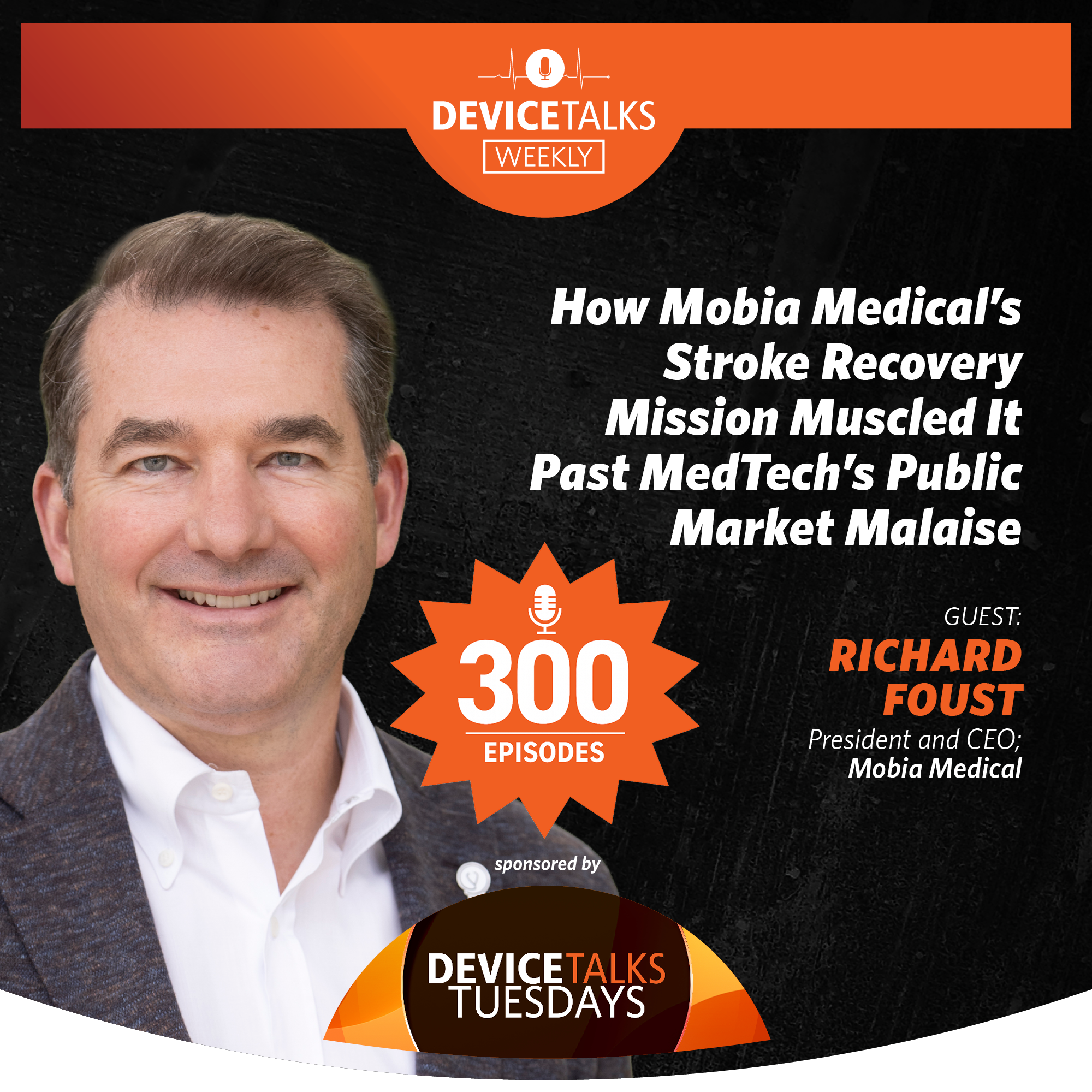
[00:00:00] Speaker A: Hi everyone. Tom Salemi here. Welcome back to the Device Talks Weekly podcast. Before we get into this week's episode, I wanted to take a moment to thank you, our listeners. Last week's episode was our 300th episode and I did not realize it at the time. Kayleen Brown pointed it out and promoted it as such on social media. But I wanted to take a moment to speak directly to you, our loyal listeners. It's been six years putting out Device Talks Weekly.
It's been a real honor and pleasure of mine to tell you these, to share these stories every week and to form the connections with all of you, the folks I see at our conferences, the folks I see at other conferences, those who connect on LinkedIn and elsewhere. It's just really fantastic experience. So thank you for being along for the ride no matter when you hopped aboard this Device Talks Weekly train. Great to be able to bring you these stories every week. This week's episode is brought to you by Cortlandt Biomedical.
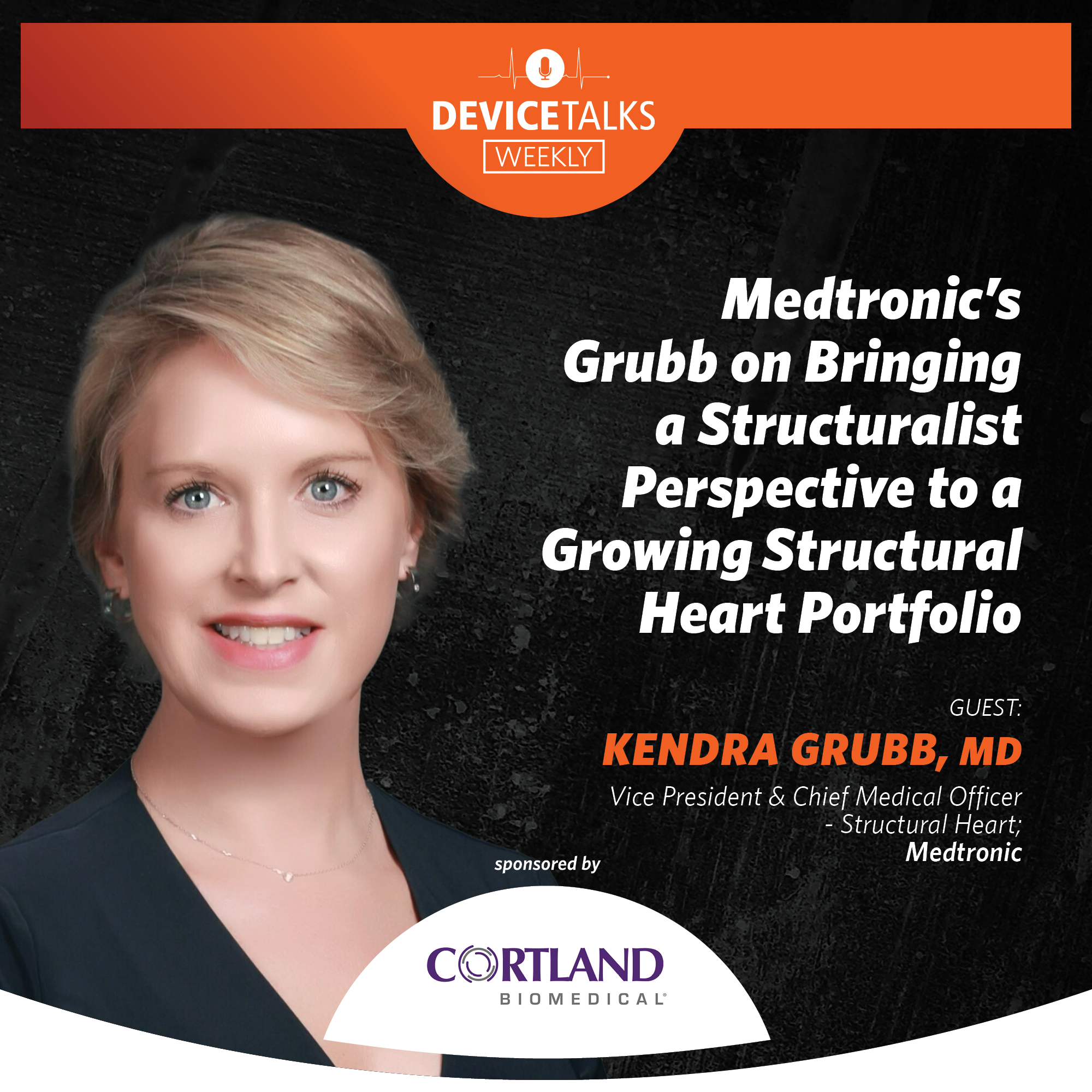
I will have a interview with our friends at Cortland a little later in the podcast. I know you'll enjoy that. And thanks again to Cortland Biomedical for sponsoring this episode. We'll kick the episode off with Chris Newmarker and I delivering this week's Newmarkers Newsmakers. And then a little later in the podcast, our keynote interview. I spoke with Kendra Grubb. She's the Chief Medical Officer of Medtronic's Structural Heart business.
She has an interesting background, has moved into industry only recently, and has a fantastic perspective on where structural heart is headed. So I know you will learn a lot from that conversation with Dr. Kendra Grubb. So without any further delay, thanks again to Cortlandt Biomedical for sponsoring this episode of the Device Talks Weekly Podcast. Oh, join us next week for the MIN Evasive Virtual series brought to you by our good friends at Medical Design and outsourcing. Go to medicaldesignandoutsourcing.com to register for conversations that we'll be having.
Skylar Rivera will Talk with the MedTech legend Mandy Vilafana.
Jim Hammerand, the managing editor of Metal Design and Outsourcing, has a cool company called Doppler that he'll be talking to. And then I'll wrap things up with a conversation with one of my new favorites, Yossi Barr of LEM Surgical. And we'll talk about lem's humanoid surgical robot in the spine and talk about opportunities in the hard tissue robotic space. So lots going on. Next week I'll put a link to the registry I'LL put a registration link in the show notes, but you can also go to medicaldesignandoutsourcing.com and hit the webinar tab and. And you can, you can register there as well. All right, now let's get this podcast started.
All right, you ready for this?
[00:02:56] Speaker B: Ready.
[00:03:12] Speaker A: Chris Newmarker. How are you, sir?
[00:03:14] Speaker B: Hey, Doing well, Tom. Doing well.
[00:03:16] Speaker A: Chris Newmarker. I forgot last week was our 300th episode on device Talk.
[00:03:21] Speaker B: I know.
[00:03:21] Speaker A: Like, I just completely like.
[00:03:23] Speaker B: Me too.
[00:03:24] Speaker A: We don't do episode numbers on the titles. And I knew we were approaching, but I had completely lost track. So happy 300th.
[00:03:32] Speaker B: I'm so happy that our wonderful colleague Kayleen Brown, like, pointed that out to everybody. Like, Kayleen was counting. Darn it.
[00:03:39] Speaker A: She has the benefit of when we have the Device Talks podcast network and the Device Talks Weekly podcast channel. And so she updates the Device Talks Weekly podcast channel, which is just Device Docs Weekly. And in that, in that title she puts the episode numbers. So that's how she tracks it.
[00:03:56] Speaker B: She knew it.
[00:03:57] Speaker A: She had it down that one. She's on top of it.
[00:04:00] Speaker B: Totally. Yeah.
[00:04:01] Speaker A: So, yeah. 300.
[00:04:03] Speaker B: Yeah. That's awesome, man.
[00:04:04] Speaker A: I did the math. Assuming like each one was an hour, and usually they're more than an hour, it's like 14 straight days of a podcast. Like you could, for two weeks, you could just. I don't just listen to us talking.
[00:04:18] Speaker B: Would that be like all around the clock for, for two weeks?
[00:04:21] Speaker A: Wow. Yeah, yeah, it's like. Yeah, yeah. And not just work days. I'm talking like no sleep, 24 hour. No, no.
[00:04:28] Speaker B: No meal breaks, no other types of night. You just, you could send someone in a, in a rocket capsule to the moon and back while they listen to all of our Device Talks weekly after that.
[00:04:44] Speaker A: That's a great idea. I think we should somehow get our podcast on Starship and make sure it gets launched into space.
[00:04:51] Speaker B: Sounds great. Yeah.
[00:04:52] Speaker A: Good representative for humankind.
[00:04:54] Speaker B: I think it's a good time of year. Everything going well over in Massachusetts?
[00:04:59] Speaker A: Yeah, it's mid August is the time. I don't know if you feel this way in Minnesota, but where you start, like some crisp fall air wouldn't be the worst thing in the world.
[00:05:09] Speaker B: State fair's coming. I was gonna say I had a nice moment. I Woke up at 6 in the morning, you know. You know, to like start looking up stories for Mass Device and just having my little cup of coffee, looking out the back window, saw a fawn at the edge of the, you know, like a baby Deer.
[00:05:27] Speaker A: Very nice, Bambi.
[00:05:28] Speaker B: You know, and then another one came out and then mom came out and then they just, you know, walked over in my garden, started eating my cucumbers and lettuce. So, but, but yeah, you know, that was, there was a nice moment. They're like, oh, it's a fawn. Like, you know, like, it's cool.
[00:05:42] Speaker A: I like how you mentioned that you grew up at 6 o' clock in the morning to look at stories from mass device. You could have just mentioned the font thing without explaining to everyone how dedicated a journalist you are. Yeah, a little humble brag right there. That was pretty good.
[00:05:55] Speaker B: It's like the old Ben Franklin idea that you should make sure your wheelbarrow is squeaky so everybody can know that you're up doing the work.
[00:06:06] Speaker A: I'm reading Isaacson's biography of Franklin right now.
[00:06:09] Speaker B: Oh, that's a great one. I love it.
[00:06:11] Speaker A: That's a good one.
[00:06:12] Speaker B: Yeah, that's a good one. Great.
[00:06:14] Speaker A: All right. Well, I was up at 6 in the morning watching the Red Sox condensed game and drinking coffee, so I was not, not doing podcast research, but I was up early as well. And I did not see a fawn, though.
[00:06:25] Speaker B: I'm sorry, man.
[00:06:26] Speaker A: Yeah, yeah, it's okay. Squirrel. I saw a squirrel. So did a dog, but squirrels are great.
[00:06:30] Speaker B: Yeah. All right, we're gonna. Our people are like, oh, these guys.
[00:06:34] Speaker A: Yeah.
[00:06:34] Speaker B: 14 hours of listening to us,
[00:06:38] Speaker A: we just added another 14 one. New Markets Newsmakers. All right, what's number five on the New Markets Newsmakers?
[00:06:44] Speaker B: Chris? Newmarker, number five on the list. This is from associator Skyler Rivera.
And this is about alcon and it's a recent earnings call said that they're going to be getting rid of their Power Vision intraocular lens technology program.
They're just saying that recent clinical data just showed unpredictable post operative outcomes. But Skyler also did Q in that. I mean, they're not giving up on this technology, which, I mean, yeah, they spent $285 million for Power Vision.
[00:07:15] Speaker A: I remember it. Yeah, I was covering, I was working on the OIS events around that time. So I knew Power Vision pretty well. That was a big deal and it was a really cool technology.
[00:07:25] Speaker B: And the fact that they're just saying like, yeah, we got to move on.
But they do have this exclusive collaboration now with RX site. So I mean, they're still at it and they're saying that they learned some stuff from it. But yeah, unfortunately, just the Power Vision, it didn't work out for them.
[00:07:43] Speaker A: And I think the trick, it's accommodating lens and it's adjustable for a presbyopia correcting iol, I think that's sort of the value add of the lens. So it's a huge deal and itech is super fascinating. I honestly lost track after the acquisition. I assumed six years later something would happen, that it would have been on the market. I didn't realize it was still.
They were still sort of, well, still monitoring and that wasn't a sure thing. So big deal, certainly for Elcon to write that off. Over $400 million.
But like you said, they're not giving up, so hopefully they'll be able to move forward.
[00:08:29] Speaker B: Yeah, I mean, it's definitely a technology that is needed out there, so you have the best luck.
Next on the list.
This from yours truly. I.
That's right. I caught a, a note about Intuitive Surgical from Oppenheimer. Like, Tudor's been having some like, challenges, you know, and their stock's been kind of down. I mean, there's been, you know, some, some talk about how they kind of have some like at least short term headwinds. I mean, around like the Affordable Care act, like actually with, you know, the subsidies going away for it, you know, that, you know, that could maybe, maybe hold down US procedures some. But the Oppenheimer analysts up their rating on Intuitive stock to outperform. And I just thought they had some really interesting arguments in their report. And so I blew that out into a story on mass device. And I mean, one of the things that really stuck out to me was that they were talking about their field checks going out into the actual health care environment and finding out what people on the ground think about things. And you know, they're, you know, we have JJ coming out with a Tava, but they were kind of pointing out some talk about like, potential, like workflow problems inside health providers using a Tova. You know, like that kind of design it has with the arms coming out of the table that, you know, there could be, you know, certain unique challenges around getting that sterilized for procedures perhaps. So, you know, they're pointing that out. They're pointing out the Hugo, even though it's modular. I mean, like, Medtronic really talks a lot about how, look, these are modular arms. We can roll around here in different configurations, that the footprint's bigger than overall in da Vinci.
So they were kind of saying they thought the big competition for Intuitive was outside the US that's more like Intuitive having to compete against homegrown companies in China when it's China competing for markets
[00:10:25] Speaker A: outside the US not ous companies coming here. Yeah, yeah.
[00:10:28] Speaker B: The US they're really thinking that Intuitive is a really good good long term bet.
[00:10:34] Speaker A: So I mean that's consistent with what has been said. You know, Intuitive has had time to build really a moat to build a strong foundation.
Flip side though, I mean you know, Hugo's been proved for two years otava just a couple of weeks, couple or a month, you know, things sort things change. But definitely a long climb uphill for for anyone trying to take on intuitive head to head.
[00:10:59] Speaker B: Yeah, absolutely.
[00:11:00] Speaker A: I think the think the opportunity in the US will be in the ASCs and the smaller spaces.
Maybe that's where certainly it's where a lot of the procedures will be going. Maybe that's where a big opportunity is for not only for Johnson and Johnson for Medtronic, but also CMR and Distal Motion and others as well.
[00:11:21] Speaker B: Yeah.
[00:11:23] Speaker A: So it's Intuitive is firmly entrenched in the larger primary settings and we'll have
[00:11:29] Speaker B: to see how that changes.
The Oppenheimer analyst that was the other challenge they were saying along with outside the US competition especially in China, like Intuitive trying to play in that ASC space outside of the hospital.
So yeah, that's kind of the place where maybe some competition could really happen.
[00:11:48] Speaker A: Absolutely.
[00:11:49] Speaker B: Yeah. So but a good report. You can read some more insights from me on mass device
[00:11:56] Speaker A: number three.
[00:11:56] Speaker B: Number three man. More cyber attacks.
Medtech has really been getting a good amount of those this year and Skyler was on top of the news of Cook Medical reporting a cyber attack compromising customer information. This looks like it's one of these social engineering attacks.
Employee exits inadvertently gave someone access to systems. So to me that's just another good reminder for people inside medical device companies like listening to the it can be hard sometimes to find time to listen to those corporate training videos but the ones kind of reminding you not that someone is like hey Chris, I'm so you got to watch out for that kind of stuff even if you're really busy. No for sure you can get a hacker getting you to disclose access to stuff that you shouldn't be.
[00:12:54] Speaker A: Now Cook Medical did say in the article by Skyler based on our review to date we have no evidence that sensitive or protected data was accessed.
The Bloomberg Indiana based company said.
But no definitely. I mean it's good for any company. I'm sure MedTech isn't I know MedTech isn't targeted when you and I get always on the slack channel at least once a Week. There's. Dude, don't answer this email from me asking for whatever, gift cards or whatever.
We get that once a week, so maybe that's maybe not once a week, maybe a couple times a month. But it seems frequent. So yeah, no interesting times to be on email. I read this and it got me thinking. I think I mentioned previously I just finished rewatching Battlestar Galactica.
The Cylons wouldn't have had to make all that effort now. They could have just sent Gaius Baltar an email promising him something and he would have clicked on the link and they would have access to the Colonial defensive mainframe. So, yeah, times are fraught.
[00:13:55] Speaker B: Yeah, fraught times, fraught times.
[00:13:59] Speaker A: What's number two? Chris Newmarker, got a lighter story for us? What do you got?
[00:14:03] Speaker B: Yeah, yeah, yeah, this is. No, not really. This is actually courtesy of Julia Rock Dorsibia, who is our associate editor over at R and D World and Drug Discovery. And Julia's been helping us out some on a mass device and she was writing about the chief revenue officer of CBRX being let go. And this came not only after a disappointing earnings report, but they also around the earnings report, disclosed that there was some kind of U.S. department of justice civil investigation going on with the company. So concerning some sales and marketing practices. And just to be clear, this is them saying that the Justice Department was requesting information. You know, it's not like, you know, nothing's been filed. This is, you know, sometimes they look into stuff and, you know, nothing, nothing comes of it. You know, there was nothing to see. But, but, but yeah, they, you know, obviously they decided it was time they needed a new top salesperson over at, over at cvrx.
[00:15:15] Speaker A: CVRX is one of those companies that's been. Been around for a long time, is starting to see some success.
So it's unfortunate to see.
But it looks like their stock's also taking quite a dip over the past week or so as a result of all this. So hopefully they'll be able to right the ship for sure.
[00:15:39] Speaker B: Yeah, John was an Abbott veteran and now they've got somebody internal, Paul Verasto assuming the role of interim head of sales. But it looks like they're looking around now for a permanent successor, so we'll see who they can.
And Verasto, by the way, I mean, my gosh, he's had sales and marketing leadership positions and Boston Scientific Medtronic guidance.
So they obviously had at least a deep bench over there, even though they're still a really young growing company.
So, yeah, we'll we'll see. Hopefully things can be better going ahead.
[00:16:19] Speaker A: Yep. Kevin Hikes, President CEO has had some good deal success in Medtech as well. So they have a strong team over there.
[00:16:26] Speaker B: Totally.
[00:16:27] Speaker A: So we'll see if they're able to turn things around.
[00:16:30] Speaker B: Yeah, number one on the list.
Also from me, I noticed when we covered G Healthcare earnings recently that there was like a little message, just a little thing in the news release like, oh, by the way, we're looking at strategic options with our patient care solutions business. That's a three billion dollar a year business. So, you know, I went back and you know, really looked at the earnings transcript and you know, like pulled out a new story kind of like about the fact that, you know, they could be selling, you know, this business and you know, they're also doing a bit of other reorganizing around the, the company right now. So yeah, that's going to be interesting to see if they sell Patient Care Solutions and who, who the buyer might be.
[00:17:15] Speaker A: Absolutely. So Patient Care Solutions includes patient monitoring, diagnostic cardiology, maternal infant care and anesthesia, which is a big business, obviously.
You know, I guess $3 billion sounds like a job for private equity to me.
[00:17:31] Speaker B: Thanks.
[00:17:32] Speaker A: Yep.
[00:17:33] Speaker B: We've been seeing more and more deals, so.
[00:17:35] Speaker A: Oh yeah, I mean, I don't know.
I'm not quite sure. I mean, maybe Danaher would want to move in, but they're looking at the businesses. I'm not quite sure who steps in.
[00:17:45] Speaker B: That would be interesting. Yeah, we're, I mean, I mean everyone here, we're. Don't, don't count us as extra experts, but I mean, we did. Yeah,
[00:17:56] Speaker A: sure.
[00:17:56] Speaker B: That, yeah, yeah. Please don't buy any stock. I got to count a me here. But I mean, you know, it is interesting. Dan, who acquired massive, I mean, that would be interesting. Like, okay, like we got this, you know, this business over at GE Healthcare that might fit in with this in some way. We're going to bring this in as well, like kind of build something there. But yeah, private equity as well.
And I should also mention that our medical design outsourcing managing editor Jim Hammerand has an article up on mdo. He spoke to some people active in the private equity space about why we're getting more deals lately in Medtech and I thought they were some good insights about what's going on there. He spoke with some shareholders at law firm Frederickson, which represents some major private equity outfits that have been looking at Medtech.
So it's a good dive into that.
[00:19:02] Speaker A: Yeah. So interesting. Top five. So bellcon discontinuing power vision. So sort of a good question, kind of a post acquisition. How long do you kind of stick with the technology you bought?
[00:19:15] Speaker B: Right.
[00:19:16] Speaker A: Intuitive, you know, how powerful can it be as with its installed base? How much of a, how much can it defend? Cook? I mean I think that's just something everyone has to be mindful of.
[00:19:25] Speaker B: The cybersecurity medical like how much can things get messed up on somebody.
[00:19:29] Speaker A: Yeah.
[00:19:30] Speaker B: Answers the wrong email whatever whatever.
[00:19:33] Speaker A: And CBRX, again, we fall in love with technology but at the end of the day, you have to overcome your commercial execution and you have to succeed there. So hopefully they'll be able to turn it around and then gee, healthcare. I mean that could, that could really upend the medical device industry. So big news on mass device this week for sure.
[00:19:51] Speaker B: Yeah, yeah. News is not slowing down here at the end of the summer.
[00:19:55] Speaker A: Nope, not at all. All right, Chris Newmarker.
[00:19:57] Speaker B: Oh, and I would be a mess that if you want to get even more like cool insights and like excitement. And we just thought we have the Menvasa webinar series coming up on medical design outsourcing. And that's going to be like Jim has a great lineup including. You're helping out. You're going to be.
[00:20:16] Speaker A: I'm helping out. I'll be talking to me and Yossi Barr, my new best friend from LEM Surgical, talking about humanoid robotics, the real kind, humanoid surgical robotics. Not the stuff I've been posting about on LinkedIn, but they've got a really cool surgical robot that could, could really upend the spine industry. And we'll talk about the hard tissue surgical robotic space. I mean all the conversation we have tend to focus on soft tissue. But it would seem to me there's a real opportunity there for hard tissue robots to come in and really change the spinal surgery space. It's been a while since there's been. Mazor was the last acquisition in that space. EOC was part of that. That was 10 years ago. It was bought by Medtronic. So there's some, certainly some room there for disruption.
I know. Skylar Rivera, is she kicking things off with her conversation with the one and only?
[00:21:08] Speaker B: She is kicking things off on August 18th interviewing the Living legend Manny Vilafana and what he's seeking to do with his medical 21 company.
Really exciting technology about these artificial graphs. And then, you know, moving on August 19th, we're gonna have Jim with, you know, Doppel, co founder and CEO Ryan James Doppel.
Sorry. Sorry about that, Doppel. I Gotta get this. Yeah. Remote cardiac ablation, you know, and, and robotic ultrasound, like so talking about tele procedures. So. And then. Yeah, and then you, you, you wrapping up on, on August 20th with Yasi Barr. So, yeah, just like, just a great lineup and you know, you can go on the medical design outsourcing and, and register that for that for free. It'll be theory is kind of like a really cool virtual event that, you know, we can have a really good gathering there and, you know, talk about some of the really cool innovations in our industry.
[00:22:08] Speaker A: No, absolutely. And folks should, I mean, it's really a great opportunity for people to be part of the conversation. I mean, if they're listening to us and kind of want to scream at us. And it's a great opportunity for folks to actually be part of the conversation.
Skyler, Jim and I will be hosting and you should certainly be go to. Where do they go Medical design and outsourcing to register for that.
[00:22:31] Speaker B: Absolutely. Just. Yeah, we have a link up on medical design outsourcing, so go and check that out.
[00:22:39] Speaker A: So I'll put a link in the show notes. Folks can, if you're on the medical design and outsourcing page, go to Medtech Resources and then go to webinars and you can click there and that's another way to find it. But again, just take a look at the show notes and we'll have a link to the series there. You can register for all three and be part of the conversation next week.
[00:23:00] Speaker B: Yeah, fantastic. Well, good as always, Tom, and catch you again next week. We'll see what the news next week is.
[00:23:06] Speaker A: Great job as always, Chris Newmarker. Now it's time for our sponsor message. Once again, let's hear from our great friends at Cortland Biomedical. Hi, everyone. Tom Salami here. Happy to be joined by Tara Young Kunist, director of commercial at Cortland Biomedical. Tara, we're going to talk a lot about some of the great work you do in structural heart. Before we go there though, I think folks would like to learn about Cortland Biomedical. Can you tell us a little bit?
[00:23:29] Speaker C: Yeah, perfect. Thank you, Tom. Thanks so much for having me. So, Cortland Biomedical, we've been applying decades of experience in textile engineering to a variety of industries, but first and foremost, cardiovascular. So we can support structural, heart, electrophysiology, peripheral vascular, as well as other spaces like robotic surgery, orthopedic, sports medicine. So it's quite exciting to be able to support such a broad spectrum of medical applications at Cortland.
[00:23:58] Speaker A: Excellent. So how do you engage with the medical device industry overall?
[00:24:03] Speaker C: Yeah, sure, absolutely. I really love this question because I think it plays right into our mission statement. And our mission is to collaborate to solve complex biomedical textile challenges with agility, credibility and curiosity. So I think first and foremost, agility. We know our customers are trying to move quickly and speed to market is super important to making sure that their application is getting to market as soon as possible. So we pride ourselves on being responsive, on getting samples out to them quickly, prototypes to them quickly, jumping on the phone whenever they need, being flexible and maybe changing a design in the middle. So we definitely have close relationships with our customers to make sure that we're serving their needs. And then secondly, credibility, of course, we're in the medical device space. We have ISO 13485 and we have a consistent history of performing well in on time delivery and quality performance. So this is absolutely needed in the space.
And then lastly, curiosity. So this is the most fun. I am a biomedical engineer by nature, even though I'm more on the sales side now, but can't get the engineer out of me. And it's super fun to have other engineers from customers come to our site. We brainstorm together, we go into the clean room, we make prototypes. So it's really, really fun and it's really effective to have the customers on site to enable them to stay curious. We want to make sure that we can get their design on the machine, try it out and see if we can produce that next innovation in the market. So it's really close collaborative relationship with our customers. And we think that transparency is really what can help set us apart because we really want to be there on the ground solving the problems with our customers.
[00:25:43] Speaker A: I love talking to biomedical engineers that just have the best energy.
We were talking earlier, you mentioned you work in cardiovascular, structural, heart, robotics. So you've got a great perspective over some of the hottest sectors in medtech. What are some of the biggest challenges facing companies out there?
[00:25:59] Speaker C: Yeah, absolutely.
Like you, I do get to travel to a lot of different conferences and one of the main themes that I hear is, you know, everything is moving toward more minimally invasive surgeries. It makes sense, right? People want to be recovering quicker, they don't want to be in the hospital as long, they don't want to be in recovery as long. So really a lot of these procedures are focused on being more minimally invasive. And that means that the implants need to be smaller, that means the delivery systems need to be more reliable. And luckily we can actually participate on, on Both sides. Because at Cortland we work on designing custom device, custom components, I should say, for both implantable but also the non implantable applications. So the delivery systems, steerable catheters, robotic surgery systems. So things that also can aid with the procedures, but also the implants themselves.
[00:26:51] Speaker A: Wow, you're in everything. So what are some of the, I guess, hottest or most popular solutions you're providing to the medtech industry right now?
[00:26:58] Speaker C: Yeah, absolutely. I think structural heart tends to be one of the most fun for me to talk about because it's the one that we, our textiles can help across the board. So I didn't talk too much about the technologies we provide yet, but we do support braiding, knitting and weaving capabilities, which are the three core textile capabilities. And structural heart uses all of them. So you can use what's called a low density braid, which you might picture like a suture or a cable.
Those can help in the delivery systems. Those can also support ice catheters, which are also used for visualization for a lot of these different surgeries. And then we can also use a variety of textiles in the implant themselves. So high density braids, various types of knit structures and woven structures all can be used in the implant itself. So if you're looking at a heart valve and you see a lot of the white fabrics, those are, those are textiles.
They're often used to prevent paravalvular leakage and also to support endothelialization. So they really have a critical component in ensuring that the device is functioning properly. So a lot more we could talk about, but those are sort of the highlights for how our textiles can support structural heart.
[00:28:10] Speaker A: Yeah, we'll definitely need to have you back to talk about cardiovascular and surgical robotics. Tara, thank you so much for joining us on the podcast.
[00:28:17] Speaker C: Yeah, thank you so much, Tom. I appreciate it.
[00:28:20] Speaker A: All right, thanks again to Terry Youngunas for joining us on the podcast. And thanks of course to Cortlandt Biomedical for sponsoring. If you want more information, go to cortlandbiomedical.com that is C O R T L A N D biomedical.com all right, now it's time for our keynote conversation. Once again, I really enjoyed this conversation with Dr. Kendra Grubb. She is fairly new new chief medical officer for Medtronic Structural Heart. She joined last year and she just brings a really broad perspective, both a medical perspective, a business perspective, administrative perspective, to building out one of medtech's great businesses, Medtronic Structural Heart. So I know you'll enjoy this conversation with Dr. Kendra Grubb. Chief medical officer of Medtronic structural heart.
Well, Dr. Kendra Grabb, welcome to the podcast.
[00:29:20] Speaker D: Thank you. I'm happy to be here.
[00:29:23] Speaker A: The structural heart space is exciting and exploding and I'm anxious to unpack your work that you've done in the space and the work you're going to be doing, are doing and will be doing for Medtronic. But let's look at your path first. Dr. Grubb, how did you find your way into practicing medicine? Why'd you decide to be a doctor?
[00:29:44] Speaker D: Well, Tom, that's a really long story and I'll try to keep it to the short version.
It goes back to my childhood. I was raised in a home where my father's veterinary practice was in our home when I was young.
[00:29:57] Speaker A: Oh my gosh.
[00:29:58] Speaker D: Watching him operate on animals was the initial spark and I wanted to be a surgeon. And he tells the story that I was about three years old when I started telling people that I was going to be a. A surgeon? Of course not. A cardiac surgeon. No, three year old, that means.
But yeah, it was that initial encounter. I like to fix things, I like to teach. And it all fit together into a career that ended up being structural based but cardiac surgeon and an academic setting. So I could teach cardiac surgery and I could do research and then just help disseminate new knowledge all over the world. So it was a wonderful career. And then about 18 months ago, had the opportunity to join Medtronic. I had done some consulting for them and, you know, it was probably the once in a lifetime chance to put all of the pieces together. I had gone to business school before I went to medical school and then I had, you know, more recently gone to Oxford and finished a master's of science in clinical trials. So all of those programs trying to fit into what am I going to do next in my cardiac surgery career. I'd already made professor. What's next? And then this opportunity came along and it's been absolutely an amazing opportunity.
[00:31:19] Speaker A: That's great.
There's a lot of great things to cover there.
I'm trying to imagine your childhood of having a veterinary practice in your house. It sounds almost like a TV show. I mean, was it as comical as I'm envisioning? Were there animals everywhere and just sort of a nice vibe?
[00:31:40] Speaker D: We had a farm too, so there were always animals everywhere. But yeah, so if you can imagine, sometimes the kitchen counter became the operating room and the floor became the icu and so you just make it work. But yeah, you know, I was, I think nine or ten when his practice moved to a standalone hospital facility and clinic not too far from our home. But as a child, you know, it's pretty magical to watch your father take a little critter, that is, and then watch that little animal heal and get better. And, you know, it's pretty magical.
[00:32:17] Speaker A: That's great.
Looking at your career a bit. I don't often talk to even CMOs who have gone to business school and gotten an MBA, and that doesn't happen very often, I don't think. We're so folks are pretty busy performing surgery and all that.
What led you to know at the time that an MBA would be a benefit to you? Did you always have an interest in the business side of medtech as well?
[00:32:43] Speaker D: Well, growing up with a small business in your home, you appreciate the importance of business knowledge. And we had enough physician friends growing up that they said, you really need to go and understand the business of medicine. So I don't actually have an mba. I have an mha, which is like an MBA specific for healthcare.
[00:33:05] Speaker C: Oh, okay.
[00:33:06] Speaker D: A Master's of Health Administration.
And really that was at a time that I did that. You know, that was the HMO era, the original HMO era, trying to understand how is healthcare going to work and how are we going to scale healthcare. Funny, we still haven't figured it out. And that was many, many years ago that I started that journey.
And so as a kid, telling everyone I was gonna be a surgeon, I had many people in business and in medicine also tell me, you know, smart go to business school, they don't go to medical school anymore. And I don't know that I considered myself a quote, unquote, smart kid. But I certainly wanted to make sure that I was making the right choice. And I knew the struggles that my father had running the business because it's not taught in veterinary school either.
My mother was his office manager for a really long time, and she had no business degree. So I felt like it was an important piece of it. What it taught me most is that you need to develop a niche. And then it further confirmed that, no, I didn't want to go into business.
I wanted to go into medicine, specifically surgery, but with a business mindset.
And so taking that knowledge, I was able to build a program not completely from scratch. They had a little startup in Louisville, Kentucky, and then we took it to as big as it was ever going to get.
And then take my business knowledge and then the knowledge from building that program to Emory, where we were going through a major restructure. And I was brought on board to help with that restructure. So very much used that business mindset.
And then as you can imagine, it just compounds when you're in a position, you know, as a VP CMO of Medtronic Structural Heart. Right. I use that knowledge literally every day.
[00:34:52] Speaker A: That's great. What I'm sure you're asked for advice a lot. What advice are you giving younger people who coming to you and asking perhaps that very question, should I do medicine or not or should I go into something else?
[00:35:03] Speaker D: Well, I think for the people who really believe that they want to fix things, they want to help people, medicine is the career for them. It's an incredibly rewarding career.
It is also incredibly demanding.
You don't have the nine to. Well, I guess if you're a dermatologist you do, but oftentimes you don't have the nine to five. No matter what, you're going to be working 60, 80 plus hours a week. Doesn't matter if you're a hospitalist or if you're a cardiac surgeon. Your nights, your weekends, they may not be your own, but there are many practice models and you get to choose. Once you finish your training, you get to choose what type of practice model that you want to have and what type of lifestyle you want to have. But by and large you are going to be hospital based in some respect. And so you just have to think through is that the lifestyle that I want? Is that the life that I want? And for me it was incredibly rewarding and I love to teach. And so that was a great opportunity to be teaching in medical school, teaching cardiac surgery, teaching physicians all over the world as we all learned together what structural heart even meant. If you see about. When I got involved into the space, TAVR was still just for high risk or inoperable patients. And I was part of that journey for intermediate risk, low risk. And now Basically anyone over 65 who has aortic stenosis gets to have a choice. I was very lucky in that I got to offer those choices as part of my whole quote unquote portfolio of offerings to patients and talk to them about the risks and the benefits and the trade offs of the different therapies and then teach that to the next generation. So I think that, you know, for the young people that aspire to be physicians, it's still an incredibly rewarding career.
And there are many new areas that we're getting into that we will still need to understand. Where does robotics play in to something like transcatheter therapies? Where Does AI fit in?
All of this is current generation and the up and comers, they're going to answer these questions. They're going to be very different physicians than I ever was.
And the amount of knowledge that we're generating, it's just incredible. The trials and then just the amount of knowledge that we can understand just by harvesting data that already exists, it's going to be a completely different career than what I had.
[00:37:33] Speaker A: That's really fascinating and I'm glad you hit upon my next question.
If you could unpack a little more. What's it been like being on the front lines of structural health, treating the patients at a time when all this new innovation, all these new devices came and gave you greater options and greater options. Because I'm not sure if there's a space within Medtech that's been transformed as much as the structural heart space over the past decade or so.
[00:38:00] Speaker D: Yeah, it was incredibly exciting. If you think back to when I first got involved, we had major randomized controlled trials that were going to build the body of knowledge not only for transcatheter therapies, but also for surgery. If you think about what we were doing in surgery, it was predicated on what we did with very little evidence from randomized control studies. Most of the knowledge that we had were observational studies or industry sponsored indication studies that you just followed out that particular type of valve, that company's valve for a certain number of years, but with no control arm.
And in those initial early trials, we would all get on calls once a week to try to get patients approved for the studies.
And the field would change about every six months. Land the valves higher, land the valves lower, pre dilate, post dilate.
There was literally learning along the way as we did the trials, and it was incredibly exciting.
That hasn't changed. We are still continuing to learn. You think of transcatheter aortic valve replacement or TAVR as a mature technology. It's been around for 20 years, but it's far from mature. There's still so much we're learning and now we have the addition that the patients are young enough that they're going to outlive their first valve. So now we're learning what's the right first valve so that we can do a second valve. Where does surgery fit in?
So everything that we learned about high risk, intermediate risk, 80 year olds doesn't necessarily apply when you bring the age down to 65.
So it's continuing to evolve. I still say every six months there's something new, more Disruptive TAVR is due for a disruption. And whether it's one of the newer valve platforms that starts checking the boxes of all of the unmet needs that physicians and patients are bringing forth, or if it's a totally different concept like using artificial intelligence and navigational technology and robotics, it's due for disruption and it's really exciting to be part of.
[00:40:20] Speaker A: That's great. Could you just take a moment to give us sort of an overview of the structural heart space, maybe a tour of the heart and the challenges that come with each of the valves?
[00:40:31] Speaker D: Yes, well, I've over indexed on talking about TAVR thus far just because, you know, it's kind of where I started in all this.
Of course, there are four valves in the heart and interestingly, the first transcatheter valve replacement was actually Medtronics technology for congenital patients in the pulmonic valve. So Melody and Harmony are the original transcatheter valves. We oftentimes forget that, but now we're into replacement in the TAVR space for aortic stenosis. So the valve is too tight. It calcifies over time. But also now newer technology for leaky valves or regurgitation. The other valves, the mitral valve and the tricuspid valve, those are still kind of the new frontier, especially tricuspid. So interesting. Mitral technology started at about the same time as tavr. It's just taken a lot of longer. There's a surgical precedent that is truly excellent in terms of repair of the mitral valve. And so the bar is set really high for new therapies. And it's just a hard place in the heart to work on.
From a transcatheter standpoint, there isn't that direct access.
You have to go either through the apex of the heart where the patient doesn't tolerate that very well, or come up, up through the venous side, so the right side of the heart and then puncture to get to the left side of the heart in order to be able to deploy the therapy. So clip therapy or transcatheter, edge to edge repair. Tear was the original technology.
Now we're just starting to get into replacement. So tear is a repair technology. Clip the leaflets together to stop the leak.
There are patients that are not candidates for that therapy or they just don't have a very good long term durable result and are going to be best treated, excuse me, with a replacement. So just now we're getting into the replacement technology and I'm excited to say that it's been a long journey for medtronic but the Intrepid system, the first look at the newest generation, we've reached 250 patients. And so we will be hopefully able to be presenting that data and then get the indication for Intrepid TMVR transcatheter mitral valve replacement very soon.
And so it's really, really exciting time. The final piece is the tricuspid valve. Very similar difficulty in treating tricuspid pathology. It comes in a lot of different ways that the valve fails similar to the mitral valve. There are four main ways that the mitral valve fails and you treat each one a little differently.
Tricuspid even becomes more challenging because we have even less data from a surgical standpoint. We don't have that surgical bar that sets the criteria for what good means.
And so for tricuspid patients we have a few technologies, none of which are perfect.
And so we'll be starting our Pathfinder study with a bespoke tricuspid replacement technology in the fall. It's actually started for a current generation, but we really want to bring forth the next generation of what's called Triton into a trial with a replacement technology.
And it's just a challenge. You have imaging limitations, you have sick patients. These patients right now that are eligible for these studies are only the high risk or inoperable patients.
And so you're balancing are they too sick to for treatment?
And we're starting to really understand who is going to benefit most. But we're only scratching the surface and we're probably still treating patients who are too far along in the disease process and won't derive the maximum benefit in the tricuspid space especially.
[00:44:36] Speaker A: And what are the. And I want to get. You've introduced some of Medtronic's portfolio. I want to make sure we cover the rest of it as well put. But I would love to just get into the experience of a surgeon. What is it like for you to be working on that organ in this way? What are the challenges? What's the environment like? I mean, the heart is still beating.
Is the intensity off the charts? Is it a very common and measured tone? What is difficult in terms of physicality for the surgeon? What are some of the things that medical devices can perhaps help in the future, what with some of the tools that we'll be talking about?
[00:45:15] Speaker D: Well, the interesting part is that the beating heart is actually very advantageous because, you know real time, whether or not your therapy worked, you think about cardiac surgery. The heart stopped for the most part now there's some beating heart operations or what we call either off pump or pump assisted. But for valves, pretty much the heart is arrested. And so once you reanimate the heart, you only then know, did you get the result that you wanted. Where with transcatheter therapies, although the heart is beating, you can modulate that by either pacing the heart to decrease the motion or use medications temporarily so you can rapid pace. That gives you a stable landing environment for the valves. But you get real time. The second you release that valve and you come off pacing, for example, the heart's reanimated and you know, did I get a good result? And so that's actually really rewarding. Unlike cardiac surgery, where you have, you know, you wait and then sometimes it's in the next day or 30 days that you realize what your actual impact is.
So I think that the intensity is very much the same.
Most of transcatheter therapies, most of that planning comes before the patient ever gets to either the operating room or the cath lab or the hybrid room.
It's all preplanning. Do they have the right anatomy for the valve, transcatheter valve that I'm planning on implanting, or is there some other device or trial device that would be better for this specific patient's anatomy? And so where we are now is not only using kind of rudimentary measurements on CT scans, but then getting into algorithm AI assisted algorithms to really decide is this the best implant for this particular patient? So it's a really exciting time. Once you get to the procedure, it's about execution. Can I navigate this patient's anatomy in such a way that I can then put the valve where I had simulated based on that pre case plan?
And we're getting better at it.
Certainly in tavr, I think that we're very much able to do that for the mitral and tricuspid. There are still a lot of variables. One of the big variables is that we don't necessarily have the imaging capabilities to truly be able to implant the valve precisely the way that we want. So we're looking for solutions to that. Are there newer imaging modalities or using the patient's own ct, can you kind of create the driverless car where I'm still using my judgment for the final deployment, but how I get there and navigate that patient's anatomy, can we make that easier and then be able to offer it to more centers that don't have the advanced capabilities of our big academic centers? So we're at an inflection point right now in structural heart and how would
[00:48:21] Speaker A: you classify surgeons in the space in terms of adoption of new technologies? Are they quick to adopt?
Is there a lot of show me before they step forward, what's the attitude like?
[00:48:34] Speaker D: Well, I think that for. And I'm going to talk about two different groups. First, I'm going to talk about surgeons that are not involved in structural heart. Okay. Surgeons who are not involved in structural heart.
Everything that a surgeon does is based on years and years of evidence and data. Right. We've been doing the same procedures for 60 years with very little difference. Right. So I'm not gonna change what I'm doing until there is evidence suggests that there is something equally as good. So when you think about tavr, we started with a patient population who were high risk or inoperable. They didn't have the choice of surgery. They were already excluded from that pathway.
Now there is choice. When you think about where we are with the transcatheter, mitral and tricuspid devices, again, high risk or inoperable patients are the patients who are eligible for these therapies. So it's still kind of that generation of evidence to show that it's similar outcomes. Only now in the mitral space do we have two studies that were going head to head clipping of the patient versus surgical repair.
So your surgeons that's not involved in structural heart wants to see that evidence to understand where there actually is equipoise.
And I think that if you're in the structural space, someone like me, where I was trained in cardiac surgery and then went and trained in interventional cardiology at Columbia, someone like me who did both my entire career, I need less evidence.
I want to understand which patients benefit most from which therapy. But offering each is an easy thing for me to do because I'm still studying, I'm still curious, I'm still answering unanswered questions.
When you think about interventional cardiologists that are structuralists, they just want to be able to help more patients in more ways that they can't help today.
So I sat in the middle of that. As mentioned, I'm a cardiac surgeon by training. I also trained in interventional cardiology. I thought of myself my entire career, not as just a cardiac surgeon, but as a structuralist.
And what do I want? I want to be able to offer to patients the same portfolio of options. Repair, replacement, mitral, tricuspid, aortic, pulmonic, same portfolio, whether it be open heart surgery or whether it be transcatheter therapies, having solutions for all patients out there and then being able to decide with that patient and their anatomy what is the best therapy for them. Many of the therapies that we're talking about, the patient is going to outlive that first therapy. With the exception of like a mechanical valve, which no patient wants to be on. Coumadin, with that exception, anything biologic, tissue based, the patient is often going to outlive. When we talk about younger patients. So it's not only the strategy of what, what treatment do I offer you today, but it's if and when this fails, what's that next step? And if you have enough years, what's the lifetime management of the third option? And so we're learning all of that real time. So where does the surgeon fit in? The surgeon that's not a structuralist wants the evidence. The surgeon who is a structuralist like me, they want to be pushing this field forward and understanding which therapy is the right therapy for this patient's anatomy at the right time. So we build that lifetime plan for this patient also knowing that new things are coming. So whenever we build that plan, it's based on what I have today.
Knowing that the field changes so rapidly. You know, think about just in the time that I've practiced, we have six generations of the Evolute platform, right? Sixth generations, and, and think about MitraClip, they're on generation five and it changes so quickly. All of this is due for disruption. So a newer technology or a newer thought about how to fix these valves could come in and disrupt all of this tomorrow.
[00:52:41] Speaker A: It's exciting, exciting space, very exciting.
And actually it might be a great time to. You alluded to that you're joining Medtronic earlier, and I've read a few stories about how you were recruited to join Medtronic by Nina Goodheart.
What was that conversation like?
It feels as if you perhaps had this as a potential path, career path for you moving into industry, or was it more serendipitous than that?
[00:53:12] Speaker D: It was a little bit of both.
One, I have always been someone who, when the door of opportunity opens, you walk through it, right? I mean, especially women in particular, we have to feel like we have 100% of the qualifications before we'll take that next opportunity.
And it just, especially in cardiac surgery, when you're in the minority, you know, you're less than 10% of the cardiac surgeons out there. In interventional cardiology, it's even lower. And I have always been of the mindset, you know, when the door of opportunity opens, you walk through it and I had hit a place in my career where I didn't know what I really wanted to do next. I had gone to Oxford to do a master's of science in clinical trials because I had thought I wanted to be a trialist and I had made professor. And so the next move is really to be a chief or a chair at a program if I was going to continue the academic ladder. And I started applying for these positions and it was a wrong fit. It just didn't make sense. I would be just leading cardiac surgeons, you know, maybe there'd be an opportunity at a heart and vascular institute where a structuralist who was a cardiac surgeon may be the right person. But it just didn't seem to fit with what I wanted to be doing for the next 10 plus years of my career.
And I started exploring other options. And I had consulted for a lot of the strategics, Medtronic being one of them. And so I'd known Nina for a really long time and I had asked her a few years prior to us sitting down and having this particular conversation that I'll walk you through to mentor me. And we would meet periodically and you know, trying to find women that are successful in medtech. Once you find one, they're your mentor forever because they have so much knowledge. And it doesn't necessarily have to be about being a cardiac surgeon or being in academic medicine. It's bigger. It's about how do you navigate a career in medicine, med, tech, healthcare, stem, whatever. You know, it kind of applies to all of that as a woman, because what got you to where you are mid career is not going to be what gets you to leadership levels after that.
And I needed help, I needed help navigating that. And so Nina was amazing in that regard in mentoring. So I had prepared to sit down and tell her, nina, I'm exploring other things, what other opportunities would be out there. And you know, I was thinking small startups, you know, be a part time CMO and still a cardiac surgeon, get involved in trials.
And she frankly said, have you ever thought about working for me?
And I'm gonna be honest, the thought had really never crossed my mind. Jeff Potman was already in the role and extremely well respected trialist, CMO extraordinaire, doing it all. And I didn't know there would be an opportunity at all.
So certainly, you know, something like that down the road after I retired from cardiac surgery was always where I was headed. So it wasn't like a completely foreign thought. But working for Nina, I hadn't really thought about that.
And it took me a few minutes to even appreciate what that opportunity would mean and what it would mean at this stage in my career, which is pretty early for someone to leave clinical practice and go into industry.
And I was intrigued. And again, that door of opportunity was there and I said, well, tell me a little bit more about what you're thinking. And the more she talked, the better it got. And we didn't know exactly what it would look like in the beginning. Just Jeff was clearly in his role. And then a few months later, Jeff announced that he would be going to CRF and leaving that role. And then it all kind of fell into place. So more luck than anything. And just that opportunity, I was asking about career opportunities and then it just came.
Landed literally on my plate.
[00:57:22] Speaker A: And what was it about the portfolio? You've done, done such a great job of introducing us to many parts of the portfolio, but are there other parts that you're excited about that perhaps we should be covering? I don't want to leave anybody out.
[00:57:35] Speaker D: Yeah, well, that was the most exciting part about the job, was that you had your legacy products, as I mentioned, the congenital Harmony and Melody.
[00:57:46] Speaker B: Right.
[00:57:46] Speaker D: That as you know, the foundation of all of it. And then you had Tavr, but you weren't really Medtronic, wasn't really a structural heart company. You're not really a structural heart company if all you have is tavern two congenital valves and a couple other little things alongside.
And so to come to Medtronic at this point where you had trials for mitral replacement trial efs, early feasibility study for Tricuspid, so much opportunity. But knowing to truly be a structural heart company, you need repair technology that fits in Mitral and Tricuspid. You needed probably a designated valve for aortic regurgitation.
You needed so many things and to be at that inflection point in Medtronics progression to becoming a real structural heart company where you have all of the portfolio, you have all of the tools in your toolbox that I had as a cardiac surgeon. And I could be part of shaping that, making the decisions about which things fit and what we wanted to do and what the future of Medtronic Structural Heart would be incredibly exciting.
So what you're going to see from us now is a big investment in accessories to make Evolute our legacy product. Easier indication expansions like redo tav.
And then how does that fit into the future of Tavr? Leaflet modification investments in short frame or balloon expandable valves for aortic stenosis. We have replacement for mitral and tricuspid and we're already looking at next generation and then not necessarily accessories, but that ecosystem that I mentioned, how do you get the driverless car robotic?
What does that look like? And then add to that replacement technologies.
And we are actively looking to build that piece of our portfolio, the repair in addition the complement to replacement, so that we have all of the tools in the toolbox.
So, incredibly exciting time in Medtech and very much an incredibly exciting time for Medtronic right now.
[01:00:05] Speaker A: That's amazing. No, you're right. A lot of CMO roles I would see more as not maintenance, but they've got an established business that they're helping to move forward and to engage the patients, engage the physicians.
You don't very often have an opportunity to help really build out a franchise. So what is this going to look like in the future? And I'll ask kind of two sub questions to the questions.
Number one, looking at the patient population, you mentioned a few times how you're able to treat patients younger. I mean, 10 years from now, what does the structural heart patient population look like?
[01:00:43] Speaker D: Yeah, well, structural heart means different things depending on which valve you're talking about. But for aortic stenosis, it is a disease of the elderly. Most of the patients who are going to have aortic stenosis, you have to live long enough for your valve to stenose. So for that patient population, what you'll see is younger patients, patients who have traditionally been mostly treated by surgery. We're going to start looking at those patients. You have new populations of patients, like patients with moderate aortic stenosis, but who have symptoms already. This was the patient population that I could treat as a surgeon if I was already going to the operating room. So let's say they had coronary disease and moderate aortic stenosis.
I would change out their valve while I was there, but they were not a target for transcatheter therapies because it was felt it was too early in the disease process. Well, we have two large trials, one that you'll hear about this fall and then our trial you'll hear about in the spring where we're treating new populations of patients that we may find that earlier treatment leads to better long term outcomes. We don't know that to be true yet, but we're continuing to study that you're going to see in the mitral space. I mentioned that those head to head trials of clipping versus surgical repair, with surgical repair being the gold standard. Those two trials are going to Help us understand which are the right patients for each therapy.
Newer generations of replacement devices, especially in the tricuspid space, we may learn that tricuspid repair with a transcatheter valve is even better than clipping the patient. And because that surgical bar is so low and so few patients are treated with surgery, and only specific types of patients are really treated with surgery, that we can help even a broader range of patients who are suffering from that disease. And that's where it starts going from just valvular disease to heart failure therapies. So both mitral and tricuspid bridge into a lot of heart failure because one of the ways that the valves can fail is because of dilation of the ventricle or of the atrium. And so that's a heart failure patient. So it's not just the valve was bad, but the structure around the valve started to fail. And can we help those patients? So newer technology, newer patient population, certainly younger, lower risk patient populations when you get into mitral and tricuspid therapies.
So tremendous opportunity to really learn about the disease, process the patients we treat, and then define who is best treated with which therapy.
From Medtronic standpoint, I brought it up a couple of times, this ecosystem and the driverless car and the robotic technology, that is a future that then becomes democratizable. Right now, the mitral and tricuspid therapies really are at the higher volume centers. And it's very us, Western Europe, Japan, Australia based. You have to have advanced imaging, you have to have expert technical skills by an individual operator. And in order to normalize the skill set, democratize the therapy, we're going to have to do something different. The technology has to catch up and we're not there yet. And so we're looking at new ways to be able to bring this technology to a global patient population in a way that you do not have to have the advanced academic centers in the United States be the only places where these therapies can be offered to patients. And so that's kind of the future of this technology.
Fortunately, there's work being done globally. Lots of companies are already doing this. But we know at Medtronic we have all the pieces already.
We're already doing this in other areas, other businesses under Medtronic. So why not bring that same type of technology to structural heart and transcatheter valves? We have a robot for surgery. We can use those concepts. We have the navigation in spine and in neuro, so bring those together under Medtronic's already existing umbrella.
So it's exciting.
Be able to work cross functionally. Coming up with global solutions for patients.
[01:05:11] Speaker A: Two more questions. I'm sorry, I only had one more, but I wanted to follow up on clinical trials. Given your experience, I mean, the clinical trial strategy you're deploying seems really innovative and I almost used the word aggressive. I mean, I love the head to head trials. I love the different sort of ways you're looking at things.
Is that unique to this business?
How first of all, am I classifying this right? Do you feel like this is a different approach to clinical trials? How do you see the clinical trial strategy sort of playing out?
[01:05:38] Speaker D: Yeah, I think that the clinical trials that we've done across structural heart are innovative in that they kind of went after the gold standard. They started with high risk patients and started then moving down to lower risk patients. I don't know that you'd seen that before because there wasn't anything as disruptive pci. So the coronary side of things, I think that's probably the closest example. When you started having stents versus traditional coronary artery bypass or cabg. That's a similar type of mindset.
Our trials aren't really that much different than that stent versus CABG philosophy.
When you think about the trials of the future though, we do need to be thinking of newer ways to bring forth data.
Right now you have a trial and then 10 years later you understand your long term results and durability. Well, 10 years later you're sick generations further in the device. And so is it really comparable? We're not implanting the device the way we were. And the devices that you started with the trial, they don't exist anymore.
And so there's some theories and some ways that we're thinking about how do we better understand long term durability and whether that's using simulation or digital twins.
It's a predictive model that we still have to prove with real patient data. We still have to prove that. But we have collected in structural heart so much data.
We have over 10 years of data from our early generation devices.
Can we use what we've learned to better build newer technology and then build appropriate trials?
Are there better ways of doing trials where we use a common comparator and then we just compare to that quote unquote gold standard? This is all theoretical at this point, but. But the amount of investment in clinical trials suggests that there is a tremendous amount of room to do it better. So although you may think of our trials as innovative, it's really the same way that pharma has been doing trials, or if you go back to stents versus cabg, the same theories that really haven't changed over decades. So there's room to be innovative in this space.
[01:08:01] Speaker A: Interesting. And final question. We talked about the changing demographics of the patient. Talk to me for a moment. Just about the interventional cardiologists, the interventionalists who are working on this, the surgeons.
How is that population changing? What demands will they have in the future? Will there be fewer of them? Do you need to account for that? Will they need, I don't know, will they be more attuned to surgical robotics and therefore easy to sort of bring those products to market? What is the future of this physician specialty?
[01:08:33] Speaker D: Look, yeah, I think that we envision a space that.
First off, let me backtrack. The patient population continues to grow at a rate that we can't keep up with right now. Today, even with TAVR being around for 20 years, we estimate that we are only treating somewhere 40 to 50% of the patients who are out there that should have treatment right now. Now, sometimes they never make it to the right referring physicians. We are not diagnosing their disease fast enough. I mean, aortic stenosis takes years to develop. We shouldn't be diagnosing it in the emergency room with a heart failure hospitalization.
Still, today, we are right. All it takes is someone to put a stethoscope to that patient's chest and hear their murmur, then refer them. But patients aren't even getting that, that level of care.
They may not be going to the doctor at all. Or their doctor isn't listening to their heart and listening for a murmur, doesn't think about that. This could be a risk. So right now, patients are already underdiagnosed and undertreated in all of the valve therapies. Then you look at certain patient populations, specifically women, and then minorities, and that gets even compounded more. It's even worse.
So I think that first we need to address the patient population that should be getting the treatment. We should not be diagnosing them in the emergency room or in the hospital setting. This should be something that's diagnosed as an outpatient. They get plugged into the pathway for treatment of their disease.
When we think about just something like aortic stenosis, if you have severe symptomatic aortic stenosis and heart failure hospitalization, that's a worse diagnosis than any cancer that you could be diagnosed with. Your mortality is about 50% at two years.
So other than, you know, stage four cancers where they're picked up super late. You know, you think about these therapies, we're missing so many patients now you have mitral, tricuspid and other valves. We don't have the capacity even to treat all of the patients that should be getting into the system and into those funnels. So we're going to have to really think about how, how we divide up those patients and how, where do we treat them, do they come in and they get same day discharged? Like what we proved during COVID was feasible, Currently it all requires at least a one night stay. So the model of how we treat them, for the interventional cardiologist and the surgeon, it's going to be figuring out which patients are candidates for structural heart therapies versus traditional surgery. And a surgeon has a seat at the table. Currently, as part of the heart team, robotics could play in robotic surgery, but robotics could also play in robotic interventional transcatheter therapies. Those are just starting in their infancy now. But if we could be more efficient, we could treat more patients, more patients in a day, you know, and be able to get more patients through the system.
So I think this entire field is going to be disruptive. It's going to be disruptive just by the sheer number of patients who enter the system, by newer technology that's identifying those patients and then getting them to the appropriate treatment and appropriate care centers faster. And then we as a Medtronic are going to have to come up with devices that treat broad ranges of patients efficiently, safely and effectively.
[01:12:10] Speaker A: Amazing. Well, I've thoroughly enjoyed this conversation and I'm really grateful for the time you've taken and glad you've joined.
I guess it's been a little bit time, but I'm glad you're part of the medtech industry and look forward to talking to you again in the future.
[01:12:26] Speaker D: Thank you, Tom. I appreciate this opportunity. You have a great day.
[01:12:32] Speaker A: All right, well, that is a wrap. Thanks so much for joining us on this episode of the Device Talks weekly podcast. Thanks again to Cortlandt Biomedical for sponsoring this episode, our 300th episode, excuse me, 301st episode of the Device Talks weekly podcast.
Great to have Cortland on the program and great to have you again as part of the ride of the Device Talks Weekly experience. It's been a great joy of mine and look forward to sharing stories with you, great medtech stories with you in the future. So please do subscribe to the Device Talks weekly podcast.
You can subscribe directly to Device Talks Weekly or to our Device Talks Weekly podcast. Network. Network. You'll get Device Talks Weekly sent to you either way. If you subscribe to the network, you'll get our other great podcasts, including a women medtech podcast episode that'll be coming out very soon. Kayleen Brown has been working a lot on that program. So please do subscribe in one form or fashion. Please do connect with me on LinkedIn. Please connect with Chris Newmarker on LinkedIn. Connect with Kayleen Brown on LinkedIn and we'd love to be part of your future MedTech conversations. And of course, please follow.
I'm sorry, follow Device Talks and follow Mass Device. I do hope you'll join us next week on Medical Design and Outsourcing's minvasive episode, including my conversation with Yossi Barr of LEM Surgical. You can find the registration link in the show notes or you can go to Medical Design and Outsourcing and look for the webinars tag and go to that page and you can register right there. It's free. You can watch live Watch on Demand, man, and you'll learn a lot and you'll get to be part of the conversation, as I said, so. All right, folks, thanks again for being part of this episode and of this wider Device Talks Weekly program and we'll talk to you next week.