Episode Transcript
[00:00:00] Speaker A: Hey everybody, this is Tom Salemi. Welcome back to the Device Talks weekly podcast. Forgive my voice, I know it sounds terrible, but you should listen to the other podcast. Get it? No, I'm just battling a, battling a bug. But wanted to bring you this episode of the podcast. No newsmakers this week.
I couldn't commit to that. But we have some great content we'll open up. Chris Newmarker sat down with Wayne Patterson. He's the CEO of Antares Technologies.
Of course, we talked about them at length last week, including multiple mispronunciations of their product name. Chris gets to the bottom of it, throws me under the bus while doing it. But that's okay. It's all clean fun and, and Wayne took a turn at the wheel as well because I might have made a comment about, about the Patriots going to the, the super bowl and I wasn't aware that the Seattle superhawks quarterback had previously been with the Vikings, which is Wayne's favorite team. So Wayne had a little, little fun at Tom's expense as well. All good clean fun. Enjoy that breakdown of where Enterus is headed. Then we'll hear from our fantastic sponsor, Confluent Medical. Kayleen Brown sits down with Brittany Mai of Confluent to talk about where Confluent is, is headed and what they're working on. A little look toward the future. Finally, I had a conversation with Dr. Adam Arthur. He is the new Chief Medical Officer for Medtronic Neurovascular.
Great talk, great guy. Did the interview using video he had just got out of the or. He had full scrubs on, had the mask hanging down, the cap on. So he was bringing it all and he backed it up with a lot of know how and insights and really excited for Medtronic's Neuro Neuro business going forward. Adam Arthur has a fresh perspective on things and I know you'll enjoy that conversation. Before we get started, I hope you'll join us next Tuesday on our Cardiac Innovations Summit. It's a, it's a virtual series, starts noon Eastern time on Monday. I'm sorry on Tuesday, Wednesday, Thursday. Hopefully my voice will be back by then. We will have hour long presentations by Syncardia Field Medical and Valcare and they'll be exploring three different, very different types of cardiac technology, both heart and cardiovascular, structural heart. So we'll cover it all. It's free to you because we have fantastic sponsors being Confluent Medical, they're sponsoring that as well. Also Jabil Healthcare, ESN Labs in Solisis. So thank you to those sponsors for making that series possible. So I hope you'll join us. Just go to devicetalks.com to register again. It doesn't cost you a thing, just. Just your time. You can watch live and ask questions directly about these cool new companies, or you can watch on demand and learn at your convenience. Other than that, I hope you'll join us at Device Talks Minnesot. Wayne Patterson of Anteris will be there as well. He'll be on our structural heart panel. So lots coming your way, including this great podcast and let's get it started.
[00:03:01] Speaker B: All right, you ready for this?
[00:03:03] Speaker C: Ready.
[00:03:22] Speaker D: Hi there.
[00:03:23] Speaker C: This is Chris Newmarker, editor in chief of Mass Device. And I'm. I'm happy to be here with Wayne Patterson, CEO of Antares Technologies. I interviewed Wayne here, you know, about a year ago about, you know, about, you know, the, the company and their. You know, Tom and I were debating about the pronunciation of it. It's. It's Durever. Right.
[00:03:42] Speaker E: Jiravar Duravar.
[00:03:45] Speaker C: Like, like.
[00:03:50] Speaker E: The genus of. That was the juror.
[00:03:53] Speaker C: Can you just say Tom was wrong? That's the most important thing.
[00:03:56] Speaker E: Well, I mean, I understood Tom was wrong, right.
He's not from here. Yeah, no, I think.
But there's an interesting story to that name because.
Sorry, not. Sorry, Tom.
[00:04:10] Speaker C: Yeah.
[00:04:10] Speaker E: The genesis. The genesis. Go Pats. The genesis of the. Of the name was when we originally thought that durability was the big issue and would. Thought would be our ju. Our defining differentiating factor. And it turns out probably no to both those things as the reality is, and the AVR is obviously aortic valve replacement, which is also our ticker on the NASDAQ and on the ASX ticker is abr.
[00:04:36] Speaker C: But once you have a name, it's hard. It's hard to change. You got to stick with it. I've been kind of like, I mean.
[00:04:41] Speaker E: Yeah, branding is consistency, right?
[00:04:44] Speaker C: Exactly.
[00:04:45] Speaker E: McDonald's taught us that.
And that name was already stuck before we realized that our significant differentiation was around these pre disease kind of mean gradients. Laminar flow, which links to mortality, left ventricular remodeling, the total disease management part of it, which all actually lead to durability. Of course, laminar flow, I mean it's been. Was shown in the SMART study that turbulent flow, which of course the sapien has as your native valve has.
[00:05:13] Speaker B: Turbulent flow.
[00:05:14] Speaker E: Turbulent flow. When you've got stenosis before you're treated right. That turbulent flow remains. When you get a sapien, that's been shown in Humans as well as evolute. And so turbulent flow is one of the, in fact, the major contributor to valve degradation and durability.
Therefore, when a flow, what you have before you have this disease helps to mitigate that degradation. And we saw that with the smart study, 40% BVD in Edwards over 12 months. So some degree of degradation because they have the highest level of turbulent flow, Medtronic has it, but it's to a lower level.
And so these are things that people have found out along the way. Since we created that name, the science in the space has evolved dramatically in the past seven or eight years we've been doing this. This is not your father's TAVR, right? And the discussion is not your father's TAVR. When we talked about mean gradients and EOAs and maybe PVL and the mechanical function of a valve, which did not address total disease management, which is how Antares has frankly led the scientific discussion for the last several years on these topics. And a little to do with my background. I mean, coming from a different industry, pharma, where we looked at diseases like oncology, from a stage one to a stage four patient, I very definitely looked at aortic stenosis and said, we're not talking about the stages of disease, we're not talking about cures, we're talking about mechanical functions of a valve. Made no sense to me. And maybe because in medtech we have a lot of engineering, you know, in management, and I looked at it through disease management, and that certainly was part of the shift and change in the paradigm that we brought to the table. And it was probably axis analyst, by virtue of a different career path that teaches you different things.
[00:06:59] Speaker C: Yeah. And you know, and of course, like as I said, people can. We'll have a link to, you know, the episode from a year ago so people can find out even more about this. But just like, yeah, this very clever, really smart pivot that you made to really like, you know, take, you know, the material and the advantages of it and kind of having a biomedic valve that, you know, could like, you know, address, you know, some of these challenges that you saw in the present tower technology. But we have you here today because, I mean, one of our top news stories on mass device over the past week was the, you know, the strategic investment that, you know, Antares received from Medtronic, $90 million. You know, Medtronic gets a, you know, that was a small stake in the company through it.
When we were talking about it before, I thought it was interesting. You kind of walked me through some of the negotiations with Medtronic around this.
What would you be able to share with people here?
[00:07:58] Speaker E: Yeah. And obviously out of respect to them and the confidentiality, the things you can't talk about. What I would say is, you know, again, having been across the table myself, having bought companies in my pharma career, a lot of companies, you have a very different perspective, I think, to what Medtronic or anyone may perceive as a smaller company here in Minneapolis.
My whole team is coming from big corporate at the EVP level, having brought companies into deals and we looked at it through that lens. I think that changes the tone. Obviously in a discussion you're clearly in a different position where you've got an asset that's obviously valuable, obviously changing the paradigm and how we treat aortic stenosis. But also at the same time you can launch that product, you can manufacture that product. You are in a very different situation. And frankly that's a position you want to be in. You want to be able to say, look, if there's a partnership here that works, I'm all in. And if there isn't, we're not going to be here to be exploited or picked up on the cheap because that's not conducive to good business for us while it might be for the other side. And of course, Medtronic is not the only company that has spoken to us in the last several years. As you can imagine, all the big players have. Why do I like Medtronic? I think they very much align with my view after 30 years now in global commercial healthcare of medical ethics, transparency in medical data reporting, the things that matter to me, patient centricity and you know, certainly taking a very physician centered approach as well to how they do business, which is great.
[00:09:46] Speaker C: I mean even like your roots, you know, like, you know, you know, coming up with the design for the Duraver, you know, like I mean high the pandemic. You're bringing physicians to, you know, here to Minneapolis to try to, you know, figure out what's best. So the kind of that physician first.
[00:10:01] Speaker A: Yeah.
[00:10:01] Speaker E: And these were big name positions. I mean why wouldn't you want to come to our tundra?
[00:10:05] Speaker C: Yeah, totally get some cross country skiing in.
[00:10:09] Speaker E: I have to say, you know, we learned things that the industry didn't know during that process. And one of them was, and I know this having spoken to many analysts at the time, trying to feel out the market that the rate limiting factor to market share changes in this market. We learned seven years ago ahead of Most folks was a delivery system and I think even in, you know, in Medtronic, to be fair, they've got a good product that's clinically better.
Objectively that's been shown time and time again and yet it doesn't have the majority market share. And that's counterintuitive from where I come from. Clinically better equals more market share.
And of course this is a product that requires a significant amount of physician input to be successful in the patient. And that delivery system is, I think it's pretty straightforward. I've been in their procedures but clearly I'm not the physician on the end of it. And it is more challenging, challenging to use and it has a, a longer, you know, implant rate from a time point of view takes about 25 minutes to do a Sapien or a Duravar.
It can take 40 minutes or more to do, you know, the Evolute valve. And if it gets complex it can take even longer than that. So you can see where the issues are. But look, I thoroughly enjoyed working with them and we've been in dialogue for, for many years as we mentioned last time.
So there's a natural evolution of both sides determining what they want and what they don't want.
And neither party walks away fully with everything they wanted in a negotiation. But that's the idea that both parties get a win. And I can say hand on heart, of all the companies I bought and the negotiations I've been involved in, this was definitely a well fought negotiation. Professionals on the other side of the table, I appreciate and respect that because I'm always that. And I think both parties ended up with a deal that ultimately is manageable for both sides addressing the objectives that we both have. Their objective is very clear. They've got to do something in tabr. Yeah, you know, they need to get a move on. It is a big space in spite of what we were hearing a couple of years ago.
[00:12:16] Speaker C: This is not a space adwords but something needs to move the needle.
[00:12:19] Speaker E: So yeah, and when we know, you know, it's two things, you can recreate the delivery system. There are other balloon expandable platforms being developed as you know, but there's still three piece valves. You've got to hit the clinically better and the delivery system at the same time and both those come together. You can't have one without the other and expect to get market share.
But you know, the interesting thing here is that they are, they're in a position where as a tavr company they could very well lose their positioning to an Abbott or to later a Boston or even to a JJ at some point, depending on what acquisitions and deals we see out in the marketplace. And I think to their credit, they understood that and said, okay. I think most people will tell you from any of the companies and the physicians globally that really Juruvar is the next thing for a bunch of reasons that you see in the science.
And so if you want to take that top line revenue, let's talk about this market. It's $10 billion.
It is by no means mature, which was one of the companies were saying a couple of years back to maybe cloud the fact that their market share wasn't growing. But this market is treating 15, 20% of patients out there. Right. There is 80% of patients left uncreated. This pie is getting a lot bigger.
But like I said, it's not your father's tavr. So now they're talking about how do we treat these patients? Total disease management. Are we alleviating that left ventricle? Are products like Durabar definitely addressing things that other ones don't and may have an impact on things like the guidelines.
[00:13:49] Speaker D: Right.
[00:13:49] Speaker E: And so I think it's a smart move for them, obviously. Good move for us. We wouldn't have done it otherwise, but we have.
[00:13:55] Speaker C: They get a seat at the table and they get closer access to this technology. I mean, and not having a seat.
[00:14:00] Speaker E: On your board, like I said.
Well, they don't have a seat on the board. They don't have a director's observer role. Yeah, yeah. And there's an important distinction there because at the end of the day, Medtronic is still a competitor to us. Right. Until they're not. They have a tab of our product, we have a tab of our product in development.
And so, you know, and I was very clear with them during the discussions that that is definitely part of the consideration here.
[00:14:25] Speaker C: But you also get through this deal, you're getting like, you know, potential partnerships around commercialization, around manufacturing, cleaning, like around here, in, in the Twin Cities, which, I mean, that's, that's good news for our industry here.
[00:14:37] Speaker E: And I love it. Look, if you're going to start making this stuff where we are today, we've obviously got a factory here, you know, then, then you want to do it in the cities. I mean, I'm, I was adamant about not offshoring this stuff because of just how we see the world now, geopolitics, tariffs and all the other things. And we were luckily in the position where we can make those decisions, where other Companies of course, have been locked into their OS manufacturing for some years, but these are the kind of deal structures that don't typically happen in Medtech. Right. And these are the kind of deals that do typically happen in pharma.
[00:15:08] Speaker C: That's where I was. Yeah, that's where I was getting next. I mean, because you're, I mean your pharma experience, I mean including like, I mean in the past you've worked at, you know, the Germany based Merck, you know, they always like argue with the America based Merck on who they are. But you know, you had experience with the Germany based Merck. I mean you kind of brought more of a, this type of deal, like something more you'd see in the pharma space than in Medtech. Right?
[00:15:28] Speaker E: Yeah. And I think where I saw a lot of this was actually Roche, where I spent a decade in my career.
And as you know, Roche is a very large oncology company. Oncology there. But the Roche Genentech deal to this day was a stunning example of success for both Roche, she was obviously the bigger partner by far, and, and Genentech, who ultimately were acquired by Roche, kept at arm's length, which is unusual for Roche. I'd been in a couple of acquisitions in Roche that we bought companies and we integrated them straight as. Roche companies didn't do that with Genentech and they drove some of the greatest brands that were 5, 6 billion dollars per product. Mabthera, Herceptin, Avastin, these were all Genentech drugs. Now the co promotion part was because Genentech had a commercial arm.
The co development part was because they had the smarts in biotech that Larch hadn't developed at that point. So it worked wonderfully on both sides. Now when I look at Medtech and I did cross licensing at Merck with bms, for example, on an oncology drug where we just basically split territories and we had other big farmers at the table that I excluded because they were not commercially as successful in that therapeutic area. So you pick your partner. I think that's a little bit different in Medtech because you've got less partners to choose from. And some of them you would definitely like line up and say, look, you're not commercially successful in my space so I wouldn't choose you.
I think some of them find that mildly offensive, but that's how you line companies up when you're looking to co commercialize. Now part of the discussion we had, and it's in the public documents, is we clearly talk about beyond the Investment, because they're not shareholders, Right? They are shareholders, but this is obviously not what the game is here. The game is to get some financial commercial benefit that puts top line revenue into their company, certainly into mine. And this is a potential $5 billion a year product.
[00:17:19] Speaker C: Right.
[00:17:19] Speaker E: The market tells us that. So it makes sense to have manufacturing relationships. Obviously they've got footprint, they've got capacity and ultimately if we ended up in a solid partnership down the track, they don't want to be pulling down manufacturing and rebuilding it over three years. So it makes sense to start that ball rolling now. If we come to an agreement, it's a placeholder right now. Co commercialization, which we did talk about at the senior leadership level and was something they appear to be open to. I like that a lot because clearly that's something that does happen in that other industry. And what that would mean is frankly splitting territories, sharing expertise.
We've marketed this product, we're very good at it. On that other industry did a lot of it did a lot of launches, 36 in fact. And so you do apply that different experience into this space that haven't necessarily taken a lifecycle management view to their products, which is what I see when I study the different therapeutic areas. So these things are beneficial. Whether they're open to fully appreciate that we may understand some of this stuff more than other folks, that remains to be seen. But I'm optimistic.
We build the relationship. It's better for patients, it's better for physicians, and ultimately better for both companies commercially and from a financial perspective. But there's a ways to go on that.
[00:18:35] Speaker C: What kind of advice would you give other Medtech innovators who are kind of like, like, gosh, I didn't think of it that way before. I mean that might be somewhere we want to go someday with a large medical device company to have kind of like something like an investment, like try to work out some partnerships, like do it that way versus, you know, the, you know, the more, you know, old fashioned let's get acquired route. I mean, what kind of advice would you give to them about negotiating that?
[00:19:02] Speaker E: It's a great question and in part it's built around my 20 years in a different industry, which gives you a different perspective in the space and credit to Medtronic that they have shifted the paradigm from acquisition because we had a lot of acquisition discussions in the years gone by, as we've had with everybody.
That is the single model that appears to be the one that Medtech likes to use. Like I said, very diverse, different so if I didn't know that, I wouldn't know to do this. There's two kinds of founders, and you can consider me a founder, obviously, in the way that I pivoted this company. This was not a tavr company when I got here was a drug company, which is why they brought me in and kind of threw that away. But I had to learn Medtech real quick, and I'm glad I did, because the space we're in is obviously a very, very large space, and it's a fatal disease that we're treating. Now, when I talk to a lot of the CEOs who talk to me, how do you approach this? I think the first thing is how you set yourself up.
Some folks will develop a product with one view, which is exit.
I don't love that. In that I don't think you're doing yourself a service. A lot of those fail, because if that's your only objective, you're not going to address the science. You're not going to really understand your doctors, because you're looking for the quickest way out the door.
When folks talk to me about their exercise, I'm less interested. If folks are talking to me about a product that will come to market, then that's a different thing. And the first thing is to engage with your physicians at a real level, not a superficial level, and really study your disease. And that's what I did. I didn't know Aortex stenosis. I come from different therapeutic areas and understand where the clinical gaps are and if they exist because you can have a product you think fills a gap, but if no one else thinks it fills a gap, and you and I have seen that in Minneapolis over the years, companies that thought they were filling a gap have disappeared. So that that understanding has to be real when it comes to approaching your strategic partners. I mean, don't always assume that that's your partner. Right. There are multiple ways to get through the door. But science will drive. You know, commercial viability is driven by clinical relevance. You've got to have clinical relevance first, otherwise you don't get commercial viability. Just no question, no way around that.
Funding is always going to be the issue. Right. And there's public and private. Most of these companies are actually private.
We're listed on the Nasdaq as you know, which helped make this last raise probably easier. But I think a lot of the public or the private money is really also maybe banking on an exit. And so that's where your strategic discussions come in. Okay, you built a Product, your physician said it works. You've actually done something and no one else has done because it's not relevant. If someone else has done it, as we've done with our so it's going to have a place in the market, then the strategics will always come at you with an acquisition earlier rather than later. Now, the way to get to the table is one to build that level of respect. Now, when I sit with Medtronic, I come from corporate. As an evp, you're in the same room with the same people. But not everyone has that background, so they could be a little bit intimidated. So you have to build your model in a way that you don't just assume you're going to get 50% market share, you're going to say how you get it. You have to build your model in a way that funds your manufacturing and potentially your commercialization. So the one thing I would say to a lot of folks, removing the early exit team out of the discussion. If you truly are bringing something that is going to help patients, it's innovative, make sure you get advice, if you haven't done it before, on what your go to market looks like. And sometimes people think go to market costs billions. For example, in tavr, it doesn't because Edwards and Medtronic have spent those billions over a decade. So look at those markets and say, what is my real cost? If I was pioneering tavr, I couldn't afford to do it. Spill inside somebody else got the CMS worked out, trained the doctors, people understand the disease and that's the benefit of coming later in the way that we don't have to spend that money. I'm putting in 30 more people in the field beyond the clinical trial. It's a relatively small increase in cost to commercialize something.
So understand those things when you're talking to a strategic and say, because often the approach I heard for many years from all of the companies were you can't launch. And I'd be like, huh, I've launched a lot of healthcare products. What have you launched? Kind of. You kind of end up in discussions like how would you know?
I'm at step 15 of 25 of the prelaunch phase. And if you knew that you know what you're looking at, tell me which part get we're getting wrong here. So there's a bit of that and you understand it between corporates, the big corporates are not necessarily experiences you might be launching or something in this case, or wanting to accept that. So because it's not in their interest. If they're trying to get you at a lower price, set yourself up in a way that you frankly don't need them so that you can launch and you can fund that launch. You can convince investors of why you can do that.
With always one view that a partnership with a strategic is a good thing to have.
We obviously do have expertise and they do have other things that are helpful. But if you can find that mutually beneficial zone, that is a win win, which we ultimately got to with Medtronic, that we haven't been, we haven't always been there with them over the years. Right. Then that's when I think you see a real potential for a deal that Medtech maybe hasn't seen before and something that will drive adoption with the strengths of both organizations and frankly the benefits to both parties. But it's a long and hard path and you have to be confident and you have to have your business plan worked out. We wrote the business plan eight years ago and just executed. You can't write it after you get an FDA approval because then it's too late.
[00:24:38] Speaker C: Yeah. Hopefully we're giving some other medtech startup people some ideas here. So that would be fantastic. Well, Wayne, as always, thanks again. It was great conversation and I'll be seeing you at Device Talks Minnesota in May.
[00:24:52] Speaker E: You will. Thanks for having me, Chris, as always, it's a real pleasure.
[00:24:54] Speaker D: Thank you.
[00:24:55] Speaker C: Thanks, Wayne.
[00:24:56] Speaker A: All right, great update from Wayne Patterson of Antares. Great week for Antares last week. Look forward to following their future stories. And of course you can meet Wayne AT Device Talks Minnesota. It's happening on May 4th at the McNamara Alumni Center. Now it's time to hear from our sponsor, Confluent Medical. Let's hear from managing editor Kaylene Brown.
[00:25:17] Speaker F: Brittany Mai, head of marketing for Confluent Medical Technologies, welcome to the podcast.
[00:25:23] Speaker G: Thanks for having me.
[00:25:26] Speaker F: Brittany, you know that I go out of my way to find time to sit down with you and learn more about Confluent and about the industry. You are one of my friends favorite people to sit down and have these conversations with. So I'm so thrilled to bring another set of interviews for 2026 and to learn even more about confluent medical technologies. So maybe we start there. Brittany, in from your own perspective, can you tell us about Confluent medical technologies?
[00:25:53] Speaker G: Yeah, absolutely. So Confluent specializes in the expert design, development and manufacturing of interventional catheter based devices and implants. Our key capabilities include nitinol components in tubing, balloon and complex catheters high precision polymer tubing and biomedical textiles with a focus in some key markets like your neurovascular, cardiovascular, peripheral vascular and interventional pulmonology.
[00:26:22] Speaker F: You mentioned Neurovascular. Can you help us understand Confluent's relationship with the neurovascular market?
[00:26:28] Speaker G: Yeah, so Confluent was originally founded as NDC Nitinol Device and Components. And that was over 30 years ago. And over those 30 years, the innovations within the Nitinol space have grown tremendously. The team then were the first ones who really brought NightKnow into the medical device space. And our experts now who have, gosh, a combined over 100 years of expertise are taking it to that next level and investing in next generation materials. And then with Filmcast, Filmcast is used in neurovascular space because of the tighter tolerances and the material science expertise and innovations that we're bringing in that space are really what are going to set our customers apart in these next generation devices.
[00:27:12] Speaker F: Well, that really is so very exciting. So how does Confluent work with medical device companies in the neurovascular market?
[00:27:20] Speaker G: Yes, so Confluent, as I said, offers over 100 years combine expertise within the catheter based implantable technologies, of course, used traditionally within the neurovascular applications.
From that rich history of Nitinol and the latest innovations in Filmcast, we use our material science expertise in our strong vertically integrated supply chain to partner with our OEM customers to help bring their medical device designs to life.
[00:27:49] Speaker F: What about news? Is there anything that we can look forward to in 2026 from Confluent?
[00:27:54] Speaker G: Absolutely. So we just recently launched Filmcast Select. This is a materials customization program that enables our OEM customers to select intentional key performance attributes of Filmcast, PTFE and polyamide tubing. Through Filmcast select, customers can choose materials based on characteristics such as flexibility, durability, strength, surface finish, regulatory compliance and optical clarity to align with specific device requirements.
[00:28:27] Speaker F: Well, first of all, Brittany, congratulations. And if our audience wants to learn more about Filmcast, is there any way that we can do that?
[00:28:36] Speaker G: Of course. So you always have our website where we love our customers and anyone wanting to learn more to come to to learn more about Filmcast select, but we're actually doing open device talks Tuesday with you guys in March. We're where our two key subject matter experts will really dive into what really makes Filmcast select this innovation within the film cast space and how customers can apply it to their technology.
[00:29:00] Speaker F: Well, I know I'm personally very much Looking forward to that. And I am fighting with Tom right now to see who can host that device AX Tuesday, so stay tuned. Brittany, before I let you go, I want to take a look at the future. So how do you see the industry changing in the near and long term future?
[00:29:17] Speaker G: As the demand for minimally invasive procedures continues to grow? Medical devices need to adapt. They need to become smaller, more sophisticated, and increasingly performance driven. That one size fits all approach is no longer sufficient. So Confluent is continuing to invest in material science innovations that give our customers the competitive edge in these next generation devices.
[00:29:43] Speaker F: So, Brittany, I know that our audience can learn more about Confluent at your website, which is www.confluentmedical.com, but we'll be seeing you in person at any shows this year.
[00:29:54] Speaker G: Of course, you have our MDNM west just in a few days, February 3rd through the 5th in Anaheim, California. Our booth number is 1812. All of our subject matter experts across our capabilities will be there.
But also we have our annual happy hour which always gets a big crowd.
So please come by on Tuesday from 3 to 5 at our booth, 1812. Grab a drink and really dive into our new technology and talk to our experts about how we can bring your medical device designs to life.
[00:30:27] Speaker F: Wonderful. Well, Brittany Mai, head of marketing for Confluent Medical Technologies, thank you so much for joining us on the podcast.
[00:30:34] Speaker G: Thank you.
[00:30:35] Speaker F: And for our audience, I can't wait to see you in March for Confluent's webinar where we learn more about Filmcast Select. If you want to learn more about Confluent medical technologies, please visit their website at www.confluentmedical.com. that's C O N F L U E-N T medical.com all right, once again.
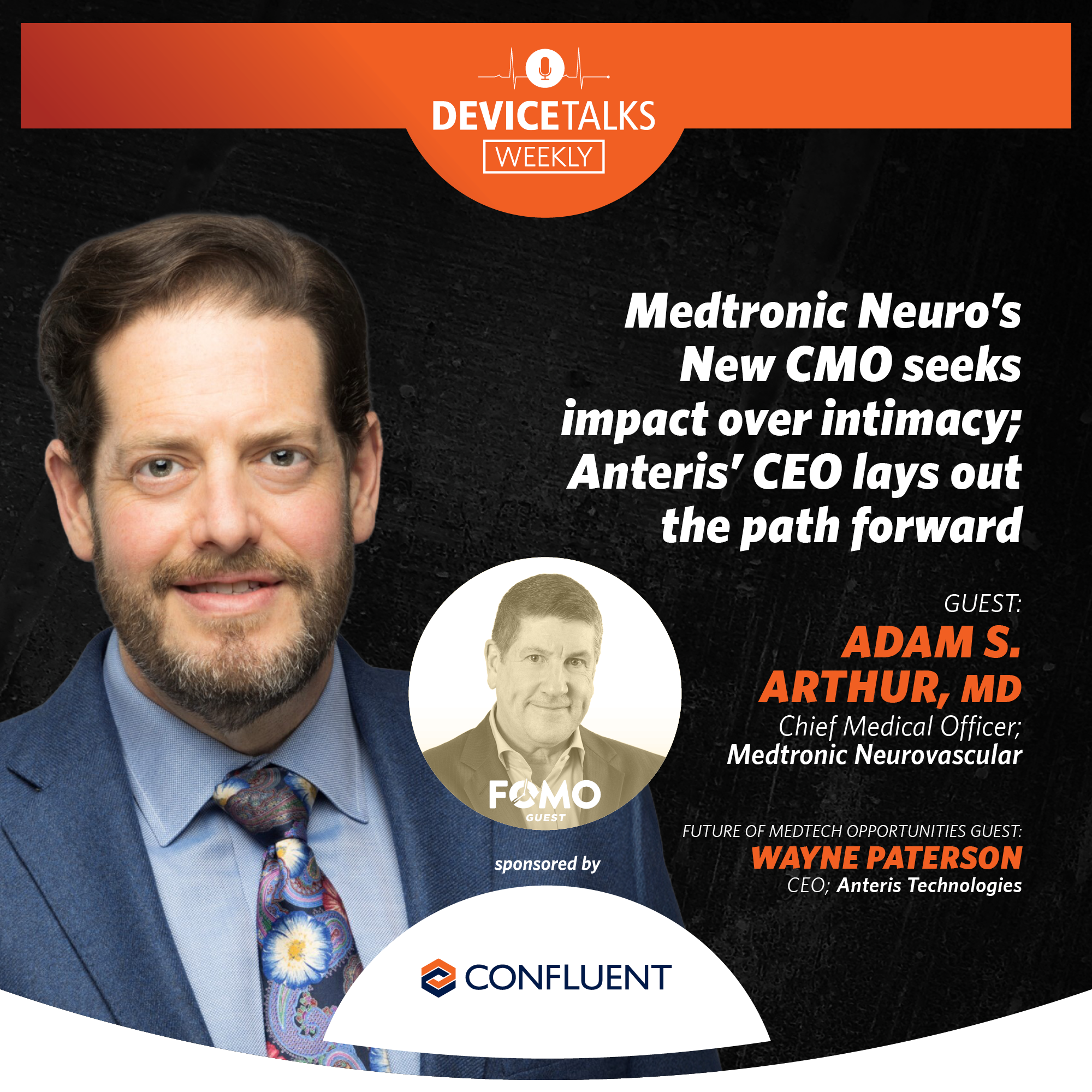
[00:30:57] Speaker A: Thank you to Confluent Medical for sponsoring this episode of Device Talks Weekly and our Cardiac Innovations series and of many other great device products. We love having Confluent on board. Now it's time for our keynote conversation with Dr. Adam Arthur once again. He's the new Chief Medical Officer at medtronic neurovascular.
[00:31:16] Speaker B: Well, Dr. Adam Arthur, welcome to the podcast.
[00:31:19] Speaker D: Pleasure to be here.
[00:31:19] Speaker B: It's great to highlight Medtronic. I think you're the newest cmo. You're certainly the new CMO for Neurovascular, so can't wait to unpack that space.
Before we get into the business. We always love to understand the person and I'd like to know how you found your way into the field. Of medicine.
[00:31:39] Speaker D: So I grew up in the Shenandoah Valley of Virginia with parents who were college teachers and a small town lawyer.
Attended the University of Virginia for college, was interested in government, was interested in biology, always interested in the brain.
And that led me to working for a vascular neurosurgeon there named Dr. Neal Cassell.
You know, there was a time when if you asked me, I would say, well, I know I want to be a doctor. And if you said, well, what kind? I'd say, probably anything but neurosurgery.
Because there are aspects of the culture of neurosurgery that aren't great. And I knew that at some point I wanted to marry and have a family, and I worried that would be hard.
It has been hard.
So I tried not to love neurosurgery, but I was unsuccessful.
I tried to become an emergency room doctor and it was great.
But it seemed to me that anytime a patient got really interesting, someone would swoop in from another team and take over.
It also seemed to me that there wasn't enough room to really grow the older ER doctors and the younger ER doctors were doing sort of the same thing.
And so I ended up in neurosurgery. I did residency at the University of Utah and then became very interested in blood vessels and stroke and aneurysms.
And at that time, there weren't a lot of neurosurgeons who did what we call neuroendovascular work, catheter based work.
But I had a few role models, a guy named Nick Hopkins who was very kind to me.
And so I ended up in Memphis through a series of strange coincidences, as a place where there's a lot of vascular disease and good mentors, both for catheter based endovascular therapy and for open surgery. And that was now almost 22 years ago. In that time, I've had the opportunity to really build a great vascular research and clinical unit here, teach and hire a bunch of amazing young doctors.
And for the last five years, I've been the James T. Robertson Endowed professor and Chair of the Department of Neurosurgery at the University of Tennessee.
And I didn't think that I was going to go work for industry. It wasn't part of my plan, but the opportunity that became available with this new position. It was something that didn't exist before.
And the opportunities that are available in medical technology right now, in my opinion. And then the people that I have to work with at Medtronic and Medtronic Neurovascular Those things really weighed into my decision to take this plunge. So I'm almost two months into this role and drinking from a fire hose, but really enjoying it.
[00:34:26] Speaker B: That's great. We'll love to unpack that change in a moment. But going back to neurosurgery and the demands of it, for folks who are listening to this, they can't see that you're in scrubs and you've got a mask on and that you've been called into the hospital.
Even though you had a very important podcast interview, you were still very important.
[00:34:44] Speaker A: You were still there when needed.
[00:34:46] Speaker B: So it just demonstrates the uncertainty of the specialty. What is it about? What are the qualities of a good neurosurgeon? Is it detail, attention to detail? What sort of type of person? I think there's an orthopedic surgeon type. I think there are other types. Is there a type for neurosurgeon? What are the good qualities of a good neurosurgeon?
[00:35:06] Speaker D: Yeah, I love that question. I've been asked that. I've got stories I could tell you.
Certainly having physical dexterity is helpful. Being smart is helpful. Having a good memory is helpful. Being able to work hard is helpful.
But I think there's room for a diverse, different people with different qualities in the field.
The real true core of it, I think, is determination, stubbornness, a sense that you are going to be there for the patient, you're going to do what needs to be done no matter what.
We really do prize going back to Cushing, who in some ways is the first neurosurgeon we really prize stick to itiveness.
It's also a team sport.
It's certainly not impossible to be a single narcissistic, focused, egomaniacal person.
That stereotype exists.
But more and more, I think successful neurosurgeons are both very determined and people who are able to join a team and make the team better.
[00:36:15] Speaker B: That's interesting.
And would you say they also have. The ones I've met have been. Well, because I work in medtech, I think have been particularly innovative and I think open to new ideas and new solutions and new technologies.
Is that a trait that neurosurgeons sort of hold?
Is commonly held by neurosurgeons.
[00:36:37] Speaker D: I think that it is a trait that's commonly held by neurosurgeons. But I'd say it's more effect than cause. In other words, you don't have to be particularly innovative to be a neurosurgeon. But we are so bad at it. We know so little about the brain that unless you really want to get better and you want to innovate, you want to have a challenge in front of you, the field is probably not as attractive. So I think it does end up with an enriched population of people who have a desire to make a difference and to innovate.
[00:37:09] Speaker B: That's fantastic. So let's again, just review the move to Medtronic.
It must have been a flip of a coin of sorts or something that led you to go this way or that.
What was appealing about this position?
And will you continue to practice? Are you leaving practice behind or are you going to be doing both?
[00:37:29] Speaker D: So I am going to continue to practice.
I'm transitioning. We're in the process of selecting a new chair of neurosurgery. The dean and chancellor and my partners have asked me to stay on until we have that person identified, but we're moving in that direction quickly. So I'm going to step back from leadership in some national neurosurgery organizations. I'm ending a term as the chair of the Neurosurgery Research and Education Foundation.
I'm going to stop being the chair of the department here. I'm still going to practice vascular neurosurgery. I have, over the last 20 years, done some general neurosurgery, disc herniations, brain tumors, other things. But I'm really just going to limit my practice to carotid disease, arteriovenous malformations and fistula aneurysms. Really, vascular neurosurgery with about a fifth of my time, and spend the other time, you know, working as an executive within Medtronic on neurovascular disease, primarily.
[00:38:22] Speaker B: And what went into. You mentioned earlier, it wasn't really part of your plan, but neither was being a neurosurgeon. So your plan, your planning isn't great.
But what led you to decide to take the course of industry? Is it just new challenges, new opportunities? What made you take this job or convince you to take this job?
[00:38:46] Speaker D: So there's one other neurosurgeon chief medical officer within all of Medtronic, a guy named Ashwin Sharon, who's at Jefferson. Really brilliant guy. And when I talked to him, one of the things he said that stuck in my head is, Adam, this choice is one where you trade intimacy for impact.
You'll have an opportunity to have a much greater impact with your work through Medtronic, but it won't be that intimacy that you get in working with residents, caring for patients and their families.
So I think for me, it was really the thought that this is a way that I can have a greater impact, because I do want to have an impact. I want to change the field. I think there's exciting things on the horizon. There are exciting things on the horizon.
[00:39:33] Speaker A: Terrific.
[00:39:34] Speaker B: Give us an assessment of the field, of the neurovascular field and the treatments that are currently available. You kind of alluded to it earlier that we're.
From what I draw from your statement before, we're sort of in the early stages, still figuring things out. What's the state of neurosurgery?
[00:39:52] Speaker D: Part of our neurointerventional or neuroendovascular DNA is finding solutions for people that don't have a good solution. And the medtech way of saying that is an unmet clinical need. Right, Perfect. So if you go back 30 years, there were aneurysms that we really couldn't handle with open surgery.
And people like Guglielmi were instrumental in developing new therapies. And in the Medtronic DNA is a lot of those new therapies. The coils that we have that are the most popular coils in the world for treating aneurysms. The pipeline flow diverter, which is the first flow diverter strategy we have in our portfolio for treating aneurysms, and then you can move to ischemic stroke.
Going back 12 years, we didn't have great tools for removing blockages in the arteries to the brain.
But the Solitaire Stentriever, which is one of our Medtronic stroke products, was really the first device that was shown to make a huge difference.
And so we went from some leaders in vascular neurology saying that thrombectomy for stroke was completely ineffective and only done because physicians wanted to be reimbursed for it, which. Which made me angry at the time because there was no reimbursement at the time. But we went from that to thrombectomy as sort of the penicillin of modern medicine. Opening that block blood vessel has an incredible ability to reduce disability for the most disabling disease we face.
And then so we talked a little about the history and some of the neurovascular devices that we have that are part of that history.
But now we're looking at. At new diseases. So chronic subdural hemorrhage, we have thought for a long, long time was bleeding between the inside of the skull and the outside of the brain.
But in the last 10 years or so, we've recognized. Wait a minute. There's leaky blood vessels there that are exuding fluid. It's really not bleeding.
So, you know, over here in the operating room, we will often do a craniotomy and a little circle right here at the top of the brain to alleviate what we thought was an accumulation of blood.
And you can go back and see skulls that are radiocarbon dated for 7,000 years with that same circular craniotomy.
[00:42:14] Speaker B: That's amazing.
[00:42:16] Speaker D: But here in the last five or eight years, we've discovered that you can take a little catheter and go up into the dura, that lining of the brain, and use onyx, a liquid embolic, which was proven in the embolize trial, published in the New England Journal of Medicine last year. Or there are some other substances that are used too to block those leaky blood vessels and with much less invasiveness and morbidity for older patients, really dramatically help the outcome of chronic subdural hematoma. I really see that disease state as almost a pivot. We started with really angiography and stroke and ischemic and hemorrhagic stroke. You could still call chronic subdural hematoma a kind of hemorrhagic stroke because it is, you know, related to blood products on the surface of the brain. But we're moving away from stroke. And so going forward, you can imagine a time where we might use endovascular access to the brain, incredibly high priced real estate within the universe of the body to treat even other diseases, because there's a full spectrum of neuroscience there to look at how we can treat a number of things in the brain and spinal cord going through the arteries. So I'm really excited about that. I'm excited about not abandoning the obligation and privilege we have to take care of stroke patients, but also expanding on that to find ways to help patients where substantial improvements in therapy haven't happened in this one case in thousands of years. Right?
[00:43:54] Speaker B: Absolutely. And it seems to me the space that you're in is under some of the greatest scrutiny, or at least getting the most attention from Medtech and from the field. Just the talk of stroke, of time is brain of the need for more access, the need to get patients the treatments they need quicker. I mean, it comes into every conversation about surgical robotics and things like that. We don't need to go down those paths.
But do you, as someone who's on the front lines, do you see help coming? I mean, you mentioned all these great products that Medtronic's working on, but do you see this field getting perhaps more attention than it did in the past. Do you see the attention on innovation as a hopeful sign that your colleagues and you will get the tools you need further, to help these patients who are well, they need to be lucky and close to some of these centers to really get the help that they need?
[00:44:50] Speaker D: Yeah, I absolutely do see an expansion in our ability to meet that unmet need and to help patients suffering from neurologic diseases 100%.
A lot of Americans can't really tell you what the signs of a stroke are, but they really don't want to be disabled.
I think a part about Americans in particular are we really, we prize our abilities, we prize our strengths, we don't want to be dependent on others, and stroke is the leading cause of disability.
I talk to a lot of patients who might say, well, doc, if it's my time, I'm ready to go.
I can die. You say, well, hey, the problem is this continuing nicotine exposure, this continuing atherosclerotic buildup is that it's not likely to kill you cleanly. It's likely to disable you and make you dependent on others for your care. And you can see somebody suddenly sit up and go, oh, heck, you know, I don't want that.
[00:45:53] Speaker B: Right, right.
[00:45:55] Speaker D: So, yeah, I do think there's a tremendous drive to invest in new therapies for neurovascular disease.
[00:46:03] Speaker B: Excellent. So talk a bit about.
You've gone over some of the products in Medtronic's portfolio.
Where do you see future opportunities?
Where do you see the ability for you to make the impact that you're hoping to make as CMO of the neurovascular business?
[00:46:21] Speaker D: Well, we talked about chronic subdural. That's just breaking now. I mean, we're talking to the agency now about whether the clinical evidence that we put together is sufficient to receive an indication for usage. A clearance to market Onyx for the treatment of chronic subdural in the United States.
I don't know when this podcast is going to air, but it could be that that's happened when it airs or immediately thereafter. That's huge. I mean, that's a whole new disease state, a new indication.
So that is right now, getting clearance to market it is step one.
Improving those therapies and improving the systems of care so that we can get to those patients and treat them properly is a whole other body of work.
[00:47:05] Speaker B: How do those patients present. How do you know that they're having this issue?
[00:47:08] Speaker D: Yeah, more commonly, older patients and the most common symptom is Headache.
[00:47:13] Speaker B: Okay.
[00:47:14] Speaker D: And so it is an often undiagnosed or misdiagnosed cause of loss of function in older patients. And as we're living longer, we all don't want to just live again. We want to have abilities, we want to enjoy our lives. We want to be there for the people who matter to us. So I think this is huge.
And that's an area we haven't always been great at, is looking at function and patient reported outcomes. How are we really doing in helping people to live their lives? It's one of the things I love about medicine in general and medical technology in particular.
It's very non judgmental. If we're doing things right, we're just giving people more time to do what they want to do in life. And I think that's beautiful. I love that.
[00:47:58] Speaker B: Do you see that you've been able to do right and to help more people over the last 10 years due to innovation? I mean, 100%. 100%, yeah.
[00:48:07] Speaker D: I mean, we talked about ischemic stroke, large vessel occlusion and a solitaire device, the move towards aspiration. There's no question we're improving our ability to help patients. There's no question. Patients who show up now with an aneurysm, you know, again, I've been here, working here for 20 years. Compared to those that showed up 10 years ago or 15 years ago or 20 years ago, we have so much better opportun opportunity to understand the aneurysm and a greater spectrum of tools to treat it.
[00:48:35] Speaker B: That's remarkable. And you're right about stroke. I mean, there's no other condition that can change your life. Literally within an hour, you've gone from perfectly vital and healthy to what you've described. And I can't think of anything more tragic than that.
So do you have some other visions of maybe things we're not talking about, where there's an opportunity for growth. And I'm not looking for you to give away state secrets of where Medtronic may head, but maybe more broadly, more systemically, where could we see improvement in the treatment of neurovascular patients, neurosurgical patients, to get the greatest impact.
[00:49:14] Speaker D: So I don't think we've always done a great job of taking care of women's health.
[00:49:18] Speaker A: Okay, great.
[00:49:19] Speaker D: And outcomes for stroke patients are worse if you're a woman and women are more likely to have an aneurysm.
And then we talked about disability.
I've talked before about how with stroke there's a butterfly effect, where if you're losing ability, you're losing your chance to take care of other people. And I feel like often in our family structures, women are the ones who take care of other people. So if you disable a woman, arguably you might be really adversely impacting the people that woman is spending so much time taking care of, because I see that often from women.
I know it seems like I'm not answering your question, but I'm going to get there.
[00:50:00] Speaker B: Nope, take your time.
[00:50:03] Speaker D: I think one disease that has not received the attention that it should and where there may be progress to be made is chronic refractory migraine and headache.
And that, again, affects many more women than men.
For men, it's less than one in 10. It's probably in the order of 6 to 7% of men, well, at some point in their life, struggle with terrible chronic refractory headaches. Women, it's one in five. It's 20%.
[00:50:32] Speaker B: Wow.
[00:50:34] Speaker D: And while there are phenomenal research and clinicians that have worked on migraine for a long time, and there are great therapies, there are a lot of patients for whom it's not enough. I bet you know some. It's so common.
[00:50:49] Speaker B: I do, and I've had conversations recently where people have migraines half of their days or more. I mean, they just. I don't know how they go through their lives with being hit by that frequently. I'm blessed not to have that, but, no, it's a terrific impact.
[00:51:07] Speaker D: So you're asking about the future, and let me make it clear, this is speculative. This is the future. But right now, a lot of the work on migraine has focused on the astroglial and auronal element of it. It starts in the brain with spreading cortical depolarizations, which you might think of as almost like a mini seizure, which is why a lot of time migraine patients will have what we call an aura or something neurologic that happens that is a warning sign that they're about to get the headache right.
Sometimes they drop things. Sometimes they see jagged lines in front of their eyes. Sometimes they smell something funny. Again, if you have friends who are migraine patients and you ask them, how do you know a migraine's coming? It's amazing the. The different answers you have. And so we focused on the brain, but what's happening after that is somehow it's interacting with blood vessel tone constriction and relaxation in the lining of the brain, the dura and inflammatory markers. And so as we treated chronic subdural Looking at the blood vessels in the dura there that are leaking that again, we've only treated by drilling holes in the skull and washing stuff out for thousands of years.
I think there's a surge of interest in whether it might be possible, through a neurovascular route, to address some of the unmet need for migraine.
So to be clear, Medtronic doesn't have a product for this now or clearance to market anything for it now. And I'm not advocating for that. But if we could go from treating arteries in the brain for stroke and aneurysm, continue to do that, get better at that, look at arteries in the dura for chronic subdural for older patients, and maintaining function, addressing a preventable cause of loss of function in older Americans, and then use the insights gained there to be able to treat women, usually from early teen years up through their most productive years of their lives, predominantly who have not been able to get relief from recurrent refractory migraines.
That would make me very proud and happy, and I think that's possible. I think we may be able to find something better than a pill.
I've said this before, but I think you asked about AI. If we asked an AI to come up with rules for which diseases are treated by which specialty in medical school, the AI might say, well, if there's a little piece of anatomy in one spot that you can get to easily, we should send that to the interventionalist or to the surgeons. But if it's instead, you know, an infection raging through your whole body, we're gonna send that to the medical doctors. You know, the first group clearly needs something done, a procedure. The second group, maybe we can find an antibiotic, a pill, something systemic.
We have thought of migraine as the second group, but it might be the first.
[00:54:00] Speaker B: Wow.
[00:54:01] Speaker D: It might be that if we address blood vessel tone and inflammation in tiny arteriolar beds in the dura, that we could, through a neurovascular way, advance how to treat those patients. So that's one example.
I think there are others. I mean, neurodegenerative diseases like Alzheimer's and Parkinson's, I think there's more that we can do there that might help us with neurovascular avenues, autoimmune diseases. My dad has multiple sclerosis. They're so complicated, they involve so many things that it may be a long time before we come up with procedures that'll address neuro autoimmune diseases.
When you look at those diseases, they involve a genetic component. They involve an environmental component. They even probably involve a component of stress in terms of your immune system attacking your own body. So it gets really complicated.
But yeah, I mean, you tell me a brain or spinal cord condition and I'll tell you that I can get into that anatomy and do things through arteries and veins in intriguing ways that might allow us to advance the field.
[00:55:13] Speaker B: That's amazing. I don't know if it's the scrubs and the hat and the mask, but you got me pumped and I can't wait to see the whiteboard. Well, I'll never see it in your office. I'm sure you've got a lot of very long to do lists.
Dr. Arthur, thanks for the time today and I hope we have another chance.
[00:55:29] Speaker A: To talk, perhaps at a conference or another podcast.
[00:55:33] Speaker D: Thank you so much for the time.
[00:55:36] Speaker A: Well, that is a wrap. Thanks again for joining us on this episode of Device Talks Weekly. Thanks of course, to our sponsor, Confluent Medical, and of course to our great guests. Please don't miss a future episode of Device Talks Weekly. You can subscribe directly to this podcast on any major podcast player, or if you want to cover all your bases, subscribe to the Device Talks Podcast network. You'll get this podcast and our many other great podcasts, including the Women in Medtech podcast hosted by Managing editor Kayleen Brown. I hope you'll join us next week for our Cardiac Innovations conference. It'll be a virtual conference and we'll have three great companies that I outlined up top. We'll start off with Syncardia, kick off the next day with Field Medical and ended it and rounded up with Valcare. So three great heart focused technologies, three very different approaches, three bright futures brought to you by four fantastic sponsors, Confluent Medical, Jabil Healthcare, PSN Labs, and Solaces. So hope you'll join us on the Cardiac Innovations Digital meeting next week. And of course, please join us AT Device Talks Minnesota. You'll meet Wayne Patterson there as well. That's happening May 4th at the McNamara Alumni Center. All right, folks, thanks for being part of Device Talks. Please connect with me on LinkedIn. Connect with Kayleen Brown on LinkedIn, connect with Chris Newmarker on LinkedIn, follow mass device, Device Talks and all of our great sponsors and be part of our future conversations. Take care, everybody.