Episode Transcript
[00:00:00] Speaker A: Hey everyone, this is Tom Salemi of Device Talks. Welcome back to Device Talks Weekly. I will give you my last Happy new year of 2026.
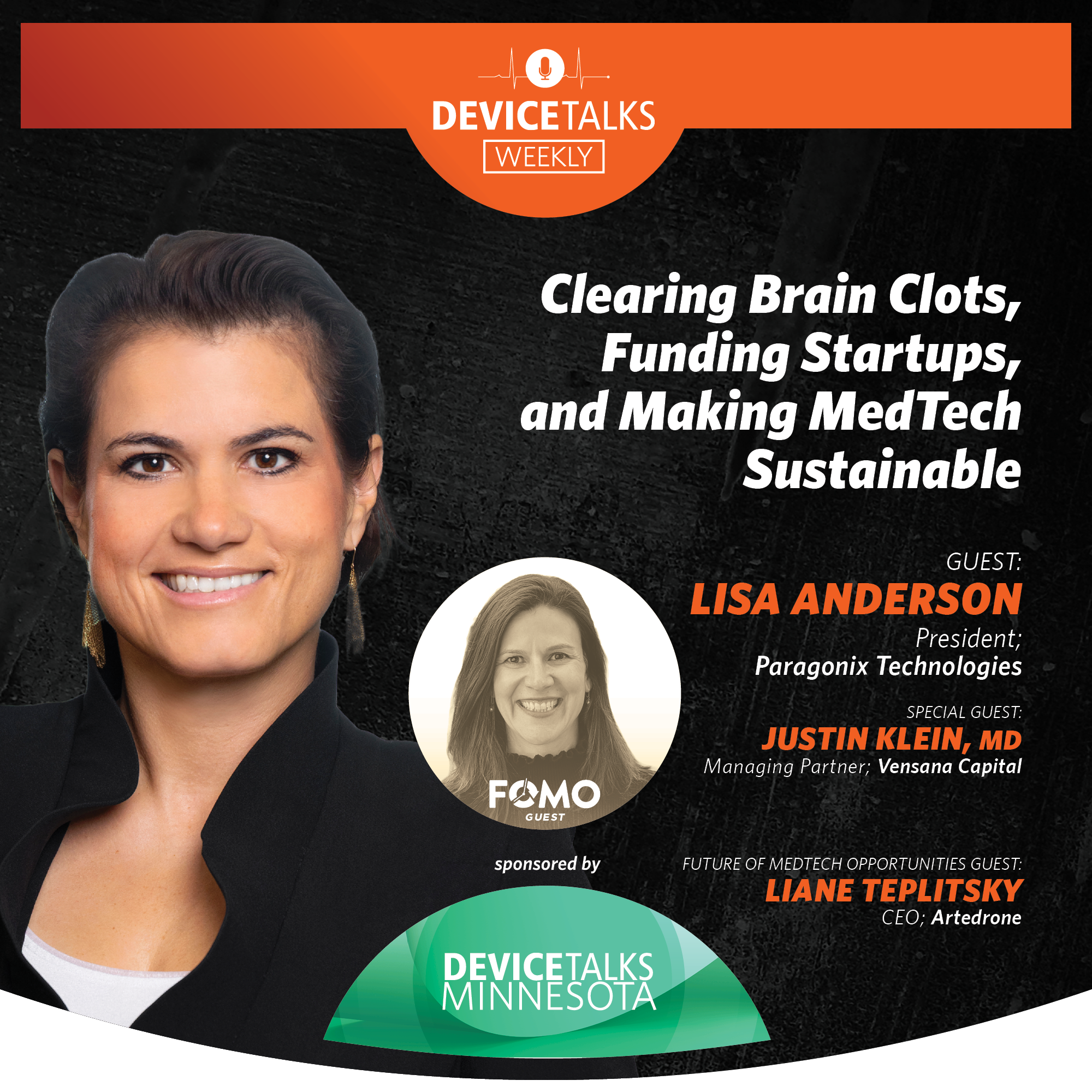
I think the shelf life is expired on that one, but you are our Device Talks family and you certainly deserve a Happy New Year greeting. So Happy New Year to you. Thanks for returning to Device Talks Weekly. Thanks for being part of Device Talks more broadly. We've got a great episode for you today. I'm going to try to New Year's resol. I'm going to try to organize my thoughts a little bit better as we move into this intro. So I've got five things for you. I'm going to try to limit it to five things that we'll cover in this quick intro. First off is our guests. We have three great guests this week. Chris Newmarker speaks with Paragonics President Lisa Anderson about that company's organ preservation system and its move towards sustainability.
I had a chance to speak with Justin Klein, one of the founders of Ensana Capital. He took part in the Newsmakers with Chris Newmarker. And then Justin and I talked about the fundraising climate for startups and unpacked the recent report by HSBC about the fundraising performance of 2026. You can find that report.
We'll put the link to that report by John Norris and his team in the show notes. And finally, Managing Editor Kayleen Brown visits with Leanne Teplitzky. She when Kealne spoke with her, she was the CEO of Artichone. Artichone had some news that I'll mention a little later in the podcast just before her interview. But this was another FOMO great FOMO recorded at Device Talks West. So enjoy those three interviews. The fourth thing I want to bring up is Device Talks Minnesota registration is open. We did sell out last year. I've got a great lineup forming, including Lisa Earnhardt of Abbott as our closing keynote. Very happy to sit down with Lisa. We've done a podcast, we've certainly talked informally but never had her as a speaker at one of our conferences. So I'm definitely looking forward to that. That'll be May 4th at the McNamara Alumni Center. And the fifth and final thing is I'll be at JP Morgan next week. I'll be walking the streets of San Francisco, of course, meeting in the random coffee shops.
Have some meetings scheduled up scheduled already. Sure, I'll add some more. But I'll also be emceeing a non Device Talks event which I'm very excited about. The event is the next Horizon Health Tech Summit and got a great lineup of speakers focusing on sort of the intersection of AI and robotics and all the technology that's driven us to driven the medtech industry to this point in time where I really feel like we're at the precipice of some rapid change coming.
So we've got several, several great keynotes that'll be giving sort of TED talk like presentations, a great panel and Scott Gottlieb will be speaking as well. So that is happening Wednesday night at JPMorgan. To find out more information, you can go to nexthorizonsummit.com I think the room is pretty full, but you are able to ask for an invitation and it should be a great conversation. And I'm excited to be part of a show at J.P. morgan. I hadn't done that before and looking forward to introducing the speakers and just being part of the festivities before and after. So I hope to see you at JPMorgan in some form or fashion once again. I'll put a link to the next Horizon Summit in the show notes. All right. With that, I'll just mention our sponsor Device Talks Minnesota. Once again, it's opening up. The registration is open and will be May 4th at the McNamara Alumni Center. Sold out last year. Looking forward to a great show this year and I hope you'll join us there. All right, let's get this podcast started.
All right, you ready for this?
[00:04:03] Speaker B: Ready.
[00:04:22] Speaker A: Well, Chris Newmacher, how are you, sir?
[00:04:25] Speaker B: Doing all right, Tom. Doing all right. We're, you know, we're talking on a Thursday and you know, it's having a rough week here in Minneapolis.
[00:04:33] Speaker A: Yeah, no, I know. I think you and I have recorded podcasts during January 6th during a lot of unfortunate parts of our history.
So.
[00:04:45] Speaker B: Yeah.
[00:04:46] Speaker A: So kind of a weird touchstone to have. And this is yet another one. So sorry to see what's going on over there in Minneapolis. You guys are taking it in the, in the snout a few times.
[00:04:55] Speaker B: Yeah, it's, it's, it's quite the time right now. But, but yeah, here's to, here's to better times. We'll just keep it going. So.
[00:05:04] Speaker A: All right, well, we'll, we'll try to, try to bring this back to a MedTech track.
[00:05:09] Speaker B: We've got, we've got good news and we got a guest here today, which is. That was awesome.
[00:05:14] Speaker A: A great guest. Justin Klein, of course, one of the managing partners at Ventsana Capital, which is a fixture in Minneapolis as well, including as well as nationwide. Justin, welcome to the podcast.
[00:05:26] Speaker C: Thanks, guys. Tom, Criss, it's great to be here with you.
[00:05:29] Speaker A: You've been a guest once or twice, I think before you were one of our early guests, I think when this little nonsense started. So appreciate your returning it obviously didn't.
[00:05:39] Speaker C: It's been long enough. You guys forgot.
[00:05:41] Speaker B: So there you go.
[00:05:43] Speaker A: Your reputation was restored enough that it can take another hit. So we're going to hit upon the HSBC annual report put together by John Norris, which is something I always look forward to seeing. These are numbers.
[00:06:01] Speaker B: I love a good media report. I love a good media report.
[00:06:03] Speaker A: It's a good media report. It's a good snapshot. The quarterly stuff I used to pay way too much attention to. The annual stuff I like to take a good look at. We'll unpack that a little later. We'll hit the newsmakers first and then we'll get into the report after. But Justin, anyone listening to this podcast, I'm sure knows Vensana Capital, but just take a moment and let folks know a little bit about yourself and about Vensana.
[00:06:28] Speaker C: Sure. Well, I'm one of the co founders of our venture firm Vensana which is dedicated to medtech venture and growth equity investing alongside my co founder Kirk Nielsen. We started the firm very beginning of 2019.
It's amazing how time has flown. It is but today we are at 15 team members spread across the US multiple time zones and offices.
We've made about 25 investments out of three funds spanning a range of different stages and clinical and commercial areas in medtech. Not just traditional medical device but also including some digital solutions, diagnostics and tools, even drug delivery that tends to quack like a device.
And excited to be with you guys to kick off 2026. You know, heading into JP Morgan. I think lots of good things to talk about and our team's excited to get out there and reconnect with everybody too.
[00:07:31] Speaker A: Yeah, I know it's a great time to sort of set the agenda for the new year.
And yeah, you and Kirk Nielsen, I remember that starting and you're two of the nicest, most solid individuals I think in vc. I think you could have gone with like a very nice VC fund and that would have been a perfect name for you too. Just like a Ron Swanson.
[00:07:51] Speaker C: The website was taken.
[00:07:52] Speaker A: Otherwise we very good vc but all right, great. Well, we're going to roll into Chris' Newsmakers of the week. These were the most popular stories. Most read stories on Master Vice or we just in Chris's editorial and godlike powers, he determined them to be the biggest news of the week. So with all that power rushing to Chris's head. Chris, what's number five?
[00:08:15] Speaker B: I usually I go and look at Google Analytics and like, say, hey, what is our audience reading the most? But yes, I then like, also make decisions. Like, a lot of them are reading this, but I still think it's boring, so we aren't going to talk about it. So but, you know, number five in the list, actually dipping into medical design outsourcing just because this is some significant news for the industry. And Dr. Tom Fogarty passed away on December 28, 91 years old.
That's a good age.
I hope we all make it up there here.
That would be good. But it's interesting. I started covering medtech well over a dozen years ago, and I feel very fortunate that I started covering our industry while, you know, our industry is young enough that, you know, we still had like, some of these, like, founding fathers around who got everything going. I mean, people like Earl Bakken, who's now also passed away. You know, we have others, you know, still around, thank goodness. But, you know, fortunately, like Dr. Fogarty has, has passed on. But he was a pioneer of minimally invasive surgery in the 1960s. I mean, the Fogarty catheter. I mean, this whole idea that he could deliver med tech into people's bodies in a minimally invasive way using cathet.
Fogarty got it going and he just didn't stop. He was inventing through his whole life.
And also just to pass things on to the future, I mean, got an innovation institute going in California that bears his name. That's going to keep on going.
[00:09:52] Speaker A: No, I had the opportunity to meet him once at a conference we had in Minneapolis, Fears a decade ago or so, and look up Lodra in life in the Dictionary. And he just was that person.
The boxing, the stories, how he engineered the brake for his friend's scooter so he could. When he was a teenager so he could. Tom Fortgood could stop getting thrown off the scooter. Just all of these things that just made for a remarkable medtech story. And I'm actually, I don't. Like I said I met him once, but it was great knowing that he was there. And it was kind of a living tribute to, to. To medtech industry. So I'm sorry to see here that he. I was sorry to hear that he passed.
And I don't know, I think there is. I think there'll be a little bit of a. An absence at JP Morgan. I think people will feel it. Justin, did you have much interaction with.
[00:10:44] Speaker C: The Tom Fordy I did over the years.
Not as much as I wish that I could have, but I appreciate Chris's comments about, you know, kind of the legacy of.
Of those that have shaped this ecosystem really don't go that far back in time.
I've been doing this now for 20 years.
One of the first companies I started paying attention to from NEA's legacy portfolio was Anurex, which Tom was a co founder of. This was a endovascular approach to treating AAA disease. So something after the Fogarty balloon, but an incredible impact on patient care.
And, you know, the people that I was mentored by were the people that invested in that company with him. So we're all so close, actually to the family tree, so to speak, from some of these seminal leaders like Tom, who created a legacy that all of us are benefiting from and frankly, have to try to live up to.
Tom was a character too, and I always appreciate that. So if you saw Tom on stage, there were two things that, you know, he made abundantly.
One, patience were everything to him.
But two, he had no patience for bullshit.
And he would say it right, and that was everything from administrators to VCs. And there was a clarity to his commitment in doing things the right way and getting things done that I think was really refreshing. And I think the work that Andrew and the Fogarty Institute team are doing to perpetuate his commitment to patient care and innovation is phenomenal. So want to continue to support their work. And of course, my heart goes out to Tom and his family and everybody there whose lives he touched. And he's going to be really missed.
[00:12:37] Speaker A: Absolutely. For sure. And, Justin, you started off at nea, and I know Dick Kremlich, the founder of nea, passed away last year as well, so he was another.
Another legend. Not in medtech necessarily, but in venture capital that we lost.
[00:12:53] Speaker C: Yeah. I mean, Dick. The same kind of theme, right? I mean, Dick.
If you guys ever been to Harvard Business School, there's the Arthur Rock center for Entrepreneurship. Arthur Rock was one of the first institutional venture capitalists who hired Dick to mentor him.
[00:13:07] Speaker B: Wow.
[00:13:08] Speaker C: Dick was the first person that took my phone call at NEA and interviewed me for a job.
[00:13:12] Speaker A: Oh, wow.
[00:13:13] Speaker C: Encouraged me to meet with John and Ryan on the east coast and help me get that internship.
And Dick was a pretty prolific and successful medtech investor. A lot of people might miss that, but, you know, 50 years ago, it was a lot more about meeting an entrepreneur, believing in a vision for disruption, and then figuring out how to support all of that. And Dick was great at it. Not, not just in technology, but healthcare, too.
So I was proud to have been somebody that was, like, one generation removed from the first cohort of true venture investors here. So it's pretty neat.
[00:13:54] Speaker A: That's great. And we'll follow up with Fogarty Innovation as well. I know they have news with crf.
They're merging with the CRF foundation, and then they're going to be moving forward in a broader effort to foster innovation in medtech. So hopefully we'll unpack that on a future podcast. All right, great newsmaker. Chris, let's move to number four.
[00:14:17] Speaker B: Yeah, number four on the list.
As I said, we're talking on Thursday and just today, Teleflex announced that its CEO Liam Kelly is departing the company, effective immediately. And this is going on at the same time that Teleflex reduced their guidance for 2025.
Their Q4 and full year reports are coming up in coming weeks, but they reduced the guidance and.
Yeah, so they'll be looking for a new leader over at Teleflex. For now, Stuart Randall is going to be the interim CEO.
[00:14:56] Speaker A: Okay, well, interesting news at Teleflex. Justin, anything about Teleflex or anything to add?
[00:15:01] Speaker C: Well, I think.
I think Liam Kelly deserves a lot of credit for what he did for Teleflex and its shareholders over, I think, a very successful leadership run.
There were things that have really transformed that company. You know, and being bold and thinking about how to navigate acquisitions of innovative products like Neotrax, Eurolift or the Vascular solutions business were things that really transformed the company, created a ton of market cap and value, and certain things have been challenging, for sure. But I think if we kind of took a step back and looked at the strategic transactions they've undertaken, they've really outperformed expectations as well. And I think a lot of that's to his credit. So he's been a great contributor to our ecosystem. I've been on the board at MDMA with him, and we'll miss him, too, but I suspect he won't go far. Hopefully he'll take a phone call for a board seat or something like that from our companies.
[00:16:00] Speaker A: And as a vc, I imagine you'll keep an eye on this. I mean, you want whomever to come in to have that same appetite for innovative medtech devices.
[00:16:11] Speaker C: Yeah, I mean, absolutely. Honestly, what he did took a lot of courage.
And it takes a lot to convince shareholders to kind of rethink what a business looks like and what kind of commitments it takes to grow new products and take some near term dilution on EPS in favor of the long term. I think you set a good example of that and I hope we can see some more from a lot of our mid cap and large cap CEOs.
[00:16:36] Speaker B: Yeah, I mean they were just agreeing. I mean they were still making big strategic moves. I mean even last month they announced that they were going to be, that they had agreements to sell off some of their businesses to kind of better focus on what was left there. So I mean, so yeah, well it definitely will be something to follow what happens next over there and yeah, exactly what's Liam going to do now? So that'll be good as well.
[00:17:01] Speaker A: All right, Chris Newmarker, let's roll on to number three.
[00:17:06] Speaker B: Well, number three was we had Star Surgical.
Their shareholders said no go on merging with Alcon. Alcon was going to pay $1.5 billion billion dollars for, for star. But there are always been opposition expressed by broad word partner, Star's largest, you know, shareholder. They quickly came out opposition to this deal. So, so that's, that's a no go. And then you know, the, the analysts are, are saying, you know, the next thing is like, okay, there's going to be some kind of, you know, some kind of change is expected in the board and the board and the company's management after, you know, something like, like this. But you know, the, the big open question is like how much and how long is all of this going to, going to last?
[00:17:52] Speaker A: Justin, do we, we're seeing a lot of shareholder involvement, we'll say in some, some of the medtech companies. Do you see any change in sort of investor attitudes at medtech companies that becoming more influential or is this just sort of a outlier of things that happen on occasion?
[00:18:12] Speaker C: So, so I mean, I'm, I'll be honest, I'm a little less familiar with the history here and how, you know, they established a 30% ownership stake. That's a, that's a big one. Yeah, we are seeing more activist shareholder activity particularly across kind of large medtech, large cap medtech companies that are a little bit slower growing frequently with, you know, a lot of diversification across their portfolio. And people are trying to figure out how to unlock value across different, you know, market growth rates in their portfolio.
[00:18:44] Speaker B: I'm really wondering what's going to happen with Elliott Capital Management with them investing in Medtronic and getting a lot more involved. I mean, that's going to be really interesting to follow.
[00:18:54] Speaker C: Yeah. And honestly it seems like that's Gone well so far. I mean there's a lot of, I think mutual respect and the Medtronic team and board have been, I think, welcoming of that engagement. In other cases it can be a lot more, you know, there can be more friction around it.
In the case of Star, you know, it's an interesting, it's an interesting market. ALCON is the 800 pound gorilla.
Star has been pretty successful in China, you know, in terms of its, you know, geographic exposure. And I imagine that was a value driver for alcon. I think there's a question as to what's next if not this transaction. So I'm interesting to see how it plays out.
[00:19:38] Speaker A: All right, great thoughts, Chris. Newmarker. Let's roll on to number two.
[00:19:42] Speaker B: Number two on the list we have and I should add that, okay, I wrote the Fogery piece Telflex and Star by our senior editor Sean Hooley. Here's another one from Sean. Is W.L. gore agreeing to acquire left atrial appendage occlusion device maker Conformal Medical?
But I mean this has been a really interesting space when it comes to these catheter delivered LAAO devices. I mean, Boston Scientific has their watchman which complements its fair pulse field ablation very well. Abbott has its amplats or amulet here in the United States. And Conformal has been saying, hey, we've got a next gen catheter delivered LAAO device. I mean, implanting this in, you know, the heart reduces risks of, you know, strokes that could occur, you know, because of afib, you know, so it's, yeah, this is, it's kind of all right. We're going to see if we get some more, even some even more competition in this, in this area.
[00:20:53] Speaker A: Justin Acquisition ads are always a good thing, I imagine. Just something good to see.
[00:20:58] Speaker C: I, I think so. I mean, I, in a few comments, I guess I think this is a bit of a coming out for Gore.
We've had a lot of interaction, engagement with their team, from Brett Snyder, their CEO, to their COO Steve and their ventures team.
It's a really great group. Broadly, they're rethinking their business and they have, I think, an impressive vision for how to take Gore to the next level.
They're a very profitable company. They have a lot of resources and a lot of depth of expertise and I think they have decided to embrace more external innovation and I think this is the first I would expect, among other moves they're going to make.
I wouldn't have had this particular like LAA closure, you know, market on my bingo card for them, just given some of their businesses and where I think they could also be successful. And I'm a little surprised, honestly. This didn't go to J and J or Medtronic. When you think about LA closure, it's a big EP indication, electrophysiology.
And as Boston has built a leadership position there with Watchmen, it's only going to be strengthened by the fact they have a strong ablation franchise because increasingly patients are getting both catheter ablation for AFIB and a Watchman or an occlusion device.
Abbott has a competitor, Medtronic and JJ really don't. But significant ablation franchises and lots of synergy there. So how Gore pursues this commercially and then how those that are sort of left out without an asset respond, it's going to be really interesting to see how it plays forward, but especially because.
[00:22:38] Speaker B: Boston Scientific has kind of shown this, that pulse field ablation and these occlusion devices are kind of like peanut butter and jelly here, bread and butter. So, you know, you'd think a Medtronic or J and J would want to get that as well.
[00:22:54] Speaker C: Yeah, I mean, I think it's a really important asset for each of these companies to have. So the category's been interesting to watch and I think it's interesting to see Gore lean into an acquisition at what sounds like a really good deal all the way around. And it's way ahead of their readiness for market launch. And so their willingness to move ahead of something that's FDA cleared or ramping revenue, when we tend to think most strategics are going to kind of show up with interest in something. It sends a really strong message that you can't just sort of sit on your duff and wait for these companies another couple years. There's buyers out there that are going to take these things off the table, which I think is great.
[00:23:36] Speaker B: Does Gore have an ablation system in the works right now?
[00:23:41] Speaker C: I don't know.
[00:23:42] Speaker B: Yeah. Okay.
[00:23:43] Speaker A: I guess there's enough that could be acquired out there. They certainly have a lot of smaller ablation.
[00:23:46] Speaker B: We are single companies, so maybe they'll be shopping for that too. That'll be interesting to watch.
[00:23:52] Speaker A: Would this have been an auction? I imagine Conformal would have solicited bids from multiple people, multiple parties.
Do we know for a fact one way or the other whether that happens here or not? Or could this just be a one off?
[00:24:08] Speaker C: I think they had bankers engaged. I don't know more detail than that, but it sounds like it was a really positive outcome for Everybody at Conformal too.
[00:24:17] Speaker B: Yeah. Fantastic.
[00:24:18] Speaker A: Chris Newmark, I know you get a run. Let's hit number one.
[00:24:21] Speaker B: Number one on the list. We've got Johnson Johnson medtech. The long awaited submission to the FDA for the ATAVA surgical robot. So pop the popcorn. The competition just is getting even more higher in the space. It's fantastic.
[00:24:37] Speaker A: Yeah, I know. It's exciting time. I think, as I think I said on LinkedIn, you know, I think five years from now, hopefully if J and J moves forward in a positive direction, we'll have a completely different looking market.
Maybe we'll actually get to see some pictures of OTAVA as well, which would be great. Some. I know we've had hits here and there.
[00:24:55] Speaker B: We've been asking that for, for years.
All they did was they sent us a picture of something with like a blanket over. No, I'm just kidding. No, they didn't do that.
[00:25:04] Speaker A: It was a blue dot over it. Yeah.
[00:25:06] Speaker B: Look like their arms sticking out. We'll have to. Yeah.
[00:25:10] Speaker A: No, but Justin, how are you? I don't know how you even Surgical Robotics obviously is getting venture capital. I don't know you. I don't think you've made any bets here yet. And if you have, correct me, but I see the area shaping up.
[00:25:22] Speaker C: Yeah, I mean this will be interesting story to watch unfold too. I mean J and J has incredible resources and breadth and strength in general surgery. Obviously they've been thinking about robotics multiple ways for a long time.
I don't know much about the product or, you know, their strategy on sort of market entry, but we, we have, generally speaking, sat on the sidelines.
This is a category that's matured so much it's hard to identify some of the potential competitive advantages a startup would bring to the category versus intuitive or, you know, eventually here, Medtronic and jj, et cetera, whether that's in the hospital or the ASC or elsewhere. So we, we're sitting there with you with popcorn.
No vested interest in seeing this play out. But of course we want to see innovation succeed and if they can strengthen the ecosystem and there's room for additional tools or digital insights or innovation like that, be great to have more fully committed and successful acquirers in the landscape.
[00:26:23] Speaker B: I certainly get.
My interest goes up when there's a startup that has something that's kind of like a play around that kind of like big hospital robot like the, you know, intuitive or, or frankly that Medtronic or J and J are, you know, rolling out, you know, so like for example, like Moon Surgical with their robotic, you know, surgical assistant. I mean, you know, so like kind of creative, things like that. But it is, it is, it's, it's fun to see all the competition at the same time, man. Intuitive. You know, they were the first out of the gate, you know, back in the 1990s, and, you know, they've, they, they've really built a dominant position.
[00:27:01] Speaker A: All right, so Chris Newmarker had to run off to a meeting, but Justin's still here to unpack HSBC's report. Justin, first glance at the report.
What was a takeaway?
[00:27:16] Speaker C: Well, I mean, first and foremost, it's remarkable to me how much effort John and his team at SBC put into this. I mean, both the breadth of coverage and the depth they go into, including in areas where we're not so focused, like biopharma and drug development, infrastructure and AI. But it is super impressive to see what the team puts together.
We can certainly talk more about the medtech data and some of the things we're seeing, but what the team's doing here as a service to our ecosystem is really phenomenal.
[00:27:52] Speaker A: Yeah, absolutely.
[00:27:53] Speaker C: Appreciate that.
[00:27:54] Speaker A: So high level, just looking at the number of investments and folks can, we'll have a link in the show notes that folks can download their own copies. But 2025, 10.4 billion committed, 454 deals. That compares to 2024, when there was only 7.3 billion committed, 396 deals. I say only.
And then a year before, of course, that was 2023, 6.6 billion, 432 deals. So these numbers are going up.
You know, no one's ever going to say, oh my gosh, there's so much capital out there, it's so easy to raise money. But from your perspective, and we can look at the report, there's a lot of big deals. They're going to sort of add to those numbers and maybe make them look larger than they are. But big picture, Justin, how is the climate for venture capital fundraising from your perspective? The vc, you're the one going out there looking at new deals, looking at the supply of companies, finding co investors, being brought into syndicates.
Do you feel like you're alone in the woods out there? Do you feel like there's a robust venture capital community and a robust startup supply? What's your sort of emotional sense of what's happening out there?
I think.
[00:29:14] Speaker C: Taking a step back, I think there was tremendous volatility from COVID and, you know, massive excess liquidity through 2023. And we've had A relatively healthy last couple of years. In 24, 25, we never saw the sort of the massive asymptotic lift to the moon like Biopharma did on the way up and we're not seeing it on the way down. So I think it's been a good and healthy ecosystem.
I think I always have to look at this data and, and parse a few of the outliers like an aura or a neuralink. You know, there's a billion and a funding for projects.
It's hard for me to wrap my head around.
[00:29:54] Speaker A: Yeah, let's stop right there for lecture. These are non traditional companies that are bringing non traditional investors into Medtech. And I think there was a time where we were like yay, we're going to get some other folks interested in this important sector. How does an aura, how does a neuralink, how do the spotlights shining upon them and the new capital come in affect everything else? Is it disruptive, is it supportive?
Is this a positive for MedTech?
[00:30:20] Speaker C: I just, I don't know. I guess again I've got a fairly traditional view of, you know, investing in regulated products with clinical indications we can define and you know, treating disease states. Oura and Neuralink feel a little bit just like outliers. You know, they're kind of just unique one offs.
I haven't looked at either, you know, closely to be fair. But you know, the valuations and kind of where they're, how they'll build those businesses just aren't really a fit for where we kind of invest our time and money.
That said, I think, you know, the more traditional, you know, medtech landscape is still one where I think people are very focused on making sort of select rifle shots at specific companies that are hitting milestones and you know, you could build a large scalable commercial business in. I think a lot of our investors still are reticent around things like timelines and reimbursement risks and so they tend to bias towards later, even post approval investing.
But we had one of our most active years in the last whatever 12 plus months in terms of series A commitments in our portfolio. I think we did one revenue stage investment and three series A's.
So whether we're contrarian or not, I don't know. But again, we're very specific in the investments we're making and we think a lot about these considerations around timeline and capital requirements.
[00:31:53] Speaker B: But.
[00:31:56] Speaker A: I thought you were skating around more the later stage earlier on in your years. Is this a pivot or is this consistent with where you've Been, it's not.
[00:32:05] Speaker C: I mean we've done everything from start companies within the fund to the incubator sort of company creation engine, Vensana Innovation we launched this year.
I think in the last decade we've just learned a lot about how to think about medtech value creation, inflection points, timelines and capital requirements.
And it is hard in this space to do a series A in a company that's going to have a 10 year path to regulatory clearance, including novelty in product development or clinical evidence generation and risk and then maybe first to market in a regulatory path sense and then have to go get new codes and coverage and payment and develop a market and train proceduralists and develop referral patterns and all that. That's a 18 year journey against a 10 year fund life. And so we have to shy away from those at the early stages, but we take them very seriously at mid to late stages.
And there's some great companies that are in the middle of that journey we want to partner with. In other cases we'll go early, but we're making a deliberate commitment to a company where we see a path to four to six years of investment and real work and risk, but an exit window or the ability to scale a new product in market commercially after that time.
And overall I think our portfolio has been pretty diversified in that sense by stage and therapeutic area.
[00:33:37] Speaker A: I think we should just stop raising series A and B and just start at C. That would make it easier. Right? Sure.
See, Problem solved.
[00:33:47] Speaker C: Thomas, the A quadruple prime.
[00:33:50] Speaker A: Exactly.
Yeah. Super secret series A.
A few things I want to. So going back to. Well, let me, let me. First I want to look at. John does a great job looking at PMA approvals and the value they generate and I want to unpack. And his team does as well. I want to unpack that in a moment. But looking more broadly at the areas that we're getting capital.
Neurology of course has been big, but it seems as if AI in sort of tech is becoming a larger. And we know this but it seems like from the dollars committed, companies that employ AI, that employ tech are becoming more common and are drawing more capital than they did. Is this just the direction that Medtech is headed when you're looking at deals? Does there need to be an AI or a tech component to really move that ball up the field for you as an early stage investor or will you still invest in a fancy piece of plastic or metal?
[00:34:52] Speaker C: I think we're investing in lots of fancy plastic. Metal for sure.
I think we're going to see people start to think of AI whatever three to five years from now. We think of the Internet as an investable, you know, thesis, whatever. It's now been 20 years ago.
It's sort of like something you're going to incorporate into your product development or how the product functions or, you know, how it's sold, frankly, you know, with more efficient, better use of data and information that's out there.
We've invested in a number of companies that have really embraced data science as part of any one of those phases that help lead to competitive differentiation for clinical outcomes or commercial strategy.
I think we fundamentally believe you still have to validate the value proposition for these products, whether they have AI or embrace data science or not, through robust clinical trials, comparing to a standard of care and demonstrating real improvements in outcomes for patients or cost effectiveness or both.
So just the idea that investing in something because there's AI stapled to the end of the name.
I think you run the risk of finding these same fundamental barriers that exist for traditional products and how healthcare users adopt them or how they can get approved or paid for.
It's going to happen there too. And I think digital health and some of the tech enabled healthcare services have found that to be the case as well.
We like these things, we embrace the opportunity they bring, but we take a pretty traditional view on how do you think value gets created in medtech and what do you have to do? What's the hard work you have to do in order to build something of value?
[00:36:49] Speaker A: And looking at the investor class as well, the types of investors, I think we're seeing once again that corporate and strategics are amongst the most active. Boston Scientific did seven deals. Intuitive five, Medtronic five. That kind of surprised me actually.
I didn't know that they were that busy.
Whereas VCs.
We had the couple with four and Venzana was in there with three.
So the corporate investors have been important for a couple of years. I guess they remain important. Do you see that dynamic changing at all one way or the other? Or is this just how venture capital gets done these days, with early and often strategic support?
[00:37:33] Speaker C: I think it's been, I think they've been pretty consistent and generally speaking, good partners to our companies.
I think some that have been doing corporate venture investing for many years through different cycles are increasingly active at early, mid and late stages.
I think some VCs used to think of them as good partners at a late stage where you're more valuation sensitive and maybe you're teeing this up for an acquisition by getting them involved a little early.
And we've had, I think, frankly, as much or more success partnering with them early, embracing their input.
I think those that have done this a lot and done it well embrace the fact that they can have a strategic interest, but they also have to act like a financial investor and maintain fiduciary duties to the companies and be respectful of syndicates, things like that. And they've been great partners in that regard. So I'm not surprised those numbers, these companies have gotten so big and so diversified to see Boston with seven or Medtronic with five. Intuitive even.
They've got different business units who are looking at external innovation as a source of their future organic growth and wanting to learn and get exposure to these markets. So that's pretty consistent with my expectation, you know, and for us, we're trying to do four or five new investments a year just to maintain our pace and keep a high bar and be focused enough that we can have real impact on each of the companies we do, you know, partner with. So we might be at 3, but there's probably a couple others that fall into other non med device categories that, you know, kind of allow us to hit that target pace.
[00:39:11] Speaker A: Number two, and circling back to the PMA approval, as I said, John has been tracking for a few years the performance of companies that are pursuing PMA approval from the FDA, which of course is a higher hurdle than 510.
So just some of the metrics and folks should download the report.
There's a lot to it.
So the first VC round to PMA approval median is nine and a half years.
PMA trials start to PMA to trial completion is four years.
It just spells out to your earlier point how long venture capital, medtech investing and medtech can take.
But it does pay out. I mean it is rewarding on the long term. So do you look closely at the PMA approval tracking that John's doing and what is your take? I mean, for a time there, this was probably 10 or more years ago when people weren't going to do PMAs, they were just going to do 5, 10Ks. We've definitely moved off that, if that was ever a thing. But what kind of appetite do venture capitalists have for the long grueling road ahead when it comes to a PMA approval for a medical device?
[00:40:33] Speaker C: So I don't think we have a contrarian view, but we might see it a little bit differently than others.
[00:40:41] Speaker B: When.
[00:40:41] Speaker C: We'Re investing in innovative technology. I think there's, if you pursue A strategy that's let's take the cheapest and the fastest path to regulatory clearance. We try to sell something, there's often less money going into that, right?
At the same time, what you get out of it is going to lack a lot of the fundamental assets that that product or that business can take advantage of for years into the future. So whether it's high quality level 1 clinical evidence or a regulatory approval via de novo 510 or a PMA that becomes a barrier to competition after and preserves more market exclusivity for a long period of time, it's harder to create that type of disproportionate value without making those investments. And frankly, that's what our companies who have the benefit of focus can do, often better than strategics, right? They've got a lot of different things they have to attend to. Our companies have one mission, right? Run the best, highest quality trial they can as efficiently as possible, do it at the best sites for clinical development.
And you know, when you play through some of these timelines like a nine and a half year path to PMA approval, you do have to be really mindful of what's next. You know, is there a reimbursement hill climb, is there a market that's developed or can we go and launch and start to scale this efficiently?
But you also kind of creep into like patent life windows and things like that.
Patents are a good barrier to competition for sure. We invest heavily in that. But so can these other things like best in class clinical evidence that changes the standard of care or a regulatory clearance and bar that's going to be hard for somebody else to be a fast follower behind. And there's value in that. When you think about the sort of the DCF associated with how big a business can get and how much of the market it can own.
So we don't avoid the PMAs at all. We pick carefully where we think there's a high probability of success and some real opportunities to differentiate a product in the market clinically and commercially.
We want the yield or the reward to be there on the money it is going to take. It's an inevitable amount of time and money to get through it. But often the payouts are better there than just the straight 510 and you know, getting to market as quickly as possible.
[00:43:02] Speaker A: Great. Well, there's a lot to be drawn from the report folks. Should definitely download it. You mentioned earlier, I don't think we've had a chance to talk about Vensana innovation. You launched that in Last year.
Talk a bit about it. It's got its own website, vensanano.com folks can check it out. But what is Vensana Innovation?
[00:43:22] Speaker C: So this is a company creation, you know, a company building platform that we wanted to launch in collaboration with some of the key team members at Inari Medical.
My partner Kirk was one of their first earliest investors and stayed on the board through their ipo. And it's a remarkable team in terms of how they approach developing a new category, you know, the commitments they made to clinical evidence and really commercial excellence.
We wanted to partner with them again.
That's one of the smartest things we can do as venture investors is embrace great talent. And when we've got good people like Bill and Tom and the engineers at Bensona Innovation, we want to empower them to go find the next thing they're really excited about because there's nothing more valuable than experience and their willingness to commit their time to something because they're going to make good things happen.
So there's a number of opportunities that they're evaluating internally that they've been developing and working on as ideas for potential new COs and they're actively engaged externally, talking to founders, talking to strategics, looking at opportunities where their skill set paired with the right idea or innovation and a path to building significant value could be really interesting. And so we're excited to have them going in 2026 and expecting some fun things.
[00:44:46] Speaker A: Do you see Vensonic creating sort of other vehicles like this to address different investing theses or we could.
[00:44:56] Speaker C: I mean this is a real commitment from us and we expect there could be multiple companies created with this team, you know, in partnership with us over time.
So we try to set up the entity and the structure of this so that there is that opportunity for, for multiple years and hopefully multiple funds for us ahead.
But there are other ways in which we've started companies in the past. Sometimes it's really taking a very special team with deep insight and expertise into an area where we think there's an opportunity for innovation and we start a company where that will be their focus. So for example, Evident Vascular is one where we did that in our first fund. So there's different ways of pursuing this and enabling that kind of innovation to happen. And I think we are open minded about alternatives too.
[00:45:41] Speaker A: Great. All right, well, once again folks, should check out the report from hsbc. We'll have the link in the podcast notes.
You can look for Justin walking the streets of San Francisco next week. But I'm sure He'll be rushing from one thing to another. But I'm sure if you have something handy, you can hand it to him.
He's going to kill me.
[00:46:05] Speaker C: Hopefully his hand sanitizer.
[00:46:06] Speaker A: Exactly.
He'll have a bag ready for it. Put it right in there, please.
But Justin, thanks for joining us on the podcast. It's always a treat to talk to you.
[00:46:17] Speaker C: Thanks, Tom. Really great to be here with you. Appreciate it.
[00:46:20] Speaker A: All right. Thanks to Justin Klein for joining us on the newsmakers and helping us unpack the state of startup financing. Now we'll move into our FOMO interview.
Quick note. Since Kayleen Brown talked with Leanne Teplitzki, the guest of today's FOMO at Device Talks West. That was in October. Last month. In December, Leanne Teplisky became executive chair of a new company called Carvalix, which is actually a combination of three companies, Affluent Medical, Carnex and Artadrone. And they are still focusing on interventionalists. They're still trying to empower those specialists to be able to treat conditions that they weren't previously able to treat.
So the mission is the same, the name is different and it's bigger than it was before. So it's all moving in the right direction. But wanted to set that scene before Kayleen Brown's conversation with Leanne Teplitzki, formerly of Arter Drone, now of Karbalix. Let's listen.
[00:47:30] Speaker D: Leanne Toplitsky, CEO of arterdrome, thank you so much for joining us on the future of medtech opportunities.
[00:47:36] Speaker E: It is my pleasure. Thank you very much for having me.
[00:47:39] Speaker D: So we're going to talk about access to stroke treatment as having my grandfather and my father both have strokes, it is personal, it is upsetting.
But to know that there are innovators like yourself who are helping to solve that problem is what wakes me up in the morning and have that hope.
So let's talk about access to stroke, but let's start with what brought your interest into access to stroke treatment.
[00:48:09] Speaker E: Yeah, so I mean, I've spent 25 years med tech, med device. You know, I'm an electrical engineer, biomedical engineer by trade, but decided I really, you know, wanted to leverage that, that skill set to treat patients. Right. To help. And so exactly like what you said, everyone knows someone that had a stroke. So I've spent my career doing cardiovascular med tech and orthopedics and looking at, you know, robotics and digital health in particular in my last role.
And I had the opportunity with this company called Artidrone to look at a Very cool technology that they were using for stroke treatment. So honestly, I didn't really understand how poor the access was. And so I started kind of looking into this particular company and what they were doing seemed super cool. And it's like, okay, that's great, but is there really a big problem? You know what, I thought that you can just. If you had a stroke, you know, lots of people know kind of that fast protocol, what you're supposed to do, you call 911, you go to the emergency room, and you would get treated. That is not what happens. It's crazy. So you can get treated through thrombolysis in most of those centers. That's kind of what happens. But a very large percent of the population has a large vessel occlusion stroke. So I have 11 million patients that have strokes every year. A large percentage have large vessel occlusion strokes. Less than 5% of the population that could have access to mechanical thrombectomy, which is the current treatment standard of care, less than 5% of the population actually gets it. And so it's crazy. That's global. So here in the US as an example, there's over 1600 centers. If you have a heart attack, I thought it was about the same, right? Have a heart attack, you go in, you get treated, you have PCI. Those 1600 centers is about what we have in the U.S. there's less than 300 centers in the U.S. that can give you mechanical thrombectomy treatment today. And so depending on where you are, you are in big trouble. So you can go to this emergency center. You have to get shipped off somewhere else if there's one nearby. Otherwise, stroke today is the second leading cause of death and third leading cause of disability worldwide. And so that access, you're just. It gives me shivers even thinking about it. It is so tragic that so many people that could benefit from stroke treatment don't have access to it today.
[00:50:18] Speaker D: Why is that? Why is there such lack of access? Like I understand?
Well, I've just learned that there's subsets of stroke.
Why is this such a problem?
[00:50:28] Speaker E: Well, it's just the lack of those facilities that are able to deliver the care and the lack of the hands and experts, interventional neuroradiologists that can provide, perform that carry. You can imagine going into your brain. It's not very simple. It's a very long process to be able to be trained to do that in its emergency procedure. So, you know, even getting the training and getting people up to speed takes a long time you can't stack cases like you would. You know, these big centers that have a lot of TAVI cases, for example, you can kind of line those up, you can get your training really quickly. The same thing is much more difficult for stroke in general. So we just don't have the right number of people and the number of centers that are able to perform this, like I said, life saving, life changing procedure of mechanical thrombectomy.
[00:51:09] Speaker D: I also get shivers that is, that's pretty surprising.
Have we made any technical advancements up to today that has helped at least move the needle forward to trying to solve that problem to access the stroke treatment?
[00:51:24] Speaker E: Well, first of all, mechanical thrombectomy in general is quite new. It's sort of only a decade in the making. So it's was the having the catheters and the tools available to go in access where that clot is in your brain and be able to pull it back out. And there was a rapid rise of that, that capability for, you know, about five or so years. When people were learning it, they got on board and they got to do it. And great, right, great for patients all around. But it's starting to plateau now because there just again aren't enough operators. So we know that the tools work. Now there are some additional advances because we know that the tools work. There's a lot of people investing, investing time and energy to make those catheters better and easier to use. So hopefully in time we can train people more quickly and more easily. In addition, there's a lot of companies working on robotic solutions to be able to handle those catheters in those centers and maneuver them. So even as the catheters get better and the robotic technology gets better, those could be paired together to have these experts to continue to be able to provide access and perform these procedures.
[00:52:24] Speaker D: So tell me more about the robotic element.
[00:52:26] Speaker E: So today there are, like I said, there's a lot of startup companies out there that are working on this robotic technology. Most of them are telerobotics. So you know, providing, having the INR in a different place. So again I said access is challenging obviously. So if now you can put, you know, a remote robotic technology where the interventional neuroradiologist can still control what's going on within those cases that may be from far away, great that however, still you need the INR and they can still be a bottleneck. So that's where Artagerone comes in. And so we are looking at developing an autonomous microrobotic solution that can be used not Only by the interventional neuroradiologist, which, of course, if they want to use it, fantastic. But the idea is to go to these level two stroke centers, or maybe even cardiac care centers in the future and have an interventional cardiologist or interventional radiologist, anyone, essentially a physician interventionalist, that can access the carotid artery, which many, many can. So, you know, at least fivefold, tenfold more of those kinds of physicians exist in the inrs today, and we want to give them access. So if they can get to the carotid artery with a delivery catheter, we have an autonomous microrobot that really essentially you push go. Lots of work to be done to make this perfect, but you push go and the little micro robot can figure out where to go. We've got sort of take a digital twin of the patient. We create a GPS roadmap of where it needs to go. The little robot is pushed. It's a magnetofluidic robot. So it's pushed by the blood flow. And then we have an external magnet that comes in, it steers the tip of the catheter, it gets to the clot, it turns on suction, the same as today in mechanical thrombectomy. You have an aspiration catheter or a stent retriever that does it manually here. We turn on the suction and then you kind of reel in that clot like a fishing rod, so that.
[00:54:19] Speaker F: Thank you. Blow.
[00:54:20] Speaker E: So, yeah, so it's really. This is where I said the technology was so compelling when I was looking at it. And I really, you know, believe in my heart that this is going to, you know, help millions of stroke patients over time because it will truly be able to give access in places that you just doesn't have it today.
[00:54:37] Speaker D: What stage are we in? Is it. Have you done clinical trials?
[00:54:41] Speaker E: Catch us up. We're not quite there yet. We're pre clinical, but we've got our proof of concept line locked in and we've had very successful preclinical trials to date. So, you know, we'll be looking at first in human in the next 12 to 18 months, which is super exciting. So exciting. But it's working, right? So they're, you know, they made this concept video five years ago and it was, you know, you look at it and go, yeah, right. And the team did it. You know, it's been really impressive to see what they've been able to do over the last few years. And, you know, again, everyone's heart's in it. The mission of the company is to give the best chance to every stroke patient. And so that's really what we're trying to do.
[00:55:18] Speaker D: If everything goes well, and we have to be very careful with how we say that, so let's say everything goes well. Your first in human goes well, you get to market, everybody's happy. It's exactly how it should be. What impact can that have on access to stroke treatment?
[00:55:35] Speaker E: So, you know, the dream is to get one of these systems in all of the level two stroke centers and all of those cardiac care centers, you know, those 1600 places where you go for a PCI. So we have the same access as you'd have for a heart attack. You now have access to the best possible stroke treatment as well, giving the best chance to every stroke patient.
[00:55:54] Speaker D: So last thought, if you were to look into the far future from now and no holds bark your most hopeful expectation of what the industry could do for access to stroke treatment, what could that look like?
[00:56:08] Speaker E: Everyone that has a stroke has that best chance that you don't end up as now the second leading cause of death and the third leading cause of disability. Those, those two metrics kind of go away and you say you have a stroke, you'll be fine, it'll be okay.
[00:56:21] Speaker D: Boy, I would have really loved to hear that over the last few years. I think so many other people would love to hear that. And I think that's why it's so exciting to do the future of Medtech opportunities because we need to be inspired and we need to see this, this hope that we can chase because it comes true. Your concept video five years ago was just a concept and you're here today. Congratulations. And Leanne Teplitzki, thank you so much for joining us on fomo. I really appreciate your time.
[00:56:47] Speaker E: Thank you very much for having me.
[00:56:56] Speaker A: All right, now we'll start our keynote conversation. Chris Newmarker of Mass Device spoke with Lisa Anderson of Paragonics. Paragonics has a fascinating organ preservation system that Lisa will share the origins about or the origins of and the direction the company's headed. And then Chris and Lisa also talk about the a little bit about the state of sustainability in Medtech.
[00:57:26] Speaker B: Hi there. This is Mass Device Editor in Chief Chris Newmarker. And I'm talking today with Paragonic CEO Lisa Anderson. Acquired by Swedish medtech giant Getting a Last year, the Massachusetts based Medtech company developed some manufacturers advanced devices and services for the preservation and transport of donor organs. I'm especially excited to talk with Lisa Day because Paragonics has been engaged in a strategy to further sustainability.
It's a subject I'm increasingly hearing people talk about in medtech. Lisa, welcome to Mass Device and Device talks.
[00:57:58] Speaker F: Well, thank you, Chris, for having me. I'm looking forward to talking with you.
[00:58:01] Speaker B: Yeah, this is great.
So, I mean, let's start out by talking about how you got involved in this space. I know I saw you told my colleague Jim Hammerand a few years ago that this all started during your medical research days in the early 2000s.
[00:58:17] Speaker F: Yeah, that's right.
You know, as an outsider to transplant, I was able to see some of the key issues of the field of transplantation, and that is the transportation of organs that really hadn't been optimized over the past five decades.
You know, the standard of care of moving organs from the site of donation to transplant centers and their recipients was really not more than just a bucket of ice. Right?
[00:58:45] Speaker B: Yeah.
[00:58:46] Speaker F: Organs were placed on ice to cool them down, reduce the metabolic activity and demand of that organ to maintain the organ quality prior to transplantation. And that method really suffered from two issues.
Number one, severe complications right after transplantation because ice is not an optimal method of preservation.
And it also contributed to transplantation becoming an extremely time sensitive procedure with very little time between the donation of that organ and the transplantation. And with our product portfolio, we've really solved many of the issues that physicians, clinicians, patients have faced over the last several decades and changed the standard of care now to what is now called moderate hyperthermia with the paragonics technologies.
[00:59:37] Speaker B: That's fantastic.
I kind of recall when you were talking about your researcher days, it was basically like they were saying they were going to be setting you an organ for some research you were doing and saying that they were going to be packaging in an ice and a cooler. And you're like, no, I need this organ sent. Exactly like he'd send it for transplant. They're like, well, this is how we do it for transplant. Which, I mean, that sounds like that was pretty shocking.
[01:00:02] Speaker F: It really was. And you know, it's one thing to worry about the quality of the organ and the impact that quality has on recipients, but also, you know, organ donors are just heroes.
Leaving something behind for somebody else to have a chance of life. And that respect and humility that we have for organ donors, Sweeling, needs to be reflected in our technologies that we market.
[01:00:29] Speaker B: Yeah, absolutely. And just, I mean, the, the shortage that is just still out there. I mean, the people, you know, waiting for, whether it's hearts or livers or whatnot I mean, just, I mean, I mean, tell us a little bit. Like, okay, so I mean, for, for listeners who don't know a lot about paragonics, I mean, what kind of devices do you offer in the, in the US and abroad? And what do they do that goes way beyond that ice pack and a cooler approach of, you know, that kind of like transplant stone age, you know, where it's like reminding me of what I do with a steak that I was, I was taking to the picnic for grill or whatever, you know, what, what do you do?
[01:01:12] Speaker F: So we are the only medical device company creating and designing, developing and marketing medical devices for all solid organs. And all solid organs really means what you just said. Hearts, lungs, livers, kidneys, as well as the pancreas. This, we make single use disposable devices to protect that organ during the, the journey from the side of the nation to the transplant center, which is often, you know, these days, this can be from Juneau, Alaska to Boston, Massachusetts.
And while these organs are protected in or in our devices, we also pair our devices with the Paragonics app that continuously reports out not just geolocation, but also the environmental conditions of that organ during transport so that the clinicians that are awaiting that organ can have eyes on that precious cargo. So complete digital insights into that journey of an organ.
And a few years ago we noticed that, you know, bringing an organ from Alaska to Boston is no easy feat if that, that surgical team from Boston has to go out to Alaska, recover that organ and come back. So a few years ago we actually partnered and then acquired a surgical network that would facilitate the organ recovery of organs for transplant centers.
And so we're not just the medical device company, but we are a surgical recovery service company.
And you can see that we're really taking care of that entire organ recovery process. So we don't just put product on the shelf, we also facilitate the logistics and provide the surgical and surgical assist expertise and talent across the United States.
[01:03:12] Speaker B: Yeah, you've really, you've moved me on being just like a device company. You're in the Oregon transport logistics business. I mean, so with the technology, you know, and the, which I mean, yes, I mean it sounds like there's all kinds of support systems inside, you know, this, you know, this, this paragonics container, right. You know, that's keeping the, keeping it alive. And you say kind of like visibility, like they're getting the data from the sensors in there to tell them how the organ is, is doing.
And then so, you know, it's interesting Too, it doesn't need to be cooled then, you know, because it's being supported like you want it to be like body temperature.
[01:03:51] Speaker F: No, we, we operate at moderate hyperthermia. We do believe that reducing that metabolism of the organ is key for safe transportation of organs cross country.
So we, what we call is moderate hyperthermia between 4 and 8 degrees Celsius. We also measure things like flows and pressures for kidneys that are perfused during that journey. We measure inflation pressure of donor lungs because donor lungs are actually transported in an inflated state and it's critical to maintain that inflation pressure within lungs. So we're adding, we're continuing to add additional parameters that can be measured during transport and obviously we're highly selective in what we're measuring. We obviously want to make sure that what we're measuring is relevant to the clinical outcome of the transplant procedure.
[01:04:39] Speaker B: And what kind of results have you been able to achieve?
[01:04:42] Speaker F: Yeah, so simply by moving that temperature from ice storage to moderate hyperthermia, so much warmer temperatures, we've actually or our investigators have demonstrated an over 50% reduction in mortality for multi year survival at 1 year, 2 year, 3 year, 4 year post heart transplantation.
Clinical investigators have shown that the Paragonics sherpopak cardiac transport system actually halves over the mortality of patients at that time point.
We're currently as a company, we're supporting a clinical registry study called the Guardian Registry and this is the largest clinical database specifically focused on organ preservation. We're currently following over 6,000 patients here in the United States as well as in several European countries.
And this data readout linking back those parameters that we're measuring, whether it's temperature, pressure, flow really has been incredibly insightful for the clinical community to dissect out what's really important in organ preservation and how that translates into improved patient outcomes, better survival, more organs being available for transplantation.
So this, this clinical data collection effort on a global basis has been instrumental in educating and providing insights into the clinical effects of our products. Products.
[01:06:11] Speaker B: With the research, like any, you know, any insights that were especially surprising like you know, from, from this work, as.
[01:06:20] Speaker F: I mentioned, you know, I, my, the, when I founded the company, my fundamental hypothesis was a better organ will translate into immediate post transplant outcomes. And when I say immediate, I was really looking at the first 24 hours post transplant. In heart transplantation there is a severe complication called severe primary graft dysfunction. And it is just what these difficult words mean. It means the heart is not functioning and needs additional assist right after transplant. It's a life threatening, very costly complication. And so the hypothesis was that if we can preserve a heart better during transport, we would impact that complication rate in a positive way. And indeed we've been able to show in every patient population that has been studied a 50% reduction in this primary graft dysfunction rate.
Now what was really surprising and you know, in a very, very positive way is that if that heart works better right after transplant, you can impact survival of transplant patients.
So just to take this one step further, just think about this. A clinician making a decision to use our technology at 3 o' clock in the morning. Right, right. Has, has an impact on that patient's mortality rate after four years.
And just to give you a sense of how long some of these hearts are in our device, the sort of the so called therapy, this improved preservation period with our devices is only for maybe four or five hours.
So you know, it's really quite surprising that the, the magnitude of the effect that we've initially hypothesized on is seen and can be measured years after the transplant.
[01:08:13] Speaker B: Wow. This is amazing too that it can just be like four to five hours of therapy, like this extra support under the organs. That's, that's fantastic.
So I mean, just something else to check on. So we're really, I mean we're really seeing a lot of excitement around this technology around the space. As I mentioned, like getting an acquired PA Organics, of course. I mean we recently report about Terumo acquiring another organ preservation company called Organox. And I mean, why are we all of a sudden seeing this technology getting folded into so many of these larger OEMs?
[01:08:49] Speaker F: Yeah. You know, when I started Pergonics, there was no strategic that was looking at the transplantation market. Right. Because there was no market for organ preservation devices.
It was one or two industry peers and myself that were driving technologies for a market that didn't exist. So what the strategics were doing is. Yeah, they were saying a few years ago, well this is kind of interesting, but is there really a market for this?
And so the startups had to prove it out.
Other companies went public, we got acquired.
Getting Air was actually the first strategic entering the space from an active acquisition basis.
And now we see several other transactions happening this year. Super exciting for this industry.
But the market had to be built, the products had to be developed, commercially cleared. And you know, with, with over 60% of donor hearts and over 60% of donor lungs going in paragonics devices that really showed our acquirer getting it, that there is A market for this thing and we've changed the standard of care.
[01:09:59] Speaker B: That's fantastic. So you kind of drove up to enough success, enough building of a market that all of a sudden these larger companies are like, oh, this makes a lot of sense. We should be bringing this into our portfolio. And that's fantastic.
So, I mean, I guess to move over to sustainability, when exactly did this come onto your radar? Or has it really been something you've always thought about, especially since you kind of got into the logistics?
[01:10:29] Speaker F: You know, we've always thought about sustainability. It was never an ugly word for us.
But as a medical device manufacturer of single use devices, you do have to bring this, you know, to a level of priority to think about senior leadership across the teams, manufacturing, R and D, et cetera, that we have to think about. Sustainability has to be brought into discussions, whether it's from a manufacturing standpoint or research and development standpoint or how these devices are being disposed of. So this was always front and center for us.
You know, our devices are fairly large and yet they're single use.
Let me tell you the sort of the, the, the story that we were facing in transplantation with our devices.
[01:11:15] Speaker B: But you can't disinfect, I mean, you can't like disinfect and reuse this, right?
[01:11:19] Speaker F: I mean, right, right. I mean, you, you, you, you bear the risk of, first of all, if you're disinfecting something, you have to return it to some location. So you're adding additional transport costs and you're adding additional environmental impacts on that transport.
And then, you know, when, when we, in, in the last 10 years or so, the donor population has changed. So many of the donors that are being utilized for transplantation actually have some sort of infectious disease. So you know, just, just in terms of a patient population from a donor side and then you're very vulnerable and very sick recipients. You really want to eliminate, not reduce, eliminate the risk of infectious disease transmission.
Organs have to travel. I already mentioned this. I've been describing this journey from the site of donation to transplant centers, often over thousands of miles.
[01:12:15] Speaker B: I mean, some of your competitors are in the airline business now. They got private jets, but.
[01:12:20] Speaker F: Right. And we tried to reduce that. We have taken an approach that, you know, private jets are I think, 10 times worse in terms of emissions than commercial charter. So what we did is we designed our devices for commercial transport, trying to move that, that require transportation on private charter to commercial. Many of our lung products are now flown routinely on commercial planes. Our kidney product is routinely flown on commercial Airlines. So really thinking about how our products are being utilized and whether it makes sense to return a product, it doesn't make sense in this industry.
One other, one other. The big initiative that we took as a company was that, well, let's make sure that we produce here in the United States. We actually decided to move our production from overseas to California, one of the most expensive states to produce medical in yet. It gave us more control of how and when our products were shipped. And also it cut out basically overseas transportation as, as well.
[01:13:33] Speaker B: Well, so did that as well. So that's interesting. So having, I mean, how, how big is the manufacturing plant in, in California?
[01:13:40] Speaker F: Like we, we, we partner with a contract manufacturing or organization.
[01:13:45] Speaker B: Oh, fantastic. So you got a contract manufacturer in California.
[01:13:48] Speaker F: Right?
[01:13:48] Speaker B: Making.
We have a lot of, a lot of our, you know, like supporters of what we do are in that kind of supplier space. But can you imagine who they are or is that something, something that you, that you don't disclose?
[01:14:02] Speaker F: We work with multiple. And you know, whether it's, it's, you know, multi, multi supplier chain. Let's put it this way.
[01:14:10] Speaker B: Yeah, sounds good. That's great. And that's kind of interesting. So I mean, even though you were like bringing in contract manufacturing in California, you know, just not having the need to ship things in from overseas, actually it bounced out, out the cost for you.
[01:14:28] Speaker F: That's right. That's right. And it made business sense and it made sustainability sense.
Also, you know, the way, you know, when, when medical device manufacturers think about sustainability, they often just think about, oh, let's package this in a way that, you know, makes it look greener and, and sort of greenwashing a little bit the product. Right. Or they think about the material that they're using.
But I think I, I am of the philosophy that you can make a much broader impact on the distribution, how your products are being distributed, how they're being stocked, and whether they replace anything that could add to that environmental impact. As I mentioned, private charter is one of the worst offenders.
[01:15:11] Speaker B: Yeah. And I, it's, you know, that's, that's interesting too at the, the, you know, the, the moving to commercial charter. So I mean, I mean, we've all, we all, I mean, if we're, you know, doing, doing enough in a particular business, I mean, I mean, probably both of us travel decent amount. I mean, commercial airlines, I mean, I mean, you have, there's definitely moments in that and you know, you know, doing that kind of travel. But I mean like chartering commercial to move these organs. This I mean, has that overall, has that been a pretty good experience?
[01:15:48] Speaker F: You know, it's been an excellent experience and I can tell you it's an excellent experience to our transplant center customers. When we can eliminate the cost of private chart across country, which can be astronomical, you know, in the six digit, kind of like price point, compare that to a $500 economy seat, that's a huge cost saving that and that those funds can be deployed for other things.
[01:16:15] Speaker B: That's fantastic. And then. So that's great. That worked out well. And then there's, I mean, it's kind of interesting when I, when I first think of the idea, like, oh, it's a single use device. I mean, I, I think a first reaction I have and probably a lot of people would have would be like, well, that, that, that's wasteful. But I mean, I, it's interesting to hear that, you know, like all the things that would go into, you know, disinfecting it, as he said, like all that extra transportation, all that extra logistics.
[01:16:43] Speaker F: Right.
[01:16:44] Speaker B: It actually balances out to, to do it that way.
[01:16:47] Speaker F: That's right, Chris. And just also, you know, just going back to transplantation and then I'd like to add a little bit more on the clinical impact on how that trade translates into how we think about sustainability.
Our product, products are not necessarily used at the site where they're shipped to. Right.
So, you know, there are three and a half to 4,000 donor hospitals across the United States, yet there are only 250 transplant centers. So you know, shipping our products to transplant centers so that they then have to take these products to the side of the nation makes no sense. We have developed a national logistics system where on demand, our products can be deployed with a few hours of notice. And we get everywhere in the United States, including Puerto Rico, Hawaii and Alaska. So just thinking about how products are deployed, how they get to where they're being actually utilized is really critical, critical in that global thinking about sustainability too.
[01:17:49] Speaker B: Oh, that's interesting. So it's not like I go to a hospital, like I want to go down to like Mayo Clinic and there'd be like a bunch of Sherpa packs, like stacked up in a room somewhere. These are in central hubs that like, like, they're like.
[01:18:01] Speaker F: That's right. That's right. And, and this is a service that we provide for transplant centers because they have so many other things to worry about.
We, we make that product deployment very easy with, you know, with a simple phone call to our hotline. But Chris, what I also want to mention is, you know, when you think about sustainability and how to measure that, I mentioned to you just a few minutes ago that the paragonic Sherpa pack, for example, has had this incredible impact on patient outcomes. I can tell you, by reducing a severe complication rate of a patient by 50%, all that waste of additional treatment and therapies and you know, readmissions and ICU stuff, all of that waste that would accumulate otherwise, you know, if patient didn't get a heart with a paragonic Sherpa pack. Just think about that too in the calculation of, of the impact of a single use device. Right? Yes, it's a single use device, but there is a tremendous amount of medical waste that we're eliminating with just one device. Right.
So thinking about that clinical sustainability impact from, from based on outcomes, I think it's really key for medical device manufacturers as well.
[01:19:20] Speaker B: So I mean just overall, how much has it benefited like your operations, your business to have? I mean I'm really hearing like kind of like the sustainability mindset that you've had with paragonics. I mean, how much has that benefited you?
[01:19:37] Speaker F: Look, it's important for us, it's important to get the best product out that fits best in the workflow. But you know, we have an obligation to really think about sustainability. Right, right.
Our, when we think about it in terms of the clinical benefits, the logistics that we are thinking about, not you know, stocking shelves that don't need to be stocked and rather deploying them to the site of where they're being utilized, all of that plays into our success.
[01:20:08] Speaker B: And I mean, what kind of advice would you give to, you know, other, you know, medtech companies that are looking at sustainability more? I mean, what's the best way to approach it and to think about how it.
[01:20:18] Speaker F: First of all, it's an absolute must in every business plan to include it and to think about it doesn't matter how big or small your, your product is, but really think beyond that first level of just material and packaging because that's what, you know, that's the, the customer reacts to material and packaging. Of course they do. But to really think about the second and third levels, second level being patient outcomes. What impact can I have with my product in reducing clinical waste? And the third layer is how are these products being, what's the logistics associated with deployment and utilization.
So we, you know, when, when you have products that are being re sterilized or, or you know, components are being taken out for recycling, to me that always sounds a little Bit like greenwashing because you're not accounting for, you know, that, that these products need to be collected. They are going on maybe, you know.
[01:21:19] Speaker B: That'S the first thing that I generally hear is like, oh, well, we're sustainable because we recycle our scrap materials.
[01:21:25] Speaker F: I think it, you know, Chris, I think I, I think if you really dig deep, I'm not sure that that is a sustainable approach in medical device.
[01:21:34] Speaker B: Wow. So it's, it's really like going beyond just that. Like, oh, we, we, you know, recycle, recycle, scrap, recycle, you know, packaging, whatnot. And like going more to, I mean it sounds like really like looking at like, you know, your, your medical outcomes. I mean that can be part of your sustainability if you're reducing medical waste, your logistics, like, you know, certain decisions. I mean, like, well, that's great if you reuse these, but you're like shipping these on trucks or jets or whatever here and there and that. And that's kind of like where, you know, putting them on a boat and sending them overseas, you know, that's gonna, that's gonna totally, you know, contribute to waste and what's, what's going on. So that, that's fantastic. Well, well, thanks a lot. This was like a lot of really, really useful. I mean, before we run, I mean like one of the overall things I'm kind of hearing, tell me if I'm hearing this correctly, that, I mean, okay, we, I mean, we don't want to get into politics, but I mean, these are different times right now.
Things are controversial that weren't controversial a few years ago. But it really sounds like, I mean, like just overall sustainability just sounds like, even if, even if you don't, even if you aren't concerned about the environment, I mean, it just sounds like this is just really good business sense.
[01:22:50] Speaker F: I agree with you, Chris. And you know, for medical device leaders, I would really urge anyone to, to, to take a very close look at that word sustainability because it itself draws criticism. Right. And you can either, you can either participate in that service surface level greenwashing, stay silent and maintain the status quo, or you can take a harder, I would call it more honest look at the food system, including how products are made, moved and used.
[01:23:28] Speaker B: Yeah. And it almost feels like this could become something like the way people talk about lean manufacturing or whatnot. Like this is just a new component of something you should really incorporate into your operations because it's going to help take you to the next level. Well, this is fantastic. Well, Lisa, thanks so much. I really appreciate having you on Device Talks Weekly.
[01:23:47] Speaker F: Thank you Chris, for the opportunity. Thank you.
[01:23:53] Speaker A: All right, well that is a wrap. Thanks so much for joining us on this episode of the Device Talks Weekly podcast. Once again, this episode is sponsored by Device Talks Minnesota. I hope you'll join us on May 4th. Go to minnesota.devicetalks.com for more information. We get some of our speakers up there, including three fantastic keynotes, Lisa Earnhardt of Abbott, Mike Blue of Histasonic, and Heather Knight of Solventum. So much, much more coming and I hope you'll join us there. Please do subscribe to the Device Talks Podcast network, but now you are also able to subscribe directly to Device Talks Weekly. So I hope you want all of our great podcasts. But if you are very organized in your podcast and you want them to to come in individual channels, you can subscribe to them all individually, including Kayleen Brown's Women in Medtech podcast, Device Talks Weekly and our many others.
And you can do that on any major podcast player. So subscribe to the entire network to make it super simple. Or pick 1, 2, 3, 4, 5 or 6 of your favorites and subscribe to them individually. You don't have to do both. I would pick either the individual shows or the network. So happy to be continuing to bring great podcasts to you in 2026. Other than that, make sure you link with me on join me on LinkedIn, connect with me on LinkedIn, connect with Kayleen Brown on LinkedIn, connect with Chris Newmarker on LinkedIn and also follow Device Talks and Mass Device. So great way to kick off 2026. We look forward to talking to you a lot in the new year and hope to see you out at the JP Morgan next week. Take care everybody.